How The Art Source Became a Manufacturing Powerhouse in Hawai‘i
The diversified company performs upwards of 80% of its production on O‘ahu. Here’s how they grew their business while keeping production local.
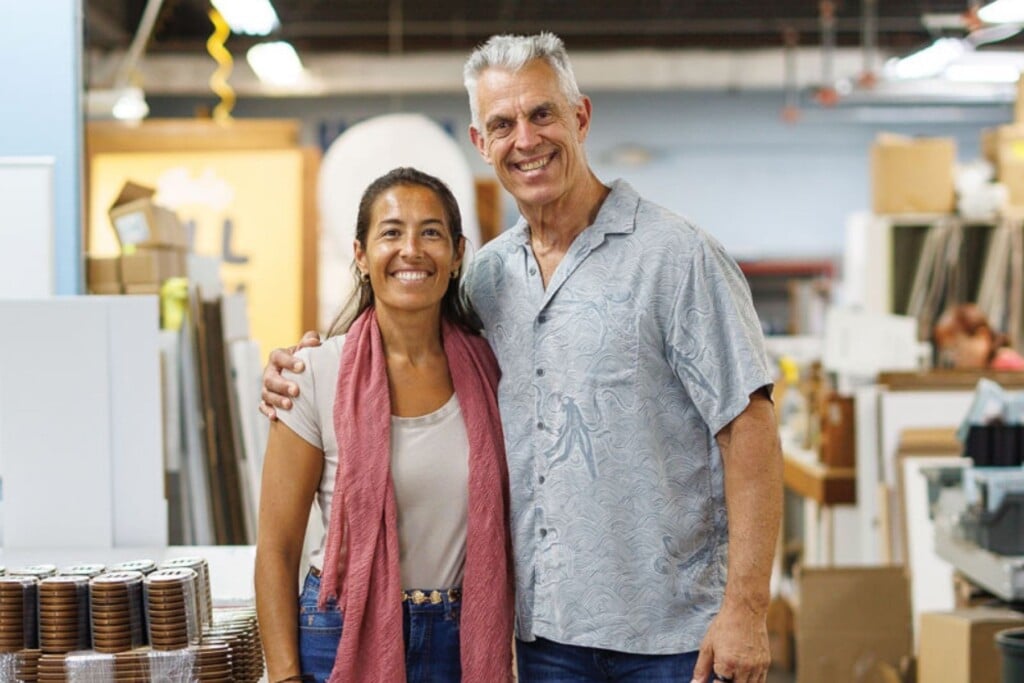
In a sunlit Kapolei factory, machines hum and workers carefully assemble picture frames, cabinets, wall art and more.
It’s a striking scene in a state where manufacturing is rare. According to U.S. Bureau of Labor Statistics data from August 2025, slightly more than 13,000 people work in the industry, giving the Aloha State the fewest manufacturing jobs per capita.
High costs and limited infrastructure mean most local businesses design products here but have them made overseas.
Yet The Art Source – the company behind Pictures Plus, Plus Interiors and Coco Nene – has bucked that trend, scaling dramatically while keeping production at its 43,000-square-foot facility since 1998.
“To get to scale and compete with the world, we have to invest in what we’re most disadvantaged at: making things on an island. The ways we overcome that, obviously, people are really important, but also the best machinery. So we try to partner with the best machinery in the world so we can be as efficient as possible,” says Kent Untermann, President of The Art Source.
IT ALL STARTED AT THE SWAP MEET

Photo By: Aaron Yoshino
Untermann and his wife, Lori, established their first venture, Pictures Plus, in 1986. Their initial operation involved buying and selling picture frames and framed artwork at the Aloha Stadium Swap Meet.
Two years later, they started manufacturing their own frames in ʻAiea to keep up with demand. The shift to local production allowed them to offer frames at significantly better prices. “When we started making the nicely framed Pegge Hoppers at about half [the cost] of what they were everywhere else, people were like, ‘Well, can you make frames for me?'” Untermann recalls. These requests pushed the company to evolve into the custom framing business.
The next major leap came a decade later when they purchased a much larger manufacturing space in Kapolei. Untermann says Pictures Plus “disrupted the industry here” due to a massive gain in efficiency. While competitors averaged three to four weeks for a custom frame, Pictures Plus could deliver in just one week.

Photo By: Aaron Yoshino
He says this was possible because the company’s inventory is made locally, circumventing the delays and costs competitors faced shipping frames from the mainland to Hawaiʻi. Untermann attributes their early success to their “competitive price advantage and faster turnaround.”
While still specializing in custom framing, Pictures Plus now also operates as an art production house. They partner with fine artists to showcase and sell Hawaiiana paintings and photography but also offer direct services to the public, allowing customers to upload their own images for printing. Artwork can be ordered in a variety of formats, including canvas, metal, semi-gloss paper, outdoor metal and watercolor paper. Customers also have a wide selection of sizes, frames and finishes to choose from.
DIVERSIFYING THEIR BUSINESS

Photo By: Aaron Yoshino
In 2010, they founded Plus Interiors, which specializes in custom cabinets and storage systems. They expanded again in 2018 with Coco Nene, which sells home decor and gifts, including wall art, frames, clocks, puzzles, stationery and stickers.
Untermann says the idea for Coco Nene came from recognizing tourists who “want to buy more of an authentic gift, if you will, or something from Hawaiʻi, as opposed to the tourist stuff that we get from China.”
To manage this growth, The Art Source was established as the corporate umbrella of the three sister brands.

Photo By: Aaron Yoshino
“Making things on an island is a really challenging thing, so I’ve intentionally tried to diversify our business,” says Untermann, who explains that each brand is geared towards a different market: Pictures Plus mostly sells to local customers and artists, while Coco Nene caters more to tourists and Plus Interiors fits into the construction industry. “We try to play into all three of those, so when something’s up and something’s down, we can kind of be stable as a company. … So that’s kind of how we try to intentionally balance our business a little bit.”
Today, Pictures Plus has three retail stores on Oʻahu and one on Maui, Plus Interiors runs a showroom on Oʻahu and Coco Nene boasts nine locations spread across Oʻahu, Maui and Hawaiʻi Island. The Kapolei factory remains the singular, centralized production hub for all three brands.
BIG INVESTMENTS

The swissQprint is massive, state-of-the-art UC flatbed printer capable of producing detailed, high-resolution artwork directly onto virtually any rigid material, including wood, canvas and metal. Untermann proudly states that their machine is one of just 13 in the entire United States. Photo By: Aaron Yoshino
Untermann says local businesses face significant headwinds if they want their product to earn the ‘Made in Hawaiʻi’ label, which legally requires 51% or more of its materials and labor originate here.
“There’s a reason why we import everything,” he says. “It’s cheaper for the consumer or the retailer or whoever to buy it from Asia or the U.S. mainland and import it, as opposed to making it here.”
To counter this cost disadvantage, the company’s core strategy is to invest in state-of-the-art equipment and premium materials to craft exceptional products. The hope is that this combination of outstanding quality, faster service and selling products that are ‘Made in Hawaiʻi’ will attract enough customers to justify the higher operating cost and pay off the massive capital investment.
“Now to do that, you also have to create demand. You have to feed the machines,” says Untermann, who is quick to point out the risk involved. “Leveraging this equipment, that’s always the hard part.” Without an existing customer base to support the increased capacity, that investment turns into a liability. He says he’s made “a lot of mistakes” in the past by jumping the gun.
Still, most of their machinery has proven to be a wise investment, so they continue to pursue this strategy. “When we started, we saw a $10,000 double miter saw as a big investment,” says Untermann. To date, they’ve accumulated several machines with a six-digit price tag.

Photo By: Aaron Yoshino
“I would say our most important machine on the Coco Nene side is our Trotec Laser, called the Speedy 2000,” says Chandel Taoy, the production manager for Pictures Plus and Coco Nene. She notes that since every Coco Nene product must go through one of the two $250,000 lasers, they are essential to production.
Over the last seven years, Untermann says they’ve invested more than $4 million in manufacturing equipment. Their most significant purchase to date is an $800,000 swissQprint machine, which they received in February 2025.
Despite the necessity of importing raw materials – namely wood, metal, glass and plexiglass – Untermann says that only about 10% of their production is outsourced. “All the rest of the value, whether it’s the designer or the guy running the laser, it happens here.”
‘OPERATIONAL EQUITY’

Photo By: Aaron Yoshino
The Art Source views its 170 full-time employees as a greater asset than its machinery.
“We definitely invest in high-tech equipment, and that really helps us,” says Alexa Untermann, Kent’s daughter and the company’s HR performance & culture manager, “But at the end of the day, we’re relying on the people.”
To recruit and retain top-talent, Kent Untermann says their hard work needs to be adequately compensated: “I thought, we want to have really great people. So why not create this strategy where the people get paid very well, so they’re happy and loyal, and they want to come to work.”
He realized that while salespeople earned a commission, the rest of the staff lacked a performance-based incentive. This led to the 2023 launch of ‘Operational Equity’, a program that returns half of the company’s monthly profits to its non-commission employees. The other half “goes to pay down debt to zero and investments in new stores and equipment ultimately to build on the shared profits longer term,” Untermann explains. “The more we can make, the more it goes back to the people.”

Photo By: Aaron Yoshino
In addition to their base salary, non-commission employees are assigned a share value (from 0.2 to 4 shares), which determines their percentage of The Art Source’s monthly profit. The bonus is uncapped; for example, if the company makes $100,000 in profit, an employee with a 1% share value receives a $1,000 bonus.
Untermann notes that the current average bonus is about $500 a month (or $3 per hour), but their goal is to triple that to an average of $1,500 a month (or $9 per hour).
“It’s really motivating for everybody, and how we gauge the success of our company is how much we pay our employees,” says Alexa Untermann. She adds that the combined average pay for their hourly and salaried workers is $33.50 an hour. “That’s the top 80th percentile for Hawaiʻi businesses. That’s something we’re really proud to say, and we want to just keep growing that.”