Cut the Crap
A Cautionary Tale About Cesspools and a Story of Hope
Government leaders including Gov. Josh Green and House Speaker Nadine Nakamura have made cesspool conversions a top priority of the state. Officials say they are creating a cesspool conversion implementation group to find solutions, but the Hawai‘i Department of Health (DOH) is working to come up with a clear strategic plan.
The only place in the U.S. that has more cesspools than Hawai‘i is Suffolk County on Long Island outside of New York City. Hawai‘i still has the most per capita, but Suffolk County has more than four-and-a-half times as many with over 380,000. The legacy of cesspools there has created serious threats to the environment, human health and the economy that can serve as lessons for Hawai‘i.
As different as they are, Long Island and Hawai‘i share many intriguing parallels. Both experienced boom and bust cycles of rapid residential development, resulting in a lack of planning and sanitation infrastructure. The result was a proliferation of cesspools, sewage pollution and water quality issues.
What happened in Suffolk County is a cautionary tale of what can happen in Hawai‘i if the problem goes untreated. But it is also an inspiring story of how a group of government leaders found a way to deal with the problem. Their solutions provide a template for Hawai‘i and other states to follow.
A massive, slow-motion sewage spill

Photo courtesy of Ted Bohlen
Sometimes it takes a major crisis to spur people into action. Ted Bohlen moved to Hawai‘i from the East Coast in 2006, partly drawn to the pristine waters of the Islands. A lawyer, he landed a job as the Deputy Attorney General for the Hawai‘i Department of Health and embraced the department’s goals to protect public health and the environment.
Unfortunately, on his first day of work, a massive sewage spill erupted in Waikīkī. A main sewer line broke, and a toxic river of brown waste flowed into the Ala Wai Canal and out into the ocean for days. The spill would eventually discharge more than 48 million gallons of raw sewage into the canal. The event made international headlines and caused the closure of beaches in Waikīkī.
Bohlen recalls how a man with a compromised immune system fell into the Ala Wai Canal and became infected with a deadly virus known as vibrio. He died in the hospital soon after. More than an environmental nightmare, the sewage spill was a health crisis that transformed Bohlen’s life. “Suddenly, the public realized how dangerous polluted water could be,” he says.
Dealing with the sewer spill crisis, Bohlen realized it was partly due to aging infrastructure. During this time, he learned more about Hawai‘i’s cesspool issues and how these substandard systems were also polluting the state’s waters beneath the surface. Over time, he realized that cesspools generated more waste each day than the state’s largest sewage spill in 2006.
While the spill in Waikīkī was 48 million gallons, Hawai‘i’s 83,000 cesspools discharge more than 52 million gallons of raw sewage into our ‘aina each day, with a portion of that making its way to the water tables and into the ocean. It was like a massive, slow-motion sewage spill beneath the surface, going on every day for decades, yet people just couldn’t see it. “I became aware that cesspools were the largest water pollution issue in the state,” says Bohlen.
Although layers of soil, sand and clay can filter much of the effluent to reduce what reaches the underlying water table or the ocean, this natural filtration can become overwhelmed in densely developed and low-lying areas close to the sea.
During his time as the DOH’s Deputy AG, Bohlen recruited younger activists and environmental groups like the Surfrider Foundation to work on policies to reduce cesspool pollution. Together, they helped pass laws to ban construction of new cesspools and mandate the conversion of all cesspools by 2050 (Act 125, 2017). But with the current rate of 400 cesspool conversions per year, that rate will need to increase eight-fold to meet the deadline.
Some legislators and homeowners say cesspools are not a major problem and that the issue is not urgent. But Roger Babcock, Director of Honolulu’s Department of Environment Services, says, “Cesspools are a primitive form of wastewater disposal. So, it’s disposal, not treatment.” Babcock adds that cesspools are “basically like having an outhouse in your front yard. Would you go out and do your business right out in your front yard in a pit, every day? I don’t think that’s what people really want.”
It’s natural to wonder how this form of sanitation became so common in Hawai‘i. “People don’t realize that cesspools were a temporary fix,” Babcock says. “They were never intended to be a long-term solution. It’s just that development happened so fast and the infrastructure couldn’t keep up with the pace of building.” It turns out that this was a common problem across the country, particularly in fast-growing places like Long Island.
As of press time, the state Department of Health did not respond to requests for comment about practices in Long Island that might apply to Hawai‘i’s situation.

At Kahaluʻu Bay, ReefTeach volunteers instruct visitors to avoid stepping on the coral reef, another threat to marine life along with cesspool contaminants. Photo by Mark A. Johnson
Brown tides and toxic algal blooms
The cold waters around Long Island were once the home of the most productive fisheries in the country. Generations of fishermen worked in their boats to bring in bountiful harvests of clams, scallops, oysters and other shellfish that fed expanding seafood markets across the country.
When Walter Dawydiak moved to Long Island in the 1980s, he felt like it was a kind of Eden compared to New York City. On weekends, he would go clamming and scalloping and bring home fresh seafood for his family. Trained as an engineer, he worked at the Suffolk County Department of Health and enjoyed his suburban lifestyle. But as a public health official, he became aware of the rapid pace of development and lack of sewer infrastructure.
“A lot of Suffolk County was planning for regional sewage treatment plants, and they would allow houses to come in with temporary cesspools,” Dawydiak says. “But the sewage treatment plants were never built so that they basically became permanent cesspools.” These substandard systems didn’t seem to be a problem at first, but then everything changed in the mid-80s.
Like a plague, “brown tides” swept over the waters, and the shellfish started to disappear. “The brown tide killed all the bay scallops,” Dawydiak says. “All the eelgrass beds disappeared.” These toxic algal blooms also led to massive fish-kills and die-offs that would devastate local communities that depended on fishing and tourism.
The devastation to the ecosystem was so severe that 99% of the shellfish industry crashed. Thousands of fishermen lost their jobs. The local economy and housing market took a downturn. As the head of the health department, Dawydiac says, “We were all faced with the task of figuring out what happened.”
Top scientists were summoned to help figure out what was causing the brown tides and the collapse of the shellfish industry. Chris Gobler, a researcher at nearby Stony Brook University, finally found the source: excessive nutrient loading and toxic pathogens from all the cesspools and failing septic systems. “We had over-polluted our environment and had to find ways to fix it,” Dawydiak says.
Reclaim our water
Armed with years of research and data, Chris Gobler began sounding the alarm. He spoke to environmental leaders, community groups and government officials about the need to protect water quality by reducing the nutrient loading of nitrogen and phosphorus from the more than 380,000 cesspools in Suffolk County. “We called him the Paul Revere of water quality on Long Island,” says Dorian Dale, Director of Sustainability for Suffolk County.

Photo courtesy of Dorian Dale: Walter Dawydiak holding the Suffolk County report
Dale and his team embraced Gobler’s cutting-edge scientific work on harmful algal blooms, and they amplified his warning about the need to reduce nitrogen loading and convert the cesspools. With so many job losses, environmental crises and economic impacts, the message resounded across the county.
Dale worked with Dawydiak at the Department of Health and Sarah Landsdale at the Planning Office. Together, the newly formed team asked their boss Steve Bellone, the Suffolk County Executive, to help them come up with a plan to solve the problem.
Those meetings with Bellone helped launch a movement. Instead of kicking the can down the road, the group decided that decisive action was needed. Bellone set up a press conference and proclaimed that it was time to stop polluting their waterways and fisheries. “I’ll never forget the moment he did this because it was life-changing,” recalls Dawydiak. “It was a John F. Kennedy moment, and he said, ‘If not us, who. If not now, when?’ He said, ‘We’re going to step up and do our part.’”
Suffolk County spent tens of millions of dollars to devise a strategic plan, hire staff and set up grants to help homeowners with the costs of converting their cesspools.
Bellone’s central message about the need to “reclaim our water” became the rallying cry for the movement and the official name of the campaign.
His decisive, impassioned message transformed everyone involved. Dale says that Dawydiak could have been “just another bureaucratic roadblock, a guy who’s just collecting his pension.” Instead, he became a transformational leader. While working full time, Dawydiak went to law school at night to learn how to create more effective policies. “I mean, Walter ends up being a superhero,” Dale says.
The magical septic tour
As the Director of Planning, Lansdale decided that they should find out what other states in the area were doing about the issue. In 2014, Lansdale gathered Dawydiak, Dale and a handful of other agency leaders, and they took a 3-day road trip along the Northeast coast to talk with other state and county leaders. They learned that Rhode Island had the best regulatory policies for requiring better treatment systems that reduced nitrogen loading; Maryland had the best model for raising funds to help homeowners with the cost of conversions; and Massachusetts had the best testing center to approve better treatment technologies.
Borrowing best practices from these other states, the leaders said the road trip proved to be a game changer for the county. Dale dubbed it the “Magical Septic Tour.” The experience made them realize they were on a common journey to solve a problem that affects many parts of the country, including Hawai‘i. “The principal mission is water quality,” Dale says. “And that’s why I’m concerned about your water quality [in Hawai‘i]. It’s a shared struggle.”
Over the next 10 years, they created new policies that could be a successful model for Hawai‘i’s Department of Health. Suffolk County required denitrifying treatment systems to remove nitrogen in coastal areas and new developments, and they fast-tracked the permitting process for cesspool conversions. The cost of conversions is still a major issue, but Suffolk County passed a bill to increase the sales tax by an eighth of a penny to create hundreds of millions of dollars in grants to help homeowners upgrade their cesspools and septic systems.
These policy and funding innovations have increased the rate of conversions and reduced the amount of sewage pollution and nutrient loading, while also improving their water quality and quality of life. But in Hawai‘i, there is still no strategic plan or dedicated source of funding to help homeowners with the high costs of converting their cesspools.

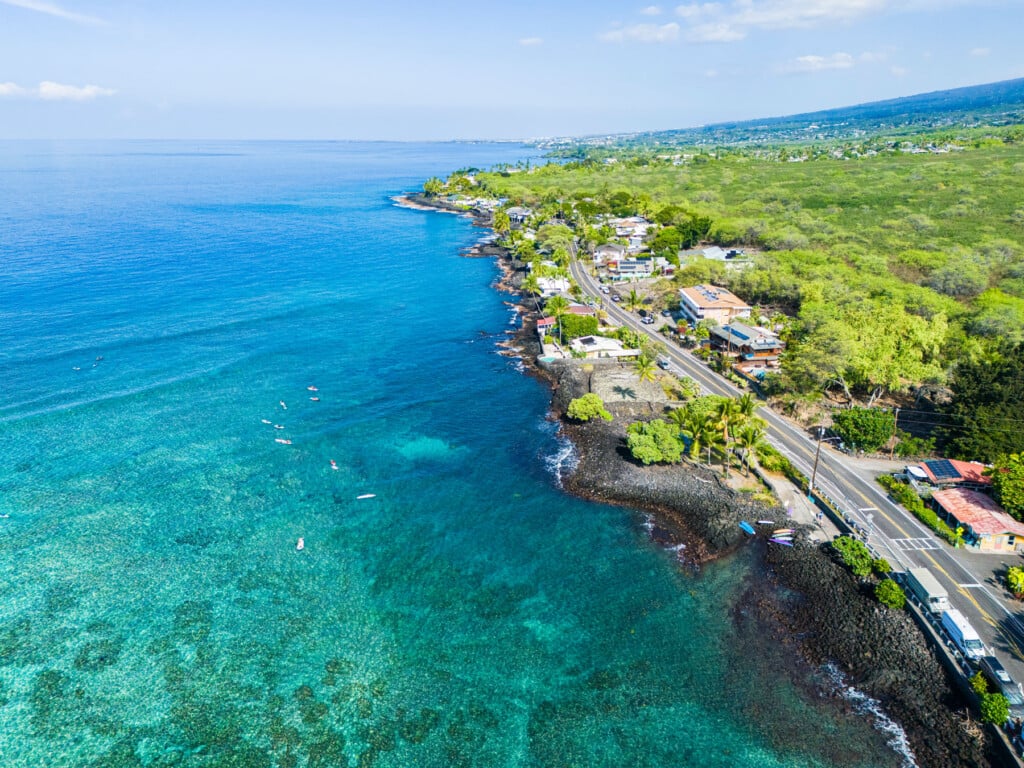
Overview of snorkelers and swimmers navigating around the elaborate coral reef structures in Kahaluʻu Bay. Photo by Mark A. Johnson
Implications for Hawai‘i
What happened on Long Island clearly has powerful implications for the Hawaiian Islands. While Suffolk County has made substantial progress in converting thousands of cesspools each year, Hawai‘i’s conversion rate is stagnant. Meanwhile, the pathogens and nutrient loading from cesspools in coastal areas are leading to serious declines in water quality, fisheries and coral reefs.
Just as Gobler showed how nutrient pollution was causing toxic algal blooms and killing the shellfish industry in Suffolk County, Greg Asner has been sounding a similar alarm about how nitrogen loading is having the same harmful effects on Hawai‘i’s coral reefs. A Navy veteran and Arizona State University professor based in Hawai‘i, Asner is a leading researcher on coral reefs and says that nutrients like nitrogen lead to algal overgrowth that smothers the reefs. He says that when stormwater runoff – including golf course fertilizers and county herbicide spraying – combines with the “toxic cocktail” of wastewater pollutants, these stressors kill the state’s coral.
On many coastlines, Asner says, “The high pollution areas already have seen massive decline.” Once vibrant reefs have been reduced to coral rubble in places across the state, including some parts of Puako and Kahalu‘u on Hawai‘i island, Ma‘alaea and Kahekili on Maui and Kāne‘ohe Bay on O‘ahu. In numerous ways, our state’s future depends on the health of our remaining reefs. NOAA has estimated that Hawai‘i’s coral reefs contribute an estimated $863 million per year to Hawai‘i’s economy.
When asked about the consequences of losing our coral reefs, Asner explains that the losses are too large and hard to calculate. “There will be more and more coastal erosion, more and more loss of homes and livelihoods and economy along the coastline,” Asner says. “The fabric of the entire coastline is pulled apart when you have these losses.”
Due to Hawai‘i’s dependence on tourism, the loss of the state’s coral reefs would be economically devastating. “Our visitor industry is the lifeblood for our economy,” says Bohlen, “and people aren’t going to want to go to the beach when they know that the water is polluted.”
He is also worried about the health effects of sewage pollution, especially when it comes to drinking water. A decade ago, a Department of Health study in East Hawai‘i found fecal indicator bacteria in 50% of private drinking water wells sampled. Besides the ‘ick’ factor, that’s a health crisis in the making.
As in Suffolk County, Bohlen believes the state should hire more staff at DOH to come up with an actionable plan to convert cesspools in coastal priority areas. Also like Suffolk County, he says the state should adopt policies to do the following: develop new revenue sources and create grants to help homeowners convert their cesspools; create a new cesspool section at DOH to streamline permitting regulations and speed up the rate of conversions; and fast-track approval of more affordable treatment technologies that reduce pathogens and nutrient loading to protect water quality and coral reefs.
Though he retired from the Hawai‘i Department of Health in 2022, Bohlen continues to collaborate with the department. He also helps guide policy for a coalition of nonprofit groups and young activists who are working on cesspool issues. “It gives me a sense of purpose and makes me feel that I’m working on something worthwhile,” Bohlen says.
After retiring from Suffolk County’s Department of Health, Dawydiac continues to work on wastewater issues. He and Dale have both offered to help the Hawai‘i Department of Health, sharing lessons learned and success stories from Suffolk County.
“I felt like I spent 40 years accumulating all of this information that could still be useful to somebody,” Dawydiak says. “So, I thought I should try to be helpful and pass it on.”