A Hawai‘i Island “Hot Spot” Aims to Be a Cesspool Model for the State
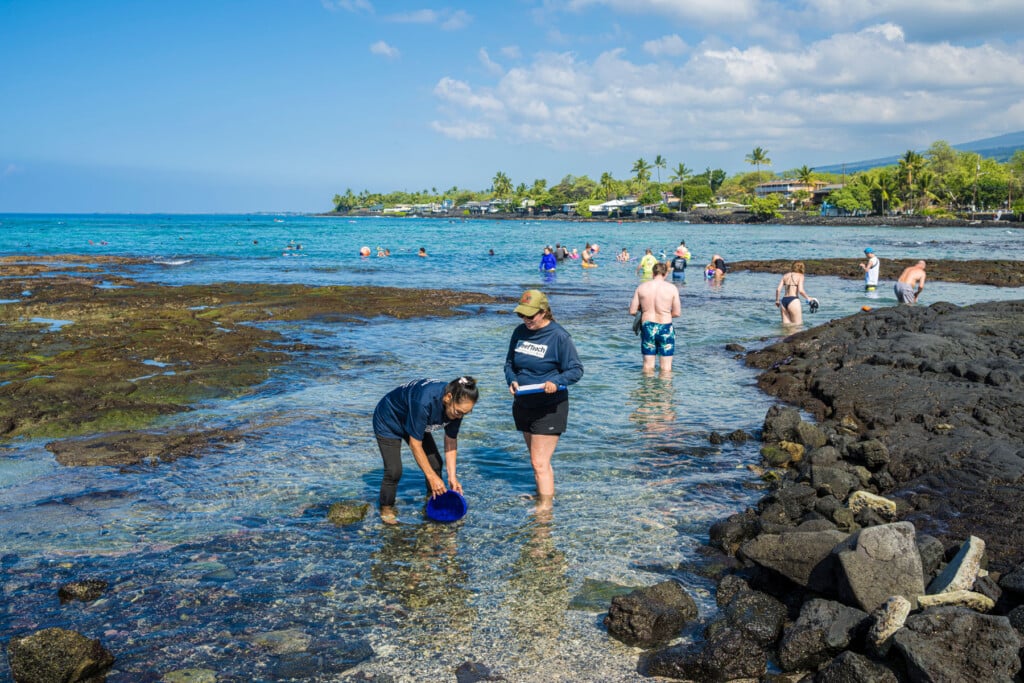
Kahalu‘u Bay on the Kona Coast of Hawai‘i island has a storied history as a former royal village with protected fish ponds inside a “menehune” breakwater, ancient heiaus nearby and petroglyphs carved into lava rock. Today it is a destination for some 400,000 visitors each year who come to snorkel and swim in the warm waters.
But underneath the surface, the idyllic marine ecosystem is struggling, making it one of a number of “hot spots” for environmental degradation in the state. Corals are under threat from rising sea temperatures, toxic suntan lotions, tourists who step on them and especially due to runoff from dozens of nearby homes’ cesspools.
“It’s such a welcoming shallow bay, and safe,” says Cindi Punihaole, whose family has lived on the Kona Coast for generations and who was featured in the “Keeper of the Bay” documentary on PBS Hawai‘i , which highlighted her efforts to preserve the aquatic life there.
“When I talk to senators, or county officials, because they’re not in the water, they’re looking at a bay that is beautiful. ….. Those who’ve been in the water, they know. They’ll tell you it’s polluted.”
Shoreline areas across the state are grappling with the damage to marine life caused by cesspools that can’t properly filter the effluent before it flows directly into the ocean. Punihaole realized she needed hard evidence and data to demonstrate the threats to the coral life and to propose specific solutions.
Toward that end, with help from The Kohala Center, the county and the University of Hawai‘i Sea Grant program, Punihaole ramped up ReefTeach, an outreach effort to educate visitors to protect coral and the marine environment. From six volunteers in 2006 when she first took over, the program now has more than 500 volunteers who help staff the beach park every day. They also report changes that they witness in marine life and coral conditions.
“Engaging with the community is the key,” Punihaole says.
But to convince state and county officials of the urgent need to address the cesspool runoff threat, Punihaole added: “I needed data.” Kathleen Clark, Punihaole’s understudy who has degrees in Conservation Science and Environmental Policy, started conducting regular water quality tests, including water temperature, salinity, turbidity, disolved oxygen and weekly visual assessments of coral conditions. They now have 10 years of data.
“Numbers don’t tell the whole picture,” says Clark. “The real lessons have come from observation in Hawaiian waters.” Although tests for fecal bacteria including enterococcus have not shown levels requiring closure of the bay to tourists, a steady flow from underground seepage along the shoreline could be enough to kill some of the coral, which provide feeding areas for multitudes of fish and turtle resting areas. They also help block shoreline erosion from surf.
“Coral that are constantly being exposed to pollution and other stresses are less resilient to stresses from rising sea temperatures,” which is a global phenomenon and poses its own risks, Clark notes. She has witnessed bleaching of coral, indicating stressed structures that may be dying.
“In the last five years, it’s gone from 100% live tissue to 30% or less” in some areas of the bay, she says. “They’ve survived hundreds of years until now.”
To be sure, there is also progress being made, including reattaching coral fragments that have been broken off by strong surf or by people stepping on them, as well as new coral being introduced from onshore nurseries
An “aha” moment came when Dr. Steven Colbert, associate professor of Marine Science at UH-Hilo, conducted a dye test in August 2024. He and his researchers poured green dye into a cesspool at a home along the shoreline, and in just five hours the dye appeared in the ocean, barely diluted at all.
Punihaole says the dye studies as well as chemical analyses of the water showing the presence of household pharmaceutical products that enter the water from cesspool runoff gave her concrete evidence to seek solutions.

Green photo dye poured into cesspool at shoreline home enters ocean after only hours. Photo courtesy of Dr. Steven Colbert, University of Hawai‘i–Hilo.
But feasibility studies showing that costs to convert cesspools or to divert the waste to treatment facilities or localized closed-circuit systems would run nearly $2 million or more, money the community and their supporters lack.
Punihaole sees hope in the shared concern of some wealthier residents just up the Kona Coast.
“We have folks, very wealthy billionaires, who believe in our work, believe in what we do, and believe in community and believe in democracy and what we can do together,” she says.
Hawai‘i island Mayor Kimo Alameda commends the efforts of Punihaole and other community leaders in Puako to the north who are trying to address the problem, but he says federal funding combined with creative local financing is a more realistic option.
“Relying on billionaire homeowners feels neither comforting nor reliable; philanthropy can help with seed funding or matching grants, but it shouldn’t be the primary financing strategy,” Alameda texted in response to a request for comment.
“It’s would be great if the federal government could help us fund a detailed pilot with transparent costs and performance data; and I’ll be pursuing legislation that phases the conversion, with the priority areas being the shoreline first.”
At 75, Punihaole is a relentless force who believes that Western science combined with Hawaiian traditions can solve intractable problems. She is not naïve about what it takes to bring about political change, nor is she ready to give up.
“It’s a huge problem, but wouldn’t it be great if we could create a model at Kahalu‘u … then share it with our communities across the Hawaiian Islands?” she says.
“Shame on us if we leave all of this to our children. We know what to do.”