Growing Tilapia and Vegetables with Aquaponics
Clyde Tamaru, an aquaculture specialist atUH Manoa’s College of Tropical Agriculture and Human Resources, is on a mission: putting marginal land to good agricultural use with aquaponics. Along the way, Tamaru helps enhance the reputation oftilapia, a fish that many locals avoid because it tends to live in dirty water – the “Ala Wai fish,” he calls it.
Tamaru explains that aquaponics is a combination of hydroponics, growing plants in water without soil, and aquaculture, the farming of marine animals.
The waste from the fish – including ammonia and nitrate – helps fertilize the plants; then the water is purified before being recirculated back to the fish tank. But not just any fish can be raised in these tanks. “Tilapia is the main fish used in Hawaii, because they can tolerate these levels of ammonia and nitrate,” he says.
Small aquaponic systems let you grow plants and fish in your backyard, but Tamaru wants to see more commercial aquaponics. “We don’t want to compete against good agriculture land. We want places that are marginal or not even used.”
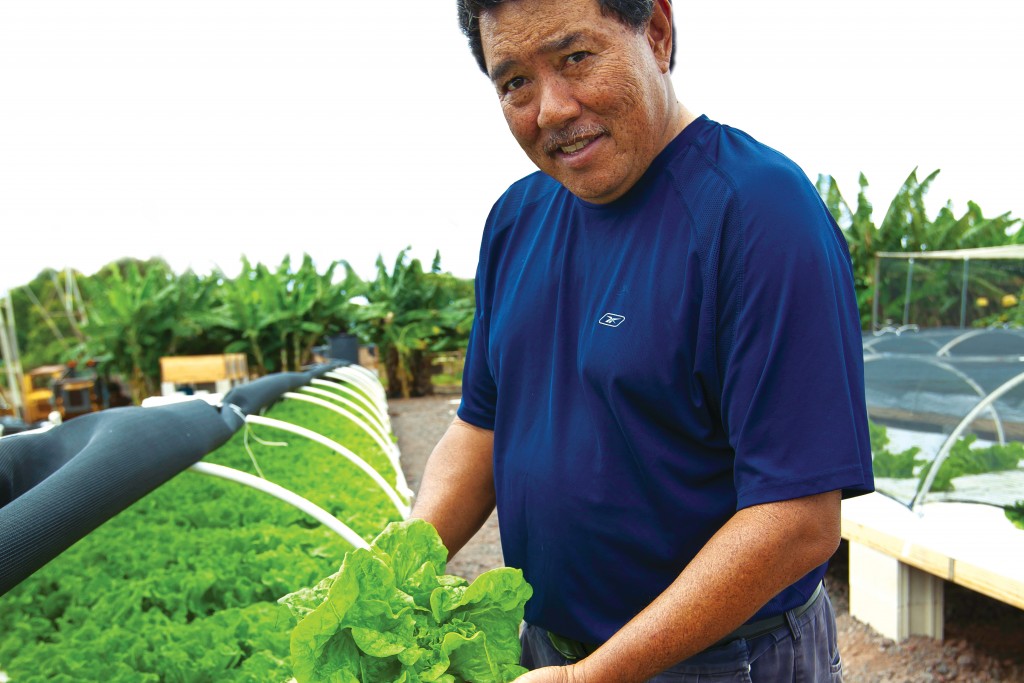
Mari’s Garden in Mililani has dedicated one of its 18 acres to aquaponics, making it Hawaii’s largest aquaponic farm. Owner Fred Lau says he reuses water from his nursery to produce 150 pounds of cucumbers a day and 14,000 heads of lettuce a month, using five tanks with 2,500 to 3,000 fish in each.
“It is a sustainable method of farming, but economically it could take awhile to be beneficial,” Lau says. “The startup costs can be quite expensive.”
Most tilapia now sold in Hawaii supermarkets and restaurants are imported, but Tamaru wants to see more local-grown sales. Restaurants such as Sansei, Alan Wong and Town in Kaimuki are already serving local, farm-raised tilapia, which doesn’t have the bad reputation of its Ala Wai cousin.
Clyde S. Tamaru
342-1063
CTAMARU@HAWAII.EDU
[A previous version of this article incorrectly identified Fred Lau in the photo. Hawaii Business regrets the error.]