Pessimism Widespread Among Local Businesses
The latest BOSS Survey reveals widespread pessimism about Hawai‘i's economy, with 51% of business leaders expecting conditions to worsen in 2026. Though tourism companies remain notably more optimistic than other sectors.
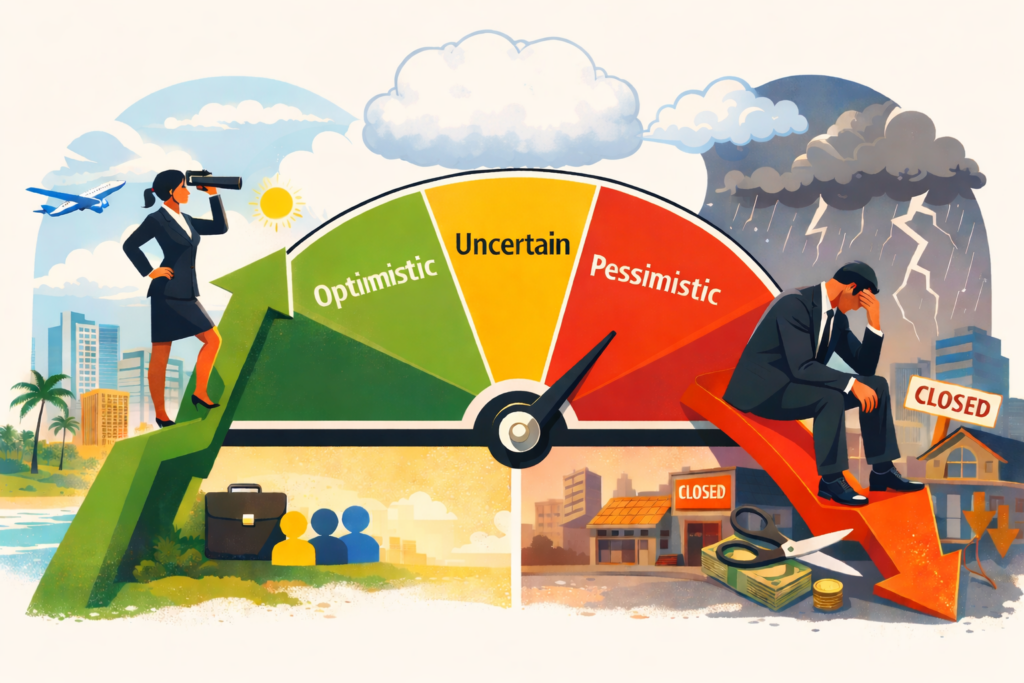
When business owners and executives feel good about the economy, they often add new products, locations and employees. When they see a weak economy ahead, they tend to delay expansion, cut costs and hold off on filling job vacancies.
In the latest BOSS Survey, a little more than half the respondents said 2026 will be worse than 2025.

FIG. 1 NOTE: Index began at 100 in 1998 | Dates listed reflect when the multi-month survey concluded.

FIG 2. *DK/DA: Didn’t know or didn’t answer.
Of the 307 owners and executives across Hawaiʻi who participated in the poll conducted from Oct. 8 to Dec. 18, 51% said the economy would get worse. Only 17% thought the economy would improve and the remainder thought things would stay about the same. Those survey answers are the basis for the Optimism Index shown below (fig. 1).
In the 19 BOSS Surveys conducted from late 2016 to 2024, the Optimism Index averaged 111.5. In both surveys conducted during 2025, the results were far below that average.

FIG 3.
To further understand the perception of the local economic climate, owners and executives were asked in the latest survey which of these statements best describes their spending plans for the coming year (fig. 2). Interestingly, there was an uptick among those who said their companies planned significant increases in spending. Nonetheless, far more said they planned substantial cost cutting.
The owners and executives were then asked which of these phrases best describes the current condition of their companies (fig. 3).
On Average, Local Businesses Hold Steady on Revenue, Profit and Staff

FIG. 4 NOTE: Dates listed were when the multi-month survey concluded.
That assessment is based on responses from 307 owners and executives who were asked: Did those key measures of business performance go up, down or hold steady at your company during the past year?

FIG 5. *Percentages do not always add to 100 due to rounding.
Businesses measure a lot of things to gauge their performance, but the BOSS Survey focuses on three crucial yardsticks: revenue, profit and staff. We asked each survey respondent: Did each of those go up, down or stay about the same at your company in the past year? The answers vary from business to business, but when they’re compiled, the overall picture is of a Hawaiʻi business community on a somewhat steady course with slight annual growth overall—with the emphasis on slight.
We use the aggregated results on those three key measures to produce a single number, the BOSS Performance Index. The graphic below tracks the Performance Index over time. After recovering from the Covid pandemic, the index has stayed within a narrow range since the May 2022 survey, always holding within 5 points of the index average of 110 over the last eight surveys. Neither boom nor bust (fig. 4).
The Performance Index was created after company owners and executives were asked a separate question about each of these three measures: Did revenue/profit/staff increase, decrease or stay the same at your company? Here are their answers on each measure (fig. 5).
BOSS SURVEY METHODOLOGY
A total of 307 random interviews of company owners and senior executives across Hawaiʻi were conducted from Oct. 8 to Dec. 18, 2025. The interviews were conducted for Hawaii Business Magazine by the research division of Anthology Finn Partners.
The sample of companies was stratified based on number of employees: businesses with 1 to 9 employees were designated as very small; those with 10 to 49 employees were designated as small; 50 to 99 as medium and 100 or more as large. The data was weighted to reflect the proper proportions of each company segment as reported by the Hawaiʻi Department of Labor.
A sample of this size has a margin of error of plus or minus 5.59 percentage points with a 95% level of confidence.
A secondary goal was to complete interviews with at least 100 businesses that derive relatively significant proportions of their revenues from the visitor industry. A total of 129 were surveyed in this segment.
808 POLL METHODOLOGY
Hawaii Business Magazine also contracted with Anthology Finn Partners Research to survey Hawaiʻi residents statewide.
A total of 541 surveys were conducted from Oct. 16 to Oct. 31. Each respondent was screened to ensure they were at least 18 years of age and full-time residents of Hawaiʻi. The margin of error for a sample of this size is plus or minus 4.21 percentage points with a 95% confidence level. The data was weighted to reflect population estimates of adults by county and by major ethnic segments.
Far Better Performance and More Optimism Among Tourism Companies than Other Local Businesses
In fall 2025, the BOSS Survey collected responses from 307 company owners and senior executives, representing all major industries in Hawaiʻi. Included in that sample were 129 leaders whose companies earned most of their revenue from the tourism industry.
Each company’s results varied, but when the numbers were aggregated, the contrast was stark: on average, tourism companies did much better in the past year on revenue, profit and staffing than nontourism companies.
Also striking: Owners and executives of tourism companies on average are far more optimistic about 2026, which suggests they’re more likely to expand their businesses—or at least not cut back—than those with a gloomy outlook.

FIG. 6
Everyone in the survey was asked separately about revenue, profit and staffing: Did those key measures of business performance go up, down or hold steady at your company during the past year? On average, companies in the tourism sector did much better on all three measures.
For instance, 31% of tourism companies added employees in the past year; only 14% of nontourism companies added employees. And 43% of tourism companies reported increased profit, compared with only 30% of companies outside of tourism.
All the responses were compiled into a single number that we call the BOSS Performance Index. The contrast between the index number for tourism companies and nontourism companies is huge (fig. 6).
The BOSS Survey also asks: What’s your outlook for the local economy in the coming year? Will it get better, worse or stay the same? The answers are the basis for the BOSS Optimism Index.

FIG. 7
Pessimism was strong even among the owners and executives in the local tourism industry. Nonetheless, 25% of them said the economy will get better, compared with only 13% of the respondents outside the tourism sector (fig. 7).
When asked whether they expected visitor spending at their businesses to increase in the next year, 39% of those representing tourism companies said yes. Only 21% expected less spending while the remainder expected visitor spending at their businesses to hold steady.
Another question revealed a stark contrast: Asked whether their company planned to significantly increase capital spending and other forms of spending in 2026, 24% of respondents in the tourism industry said yes. Only 17% outside of tourism said yes.
DO YOU SUPPORT THE NEW VISITOR GREEN FEE?

FIG. 8
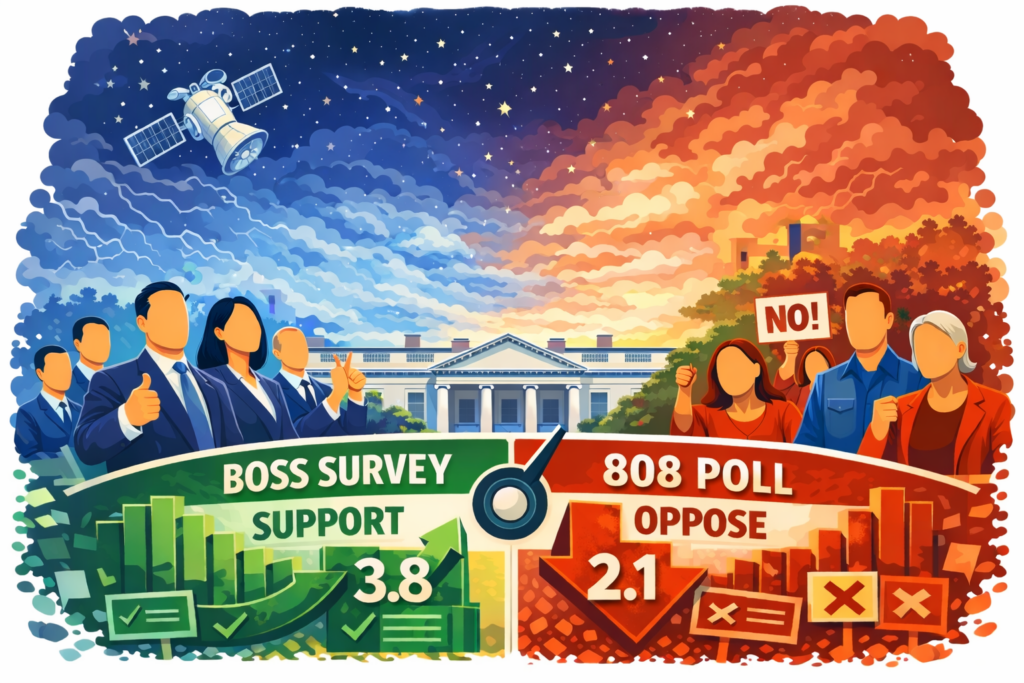
Respondents in BOSS Survey of business leaders and the 808 Poll of the general public were presented with the following statement in Fall 2025: Hawaiʻi’s new “Green Fee” for tourists goes into effect Jan. 1, 2026. It increases the state hotel and short-term rental tax by 0.75 percentage point to 11%. (County taxes are extra.) The revenue is supposed to be used to fund environmental protection, climate resilience and infrastructure improvements.
They were then asked how strongly they supported or opposed this new fee. Each possible answer was assigned a value: “strongly support” was assigned 5; “somewhat support” 4; “neutral” 3; “somewhat oppose” 2; and “strongly oppose” 1. Answers of “did not know” or “refused to answer” were left out of the calculation. The higher the score, the stronger the support (fig. 8).
Significantly, support for the green fee was stronger among company owners and executives within the visitor industry than from owners and executives outside the industry. The general public was more supportive than either business group.
Read the other parts to this BOSS Survey:
Part 2: Hawaii Business Surveys Show Trump Policies Unpopular