Three Hawai‘i Powerlifters Make History at 2025 World Championships in Seoul
Three Hawai‘i athletes brought home medals and shattered records at the IDFPA World Championships proving that grit, community and aloha spirit can overcome any obstacle.
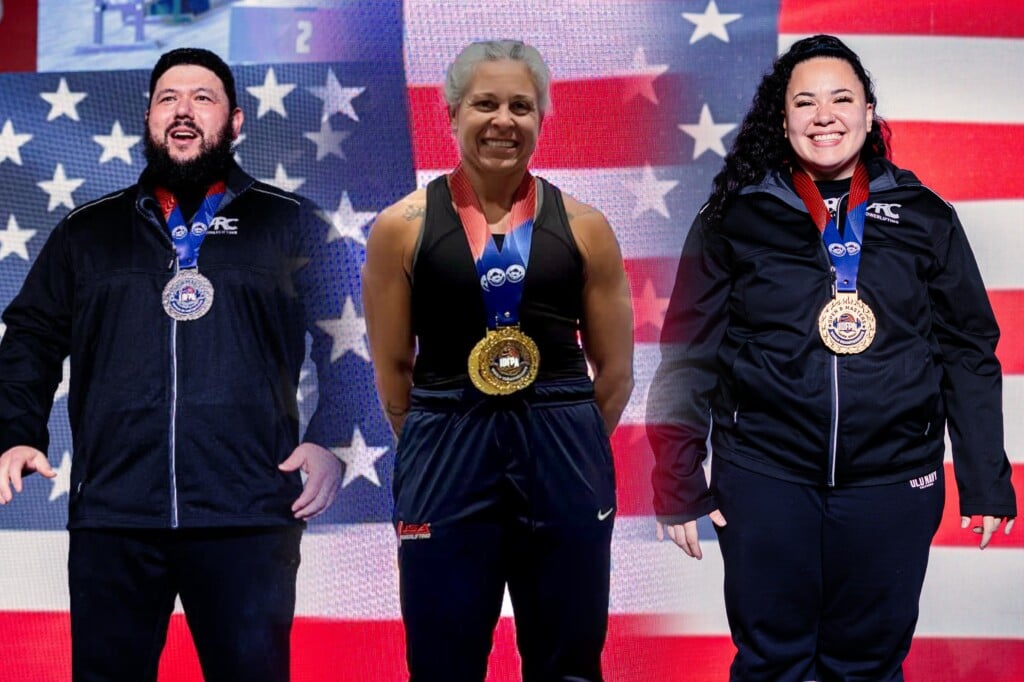
The warm-up area had no heat, and Seoul’s December temperatures were in the 20s. Athletes wrapped themselves in blankets and puffer jackets between attempts, placed hand warmers on their backs, and did whatever it took to keep their muscles warm enough to lift. It was an unlikely setting for history. But at the inaugural IDFPA World Championships in South Korea’s capital, three powerlifters from Hawai‘i were about to make it.
Chanelle Perry struck first, winning the Women’s Raw Open 100kg division. Robert Ken Tyson returned from a devastating April 2025 injury with just five weeks of full power and earned second place in his division. Rachel Prados shattered a world record with a 200 kg (440 lbs) deadlift and was named the competition’s top Master’s lifter.

Tyson and Perry posing their silver and gold medals. | PHOTO: Chanelle Perry
Powerlifting is simple in theory—squat, bench press and deadlift, with three attempts at each lift—but success depends on strategy, timing and mental toughness.
Winners are determined by the highest total weight lifted across all three movements, with competitors divided by weight class and age division.

Prados at the IDFPA World Championships. | PHOTO: Rachel Prados
In a sport still dominated by men, Perry’s championship is bigger than a personal achievement. “I get on the world stage and win and bring that back home to our community, where I know there are girls and women that look up to me—it’s not just about me,” she says.
Held December 11–14, 2025, the inaugural International Drug-Free Powerlifting Association Open and Masters World Championships drew drug-tested competitors from around the world. For lifters accustomed to training in Hawaiʻi’s year-round warmth, the unheated venue and low-20-degree temperatures added a layer of difficulty—conditions that made the performances of the islands’ three representatives all the more notable.
CHANELLE PERRY CLAIMS GOLD

Perry during her squat and deadlift attempts. | PHOTO: Chanelle Perry
Three years ago, Perry began powerlifting during Covid, but 2025 was the pivot year that turned her hobby into a passion.
“I’m just a normal person who has a normal job that likes to lift heavy things,” she says. But powerlifting became a mindset. “It’s about stepping on the stage and representing all of the girls that think they’re not strong enough or they can’t do enough, or they can’t be enough to get onto that world stage.”
Perry manages a team of 15 sales agents at Spectrum’s call center, balancing a standard 8-to-5 job with training sessions that stretch up to three hours. She’s competed 11 times in three years, methodically climbing from local meets to national competitions.
Perry placed fourth at USA Powerlifting’s Raw Nationals in July 2025, just outside the automatic top-three invite to Worlds. When one of those finishers declined, Perry got the call. Her reaction was gratitude mixed with self-doubt. “There was always that quiet voice saying, ‘It’s okay if you get second,'” she admits.
Her coach, Randell Barrientos of ARC Powerlifting, had a strategy two nights before competition: take massive jumps between her first and second attempts. Perry would match her personal records on her second attempt for both squat and deadlift, meaning any third attempt would be an all-time PR.
“I literally looked at him and was like, ‘Are you delusional?'” Perry recalls.
The strategy had another layer. Perry was in a head-to-head battle with Rachel Stark, who would be lifting right before her in deadlifts. Barrientos and Perry submitted a fake opening deadlift attempt—a heavier number designed to manipulate Stark’s coaches into pushing her harder on earlier lifts.
“We put in a fake number for my deadlift,” Perry explains. “That way, their coaches would think, ‘Oh, she has the bigger pull, so we have to push on her squat and her bench.’ And then if she fails, I have the upper hand.”
On competition day, Perry squatted 451.9 pounds, benched 231.5 pounds, and deadlifted 451.9 pounds. When the final total was calculated, she won.
The celebration back at their Airbnb was pure joy: Korean fried chicken and four bottles of champagne shared among the Hawaiʻi crew. But for Perry, the victory carried deeper meaning. “I’m more humbled than I am boastful about it,” she says. “Yes, although it’s amazing to know that I went there and I won and I brought it home for myself and my team, to me it’s, if I can do it, anybody else can. I didn’t just bring it home for myself. I brought it home for everybody else, too.”

Tyson and Perry poses with their coach, Randell Barrientos of ARC Powerlifting. | PHOTO: Chanelle Perry
Perry credits her tight-knit support system—her partner Q, Barrientos, training partners Sevon Bumper, Rochelle Cariaga and Tyson—for getting her to the podium. Without them, and without the facilities at local gyms like Ukiyo Hawaiʻi, she says this achievement wouldn’t have been possible.
Now, Perry is ready to pay it forward. After competing at one more national competition in Chicago in 2026 with her ARC Powerlifting team, she plans to step back from competing for a while to focus on growing her coaching roster. She’s been coaching powerlifters throughout her own competitive career and wants to dedicate more time to sharing what she’s learned.
“I definitely want to share my love for the sport with other women and other girls that want to get into it,” Perry says. “It’s very daunting as a girl stepping into a weight-bearing sport, and I want to be able to show other girls that you can do it just like I did.”
After three years of back-to-back competitions, Perry is also looking forward to simply enjoying the pleasures of ordinary life for a bit.
ROBERT TYSON CLAIMS SILVER

Tyson during his squat attempt. | PHOTO: Robert Tyson
In April 2025, Tyson’s powerlifting career should have been over. A herniated L3-L4 disc pressed on his quad nerve, causing his right quadricep to atrophy. The injury was severe enough that doctors told him recovery would take months, and there was no guarantee he’d return to normal life activities, let alone elite-level powerlifting.
Eight months later, Tyson stood on the podium in Seoul as the second-best powerlifter in the world in his division.
“I didn’t get to true full power until five weeks out from Worlds,” Tyson explains. “I basically recovered in 32 weeks and then had five weeks of actual true training. I actually had a meet PR (personal record) at Worlds—a small 2.5 kilogram PR, but it’s huge coming from having such a big injury.”
Tyson, who serves as Senior Financial Systems Manager for Kamehameha Schools, was simultaneously managing a massive project to change the school’s entire ERP and EPM accounting systems. “There was a part where I was ready to quit,” Tyson admits. “But my wife put it in a good way, saying that I’d have to do that rehab anyway just to get back to normal. So, I was like, well, if I don’t do that, I might as well keep going.”

PHOTO: Robert Tyson
His decision to compete at nationals in July wasn’t his own. Perry convinced him to go. He placed fourth while still dealing with nerve damage that left parts of his leg numb. When a top-three finisher declined a Worlds invitation, Tyson got the call.
By meet day in Seoul, Tyson had become known as “Uncle Aloha” among the Hawaiʻi crew—the loudest person in the warm-up area, fist-bumping competitors, getting everyone energized. He squatted 518.2 pounds, benched 391.3 pounds, and deadlifted 617.3 pounds for a total of 1,527 pounds.
For Tyson, representing Hawaiʻi went beyond just his performance. He and the team were intentional about including the Hawaiian flag on their meet shirts. On his deadlift shirt, he wore “Ola Pauahi, Ola Hawaiʻi”—Protecting the charge of Princess Bernice Pauahi Bishop.
“I call it ‘I assume Aloha,'” Tyson explains. “That aloha spirit, that love for the sport, that love for the space, and that love for each other as lifters—that’s what I wanted to shine through. That’s something the world really needs right now.”
For Tyson, who credits his recovery to his coach Barrientos, Cariaga, Perry, his wife and the tight-knit community at local gyms like Ukiyo Hawaiʻi, the next chapter is about using his “kupuna status”—his elder wisdom—to bring the community together.
“When you can put over 500 pounds on your back and squat it, not much in life is really that hard,” Tyson reflects. “That builds that grit. And when you have to grind your way out of a hole with that weight, everything in your body screaming to put it down, but you don’t, that teaches you something about yourself. That’s what powerlifting gives you.”
PRADOS CLAIMS WORLD RECORD DEADLIFT

Prados attempting her world record deadlift. | PHOTO: Rachel Prados
Rachel Prados stood backstage at the Seoul venue, tears streaming down her face. She’d just walked off the platform after missing her first squat attempt—a weight she’d lifted countless times in training. The rack heights were uneven. The head judge spotted her soft knees and called for a re-rack. If a lifter has “soft knees,” they have not established the required starting position.
Time had run out.
“There’s no way this is how Worlds is gonna go,” Prados recalls thinking. “I didn’t fly all the way over here to bomb out on squats.”
Three years ago, that moment would have ended her competition. But on this day, Prados pulled herself together, walked back out when the judges gave her a second chance, and—despite shaking so badly she could barely grip the bar—nailed the lift.
It was a glimpse of how far she’d come, not just as an athlete, but as a person rebuilding her life one rep at a time.
Prados is a former addict with 16 years of sobriety. She runs her own vacation rental cleaning business in Kona, trains at 5 a.m. before her clients’ 11 a.m. checkouts, and is in bed by 7 p.m. to prioritize recovery. She started powerlifting just three years ago after discovering her strength through CrossFit.
“I’ve grown more in the last three years of powerlifting than I have the whole 16 years I’ve been sober,” Prados reflects. “Being a former addict, you don’t see yourself as strong. It’s quite the opposite, really. Everybody else knows I can do things besides me. I don’t have any faith in myself. This whole powerlifting life has brought me some confidence in myself.”
Her journey to Seoul started when she unexpectedly won USA Powerlifting Nationals in April 2025. “I didn’t even think about how much it would cost or anything. I just automatically signed up, and my husband was like, ‘I guess we’re going to Korea.'”

Prados winning gold and overall masters lifter. | PHOTO: Rachel Prados
Her husband, Albert Prados, serves as her coach and handler. She uses the Juggernaut app for programming, which has been building her numbers toward one specific goal: reclaiming the 440-pound deadlift world record that had been broken between nationals and Worlds.
But the path there was anything but smooth. After nationals, Prados tore her shoulder so badly she couldn’t even lift the bar for bench press. Physical therapy became part of her daily routine alongside training.
At Worlds, after overcoming the first squat disaster, Prados fought through her second bench attempt—a 170-pound lift she hadn’t hit since nationals—only to have her back lock up so severely she could barely get off the bench. She opted out of her third attempt, conserving energy for what mattered most: the deadlift.
“I had already won the competition with my first deadlift,” Prados explains. “So, the second attempt was just for the record. I wanted it. I wanted it back.”
When 440 pounds of barbell sat waiting on the platform, Prados channeled everything she’d learned about not giving up. “It felt really heavy, and it felt like it was stuck at my knees, like I wasn’t moving,” she says. “But I locked it out. I made sure my knees were locked out.”
The world record was hers. Again.
Later, when the scores were tallied across all weight classes and age divisions for the Masters competition, Prados learned she’d won the best lifter award for the entire Masters field. “I just won overall Masters at Worlds,” she says.
For someone who spent years not believing in herself, the victory represented a fundamental shift. “I can probably say today that I’m proud of myself,” Prados says quietly. “Which is a big, big thing.”
She credits Pacific Island Fitness in Kona, her training partner Kevin, the Juggernaut app and her husband Albert for their unwavering support. “Without that, I don’t even know if I’d be where I am today.”