High Tech Meets Hawaiian Tradition
UH-West O‘ahu's Create(x) lab and community partners help restore endangered ecosystems using ancestral knowledge.
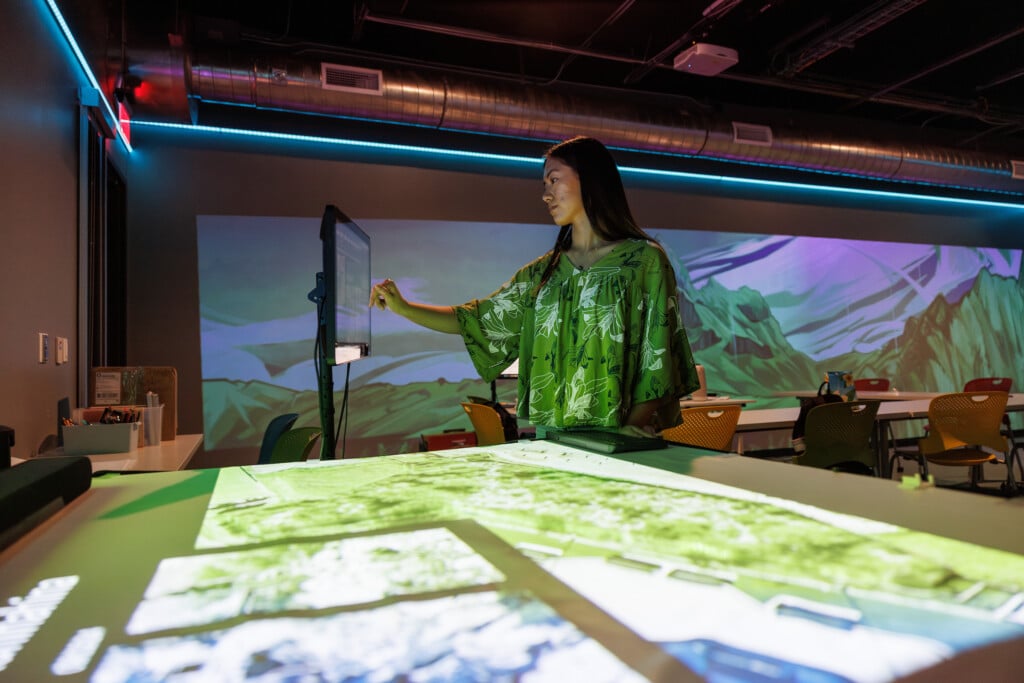
Computer science graduate student Shaelyn Loo points to a bright computer touchscreen in the dark Create(x) lab at UH-West Oʻahu. She’s gathering data for a restoration project at Kīpuka O Kahinahina, in nearby Kalaeloa, to reopen sinkholes once used to cultivate food and medicinal crops that struggle elsewhere in ʻEwa’s dry climate.
“This is where you control everything, your UI, user interface,” she explains, then points to the Projectable, a data visualization tool that shows where the endangered ʻewahinahina plant is growing in a kāluamahi, a type of sinkhole formed in ancient coral where Hawaiians, such as her ancestors, practiced agriculture.
“And down here, this is an overarching view of the Kīpuka (ancient geological oasis) space as a whole,” Loo says. She selects an orange-colored “kaluamahi 1” label, which corresponds to a particular sinkhole, and pulls up more information on the tiny plant in West Honouliuli that kūpuna say is important to the health of ʻEwa Moku.
The software Loo uses is named Napuʻukilolima, a tool created by multiple community organizations. It can display interactive maps and survey results and, in this instance, show images of what kāluamahi sinkholes and their plants look like at different times based on images and observations taken by Loo and volunteers.
Kāluawai, sinkholes with water, at one time nurtured ʻōpaeʻula, a native shrimp. The data collected provides hard evidence to supporters and community partners of the impact of regeneration efforts.
The ʻEwa Moku project is co-designed by Kumu Dietrix Jon Ulukoa Duhaylonsod, an archaeologist and ethnohistorian born and raised in the old village of Honokai Hale. He works with Kauʻikiokapō, a Native Hawaiian nonprofit founded by members of Hālau Kiawekūpono O Ka Ua to restore the area with a blend of new technology, traditional practices and Hawaiian ancestral knowledge.
It’s one of several Indigenous Data Hub projects managed by the UH System Office of Indigenous Knowledge and Innovation, or OIKI, and funded through Change Hawaiʻi, a multidisciplinary UH initiative.
Loo has been an IDH fellow since 2024, first as an undergraduate and now as a master’s student.
The project focuses on restoring Kīpuka O Kahinahina, a crucial habitat for the ʻewahinahina, an endangered endemic plant once found throughout West Oʻahu.

Kumu Dietrix Jon Ulukoa Duhaylonsod, an Indigenous archaeologist and ethnohistorian, holds an endangered ʻewahinahina in a kāluamahi, an agricultural sinkhole. Photo courtesy of Hālau Kiawekūpono O Ka Ua
ʻEwa Moku Community Partner
The IDH and its fellows program were co-founded by OIKI director Kamuela Enos and Create(x) lab director Kari Noe. The IDH fellows partner with community groups and individuals who are active in regeneration efforts.
The ʻEwa Moku IDH hub, based at UH-West Oʻahu, is focused on regenerating resources, including subterranean water, in a place that’s been degraded or destroyed by commercial, residential and other development.
Enos says: “IDH is about, ‘How do we take ancestral practices and bring them into contemporary spaces to provide tools to practitioners and students of a community so they can deeply understand what’s happening there, how their ʻāina and their area worked and functioned?’
“The goal is not just building students but building citizens,” he says. The ʻEwa Moku project “represents an investment in regional practitioners who are doing ʻāina work to give them the tools necessary to move what was once anecdotal to hard data points.”
Though less well known than restoration of loʻi kalo and fishponds in Hawaiʻi, ʻEwa Moku coral sinkholes, and their cultural value, are coming back to life through this collaborative work. Students and experts in data science, botany, archaeology and water science collect data in Kīpuka O Kahinahina, led by Duhaylonsod.
Duhaylonsod also advocates for Indigenous rights internationally, particularly the protection of intellectual property rights.
“A big focus of the project is the data sovereignty,” to ensure the community has authority over the information, who has access to it, for example, or who can share it, Loo says.
Noe, Loo and others are developing protocols by collaborating with the community on how the data should be collected and shared. Community members and students can also help gather data and monitor the project.
Loo and Noe are both Hawaiian, and the project is grounded in a Hawaiian mindset and worldview, which they integrate with their technical skills. Noe has a doctorate in computer science and a bachelor’s in creative media from UH. Loo is working on her master’s in computer science.
They carried a portable Projectable display and a generator to the Kahe Point Beach Park pavilion on May 30 to share data visually about the sinkhole and plant regeneration progress with the community.
“We want to be able to inform and educate people about this practice,” Loo says.
“It’s a form of Hawaiian agriculture that is probably less known and less popular to some other forms of agriculture that people may be familiar with, like loʻi kalo, because this is very unique to more hot, arid landscapes, and it relies on these kālua, but it’s a very fruitful and very productive practice,” Loo explains. “It’s so tiny, they (the plants) can be overlooked.”
When studying the sinkholes’ water data, observers noticed “fluctuations with water level around the time of the tsunami; we can infer that the subterranean waters under the space are connected with the ocean tide,” Loo says.
Trenching to build in adjacent parcels likely caused water levels in the sinkholes to drop, Loo and others say, and the plants inside died unexpectedly at that time. Despite such challenges, volunteers continue the restoration work, driven by a commitment to regenerate Hawaiʻi.
For example, they took ʻewahinahina seeds to Molokaʻi, reintroduced them there, and the plants that grew from those seeds were brought back and planted in Kīpuka O Kahinahina.

Photos: Aaron Yoshino
Blending Tech and Indigenous Practices
Noe and Enos say that ancestral knowledge is key to innovation. That means designing protocol for practical project development and management that is grounded in Indigenous-centered practices and equal co-design with community partners.
Their goal is to launch practical projects through the Indigenous Data Hubs that are grounded by the “three pillars” that Noe developed in her doctoral dissertation.
The first pillar is to locate hubs where they can be accessed by students, faculty and community partners from that area. Create(x) is at UH-West Oʻahu, and it serves as the ʻEwa Moku IDH.
The second is to enable student fellows to work with community partners to co-design projects that involve collecting, analyzing, visualizing and/or archiving local data.
The third pillar is “reciprocity,” sharing technology and co-development with community partners, which enables partners to benefit from the collaboration and have authority and sovereignty over their own data.
Director Noe has managed the Create(x) lab since 2020 when she was a graduate student. She earned her doctorate in 2024. As director, she oversees the hubs as well as other innovative and creative projects that weave together artificial intelligence, data science and creative immersive technology with ancestral knowledge and practices. The new Center for Indigenous Innovation in Data and Emerging Technologies, under OIKI, is the home for these innovations.
The “x” in the lab’s name refers to a common variable in code. Create(x) means “Create anything,” and students and researchers are encouraged to experiment.
The hubs are supported by the National Science Foundation with seed funding from Change Hawaiʻi through the Community Data Hub Initiative.
Key projects include the IDH and its Makawalu “eight perspectives” Visualization Environment, developed by Noe, that serves as the code base to develop many of the data visualization projects.

Holoholo is a conceptual prototype of an immersive interactive classroom for Hawaiian navigation at the Create(x) lab at UH-West Oʻahu. Photo: Aaron Yoshino
Indigenous Knowledge and Innovation
The mission of UH’s Office of Indigenous Knowledge and Innovation is the restoration and regeneration of Hawaiʻi’s biosystems. Being a catalyst for community-based projects and research that merges ancestral science with contemporary science and technology for long-term social and economic abundance, while educating future innovators, is key to that.
“Restoration is innovation,” says Enos, the OIKI director.
Enos says restoration requires “patient” capital invention, meaning that both for-profit and nonprofit investors must be in it for the long run.
He explains state funding tends to be focused on culture, “but when we shot past the state and started getting money from the feds and foundations, they were calling us innovation.” The information collected is evidence that shows funders the impact of restoration efforts.
Enos’ family was active during the Hawaiian Renaissance, with his father, Eric Enos, who was one of the founders of Kaʻala Farms, a pioneer in ʻāina-based education. Kamuela Enos’ experience at Kaʻala shaped his belief that Indigenous communities can deploy their ancestral systems to overcome institutional and systemic barriers.
“It came directly from people holding on to their practices and trying to figure out, how do they underwrite it. And that ʻāina-based education movement birthed the community-based economic development movement,” Enos says.
This perspective was reinforced earlier in Enos’ career when he helped Maʻo Organic Farms grow into one of the largest organic farms in the state and one of the largest employers on the Waiʻanae Coast.
He explains that restoration projects can be co-designed and managed by community members like him who have both cultural competencies and expertise in fields like urban planning and business, computer science, creative media, data science, archaeology, botany, fisheries and more.
Many Hawaiians and kamaʻāina are dedicated to restoration, and Enos wants to find ways to bring Hawaiian ancestral systems back and make communities economically solvent. That includes communities owning their knowledge and industries.
“The restoration of the community economically is critical for the restoration of identity,” Enos explains.