My Job Is Restoring Maunalua Bay to Its Full Health
Alex Awo hopes work on the estuary can serve as a model for future environmental advocates across Hawaiʻi and beyond
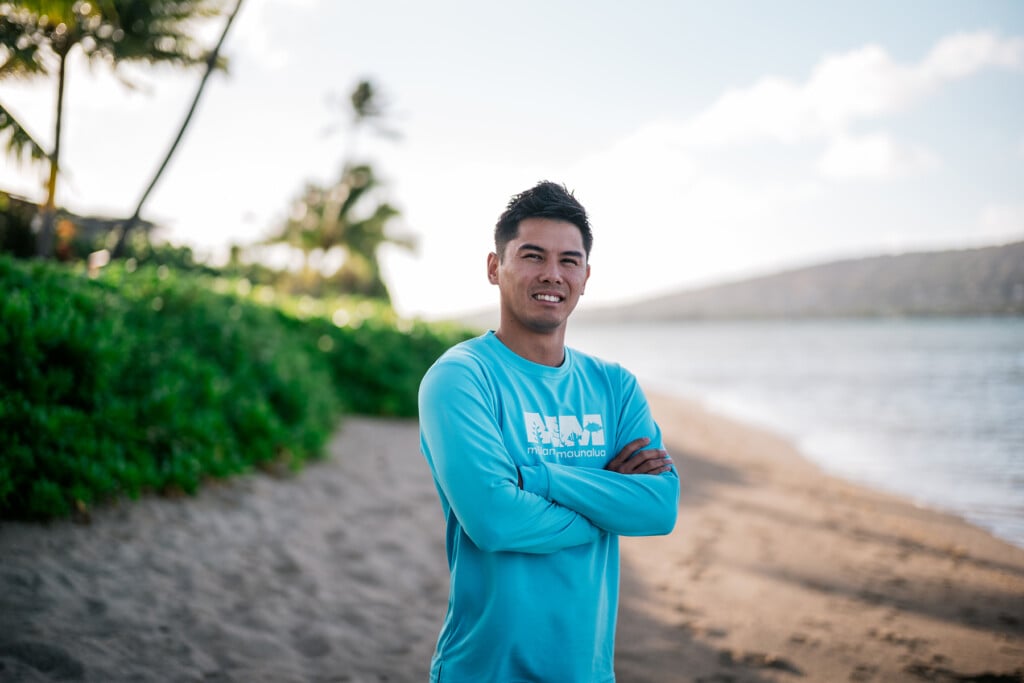
Alex Awo’s love of nature began in childhood, then turned into a lifelong commitment to conservation.
He grew up near Maunalua Bay, on the southeast shore of O‘ahu, when it “was not a healthy or thriving ecosystem or environment,” he says. “It was something that we would describe more as a toxic wasteland … overrun with pollution and invasive species.”
He first volunteered with Mālama Maunalua in 2014 while a research student at Kapi‘olani Community College, then joined the staff in 2016. Now as the nonprofit’s director of habitat restoration programs, Awo recruits and hosts volunteers, educates the community about conservation, conducts research and manages efforts to combat invasive species and restore coral.
COMMUNITY
Mālama Maunalua depends on community involvement, so it prioritizes strong relationships with volunteers and gives them the tools needed for conservation. Volunteers with the huki program, for example, have removed over 4 million pounds of invasive algae from Maunalua Bay.
Ranging from kindergarteners to senior citizens, the volunteers wear gloves to pull out the invasive algae, which is converted to compost and donated to farms, schools and nursing homes in the area.
“We’re able to take something … causing a lot of harm and turn it into something really positive,” Awo says.
INTERNS
Among Awo’s proudest achievements at Mālama Maunalua is developing its intern program.
It provides high school and college interns with hands-on research experience in conservation and educates them on marine science, surveying, water quality, invasive species and more.
Along with volunteers, interns help plant thermally tolerant and resilient corals that resist bleaching. They also work on efforts to mitigate stormwater runoff that carries chemicals and sediment into the bay.
MAUKA TO MAKAI
Awo says Mālama Maunalua takes a “mauka to makai” approach because the entire ecosystem is connected. What people do on land ultimately affects the ocean. The organization’s programs are designed in part to help residents understand those connections and the environmental problems unfolding in their own community.
THREATS TO THE BAY
Despite progress made, Maunalua Bay continues to face significant environmental pressures in addition to the stormwater runoff. Invasive species compete with native species and disrupt marine habitats, Awo says. Coral bleaching and rising sea levels pose additional challenges, along with overfishing and unsustainable development.
CHALLENGES AND SUPPORT
Much of the nonprofit’s funding comes from government grants and private donors, and securing the money requires constant effort.
Mālama Maunalua partners with businesses that want to give back to the community and nurture team bonding among their employees. Those partners have included Hawaiian Airlines, First Hawaiian Bank, Bank of Hawai‘i, Duke’s Waikiki and Maui Brewing Co.
OFF-HOURS
When not working, Awo is usually outside, hiking, fishing, diving, volunteering and taking photos of nature and the progress made in conservation efforts.
THE FUTURE
Over the next 10 years, Awo hopes to see the nonprofit continue to evolve as it works to improve the environment, expand programs, reach more students and make a bigger impact.