New Soil Lab Helps Rejuvenate the ʻĀina
Makaliʻi Metrics is blending advanced technology with ʻike (traditional Hawaiian knowledge) to support farmers and land stewards.
Daniel Richardson is ok with getting dirty, because he cares about Hawaiʻi’s ʻāina.
The CEO and founder of Makaliʻi Metrics spends much of his time collecting soil samples for analysis at the company’s new testing lab in Mōʻiliʻili. He wants to know what’s in local soils and to help people restore and rejuvenate their lands using both traditional and modern land-management techniques.
The company’s tests tell farmers, gardeners and researchers about the nutrients in their soil, something many soil labs on the mainland could also do.
But Makaliʻi Metrics adds so much more that is vital: information about the land’s geology, volcanic soil and microclimate and how it was used in earlier times, gleaned from historical newspapers, local kūpuna and traditional histories and narratives. It also provides guidance on how to nurture soil in the post-plantation era and how to deal with invasive species.
For Richardson, it’s not just a job. He says he’s driven by a passion for land stewardship, regeneration and caring for the ʻāina.
“I see myself as a tool that’s being used in this moment” to rejuvenate Hawaiʻi, Richardson says, and adding that he hopes his company’s lessons will benefit future generations of farmers and land stewards.
An important kākoʻo, or support person at the company, is former kalo farmer Zachary Pilien from Purple Maiʻa Foundation. As chief technology officer, he works with tech builders from Purple Maiʻa to manage all the soil company’s data systems and machine learning models, and “dig holes.”

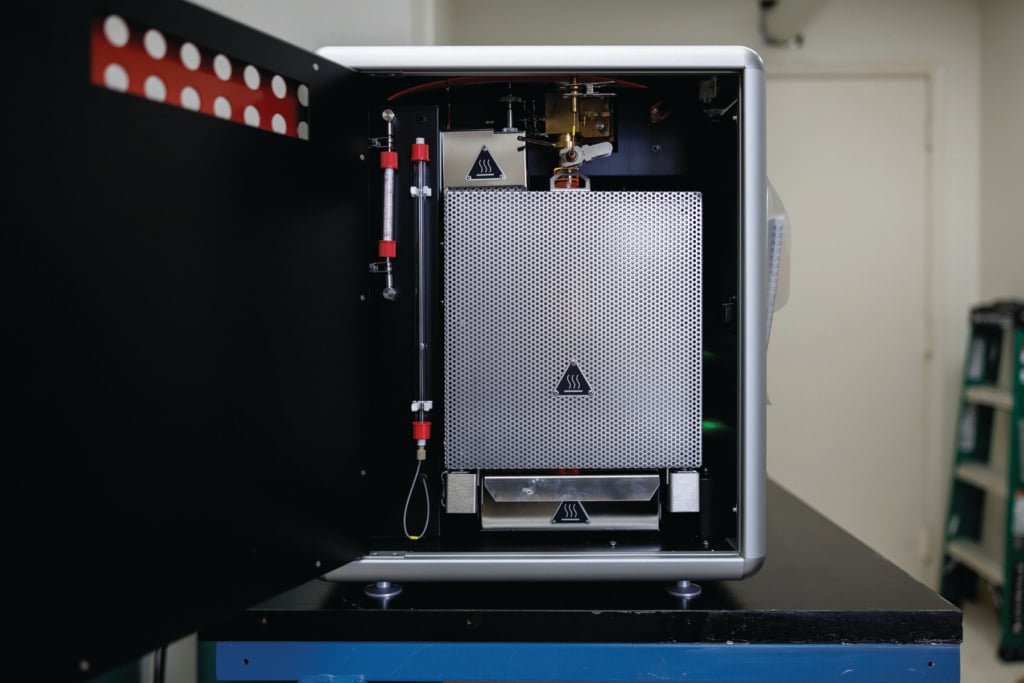
Each test Makaliʻi Metrics runs is calibrated for Hawaiʻi’s unique volcanic soils, microclimates and agricultural conditions. Photo: Aaron Yoshino
Lab Fills a Need
Makaliʻi Metrics was founded as a private company in 2022 and opened its lab May 14 after a UH Mānoa soil testing lab closed temporarily, partly because of federal funding cuts.
Richardson had worked at the lab while earning his undergraduate and graduate degrees in natural resources and environmental management.
Makaliʻi Metrics was created to take some of the load off the UH lab, and when that lab closed, soil samples waiting to be analyzed piled up. Richardson stored hundreds of the samples in freezers at his new lab.
“We’re just like, shoot we’ll just do it ourselves,” he says.
The company emerged from a group that included co-founder Kūhaʻo Zane, creative director of Sig Zane Designs; Kamuela Enos, head of the UH Office of Indigenous Knowledge and Innovation; and UH soils professors who had advised and supervised Richardson. The Purple Maiʻa and Edith Kanakaʻole foundations provided funding and support.
“What was in place were university labs and continental labs that spit out spreadsheets with nutrients and parts per million … (but clients) needed useful tools and actionable insights into that data,” Richardson says.
That info is available to farmers and other clients on an easy-to-follow dashboard created with the help of Purple Maiʻa. There, clients can also access old Hawaiʻi newspapers and archived information about their locations.
Zane, who is also president of Edith Kanakaʻole Foundation, shares Richardson’s vision. “How can Kanaka perspective inform our soil analysis? Especially for us in the hālau where you learn about these different kino lau, ʻie ʻie to koa to maile to lauaʻe and palapalai that are important to our kuahu. They all interact with the soil. Maybe there are specific soil signatures in the kino lau,” plants that are manifestations of Hawaiian akua and ancestors. Zane does the branding for Makaliʻi Metrics.

Makaliʻi Metrics founder Daniel Richardson is a Native Hawaiian and deeply committed to giving Hawaiʻi’s farmers and land stewards access to soil analysis that actually reflects their land. Photo: Aaron Yoshino
Hawaiʻi as a Leader in Soil Science
“Our belief is that there’s no reason that Hawaiʻi shouldn’t be a leader in soil science … because we have so many different microclimates, so many different ages of land happening all in such a small space,” Richardson says. “It’s like a natural laboratory up here.”
Richardson says members of the U.S. Department of Agriculture’s Natural Resources Conservation Service recently toured the lab to determine if Makaliʻi Metrics could assist in Pacific region soil analysis.
He says he understands the economics of farming and the risks farmers take when they try to make their lands more sustainable and fertile. “Do you have the money to put down, like, three tons of compost on your acreage? And do you have insurance to weather anything that might adversely affect your yields? Can you support your family?”
Makaliʻi Metrics encourages high school and university students with a passion for the ʻāina to be interns because education is at the core of its mission. Interested students can contact makaliimetrics@gmail.com. The company partners with the Kōkua Foundation and Purple Maiʻa to host its interns, Richardson says.
“In five years, I hope that we have built the frameworks that tightly weave these practices that our kūpuna were implementing on the ʻāina with these modern analytical tools and educate as far out globally in that sphere,” Richardson says.
“And second,” he hopes to have “a robust team of ʻāina practitioners, scientists, students, interns, college graduates all working here in Hawaiʻi on the food security and soil degradation issues that we face today.”
Bags of different-colored soil samples from Oʻahu, Kauaʻi and Hawaiʻi island, each labeled by name and GPS location, are piled in the lab’s freezers, ready to be tested. Standard soil sample tests cost $75; specialty samples, such as for macadamia, coffee and fruit growers, cost $95. Large projects that require many samples cost more, and water samples can also be tested.
Makaliʻi Metrics offers restoration packages too, which include baseline carbon tests, nutrient mapping, and zone analysis for large land restoration and transition projects.
Among the basic chemical elements measured are nitrogen, carbon, hydrogen and sulfur. And the company’s large spectrometer can measure many more elements, including levels of potassium, magnesium, calcium, phosphorus, sulfur, boron, manganese and aluminum.
“They can click into each site that we’ve sampled, and hover over and see why sulfur is important for your plants, why phosphorus, why calcium, etc.,” he says.

These samples of soils from Oʻahu and Hawaiʻi island were later put into small packets for analysis by Makaliʻi Metrics’ equipment. Photo: Aaron Yoshino
Building Relationships Adds to Understanding
Makaliʻi Metrics prioritizes relationship-building, Richardson says. “We don’t want to be necessarily a lab where it’s just a black box and there’s no interface, [and] you don’t know who’s analyzing or why.
“Walking a space with someone who has dedicated so much of their lives to restoring it, that’s where information arises.”
As an example, he describes two kalo varieties that are growing close to each other. “One grows better over here for some reason,” even though it’s just steps away from the other plant, he says. “Could we take a couple of tests there?” People only get into those kinds of details “when you are on the ʻāina with them.”
Richardson is especially excited about huiMAU (alaulili.com), a nonprofit community organization in East Hāmākua on Hawaiʻi island that’s dedicated to revitalizing the ʻāina through both ancestral knowledge and practices. The goal is to grow healthy food and ecosystems for generations to come.
huiMAU stewards more than 1,000 acres leased from Hawaiʻi County and Kamehameha Schools. Invasive eucalyptus trees were planted on the former sugar cane land 35 years ago and never harvested. The nonprofit has restored 35 acres of the land and plans to restore an additional 10 acres to create “the largest regenerative ʻulu (breadfruit) agroforestry system in Hawaiʻi,” huiMAU Executive Director Noʻeau Peralto says. It also includes banana, kalo and other Hawaiian ancestral crops.
huiMAU was co-founded in 2011 by Peralto and Haley Kailiehu, director of creative development, who are both generational descendants from that area. Mau also means to perpetuate.
Richardson says huiMAU is growing ʻulu and kalo in both traditional and new ways, and pairing them with plants that supply nutrients and shade for starter crops. Makaliʻi Metrics supplied the soil testing.
The community did research and identified a traditional practice used in that ahupuaʻa called pākukui. “You’re taking kukui material, digging pits and burying it and growing kalo on top of that buried, composted kukui. And this practice is very specific and reported through Hāmākua, in oli, in newspapers,” Richardson says.
Trials supported the process and tracked how it affected nutrient levels in the soil. And he says that new technologies could complement and enhance other sustainable pre-plantation era practices.
Richardson lauds the huiMAU community. “They are a rare group, coupling that knowledge with the ability to rally resources and make big steps towards their goals.”
And the organization has created jobs. Peralto says that huiMAU is the second-largest employer in the community, with 21 full-time employees. Its programs range from ʻāina restoration to culture-based ʻāina education and a food hub.
“We’re just one strand in a long line of genealogy in this place,” Peralto says. “It’s our kuleana to hold on to the rope, to maintain the connection to our ancestors and to add to it our own experiential knowledge, so that the generations to come have a stronger rope to guide and support their way.
“A practice that fed our ancestors may not be able to feed us in the same ways today, but the knowledge and values embedded in that practice form the foundation upon which we develop our own practices in our context.”