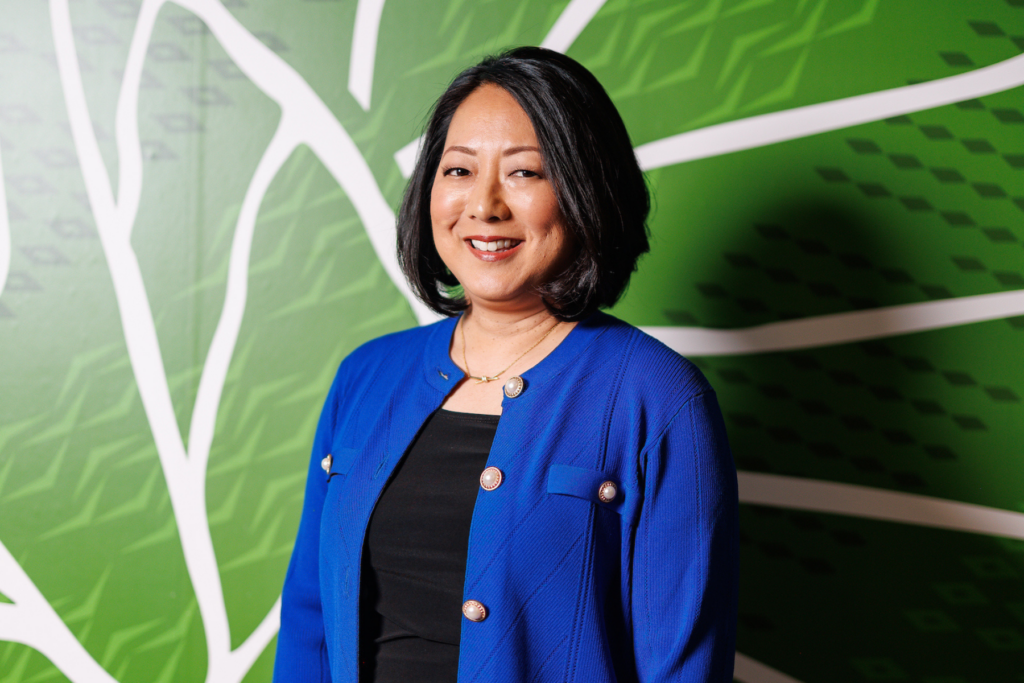
Exclusive Interview with Hawaii Business Magazine’s CEO of the Year: Ann Teranishi of American Savings Bank
Teranishi helped steer American Savings Bank through the COVID-19 crisis and its landmark 2024 transition from Hawaiian Electric Industries to an independent, investor-owned bank.
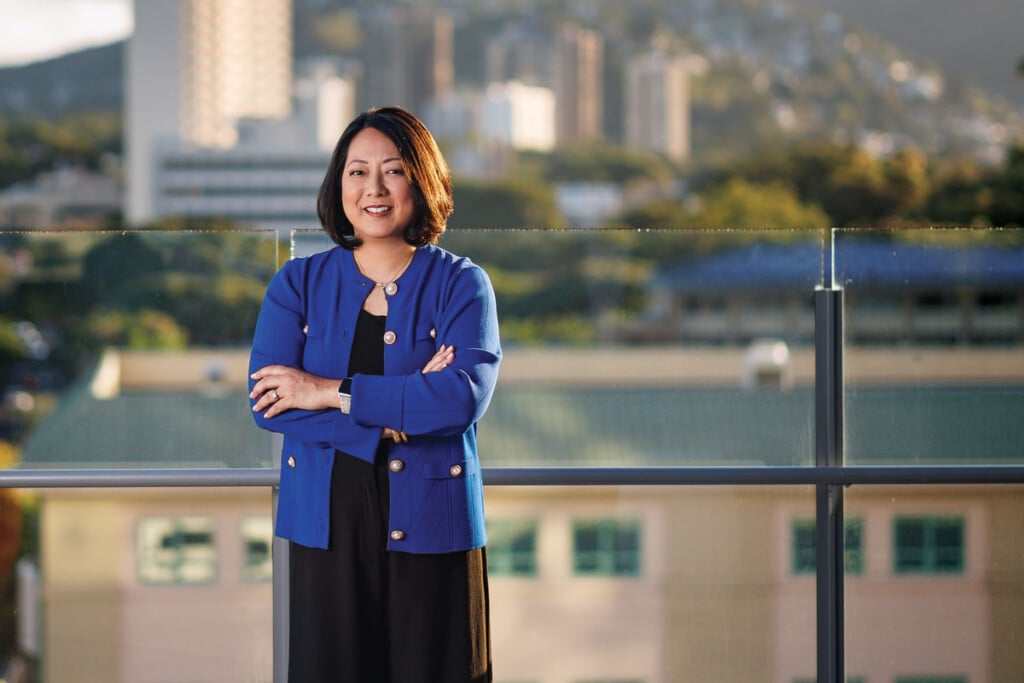
At an October event on the lawn of the Royal Hawaiian, legendary Hawaiʻi business leader Dennis Teranishi stood alongside his daughter Ann, freshly named CEO of the year, mingling with other executives over drinks.
When I congratulated him on his accomplished daughters – Ann and Lori, founder of the strategic communications firm iQ 360 – he smiled modestly. “That’s because of my wife,” he remarked, before stepping back to let Ann have her moment.
Humility clearly runs in the family, and so does quiet influence. It was Dennis who helped shape Ann’s sense of direction decades earlier, including during their 6 a.m. walks through Kakaʻako Park before her summer stint as a law clerk.
As they talked about her career, he suggested, “If you decide to work on the continent, I do hope that you’ll consider coming back. You can really have an impact here,” she recalled.
He also told her that he could see her as a CEO or president of a company one day.
“I thought he was nuts. I thought he was crazy. People will see things in you that you don’t see in yourself,” Ann said to a group of UH students during a 2022 leadership virtual seminar.
SHEPHERDING ASB THROUGH TESTING TIMES
Those words from her father, whom she considers a mentor, stayed with her and ultimately guided her toward a career rooted in Hawaiʻi, where she has made a profound impact on the business and community landscape.
As president and CEO of American Savings Bank, Ann has shepherded the institution through some of its most testing times, including the Covid crisis – when she led a 24/7 “war room” on the 7th floor of the ASB Campus in Honolulu devoted to supporting employees and customers – and ASB’s separation from parent company Hawaiian Electric Industries following the Maui wildfires.
Ann has also woven her values into the fabric of the company: Women make up 65% of ASB’s workforce, including nearly half of its executives. With a woman at the helm, ASB stands as a leader in workplace equity and representation – one of only nine woman-led companies among Hawaiʻi’s Top 100 largest businesses by revenue.
Several employees tell Hawaii Business Magazine that Ann is often the first to turn on the lights in the morning and the last to shut them off at night. “If she isn’t traveling for work, her car is always in her parking stall – first person in and last to leave,” one employee says.
It’s no surprise, then, that American Savings Bank has once again been recognized by Forbes as one of Hawaiʻi’s Best In-State Banks, marking six consecutive years for the prestigious honor. Among 213 banks nationwide on the 2025 list, ASB ranks in the top 4% of thousands of U.S. financial institutions, according to Forbes.
ASB manages $9.3 billion in assets and was recently honored at the American Bankers Association annual convention for its innovative Hui Kapili program, an accelerator created in partnership with aio Hawaiʻi to support small and midsize businesses in the vital construction and home remodeling sectors.
Hui Kapili – which means “building together” – coaches local entrepreneurs in strategic planning, financial management, workforce development and technology, thereby helping them address Hawaiʻi’s affordable housing and labor shortages.
You might think going public would be the natural next step for such a successful bank. However, Teranishi says, “I think for now, our focus is: It’s nice to be private. But we’re still keeping all the regular rigor: quarterly shareholder calls, monthly reporting to our board, all the governance you’d expect. The decision about going public really rests with our board, so there’s nothing to share at this time.”
CIVIL RIGHTS ROOTS

Ann Teranishi at far right, with some of her family. From left, father Dennis Teranishi, Brother-In-Law Troy Fujino, mother Brenda Teranishi, niece Sydney Teranishi Dake, and sister Lori Teranishi.
Ann Teranishi’s rise to the top in Hawaiʻi was never preordained. She originally thought she’d make her career on the mainland and never set out to become a bank CEO.
She found her footing after her second year at UC Hastings College of the Law (now UC Law San Francisco) when she clerked at the Honolulu firm of Kobayashi Sugita & Goda, working under Bert Kobayashi Jr. and Lex Smith, who became early mentors.
That summer home shifted her perspective. After graduation, she returned to Hawaiʻi and accepted a full-time position at the firm.
If her father inspired a long-term mission, her mother, Brenda, instilled execution and resolve. Ann’s elder sister, Lori Teranishi, describes their mother – a civil rights activist in the 1960s and ’70s – as “the matriarch of our family,” adding that their mother pushes her two daughters to think beyond themselves and their work.
“She’s shaped how we all see our responsibility to make this place better,” Lori says.
Their mother often reminded them that to succeed and to make the world better, they would need two things: courage and compassion.
“Ann exemplifies that,” Lori says, adding that family dinners often revolve around conversations about how to make Hawaiʻi a better place to live.
“Ann looks for the people who aren’t being talked to and tries to bring them into the fold. And that’s just one example of her leadership style. It’s an inclusive style.”
For his part, Dennis Teranishi, an Army veteran honorably discharged as a captain, declined to formally be interviewed for this story, preferring the focus remain on his daughter Ann.
He’s best known for his leadership in agriculture, business and technology innovation in Hawaiʻi. He has served as president and CEO of Hawaiian Host and, since 2011, as chairman and CEO of the Pacific International Center for High Technology Research (PICHTR), where he has driven technology commercialization to boost security, safety and economic opportunities across Hawaiʻi and the Asia-Pacific region.
100 YEARS IN AND FOR HAWAIʻI
 As American Savings Bank celebrates its 100th anniversary this year, one of its most meaningful milestones is its growing commitment to supporting Native Hawaiian communities.
Ann’s inclusive and caring approach extends to local people, many of whom have been forced to leave their home state because of Hawaiʻi’s high cost of living and limited access to affordable housing and financing. The U.S. Census Bureau reports only 47% of Native Hawaiians now live in Hawaiʻi, while 53% reside on the continent – a reversal from a decade ago.
As Lori Teranishi recalls, “After one of the Hawaiʻi Executive Conferences, she began collaborating with a diverse group of people to create a Native Hawaiian loan program at American Savings Bank. The goal was to provide access to financing for a community that had historically faced significant barriers. It was about truly putting ideas into action. It’s something she’s deeply committed to.”
The bank has since introduced mortgage programs designed to expand affordable homeownership opportunities for Native Hawaiians. In April 2023, ASB received approval from the U.S. Department of Housing and Urban Development to offer HUD 184A and FHA 247 loans – programs that provide affordable financing options for Native Hawaiians purchasing or refinancing homes on Department of Hawaiian Home Lands leased land.
ASB also offers its This is Home program, created to help first-time homebuyers in Hawaiʻi, including Native Hawaiians and everyone else.
ASB also partners with local developers and nonprofits to finance housing and provide essential resources. And in partnership with the Federal Home Loan Bank of Des Moines, ASB has awarded nearly $2.7 million in grants to nine nonprofits dedicated to expanding housing access across the Hawaiian Islands.
CRISIS MANAGEMENT DURING THE PANDEMIC
 In March 2020, Ann Teranishi was executive VP of operations at American Savings Bank, running every aspect of the bank’s day-to-day operations.
When Covid hit that month, she turned an open space on the 7th floor of the bank’s new campus at 300 North Beretania Street into a “war room,” where employees could safely process critical loans while socially distancing.
The bank pivoted swiftly to hybrid and virtual operations, coordinating remote teams, sanitation protocols and essential banking functions such as payroll and wire transfers.
Teranishi also played a central role in processing Paycheck Protection Program loans, ensuring local companies had access to vital federal PPP funding to stay in business.
“We worked around the clock,” she recalls. “We did 24-hour shifts the first couple of days because we were so uncertain how fast the federal funds would run out.
“We were nervous that the funds wouldn’t get to Hawaiʻi because of the six-hour time difference (with the East Coast). I just said, it’s better for us to be here and enter as many applications as we could during the window. We didn’t know if that money would run out in 24 hours, 48 hours – so we entered them as fast as possible.”
Though she was not yet CEO, Teranishi acted like one. “I said, ‘Here’s what I think we should do: 24-hour coverage in six-hour shifts. I’ll take the 12-to-6 shift, but I need at least one executive at every shift to show we’re not asking anyone to do something we won’t do ourselves.’ Everyone signed up. EVPs entered applications alongside the team. It was a mentality of whatever it takes to support businesses.”
WILDFIRE CRISIS WAS “NEXT LEVEL”
Two years later, shortly after becoming CEO, Teranishi faced another high-stakes challenge: the 2023 Maui wildfires.
The disaster devastated communities and intensified scrutiny on Hawaiian Electric Industries, then the bank’s owner. Lawsuits mounted and HEI agreed to contribute nearly $2 billion toward a broader $4 billion settlement to help rebuild and compensate survivors. The utility pledged to finance its share over several years, a sobering reminder of how deeply the fires reshaped Hawaiʻi’s corporate and community landscape.
The crisis tested everything Teranishi had learned. “It’s always interesting to sit down and replay the moments you live through as a leader,” she says. “I thought the epitome of my leadership challenges was becoming an executive, then Covid happened. When I became CEO a year later, which was not expected or planned, I thought: That’s the biggest challenge.”
But when the wildfires struck, she realized it was “next level.” The event felt almost existential: “A challenge for the whole corporate structure.”
American Savings Bank’s leadership team and board moved quickly to stay anchored in serving the bank’s customers and teammates. “The utility had to focus on the utility, and the bank had to focus on the bank,” she explains about HEI. “It was essential to show people that ASB was strong, stable, and independent, especially when many didn’t understand the separate corporate structures of the two entities.”
It was a time when regional bank failures on the mainland like that of Silicon Valley Bank had already shaken investor and customer confidence, so Teranishi and her team doubled down on communication.
“We were laser-focused on reassuring customers and employees that the business of the bank hadn’t changed,” she says. “We made it very clear we were not reliant on HEI for capital; we hadn’t received capital from them in 25 years. In fact, we’d been a dividend provider.”
That approach paid off. American Savings Bank held firm as a trusted community anchor, quietly doing what it has always done: serving customers with consistency and care.
“What got us through was staying close to people – talking one-on-one, emphasizing that we were steady. The human part of leadership mattered just as much as the financial side.”
Looking back, Teranishi sees how both Covid and the wildfires shaped her as a leader.
“As you talk to leaders over time, it’s like each additional hurdle you have to overcome becomes the thing that builds a resilient center. It’s never going to be easy, but it’s not so unfamiliar anymore.”
Following HEI’s sale of 90% of its stake in ASB to independent investors – retaining only a 9.9% non-controlling interest – the bank stands fully autonomous for the first time in decades. The transition was completed on Dec. 31, 2024, in time for the beginning of the bank’s 100th anniversary celebration in January.
“We were very, very focused on wanting it to close at the end of the year, so that we could start the new year of 2025 as a standalone independent company. That was super important to us as a bank because January 8 was our actual 100th birthday,” Teranishi says. “It felt incredible to be able to tell our team: This is how the chapter with HEI ends and this is how the next one begins. We’re starting our second century as a standalone, locally owned bank.”
A CONVERSATION WITH CONNIE LAU

Teranishi was a member of the 2018 cohort of the Hawaii Business Magazine’s 20 for the next 20. In 2019-20 she was an Omidyar Fellow. She is shown with others in the Omidyar cohort. From left, Lia Hunt, Meli James, Omidyar Fellows Director Bill Coy, Brandee Menino, Teranishi, and Rachel Solemsaas.
A pivotal moment in Teranishi’s career came while she was serving as VP and legal counsel at Central Pacific Bank, where she handled contract negotiations, litigation and corporate compliance from 2005 to 2007, including responsibilities under the Bank Secrecy Act and the Office of Foreign Assets Control.
“I was tasked with helping them with a very difficult regulatory situation,” she recalls. “And then, a year and a half into that, I was called by American Savings Bank to help them with a similar situation.”
It was demanding, high-stakes work that gave her a front-row seat to the intricacies of regulation and risk in Hawaiʻi’s banking world.
At that point, Teranishi was still at Central Pacific Bank when she was first approached by American Savings Bank. She declined the initial offer, explaining that she wanted to return to practicing law. But then Connie Lau came back to talk to her — and the conversation changed everything.
“I said, ‘Thank you so much, but no. I don’t think it’s the right fit. I’m actually going to go back to practicing law,'” she recalls.
Lau, then ASB’s CEO, heard about Teranishi’s decision and called her personally. “Before you really say no, can you tell me why you’re thinking about going back to law?” Lau asked.
Teranishi explained that while she respected compliance work, she worried about being pigeonholed. “I knew it would be really heavy lifting for two years,” she says. “I knew how to do it, but I wasn’t sure that’s what I wanted to do for the rest of my career. And I also said, if I do this a second time, then you’re the chief compliance officer and that’s the role you have for life.”
Lau, herself an attorney with an engineering degree and an MBA, offered a different view. “If that’s your concern,” she told Teranishi, “come help us build this program and you’ll have opportunities to move into other areas of the bank later.”
Teranishi accepted the challenge and joined ASB as Bank Secrecy Act officer and compliance manager, building the bank’s compliance function from the ground up. Not long after, leadership shifted: Lau moved to the parent company, Hawaiian Electric Industries, and Rich Wacker became ASB’s CEO. But Lau’s mentorship continues to shape Teranishi’s path.

ASB is a regular sponsor of the Hawaii Entrepreneur Awards, which is led by Meli James, shown here with Teranishi.
Lau saw something in Teranishi immediately. “She’s incredibly capable and humble. She didn’t think it should be her, but it was her. She’s one of those people who just has it: the intellect, the integrity, the steadiness. And the other thing is, she’s very respectful. She wants to be sure that she’s not bumping anybody else out.”
Her advice to Teranishi was simple but powerful: Trust the people who see your potential. “You’ve just got to believe that the people who are asking you to take these bigger jobs know what they’re doing,” Lau says. “We knew Ann could do it.”
Under Lau’s leadership, Teranishi expanded her expertise beyond her legal background, rotating through roles in compliance, consumer credit and customer experience – a new strategic initiative designed to embed a customer-first mindset across the organization.
“That’s what women and really, all people have to do,” Lau says. “You tell young people it’s limitless. You can do whatever you want to do if you work hard and stay open to learning.”
Only three women have held the title of CEO at Hawaiʻi’s major banks. Lau was the first: She became CEO of ASB in 2001, before moving on to lead Hawaiian Electric Industries in 2008, then retired in 2021.
Catherine Ngo served as CEO of Central Pacific Bank from 2015 to 2021. And Teranishi became president and CEO of ASB on May 7, 2021, succeeding Wacker, after she had been with the bank for 14 years.

Teranishi served as Grand Marshal for Chinatown 808’s year of the snake parade this year.
When asked what stood out most about Teranishi as a leader, Lau didn’t hesitate: calm.
“CEOs have to be calm,” she says. “I always thought of it as a pyramid – if the person at the top is anxious, that anxiety ripples all the way down. But if you’re steady, the whole organization stays steady. Ann has that inner calm. You can’t really mentor that. It’s something she brings from within.”
That calm comes from a sense of being self anchored in authenticity and community, Lau says. “In Hawaiian culture, we call it knowing your naʻau – your gut, your center. You bring your authentic self to work, you surround yourself with good people, and you lead with purpose.”
When the Covid pandemic and Maui wildfires tested institutions statewide, her centered leadership became Teranishi’s hallmark. “That’s why we chose her,” Lau says simply. “She has the character, the stamina, the integrity, the care for her community. Those things can’t be taught, but they’re what truly matter.”
From the start, Lau saw in Teranishi the makings of a future CEO. “I always knew she’d lead this bank one day. She’s exactly the kind of leader Hawaiʻi needs: grounded, humble and unflappable. American Savings Bank is an important institution for this community, so it needs to be led by someone who understands the community and is committed to the goodness of the community.”