Hawai‘i’s Economic Outlook 2026
Construction is expected to be strong, driven in part by large infrastructure projects, but tourism is slipping and the safety net fraying.

Illustration: Christine Labrador
Table of Contents
Buckle up for more bumps and uncertainty
Tracking Hawai‘i’s most important sectors
Hawai‘i Banks in Strong Shape, But Economy Faces Headwinds
Transportation Sector Can Only Get Better… Right?
Buckle up for more bumps and uncertainty
By Cynthia Wessendorf
At the end of one chaotic year and the threshold of another that could be equally turbulent, Hawaiʻi’s people, institutions and economy remain fairly resilient, though vulnerable to developments beyond its borders. The rapid, disorienting changes of 2025 show few signs of letting up, adding pressures on the local economy.
Nationally, trade has been disrupted, while the role of the federal government in education, health care, public health, disaster recovery, assisting the poor, scientific research, and clean energy initiatives is being dismantled.
In Hawaiʻi, at least 1,200 civilian federal employees have already left their jobs, millions of dollars in federal grants have been slashed or are at risk, and monthly premiums are rising on the Health Insurance Marketplace.
Troops have been sent into cities and ICE agents are running aggressive deportation campaigns, including in Hawaiʻi. The result is a declining job market nationally as inflationary pressures are accumulating, says Seth Colby, chief state economist at the Department of Business, Economic Development & Tourism. In the fall, the longest federal government shutdown in U.S. history led to cuts in food assistance and airline flights.
In Hawaiʻi, the shutdown intensified an existing economic slowdown, pushing tourism—the state’s most important economic engine—into a sputter. Visitor arrivals and real spending, adjusted for inflation, have fallen after a promising spring season, and many international visitors are staying away. The UH Economic Research Organization expects numbers to continue dropping significantly in 2026, though the state Department of Business, Economic Development & Tourism is more optimistic.
Together, tourism and federal spending represent almost a third of Hawaiʻi’s economy, so slowdowns and cuts hurt badly, cascading across sectors. “Federal spending is much broader than just its direct contribution in GDP. It’s also showing up in the hospitals. It’s showing up at the university. It’s showing up through grants to the state and grants to nonprofits,” explains Carl Bonham, executive director of UHERO.
“We’re really dependent on what happens in the U.S. economy right now, arguably more so than at any time that I’ve observed, because of cutbacks in federal spending, and also because roughly 80% of our visitors are from the U.S. right now,” he says. With consumer sentiment sinking, fewer people will want to splurge on a Hawaiʻi vacation.
TARIFF VERTIGO
Hiring, business planning and new investments have stalled across the country, including Hawaiʻi, amid concerns about tariffs and rising prices. While the impact so far hasn’t been as dramatic as predicted, researchers at Harvard Business School found a 5% increase for imported goods since March 2025, and 2.5% for domestic goods—and even larger price increases when compared to the pre-tariff deflationary trends of 2024.
About half of imports are materials and equipment used to manufacture goods, says Steven Bond-Smith, an assistant professor at UHERO and expert in regional economies, so tariffs drive up the cost of even locally produced goods and create a “headwind for future activities.” In mid-November, the average tariff rate was 18%, up from 2% in 2024. But the whiplash of add-ons, roll-backs, special deals and targeted punishments make it hard for many companies to plan or invest in production.
The U.S. Supreme Court was still deciding at press time whether the emergency powers used to impose tariffs were legal, but the Trump administration has promised to seek other mechanisms to keep them in place. Many large companies have been absorbing the levies while they wait to see what happens next, but small businesses with lean profit margins and negligible negotiating power can be facing extinction.
I spoke with a local jeweler who imports saltwater pearls from French Polynesia and other Pacific nations, as well as jewelry hardware and some freshwater pearls from China. The pieces are designed and assembled in Hawaiʻi and sold primarily to mainland stores and customers.
His monthly UPS tariff bill has quadrupled from about $5,000 a month to $20,000 a month since the trade wars began in April 2025, forcing him to slowly raise prices at the same time that customers pull back on spending. With three full-time employees and health insurance costs, there’s little left over. He says he’s prepared to close the business.
For all the self-inflicted damage to the economy, national and state-level GDP continues to inch upward. That growth, however, is largely a reflection of the 2024 economy showing up in data for the first half of 2025, according to Bonham. Others point to a massive buildout of data centers—much of it tied to the tech industry’s push into artificial intelligence—propping up the U.S. economy.
Seth Colby at DBEDT is less alarmed by tariffs, and says the national economy should continue to grow, though less than if there weren’t tariffs. Estimates of lost GDP range from 0.2% to 1%, distributed over a couple of years, he says. “It’s not great, but it’s not the end of the world.”
Indeed, the stock market bounces back from every shock, driven to new records by a handful of tech companies and investors’ exuberance for AI. Interest rates were cut in September and October by the Federal Reserve, with more cuts possible on the near horizon, which could spur homebuying in Hawaiʻi. Meanwhile, billions of dollars in defense spending for infrastructure projects are rolling into the state, a bright spot in projections for 2026.
The country seems to split into separate worlds: the comfortably affluent, who now account for half of all spending, and working people scrambling to cover housing and food. The soaring financial markets and the struggling small businesses. The beneficiaries of government largess and the targets of its ire.
For Hawaiʻi, geography exacerbates the split: A remote island chain vulnerable to global shifts and a continental behemoth that dominates the globe. “The U.S. economy has proven over and over for the last five years that it’s way more resilient than most people could believe,” says Bond-Smith.
“UHERO’s forecast for the U.S. economy is about 1% GDP growth for next year. If it ends up being 1.5% or 2%, which is completely possible, then things will look better here than we expected,” Bond-Smith says. And if the mid-term elections change the balance in Congress, cuts in federal funding to Hawaiʻi are expected to slow, he adds.
AN ISLAND ECONOMY
Although Hawaiʻi is 2,500 miles from the U.S. West Coast, its open economy is integrated with the continent through tourism and the military presence. That makes Hawaiʻi “the richest island chain in the world,” says Colby from DBEDT.
“We definitely punch above our weight. Generally, we are wealthier and more diversified than most island economies,” he says. Hawaiʻi incomes, for example, are closer to the continental U.S. than incomes in the Canary Islands versus continental Spain, he says.
Hawaiʻi is also less dependent on tourism overall than many other islands, says Colby. In a recent presentation to a Chamber of Commerce Hawaii gathering, he explained that tourism accounts for about 22% of Hawaiʻi’s GDP. That figure is 32% in the Canary Islands and 29% in the Azores off Portugal. Hawaiʻi’s GDP per capita compared to the mainland economy is 92%, the Azores is 83% and the Canary Islands is 78%.
While these figures show comparative strengths, fractures have appeared in the economic picture, and they’re getting worse. Hawaiʻi’s strict pandemic lockdown, for example, pushed people out of jobs, sometimes permanently. Job growth never fully bounced back.
Today, the number of jobs is stuck at 2016 levels, while the unemployment rate is one of the lowest in the country. “And the reason for that rate is not because our economy is hot, hot, hot,” says Colby. “It’s because we don’t have enough workers, which is a very big constraint on the Hawaiʻi economy.”
Low pay and high prices are driving people out of the Islands. While Hawaiʻi salaries are higher than most states—11th highest in the nation—when adjusted for cost of living, that ranking falls to 43rd. “So everyone here feels like they’re not getting paid enough,” says Colby.
According to Bond-Smith from UHERO, Hawaiʻi incomes and economic growth, adjusted for inflation, started slowing in 1990, and they’ve remained below national averages ever since. In the past several years, incomes have fallen even further, he says, particularly for professional jobs such as lawyers and accountants.
“If you look at per capita incomes, or you look at GDP per capita, that number is now 5% to 10% below the U.S., and the gap is getting wider,” says Bond-Smith. “That income pressure, and even productivity pressure, pulls people and activity to the mainland, away from Hawaiʻi. That’s why there’s fewer jobs and super low unemployment.”
And many people in Hawaiʻi, notes Bonham, are underemployed, stringing together part-time service jobs. In economic reporting, even a substandard, limited-hour job counts as being employed.
THE HARDEST HIT
Hawaiʻi’s decades-long affordability problem is worsening as wages fail to keep up with escalating prices. In the nonprofit Holomua Collective’s 2025 affordability survey, 42% of respondents said it was “very difficult” to save money from their paychecks, compared to 34% of respondents in 2024. Their biggest worries centered on earning enough given the state’s high cost of living, not being able to meet basic needs and achieve economic stability, and the heavy burden of Hawaiʻi’s expensive housing.
The survey gathered input from 3,200 working people in Hawaiʻi, the majority middle or upper-middle earners. Among respondents, 29% said they plan to leave and 46% hadn’t ruled it out—together, up 5% from 2024. Households earning more than $150,000 a year were less likely to say they plan to relocate, while those making less were more likely to want to move away.
Among people in the lower income levels, two state initiatives will provide some relief in 2026: the minimum wage rises to $16 from $14, and the standard deduction for a single person filing a state tax return rises to $8,000 from $4,400. The deduction will rise incrementally to $9,000 in 2031.
But housing, food, childcare, transportation and health care can still exceed wages, and cuts are planned for many federal programs that serve as lifelines. For example, a “thrifty” food budget for a family of four in Hawaiʻi costs nearly $1,500 a month, according to the USDA, which administers the SNAP program. While about 150,000 Hawaiʻi residents depend on the hunger-relief program, the “One Big Beautiful Bill” calls for large cuts.
The OBBB also scales back subsidies that lower the cost of health care for people purchasing plans on the Affordable Care Act’s exchanges. In Hawaiʻi, 24,606 people, many self-employed, buy plans through the health insurance marketplace; costs for most people are expected to rise, and sometimes astronomically.
Looming ahead in 2027 are major changes to Medicaid’s eligibility rules and the potential loss of health care for many of the 441,000 children and adults in Hawaiʻi who depend on the program. And the state’s vast nonprofit sector, which helps stitch together a relatively robust safety net, faces a shortfall of $129 million in federal funding, with more cuts likely.
As we head into 2026, economists at UHERO predict a weaker economy, with slowdowns in tourism and cuts to federal jobs and spending cancelling out the gains in construction. DBEDT predicts modest growth. Both UHERO and DBEDT see rising unemployment ahead, but with better news coming in 2027.
Barring a major disaster, such as a stock market crash brought on by a deflating AI bubble, the state should be able to weather a softening economy or mild downturn. But for the 45% of residents in poverty or struggling to cover basic expenses, life in Hawaiʻi will get even harder.

SPOTLIGHT REPORTS: Tracking Hawai‘i’s Most Important Sectors
TOURISM
Slowing Visitor Numbers Could Spell Trouble
- Mainland visitors dominate the market, exposing the sector to downturns
- Alaska/Hawaiian expect more visitors from West Coast markets
- Group travel to drop as convention center closes for repairs
When tourism surges, it’s easy to spot: crowded trails, overrun snorkeling spots, grumbling residents. That last happened in 2022, when Hawaiʻi experienced a wave of post-pandemic “revenge travel.” But when tourism dies, as in 2020, the results are much uglier: mass unemployment and long lines at food banks.
At the moment, the mood has turned anxious, as a strong start of the year shifted into a disappointing summer season. By the end of September 2025, visitor arrivals were down 3.2% from a year ago, according to UHERO. Real expenditures, adjusted for inflation, had risen just 0.1%, though the total dollars spent was higher.
The six-week federal shutdown in October and November reduced flights to Hawaiʻi and could lower fourth-quarter results. On Dec. 1, the Honolulu Star-Advertiser reported that Waikīkī hotels and restaurants were unusually empty and the industry was confronting its weakest holiday season in years.
With tourism accounting for about 22% of Hawaiʻi’s economic activity, according to DBEDT’s Seth Colby, the current dip strains hotels, restaurants, shops, rental companies, and all the small businesses that rely on visitors.
Carl Bonham from UHERO says what worries him most is the makeup of those visitors: about 80% now come from the U.S. continent, which is vulnerable to a downturn. That figure was about 60% in 2019, according to Jeffrey Eslinger, senior director of market insights and CRM at the Hawaiʻi Visitors & Convention Bureau.
While projections for a U.S. recession range from dire to upbeat, the hiring slowdown and a surge of layoffs announced in October can make potential visitors jittery.
As for international visitors, the once-booming markets of Japan and Canada now comprise only about 5% each of the overall market, says Bonham. The remainder of visitors come from South Korea, Australia, New Zealand, Europe and elsewhere.
Japanese arrivals peaked at about 2 million in the early 1990s. By 2025, their numbers had dropped to less than a quarter of that amid a stagnant economy and weak yen, but some positive movement may be afoot. The merged Alaska and Hawaiian airlines reports a “steady rebound of Japanese visitors to Hawaiʻi. We continue to see improvements in point-of-sale bookings to Hawaiʻi, but we remain well below pre-Covid demand levels,” says Alex Da Silva, the regional communications manager for Hawaiʻi, in an email.
Canadian visitors began dwindling after the 2023 Maui wildfires, and took a nosedive in 2025 when the Trump administration launched a trade war and threatened to annex the country. The Canadian economy is now feeling the sting of tariffs, with real GDP projected to grow just 1% in 2025 and 2026, compared to earlier projections of 2%—another deterrent to traveling.
In preliminary forecasts, UHERO expects about 9.48 million visitors to arrive by air in 2026, about 1% less than 2025; DBEDT expects 9.76 million visitors by air and cruise ship in 2026, a 0.6% gain over the previous year. UHERO forecasts a steep drop in real expenditures—down nearly 6% in 2026—while DBEDT forecasts a 2.2% increase in expenditures, not accounting for inflation. Both organizations expect arrivals and spending to improve in 2027.
WILL TRAVELERS GO SOMEWHERE CHEAPER?
While Hawaiʻi Tourism Authority’s visitor surveys find the vast majority of people are happy with their Hawaiʻi vacations, some tourism leaders have misgivings, particularly about stiff competition from resort spots in Mexico, the Caribbean, and Southeast Asia, where visitors get more for their money.
“Tourism in Hawaiʻi,” a September 2025 report by UHERO Associate Professor Colin Moore and a team of researchers, interviewed 19 tourism executives. Some thought Hawaiʻi is coasting on its reputation, which doesn’t match the reality of subpar infrastructure and crowded beaches. They worry that the state relies too much on tourism for its economic survival.
Executives at the Hawaiʻi Visitors & Convention Bureau, the nonprofit agency that oversees tourism marketing to the U.S. continent, say Hawaiʻi remains a sought-after, “aspirational” destination. They say they’ve had success reaching the ideal “target travelers,” described as having the means and desire to regularly travel for new foods, adventures and cultural experiences.
But they’re now worried about getting the message out as their funding has been “dramatically cut,” says Aaron J. Salā, president and CEO of HVCB, amid broader state cuts to the Hawaiʻi Tourism Authority, which contracts with the bureau. In 2025, HVCB’s budget was about $16 million—half its 2011 budget. In contrast, the Las Vegas Convention and Visitor Authority has budgeted a whopping $138 million for marketing and sales in 2026.
“We invested in the marketing of Hawaiʻi, which is why everybody in the world knows Hawaiʻi. You now see the diminishing of marketing, and we start to lose control of our own story,” says Salā. He says without the Hawaiʻi brand put front and center in the visitor’s mind, many might head to Mexico instead.
And the sector is facing another painful hit: the Hawaiʻi Convention Center’s main event spaces are scheduled to close for repairs in January 2026 and aren’t expected to reopen until early 2028. Honolulu conventions account for about 150,000 visitor nights a year and about $1 billion to Hawaiʻi’s economy, says HVCB’s Eslinger.
At the moment, HVCB is trying to reschedule conventions for 2028 and beyond or redirect groups to large hotels. Eslinger estimates that 60% to 65% of that business could go missing in 2026 and 2027. The agency is also trying to fill the gap in international visitors with more travel from the U.S. East and West coasts, which are now Hawaiʻi’s biggest markets.
Da Silva from Alaska and Hawaiian airlines writes in an email that travel between Hawaiʻi and cities such as Seattle, San Francisco, Los Angeles, San Diego and Las Vegas remain popular, and they’re optimistic that traffic will pick up in 2026. He says combining the airlines has quadrupled the routes connecting the Islands to the U.S. continent and internationally. And in April 2026, Hawaiian will join Alaska’s global airline alliance, opening up 125 routes to and from the Islands—and lots more potential visitors.
CONSTRUCTION
Big Infrastructure Projects Coming
- Construction is a bright spot in UHERO’s 2026 forecast
- NAVFAC Hawaii to award $8 billion in construction contracts
- Rising material costs and labor shortages are persistent challenges
Hawaiʻi’s construction industry continues to boom, with residential housing, particularly multi-family housing, making up more than 50% of the market in the first three quarters of 2025, according to the Pacific Resource Partnership, a nonprofit organization aligned with the carpenters’ union.
UHERO’s third-quarter forecast says total commitments to build in 2025 would exceed $10 billion, up 10% from 2024. Residential building permits rose more than 27% and government contracts rose more than 12%. While the forecast expects construction to cool in 2026, to $9.35 billion in total commitments, the sector will continue to help drive Hawaiʻi’s economy.
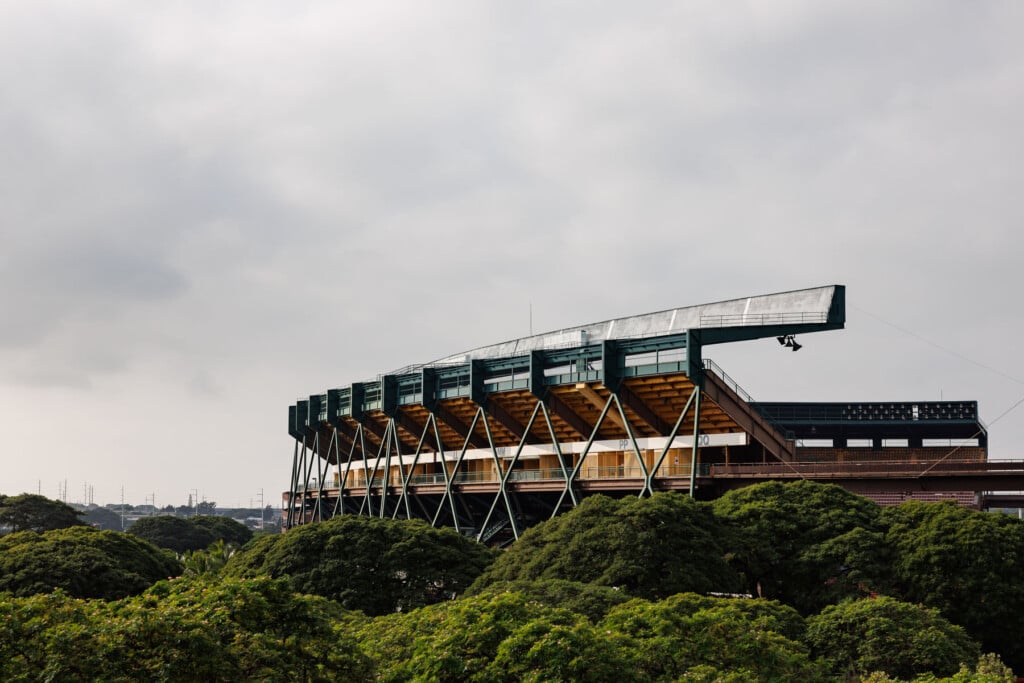
Much of the future growth will come from state and federal infrastructure projects, including an influx of defense spending that’s expected to last for years. At the state level, construction on the Middle Street-to-Kakaʻako rail segment is underway. In October 2025, the Honolulu Authority of Rapid Transit contracted Tutor Perini Corporation to design the next Skyline segment running to the Ala Moana Center. Demolition work to make way for the massive Aloha Stadium Entertainment District is expected to start in 2026.
The rebuilding of Lahaina has picked up pace, with 784 residential and 191 non-residential permits in process, issued or completed as of November 21. On Oʻahu, a multitude of large residential and industrial projects are underway or expected to begin in 2026, much of it in Kakaʻako and West Oʻahu, according to Colliers’ third-quarter 2025 reports on commercial real estate.
Among federal projects, construction of a new dry dock at the Navy’s Pearl Harbor shipyard will continue until at least 2027. The $3.42 billion project began in 2023 to support the nuclear-powered submarine fleet in the Pacific. Work is also ongoing on a nearly billion-dollar Naval Facilities Engineering Systems Command (NAVFAC) contract, which includes local construction companies.
In June 2025, NAVFAC Hawaii announced a mammoth $8 billion contract for new military construction projects across the state and at the U.S. base on Wake Island, a small atoll more than 2,000 miles west of Honolulu. The contract runs through 2033, and includes housing, industrial buildings, airfields, roads and waterfront areas.
Five Hawaiʻi-based companies were pre-qualified to bid on specific projects: Hawaiian Dredging Construction Company, Hensel Phelps Construction Company, Nan Inc., Kiewit Infrastructure West Company and Nordic PCL Construction Inc.
“WE ALL ROLL THE DICE”
Nordic PCL’s recent experiences illuminate some of the challenges facing the construction industry, even in times when work is abundant. Some of its new or upcoming projects include the Nāulu affordable apartments in ʻAiea; a 32-story tower for Hilton Grand Vacations in Waikīkī; housing at Schofield Barracks; a large expansion of Queen’s Medical Center, West Oʻahu; the renovation at Mauna Kea Resort on Hawaiʻi Island; and a new Hilton hotel, Hale Malana, in Līhuʻe.
The company, like others, ships in all its materials, including stone and glazing from the U.S. continent, pre-made cabinets from Asia, and lumber from Canada. Goods entering from Asia and Canada are subject to wildly fluctuating tariffs. At press time, the rate for some Canadian imports was 35%. Imports from China have reached a high of 125% in April 2025 and had dropped to 47.5% in November.
While the price of materials continually rises, there’s no clear culprit, says President Glen Kaneshige. “We don’t know what the driver is, whether it’s the cost of transportation, the cost of production, tariffs or some middleman marking it up,” he says. “They all get built into the final cost of the product.”
And Kaneshige says the supply-chain snarls from the start of the pandemic still haven’t been resolved. What used to take three months to arrive in 2019 turned to 12 months in 2020; today, it can still take six months, he says. Delays and price hikes complicate planning.
When construction companies bid on projects, “we all roll the dice,” he says, particularly with county and state contracts that don’t adjust for inflation. For structural steel and mechanical, electrical and plumbing work, Nordic uses subcontractors, which only offer short-term price guarantees as they’re also at the mercy of inflation and tariffs.
In 2024, Nordic PCL had about 250 employees and $437.3 million in gross revenue, and Kaneshige expects those numbers to be about the same in 2025 and 2026. But his outlook beyond that is more cautious, a sentiment shaped from living through the state’s decade-long recession that followed the 1991 crash of Japan’s economic bubble. Japanese investors had poured billions of dollars into Hawaiʻi real estate and resort properties, and the fallout was rough.
“I’ve been around long enough you see how things can go bad,” says Kaneshige. “We basically went through two cycles of our recession where our industry really suffered, and we had to scratch and claw to get the next project.”
At the moment, he says “there’s enough work that will sustain us through 2026. But in our business, it’s hard to see beyond 18 months or maybe 24 months out. Going farther out on the horizon, it’s too blurry. There are too many things that can come into play.”
He sees positive developments, such as the flow of military dollars into the state, major expansions to health care facilities, and dense, vertical housing rising across the urban corridor, including ambitious affordable housing projects planned for Iwilei. But he also worries about the volatile tourism industry, the risks of conflict between China and Taiwan, and serious workforce pressures in the construction industry.
UHERO expects the number of construction jobs to stay in the current 40,000 to 41,000 range through the end of the decade. At some point, those numbers will be even harder to fill than they are today, says Kaneshige, because not enough young people are entering the skilled trades to replace those who are retiring.
“I think we will continue to struggle with workforce development, and that is not going to get resolved in the very near future,” he says. He says he hasn’t heard of ICE raids at local construction sites, but that the national industry as a whole depends on immigrant labor and can’t afford to have its workforce disrupted.
RESIDENTIAL REAL ESTATE
“Light at the End of the Tunnel”
- Mortgage rates have dropped, lifting sales and prices
- NAR Economist Lawrence Yun expects “double-digit growth”
- Affordability continues to lock residents out of homeownership
In good news for home sellers, buyers and real estate professionals, the Federal Reserve cut interest rates twice by press time in 2025. While mortgage rates are higher than interest rates, they run in tandem, rising and falling together. The cut is expected to entice buyers and sellers and reinvigorate the sector, which has stalled over the past few years.
“We’ve been living in the doldrums,” said Trevor Benn, president of the Honolulu Board of Realtors, at an Oct. 31, 2025, economic forum that HBR hosted in Waikīkī. High prices and interest rates have made it hard to buy property, while people with sub-4% mortgages are loath to sell and give up their rates. Little went on the market, little was bought.
But conditions are changing nationally. “Now that the mortgage rate is coming down somewhat, that’s going to help on the affordability, and then inventory showing up. That’s why we anticipate double-digit growth and home sales activity, but it won’t be back to pre-Covid levels,” says Lawrence Yun, chief economist at the National Association of Realtors, who spoke with me after the forum.
In his address to a room packed with real estate professionals eager for business to bounce back, Yun offered a message they wanted to hear: Even if the economy softens in 2026, “we will not have a home-price crash. There’s a light flickering at the end of the tunnel.”
For the local market, Benn says he expects a slight increase in volume and prices in 2026. However, “if we get rates to 5%, then it’s off to the races,” he writes in an email. “But with price inflation and slowing job growth, the Fed is a little stuck between fighting inflation (keep rates higher) and stimulating job growth (lower rates).” He wrote that if the mid-term elections in 2026 bring mixed-party leadership, “it will bring more stability, which markets like.”
In mid-November, many local banks offered 30-year fixed mortgages at 5.5% to 5.625%, which is below the 6.5% to 7% range of much of the year. The Honolulu Board of Realtors’ September 2025 report for Oʻahu shows a flurry of activity through the third quarter, with the number of sales of single-family homes up 27% year over year and median prices up nearly 4%.
The condo market is more sluggish, though, and represents a “tale of two markets,” as Benn puts it. He says maintenance fees have risen 40% over the past decade, driven by skyrocketing insurance costs from old plumbing, fire-suppression installations and a surge of weather-fueled property damage across the country. Hawaiʻi’s average condo association fee is about $1,000 a month, according to Stephany Sofos, principal at SL Sofos—an obstacle to affording a unit.
Some assistance arrived in July 2025. The Hawaiʻi Hurricane Relief Fund, described as “the state’s insurer of last resort,” was signed into law to help condo associations afford coverage and tap low-cost loans for big repairs. It also helps them purchase enough insurance to fully replace their buildings, which is a requirement for mortgage lenders.
A FOCUS ON SUPPLY
Despite problems with Hawaiʻi’s aging condo stock, it’s often the only route into an otherwise prohibitively expensive market. For a glimpse of how unaffordable it is, consider this jump-scare data: the latest cost-of-housing index from the National Association of Home Builders and Wells Fargo found a typical family in urban Honolulu would need to allocate 73% of its pre-tax income to cover the mortgage payment of a median-priced home.
Exorbitant prices are nothing new on Oʻahu, where just 4% of land is zoned for urban housing and 0.3% for multi-family apartments and condos. The state also has some of the nation’s most stringent regulations blocking development, leaving it 64,490 housing units short, according to a 2024 study by the Hawaiʻi Housing Finance & Development Corporation.
Oʻahu has historically embraced suburban sprawl over a dense, walkable city with enough housing, at various prices, to accommodate everyone. But attitudes are shifting. Even the Honolulu Board of Realtors wants leaders to focus on supply, says Benn, as do a wide range of would-be homebuyers and city and state officials.
Gov. Josh Green told attendees of the Chamber of Commerce Hawaii’s cost-of-living summit in October that 10,000 new units in affordable housing projects are scheduled in the 2023-2026 timeframe, and another 64,000 units are in the pipeline. If the momentum holds, we may see giant cranes sweeping their arms across the skyline for years to come.
COMMERCIAL REAL ESTATE
Stable and Improving After a Slump
- Tight industrial market to gain 578,000 square feet of warehouse space
- Office vacancy on Oʻahu stabilizes at 13% compared to 18% nationally
- Local investors continue to dominate the market
After years of turmoil from the pandemic shutdown and rising interest rates, the commercial real estate market has stabilized and is steadily improving, says Mike Hamasu, research and consulting director of Colliers’ Hawaiʻi office.
“Volatility appears to be the only thing stable in our market right now,” he says. “But from a real estate perspective, we’re not seeing a dramatic increase in vacancy rates and we’re still seeing real rate growth at a very slow pace.”
Hamasu says that stability makes him a little more optimistic than local economists, given that they look at a wider range of economic indicators. “For commercial real estate, nothing affects it more than the interest rate environment and federal policies that could affect taxes,” he says.
The Federal Reserve cut interest rates twice in the fall 2025, with more on the horizon. Among its tax provisions, the “One Big Beautiful Bill” makes many business-income deductions permanent and reduces personal income tax rates, according to an analysis by the National Association of Realtors.
Commercial real estate is an amalgam of five different spaces—office, industrial, retail, hospitality and multifamily—with different trajectories. For example, the industrial market on Oʻahu is strong but also tight, with vacancy rates hovering at 1%. In 2025 and 2026, about 578,000 square feet of new warehouse space is scheduled to be built, which will allow businesses to expand or relocate.
Oʻahu’s office vacancies have stabilized at about 13%, compared to the national average of about 18%. One factor helping to drive down vacancies are office conversions and commercial renters that buy their buildings, he says. “Once they move into alternative usage, we remove that building from our statistics,” says Hamasu. He estimates that about 1.4 million square feet of office space has been removed from the inventory over the past decade.
The retail market on Oʻahu was strong in 2025, with vacancy rates falling to 5%, which is below pre-pandemic levels. Monthly rates for prime real estate reached a record high of $4.80 per square foot, which is 4% more than the previous year, according to Colliers’ third-quarter report. But as the fourth quarter approached, economic uncertainty signaled “a more measured retail environment” in 2026.
Among real estate investors, local investors have been entering the market more frequently in the past couple of years, Hamasu says. Institutional investors from the mainland and foreign investors pulled back during the pandemic and as interest rates rose, giving local investors an opening as those rates drop.
“A lot of investors have been acquiring capital on the sidelines, waiting for an opportunity when the market might show a shift,” he says. Local investors gravitate to small apartment buildings, retail stores and office buildings—”properties that had not been on the market for a long time.” In 2025, Hawaiʻi-based investors accounted for nearly 60% of sales volume, a pandemic-era shift that’s expected to continue.
Hamasu has also seen an uptick in megadeals of $100 million or more, most of it land sales. In 2025, for example, Kamehameha Schools sold the leasehold land under the Royal Hawaiian Resort Waikīkī for $510 million to the Japan-based Daisho Company. The trust also sold the land under the Four Seasons Hualālai on Hawaiʻi Island for $400 million to a group of investors that includes the hotel’s billionaire owner Michael Dell.
As for the Neighbor Islands, they are “a microcosm of what happens in Honolulu,” says Hamasu, with similar strengths and vulnerabilities. The retail sector is strong in places such as Hilo, which has a more diversified economy, including UH Hilo, health care facilities, and astronomy. Kona, on the other hand, has seen downturns because of its reliance on tourism.
Hamasu is closely watching what happens in tourism, government and construction—the three stool legs of Hawaiʻi’s economy, he says. “The interaction between all these sectors on the real estate market is direct, and we’re adversely affected by any negative changes.”
He sees a retail market that could be damaged by declining tourism. The office market could be impacted by a downturn in job growth. And the industrial market is dependent on wholesale distributors and construction companies, both of which are dealing with erratic trade policies that are driving up prices.
“If material pricings escalate at a dramatic rate, it’s going to slow development activities in the Islands,” he says. “We’re part of this economy, and investment and leasing and store expansions and office growth are all interwoven into how the economy performs.”
HEALTH CARE
A Future with Fewer Insured Patients
- Cuts to Obamacare and Medicaid insurance will strain the sector
- Changes to H-1B visas and student loan limits will exacerbate doctor shortage
- Costs, staffing, patients, revenue are always climbing
Hawaiʻi is one of the healthiest states in America, with the highest life expectancy. That’s thanks, in part, to a piece of progressive legislation passed in 1974, the Hawaiʻi Prepaid Health Care Act. It requires private employers to provide health insurance to employees with at least 20 hours per week.
Another large portion of the population—about 30%, according to 2025 data from the health policy organization KFF—gets insurance through Medicaid, the federally subsidized program for low-income people. Many recipients are children, nursing home residents and working people.
A much smaller group—about 24,606 people—purchased plans in 2025 through the Affordable Care Act’s health insurance marketplace. With the addition of Medicare for seniors and military plans, only 2.8% of Hawaiʻi residents lack coverage—one of the lowest rates in the nation.
That low rate helps the entire health care ecosystem function smoothly. In fact, Hawaiʻi ranks first in the nation for overall health care quality, access and public health, according the U.S. News and World Report. But some of the programs that drive that ranking are being undermined by recent federal policies.
Federal subsidies that lowered the cost of ACA marketplace premiums have been eliminated under the “One Big Beautiful Bill” and prices are now rising. As an example, the average premium in Hawaiʻi after tax credits was $244 a month in 2024. Without the credit, the full price costs $704. Though price hikes are expected to be less severe in Hawaiʻi than in most states, some people will be forced to drop their plans.
Dramatic cuts to Medicaid are planned for 2027. The OBBB requires recipients to reapply every six months and to verify that they’ve worked at least 80 hours per month, which can include school or volunteer work. That means getting sick or having shifts cut could result in losing health care. KFF estimates that roughly 41,000 residents could lose coverage in 2027.
Judy Mohr Peterson, the Hawaiʻi Medicaid administrator, is working to help clients keep their insurance. In an August 2025 conversation, she was already investigating ways to connect people with job training, volunteer activities and educational opportunities.
“We know we won’t be able to help everybody,” she says. “We know some people are going to drop off. But at the same time, if you focus on that then you become paralyzed. So we’ve got to figure out how to do this with intention, to be as helpful as possible and do the least amount of harm.”
Claire Tong, VP of marketing and communications at Hawaiʻi Pacific Health, says HPH expects to see more uninsured patients turning up in their hospitals, which burdens the organization financially. For patients, they can be stuck with bills they can’t pay, or forgo routine checkups, prescription drugs and other forms of preventative care.
HEALTH CARE PIPELINE CONSTRICTED
The state’s physician and nursing shortage is about to be exacerbated by an OBBB provision targeting student loans. Starting July 1, 2026, the federal loan program will cap borrowing for professional degree programs to $200,000. That’s far less than the costs of medical school, which costs $228,959 on average—not including living expenses.
Graduate students studying to be nurses and other high-level health care positions face a $100,000 lifetime borrowing limit. The restrictions will force people to take more expensive private loans or give up on health care careers altogether.
Adding to professional staffing problems is the cost of new H-1B work visas. As of September 2025, the federal government is charging $100,000, up from $2,000 to $5,000 previously. Tong says Hawaiʻi Pacific Health regularly brings in specialized physicians through the visa program, but the hefty fee will limit future hires.
Despite the turmoil, health care has been a steadily growing sector. “It’s one of the areas that grows almost nonstop in the state,” says UHERO’s Carl Bonham. UHERO expects 2025 to close with 76,900 employees working in health care and social assistance roles. That number is expected to dip slightly in 2026, then rise again in 2027.
Gross annual revenue increases nearly every year for the state’s three largest health care systems, according to data collected for Hawaii Business Magazine’s Top 250 list. Over the past five years, Kaiser Permanente reported an average annual gain of 5%, The Queen’s Health Systems reported an 8.5% gain, and Hawaiʻi Pacific Health a 6% gain. These gains follow a decades-long trend of rising health spending in the U.S.
The coming cuts to the system will make it harder to get health care insurance, and as emergency rooms fill with uninsured patients, the cost of health care will only go up for everyone.
SMALL BUSINESS
Gale-Strength Headwinds
- Steep, fluctuating tariffs are hitting this sector hard
- Any slowdowns in consumer and visitor spending will hurt
- Hawaiʻi’s minimum wage increases to $16 per hour in 2026
Small businesses are big players in the economy. Of the more than 33 million small businesses in the U.S., the majority are solo operations. But those with staff employ nearly half of the American workforce, according to the U.S. Chamber of Commerce.
In Hawaiʻi, 99.3% of all businesses are small, defined by the U.S. Small Business Administration as having fewer than 500 employees. By that definition, most are tiny. Based on U.S. Census data from 2019, there were 141,460 small businesses in the state, of which 83% had no employees, 15% had 1 to 19 employees, and about 2% had 20 to 499 employees.
On top of Hawaiʻi’s notoriously difficult business environment—ranked 49th in CNBC’s “Best States for Business 2025″—many small businesses now face slowing tourism in the Islands, a $2 minimum wage hike and steeply rising costs. The HR company ProService Hawaii recently surveyed 200 local businesses about what keeps them up at night: 85% said ever-increasing business costs, 78% said the impact of tariffs on Hawaiʻi’s economy and 36% said hiring woes.
In a webinar hosted by the company on November 13, 2025, Butch Galdeira, president of Diamond Bakery, said his company feels the impact of all three forces, but the cost of importing packaging from Taiwan and China is particularly onerous.
“We’re a relatively small company, and we’ve paid $235,000 more this year in tariffs compared to last year during the same time period. That’s three or four full-time, frontline positions that we could have hired,” he said. “Taiwan tariffs rose from zero to 20%. China has surged from 25% to well over 100% depending on the product. Our average for China is 55% percent.”
The ingredients for soda crackers, cream crackers, saloon pilots and other snacks are shipped in from the U.S. continent or purchased locally, so not subject to tariffs. To try to lower costs, he says he renegotiates prices with major vendors and, in some cases, has found new partners with better terms and pricing.
“The last thing we want to do is increase prices to retail because you’re not going to be able to sell a box of soda crackers for $7. People won’t buy it,” he said.
In November, Diamond Bakery was still absorbing the extra costs, but Galdeira says he can’t keep it up and is planning changes for 2026, specifically “shrinkflation without compromising brand integrity. Instead of a 12 count, maybe it’s a 10 count.” He’s also working to expand the company’s reach to the Hawaiʻi diaspora on the West Coast, Texas, Nevada and other states.
Frank Duval, the jeweler mentioned in the introduction, has worked in the pearl business for decades but is seriously considering getting out. The saltwater pearls he buys from French Polynesia, Australia, Japan and the Philippines aren’t produced in the U.S. and must be imported. Until 2025, loose pearls and other gemstones were duty free if they came from countries with normal trade relations. Those days are over.
The jewelry findings—such as clasps, jump rings, connectors and pins that keep the pieces together—as well as some packaging and freshwater pearls are imported from China, for which he pays a total duty of 47.5%. All told, he says his monthly tariff bill jumped from about $5,000 to $20,000, which is unsustainable.
“It has a huge impact on my cash flow, it slows down my buying. I’m slowly raising my prices as the taxes are eating into my profit,” he says. “Customers say, why is it so expensive? I say, have you followed the news?”
Duval says that if the tariffs aren’t dramatically scaled back, he won’t be able to keep his three full-time employees, and he’s preparing to wind down the business. Even the Great Recession and the pandemic were survivable, he says, but not the new tariff regime: “I have never seen anything like this, nothing this threatening.”
Beyond tariffs, small businesses can no longer use the de minimis provision that let them import up to $800 of goods duty-free. The longstanding rule was killed in August 2025, causing headaches for mom-and-pop importers. Even ordering a single book from abroad can be impossible as many postal services in Europe and Asia have suspended mail packages to the U.S., citing confusion about the new requirements.
While some businesses are buckling under the pressure of tariffs, those with products made exclusively with U.S. materials could benefit from having less competition. Other small businesses are working hard to adapt, such as the Hawaiʻi-based solar company RevoluSun.
David Gorman, president of RevoluSun, told ProService’s webinar attendees that the abrupt removal of solar tax credits in 2025 sent customers into a frenzy to get rooftop panels installed. As the inevitable 2026 slowdown approaches, he’s trying to help customers tap alternative financing options and expand into areas such as the maintenance of complex solar and battery systems.
Health care will get significantly more expensive in 2026 for many business owners. Plans purchased on the Affordable Care Act marketplace are rising as federal tax credits are eliminated. KFF research finds that, nationally, 38% of marketplace enrollees are self-employed.
While optimism among small business owners is slipping nationally, according to the National Federation of Independent Business, the OBBB’s permanent extension of a 20% deduction for qualified business income will help offset rising costs and, as U.S. Chamber of Commerce says, “deliver meaningful benefits to America’s small businesses.”
FEDERAL SPENDING
Winners and Losers
According to the Council on Foreign Relations, the OBBB allocates $13 billion for the U.S. Indo-Pacific Command, headquartered in Hawaiʻi, in fiscal year 2026. It’s part of a $156.2 billion temporary increase in national defense funding, on top of the Pentagon’s request for $848 billion in 2026.
Steven Bond-Smith at UHERO says the steady flow of defense spending is a significant advantage for the state’s economy. “It doesn’t have market forces pushing it around,” says Bond-Smith. “It’s geopolitical in that Hawaiʻi is a strategic location in the Pacific where it makes sense to have all this extra federal defense spending,” he says.
That money trickles into the local economy in a variety of ways. The 45,000 active-duty military members stationed in Hawaiʻi also buy in Hawaiʻi. The military provides well-paid civilian jobs, particularly in the construction industry. And it enlists many local people; Hawaiʻi has one of the highest recruitment rates per capita in the country. “It’s an important source of upward mobility for our local population,” says Seth Colby from DBEDT.
All told, about 11% of Hawaiʻi’s GDP comes from direct federal spending in the Islands, according to Carl Bonham of UHERO. It’s a critical lifeline, but also puts the state at risk of federal cuts.
Cuts can target federal jobs, contracts to local businesses, grants to nonprofits, subsidies to state and local governments, and direct assistance to vulnerable populations, according to an Oct. 2, 2025, UHERO brief by Trey Gordner and Jack Driggers.
Some of those cuts arrived in dramatic fashion when the world’s richest man, Elon Musk, rampaged through the federal bureaucracy as head of the newly created Department of Government Efficiency. The Sturm und Drang of the DOGE project has shifted into a quieter, more successful government-shrinking effort now underway.
In Hawaiʻi, about 128,600 working people, or 19% of the overall workforce, are employed in civilian government jobs at the city and county, state, and federal levels. Of those, about 34,800 are civilian federal jobs, or 27% of all government jobs. UHERO projects the loss of about 4,500 federal jobs in Hawaiʻi through the end of 2026.
Another 12% of Hawaiʻi employees work for nonprofits, which are also hit with federal funding cuts. Gordner and Driggers found that 74 federal grants to 59 Hawaiʻi nonprofits—worth $126 million in unpaid balances—are vulnerable. Most of these grants are for health care, human services, environmental and education programs.
Taking a longer and more alarming view, the Hawaiʻi Alliance of Nonprofit Organizations estimates that total losses could reach $400 million, and more than 500,000 residents could lose access to food assistance, housing support, health care and other services.
In response, the state awarded $49.5 million in November 2025 to 95 nonprofits that saw federal cuts or that serve populations vulnerable to cuts. The biggest award, at $5.5 million, went to the Hawaiʻi Foodbank, which like others around the Islands saw a flood of requests during the six-week government shutdown. Michelle Bartell, CEO of Aloha United Way, says her organization was averaging 930 calls a day on its 211 helpline during the shutdown, up from about 125 to 150 calls a day, with the most common request being food support.
The OBBB, meanwhile, specially targets the safety net. Among its provisions, the law makes it harder to qualify for Medicaid health insurance, purchase subsidized insurance plans through the Affordable Care Act and qualify for SNAP benefits. The need for food assistance during the shutdown exposed some of the challenges ahead when SNAP programs are scaled back, particularly as food insecurity is rampant in the Islands.
In a report from five local food banks released in November 2025, 32% of Hawaiʻi households had trouble getting enough food—slightly up from 2023, and reflective of a persistent problem. In addition, 1 in 5 households skipped meals or didn’t eat at all on some days. Food insecurity is worse on Maui and Hawaiʻi Island, and it impacts Hawaiʻi’s Filipino households the most, at 47%.
The coming year could see new pressures on the state and hard-hit nonprofits to fill widening gaps in the fraying safety net, at the same time that federal funding cuts squeeze the flow of money into Hawaiʻi.
Hawai‘i Banks in Strong Shape, But Economy Faces Headwinds
By Jennifer Ablan
Hawaiʻi’s banks have earned consistent national recognition from Forbes and Newsweek for their financial health, stability, and customer service—a trend leaders expect to continue in 2026 as the state enters another period of economic reinvention toward a more diversified, tech-enabled future.
At the same time, they see a mixed outlook ahead. Easing interest rates, emerging industries, and fresh investment opportunities are creating momentum, even as affordability pressures, workforce out-migration, and a persistent housing shortage continue to weigh on the islands.
That blend of optimism and realism defines the outlook among Hawaiʻi’s major financial institutions, which say the state is positioned for growth—if it can successfully channel national trends, advanced technologies, and capital into meaningful local gains.
Peter Ho, CEO of Bank of Hawaiʻi, describes the environment as “mildly optimistic.” After a turbulent 2025 marked by political distractions, fluid federal policies, and global uncertainty, markets held steady, real estate remained resilient, and key industries performed reasonably well. Lower interest rates now offer an additional lift.
“If long-term rates drop along with short-term rates, it could create real benefits for lending and economic activity,” Ho says. A positively sloped yield curve could support commercial lending, construction, and small-business expansion, helping the state capture more momentum.
National signals add another layer to the outlook.
“We’re a reflection of the economy,” says Bob Harrison, president and CEO of First Hawaiian Bank. Some analysts at Bank of America describe a potential “Goldilocks” scenario for the U.S. in 2026, with GDP growth around 3.3%, inflation moderating near 2.9%, and unemployment nudging slightly higher, to about 4.4%.
Still, Harrison urges caution. Many working families—including some bank employees—rely on federal benefits to meet basic needs. Recent interruptions in SNAP payments, he says, highlighted the fragility of household finances. “The biggest concern is the people who might get left behind,” he says.
He also warns that Hawaiʻi’s tourism-driven economy has yet to fully recover. “I’m not ready to say I’m bullish yet,” Harrison says. “We still have Japanese and Canadian tourists not fully back. If we had one of those, I’d feel better. If we had both, I’d be really bullish.”
While visitors from the U.S. mainland—particularly the Western states—remain strong, the lack of a full recovery from Japan and Canada continues to limit overall confidence.
Housing affordability, however, remains what Harrison calls his “hot button.” He emphasizes the urgent need for more housing aimed at working families—not luxury buyers and not only those who qualify for subsidized programs. “That’s the gap. That’s what’s missing,” he says.
“That’s what’s holding us back as a state,” he says. “The sooner we build a lot more mid-priced housing, the better off we will be. There’s a limit to how much tax-subsidized housing we can do through low-income tax credits because it’s constrained by how much the state and federal government can support through tax offsets.”
He says Hawaiʻi is short more than 20,000 middle-priced homes. “We need 20,000 more homes for middle-priced housing. The high-end market takes care of itself, and the low-income tax credits and senior housing programs help those in need. But the thousands of homes in the middle—the working people in all sorts of jobs—are what we really need to build, and we’re just scratching the surface on it.”
Despite these structural burdens, the banking sector overall remains deeply tied to the state’s long-term success.
“The banking marketplace is supported by several large, locally headquartered institutions,” Ho notes. “We have to be successful here in order to be successful—period. For Bank of Hawaiʻi, Hawaiʻi is more than 90% of our business. If Hawaiʻi isn’t successful, we aren’t going to be successful. That’s true for most other banks as well. We all have a vested interest in ensuring this marketplace prospers.”
That vested interest is informing how banks view Hawaiʻi’s next economic chapter. Alongside core sectors such as tourism, construction, defense, and military spending, leaders are paying closer attention to technology and knowledge-based industries.
Ho describes artificial intelligence (AI) as a “scale enabler,” allowing small companies to produce what once required hundreds of employees. In a labor-constrained state, that kind of technological leverage could be transformative.
It may enable Hawaiʻi to attract more innovative, low-impact businesses that create revenue and career pathways without straining housing, infrastructure, or the environment.
“There are a lot of assets that we have here,” Ho says. “We have a community that is more integrated, more diverse than any community in the United States. And the idea that we can’t reconcile a quality economy out of that is a little crazy.”
Still, the pressures are real. Out-migration continues to drain young talent. Many early-career professionals cite high housing costs, limited upward mobility, and fewer career opportunities as reasons for leaving. Ho frames that challenge in terms of productivity and output: affordability must be paired with industries that generate real income.
Streamlining permitting, accelerating construction timelines, and strategically investing in tourism and military infrastructure could create both jobs and economic activity. Without those structural improvements, growth may remain constrained.
Hawaiʻi’s history suggests reinvention is possible. The state has repeatedly transformed its economy—from whaling to sugar to mass tourism. Ho believes the next transformation will be driven by AI, technology, and niche markets like wellness tourism, paired with Hawaiʻi’s natural beauty, climate, and culture. With the right regulatory and infrastructure support, those sectors could draw high-value investment while preserving local quality of life.
Overall, U.S. investor sentiment mirrors cautious optimism. In Bank of America’s November 2025 Global Fund Manager Survey, 53% of respondents said they expect a soft landing for the economy, while only 6% foresee a hard one. Improving financial conditions and global capital flows could support local banks and businesses, especially those connected to international tourism, trade, or emerging tech.
“There is opportunity to generate economic output without jeopardizing the community,” Ho says. “We need to focus on what Hawaiʻi does best and make it easier for capital to flow here responsibly.”
Harrison adds that if Hawaiʻi takes care of its people and communities, the banks will follow—and so will the state’s future.
Transportation Sector Can Only Get Better… Right?
By Ken Wills
If business executives loathe surprises, few will be nostalgic for 2025. Business plans were whipsawed by fluctuating government policies, rising fuel costs, and a host of disruptions that are difficult to predict.
After on-again, off-again tariffs affecting global commerce and tourism, followed by a 43-day government shutdown late in 2025, the longest government shutdown in U.S. history, the sector could benefit from stability.
Even without fresh curveballs, the year ahead could bring more turbulence, as several underlying conflicts—including unresolved political standoffs—were kicked down the road.
That dispute—over extending Affordable Care Act subsidies—was unresolved as of press time and may come up again in late January. Without a deal, health insurance premiums due to soar on Jan. 1 may rise further still. And another shutdown would cause further damage to the U.S. economy on top of the $11 billion loss from the 2025 closure, according to the Congressional Budget Office.
Cascading effects of shutdowns on air cargo, ocean container shipping and commercial aviation can have a profound impact on this island economy. While many analysts are optimistic that the worst can be avoided, others see more uncertainty and volatility ahead.
At least the state’s economic pain may be short-lived, according to UHERO’s forecast for the state in September. After what the research organization projects will be a mild recession in the state’s economy, “a gradual recovery will begin by late next year.”
AIRLINES
Alaska Air Group, the owner of Hawaiian Airlines, couldn’t catch a break in 2025. Dogged by higher fuel costs due to a West Coast refinery fire as well as increased labor and maintenance expenses, it also ran into snags as it aims to complete the integration of its 2024 $1.9-billion purchase of Hawaiian Airlines.
If that weren’t enough, the group faced flight delays and cancellations during the 43-day government shutdown that strained the air-traffic control system across the nation. A portion of those bookings were lost for good.
On the plus side, the airline’s core bookings remain strong. Despite a 23% revenue increase in the company’s latest earnings report, third quarter 2025 expenses surged 32% in the period from the prior-year quarter, causing profits to fall 69.1%.
When Alaska reports its fourth quarter earnings in late January, it’s expecting higher fuel costs to continue to drag on profits for the year. Even so, a number of analysts are bullish on the company’s outlook.
“There have been some [earnings] drags due to the economic slowdown that the sector witnessed post-‘Liberation Day’ (when President Trump announced sweeping tariffs), says Atul Maheswari, transportation sector stock analyst at UBS Group.
“There have also been Alaska-specific issues related to a couple of IT issues that the company had, and there’s also been higher fuel prices that Alaska has had to deal with plus a higher tax rate. So, a bunch of things put together that comprise $2.70-$2.80 in earnings-per-share that was essentially lost (in 2025). We think Alaska can recover that. And obviously there are the merger synergies as it makes more progress with the Hawaiian acquisition. So, we think 2026 can be a very good year for Alaska.”
Integration headaches have dogged the combined company. Customer complaints about glitches and delays with the combined frequent-flyer miles program and the check-in system reached a crescendo in November. That prompted Hawaiian’s new CEO, Diana Birkett Rakow, to issue an email to customers, seeking to reassure them the airline was addressing the problems and hoped to have them resolved by spring.
“As we pushed a lot of change through our systems to bring you more value, I know that some of you encountered technical issues with your Atmos account, managing travel, or knowing whether to contact Hawaiian or Alaska for support,” she wrote in her email. “Mahalo for your patience as we work through this transition and improve your experience across our apps, websites, and airport spaces. Our teams are focused on resolving issues now, even as Alaska and Hawaiian remain on separate passenger service systems.”
The Hawaiian booking system is due to be moved over to Alaska’s system by late April.
Even as the email went out to customers, however, wait times on the hotline for the combined miles program were two to three hours long, testing the patience of some of the most loyal passengers seeking to use miles for their bookings.
For 2026, the airline group is hoping for a return of Japanese travelers who have stayed away due to an unfavorable dollar-yen exchange rate. The company says it is seeing an uptick in bookings from Japan to Hawaiʻi, but those remain “well below” pre-Covid levels. A lopsided exchange rate has stunted travel from the state’s premier foreign source of visitors and continues to discourage Japanese tourists from visiting the Islands. However, the same dynamic has increased travel from Hawaiʻi to Japan.
Meanwhile, new flights are being added to serve Fiji starting in March, and Los Angeles and Seattle on the continent. The airline declined to say whether it was cutting back flights to other destinations.
“While we experienced some post-summer softness, we are pleased with end-of-year bookings and into 2026,” says Alex Da Silva, regional communications director for the airline.
Another sore point is an ongoing boycott by Canadian tourists to its southern neighbor. Canada is Hawaiʻi’s second-largest source of international tourists. The backlash to Trump’s tariff threats and comments about annexing Canada has deprived Hawaiʻi of an important source of tourism revenue.
The Economic Research Organization at the University of Hawaiʻi reports that the number of visitors to the state was projected to fall in the second half of 2025, and it expects even fewer in 2026.
In one move benefiting airlines, if not consumers, the Trump administration eliminated a rule finalized in the last months of President Joe Biden’s administration that would have required airlines to pay travelers between $200 and $775 for cancelled or delayed flights. Now any payments will be at the discretion of the airline.
OCEAN SHIPPING
Hawaiʻi’s shipping sector, including Matson, the state’s dominant ocean shipper, is feeling the pinch of President Trump’s tariff policies that raised prices for some goods and has played havoc with supply chain operators who have sought to dodge the tariff impact.
First, companies tried to get ahead of anticipated tariffs by frontloading orders, only to cut back when hefty tariffs were imposed on China and other key trading partners. Then came a game of shifting orders to manufacturing countries with the lowest tariffs. By turns, tariffs or threats of tariffs changed again.
The good news in 2026 is that analysts were able to scale back some projections for worst-case scenarios. Transportation analyst J. Mintzmyer says that among the reasons he’s optimistic about the sector for the year ahead is that the worst projections didn’t come to pass.
“The broad shipping sentiment headwinds (particularly around tariffs) are shifting into tailwinds, and the market has not yet adjusted,” he wrote in a November outlook on Seeking Alpha.
“Tariff announcements, pauses and retractions have ebbed and flowed throughout 2025, but the fear of a full-blown U.S.-China trade war has lurked in the background,” he adds. “Until recently, both nations were poised to implement onerous port fees on each other’s vessels. Then … we received news of a one-year pause for these efforts along with a White House endorsed agreement with China to establish a mutually respectful framework for future negotiations.”
Matt Cox, chairman and CEO of Matson, said the company would focus on what it can control in the year ahead.
“While the global economic picture remains dynamic, the framework trade and economic deal reached between the U.S. and China in October, which rolled back much of the tariff escalation in 2025 for a year, created a more stable trading environment for our customers and we are optimistic this will lead to a more lasting agreement between the two countries,” he said in a statement.
“Still, the effects of all the disruption to supply chains, inflation and lingering atmosphere of uncertainty are all likely to continue weighing on businesses and tempering consumer spending into the new year.”
Reed Seay, equity analyst at Stephens, says Matson’s outlook for 2026 is expected to be profitable from April-December after a sharp loss in the first quarter. That is due to much lower shipping rates in the first three months compared to a year ago when they were still strong. For the full year, per-share profits are expected to decline a modest 1.5%, Seay says, noting the outlook is closely tied to its China trade.
“Matson has a much quicker and more reliable service from China to California, which allows them to command [rates that are] multiples higher than others who offer the same service,” he says. Its premium customers, meanwhile, are less likely to leave China and are willing to absorb the higher rates.
“Our expectation that we express in our model is that it will be more stable [in 2026] than this year, which is a low bar to clear, but we expect more stability,” he said in December. “It’s really tough to tell with this administration, which direction things will go.”
INTER-ISLAND SHIPPING
Inter-island shipping, meanwhile, faces rough waters in 2026. The main player—Young Brothers LLC—is predicting it will lose money even after winning a 25.75% cargo rate increase from the Public Utilities Commission in November.
Although the commission denied a request for additional annual increases to cover inflation up to 5%, the move was sharply criticized by local businesses such as agricultural entities who ship goods between islands.
At a commission hearing ahead of the vote, Edward Knox, an attorney for the state Division of Consumer Advocacy, criticized Young Brothers’ management practices that led it to ask for new rate hikes on top of a 2020 Covid-era emergency increase of 46%.
Knox said Young Brothers sends funds to Saltchuk, its Seattle-based parent, but when it faces downturns, it returns to the commission, requesting rate hikes to close the gap.
“And for every crisis, Young Brothers’s one answer seems to be repeatedly to seek higher and higher rates. That has been the cycle Young Brothers has been stuck in,” Knox said.
In unanimously approving the increase, the three-member commission said the move was necessary to avoid a sudden loss of service by the monopoly tug-and-barge operator.
Young Brothers’s interim president Frank Almaraz said of the increase: “These new rates address our most immediate financial solvency risk by better aligning customer rates with the costs to provide and maintain reliable service across every island.”
The company said operating costs since 2020 have increased by about 44% while cargo volume declined by about 14%.
Paradoxically, the rate hike meant to stabilize revenue may further shrink shipping volumes, setting off a vicious cycle of declining demand and rising costs.