Matson in Motion, “Ship-to-Shelf” in Photos and Text
Hawaii Business Magazine takes you down on the docks when the Matsonia container ship arrives at the company's Honolulu port. A precision-timed symphony of giant machinery and semi-trailer trucks work in concert with crane operators to unload hundreds of huge containers, packed with goods headed to stores near you.
Nearly everything you touch in your day– from the clothes you’re wearing to much of the food on your plate, the car you drive to work, even the toilet paper in your bathroom – probably arrived in Hawaiʻi on a Matson ship.
Few people stop to think about the logistics behind the supply chain that brings nearly everything we consume in the state from the mainland, or from manufacturing hubs in China, Vietnam, Japan and beyond.

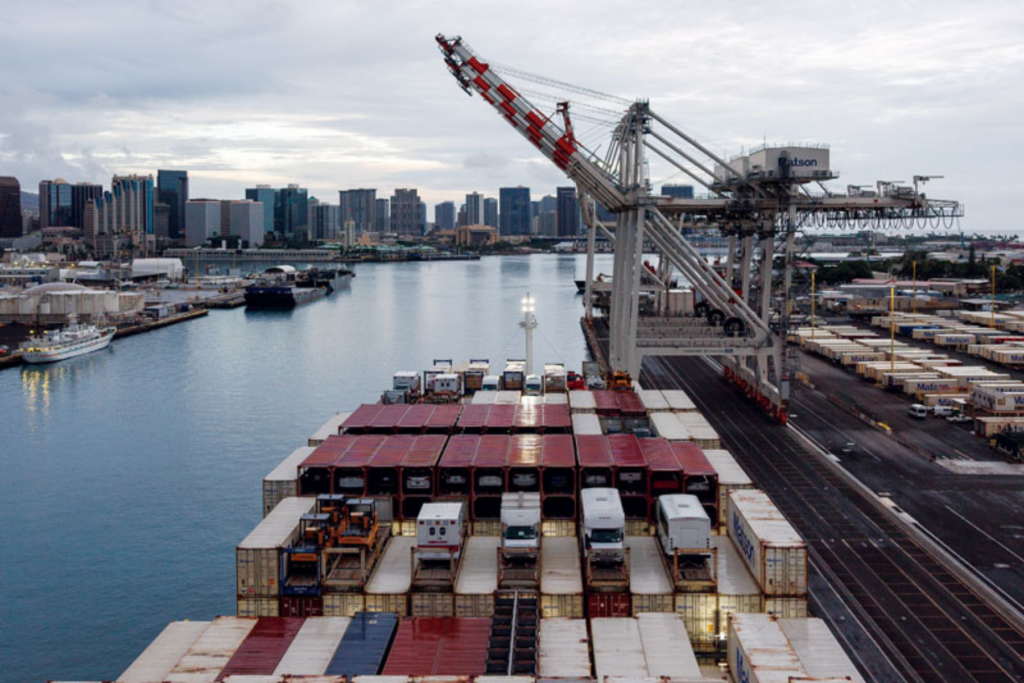
The Matsonia ship arrives at the company’s Sand Island terminal where hundreds of containers will be off-loaded for retailers to pick up.
When you reach for a product on a shelf of your neighborhood store, pause a moment to consider the journey that those shoes, or spices, or treadmills, or building materials or a myriad other large and small goods took to make your life convenient and better.
Most shipped goods arrive either by the Matson line or Pasha Hawaii just down the dock.
To help visualize a key part of that journey, Hawaii Business photographer Aaron Yoshino spent two days at the Sand Island terminal where the namesake Matsonia, one of Matson’s fleet of 20 ships, docked and unloaded its cargo after a four-day journey from Long Beach, California.
Yoshino’s photo essay over the following pages highlights the enormous scale of the machinery and equipment involved in bringing goods to Hawaiʻi. Pairing a photographer’s eye trained to capture poignant action with an artist’s appreciation for subtle lighting, framing and subject, Yoshino excels at his ability to bring a human touch to an industrial setting.

Left: Tug boats push the ship toward the dock where linesmen tie it up and prepare to hoist the metal gangplank stairway that allows crew to exit and gives laborers access to the containers. | Middle: Linesman waits for tugs to push the ship to the dock so tie lines can be thrown down to secure it. | Right: Orange-colored “spreader” dangling by cables is controlled by the crane operator who moves containers from the ship to awaiting trucks.
Once a ship arrives at port, Matson, the dominant shipping lifeline to the state and Hawaiʻi’s most profitable company for four years in a row – as well as the most charitable company for two years running – sets in motion an army of linesmen, laborers, semi-truck drivers, crane operators and others in a well-honed routine that unfolds like clockwork.
“What makes Hawaiʻi different from other ports is we don’t have lots of warehouses and distribution centers like on the mainland,” explains Keoni Wagner, Matson’s vice president of Corporate Communications. “So when the container comes off the ship, it’s loaded immediately onto a truck chassis, our guys wheel it around to a slot near the gate where customers – from big retailers to mom-and-pop outlets working through consolidators – come and pick it up to take to their stores.
“The whole thing is built for speed,” he says. “You’ve probably heard of ‘just-in-time delivery’. We call it ship-to-shelf.”
CHOREOGRAPHED SPECTACLE
Indeed, the process on a recent Sunday evening is a spectacle both graceful and surreal.
As a light breeze pushes humid air across Sand Island and as the last remnants of a sunset disperse into a spray of faded colors, nearly 200-foot-high cranes supported by thick steel columns come to life, crawling slowly down tracks toward the Matsonia ship that had been securely tied to the dock moments before.
The three cranes’ arms reach out across the top of the ship, poised like gargantuan praying mantises preparing to feast on the 20-, 40- and 45-foot cargo containers stacked on deck.
On the port’s apron below, part of Matson’s 107 acres that make up its Honolulu terminal, dozens of workers begin the process of removing nearly 1,000 containers as well as six floors of cars, trucks, boats and even a 124,000 pound crane from the ship, which extends the length of nearly three football fields.
Against the gigantic scale of the ship and towering cranes, workers below appear in a tightly choreographed Lilliputian routine that is performed on schedule three times a week as new ships arrive.

A view of the Matsonia’s cargo and downtown Honolulu from the wheelhouse.
The Matsonia, which came into port on a Sunday, is unloaded and reloaded by Monday and is back at sea and off to its next destination of Guam on early Tuesday morning. From Guam it will go to Okinawa, Japan, then Ningbo and Shanghai ports in China, and finally completing the cycle back at the Long Beach port in California, 35 days after it set off.
“You’ve got to keep things flowing,” says Gregory Chu, general manager of Container Operations – Hawaiʻi and the task master who coordinates departments to make sure everyone is aware of their roles and the timelines for the shore operation. If problems arise, he gets a call and puts the right people into action to solve them.
“Every morning, I meet with about 30 people, and we go through the schedule for the day, from the sales side to the vessel side to the terminal side,” Chu says. “They have to move in unison, because we’re trying to get [the containers] out as quickly as possible.”
Adds Alex Keaunui, Terminal Operations superintendent who was watching to make sure the transfer of refrigerated containers moved smoothly from the Matsonia to a barge set to leave for Maui: “There are milk and eggs in there, and it will go bad if we miss the transfer – so we don’t miss it.”

The three cranes’ arms reach out across the top of the ship, poised like gargantuan praying mantises preparing to feast on the 20-, 40- and 45-foot cargo containers stacked on deck.
PRECISION OPERATION
The first step in the process is a sight to behold. The transfer of 40-foot containers stacked four high on top of the deck, and more piled below deck, happens in mere minutes. Seated in a glass-bottom “cab” or cockpit suspended about 100 feet off the ground, the crane operator controls a spiderweb of cables that swing a “spreader” to hover above a container, locking hooks into the four corners.
The operator then lifts the container, maneuvers it over the dock below to a semi-trailer truck that has just arrived with precision timing, and lowers the container a hundred feet or so to the waiting chassis, exactly hitting the edges before unlocking the corners and climbing the spider wires back up to do it all over again. And again. And again.
The trucks then carry the containers to their assigned parking spots, or to a waiting barge, where they are loaded in the same process in reverse. Everyone wears hard hats and brightly-colored safety vests, and traffic lanes are kept clear for all of the massive moving metal.
“Everything is safety, safety, safety,” explains Kuʻuhaku Park, senior vice president of Government & Community Relations.
It wasn’t always done this way. Decades ago, ports were filled with legions of longshoremen – and they were all men – who unloaded ships’ cargoes piece by piece, a lengthy and expensive process. It wasn’t until the early 1970s that uniform-sized containers became ubiquitous and standardized the loading, storing and distribution of goods.
That “containerization” revolutionized the shipping industry and the entire supply-chain network, with a profound impact on price.
“It’s amazing that shipping 1,000 pounds of goods today costs far less than it did in the 1950s,” says Matsonia’s Captain Paul Schulman, who has been in the business for nearly 37 years and with Matson’s vessel business for 28 years.
Standing in the Wheelhouse, or the bridge where the ship’s controls are located, Schulman marvels at his role in the global supply chain. “If you think about it, it’s just a small part of this huge global multi-billion dollar network of goods moving around the world,” he says.
As Captain of the Matsonia, Schulman spends two 35-day “cycles” at sea, and then has the next 70 days off while his replacement captain takes the helm for the next two cycles.
“So, pretty much I’ve spent half my life at sea” for decades. It’s a lifestyle he admits is not suitable for everyone, but somehow he managed to raise two children with his wife, who also has a peripatetic schedule as an airline flight attendant. His son actually chose to follow in his father’s footsteps, becoming a “junior mate” with another shipping line.

Left: Harbor pilot Captain Nathan Silva is all smiles after he successfully brings the ship to dock. Harbor pilots board the ship off port and then pilot the vessel into the port, working with the ship’s bridge team and captain via VHF radios. | Middle: Matsonia Captain Paul Schulman looks out over the ship and its cargo from the bridge. He has spent nearly half his life at sea for decades and concludes: “It’s been a good career.” | Right: First mate Reece Reed tracks computer monitors to assist the captain throughout the voyage.
42,000-HORSEPOWER ENGINE
Schulman moves about the bridge with an air of confidence and pride as though he’s welcoming guests to his exotic home. He lets them pose for photos in his captain’s chair as they marvel at the radar dials and other instruments that keep the vessel safe once land is far off beyond the horizon.
“The main thing when we’re out at sea is not to hit anything,” he says with a nonchalance that belies the risks of mercurial ocean travel.
It seems an odd thing to say, with the vast expanse of the Pacific, which covers nearly a third of the Earth and almost half of the planet’s water surface. But even outside of busy ports there are objects out in the ocean that need to be avoided.
“We come across whales and we try to avoid them” even though they go where they want to go, Schulman says. Other ships show up on radar, of course, but there’s also debris in the ocean, especially after the Fukushima earthquake and tsunami in Japan, and an occasional boat in distress, causing ships in the area to divert to assist them.
Schulman said he once had to board a vessel that was adrift and had an SOS sign on it, but they arrived too late to help.
He won’t bring the subject up unprompted, but Schulman turns serious when asked about the dangers he and the crew of 24 face when the Pacific Ocean transforms from a relatively benign surface into mountains of uncaring waves. Even a ship the size of the Matsonia with its 42,000-horsepower engine can get buffeted as huge waves crash into it.
Although captains continually monitor weather conditions and steer through dangerous storms when possible, conditions can also change quickly.
“I know beforehand [when rough seas are ahead.] I alert the crew, and we strap everything down,” Schulman says with calm detachment. “We just have to suffer through it. Weather eventually moves away from you or subsides, but it can last days.”
On one voyage, Schulman recalls, they battled 36-foot waves. “My comfort level is up to about 6 meters (about 20 feet),” he says, as though one could get comfortable with that. “We make a very conscious effort to go around bad conditions when possible.”
Captains share information about sea conditions just like airline pilots relay air turbulence, and captains alert shore crew when diversions are necessary. Schulman also said he’s noticed that storms are getting worse and typhoons are covering ever larger patches of the ocean as a result of climate change, making it more difficult to divert around them.
“Most of the time it’s fine,” Schulman says, but adds the crew has to be prepared for weather extremes, including driving snowstorms on the route to Japan.
“It could be horrible weather, we’re just getting beat up, and I say to myself, there’s got to be a better way of making a living,” Schulman says in a moment of reflection, but adds that for the most part, “it’s been a wonderful career.”

Left: Vehicles stored in the ship’s cargo hold begin to “roll off” down a long metal ramp that is extended to the dock. Vehicles will be parked in the terminal area for auto dealerships and individuals to retrieve them. | Middle: A view from the captain’s chair: The small steering wheel controls the massive ship, and a bank of monitors and instruments assists in navigation. | Right: Lights keep the dock area aglow as night descends on the Matson terminal at Sand Island.
WOMEN MAKE INROADS
Although mariner jobs and stevedore and other terminal operation jobs have long been the domain of male employees, some women have taken up key roles, including as crane operators. Schulman says that during the last five voyages, between 1 and 3 women have been on board among his crew.
Another significant change within the last year or so is access to satellite communication that allows crew members not only to do email, banking and other business while at sea, but also to have video calls with family and friends, or to stream video programs. Each crew member has their own single-bedrooms, with private bathroom and shower, as well as a TV monitor.
“That’s been a real game-changer,” says Schulman about satellite access improving quality of life onboard ships during long voyages.
In early November, Matson reported 3rd quarter revenues were down 8 percent from a year ago and quarterly profit also fell on the year. The sector has been buffeted by global trade patterns affected by ever-shifting tariff threats from the Trump administration.
With year-end holidays approaching, freight loads have included goods that retailers have ordered to stock shelves ahead of Christmas. Soon containers with perishable Christmas trees will be added to the cargo holds.
“They come from Oregon, through the port in Tacoma, then down to Oakland and over to us,” says Chu. The number of live trees arriving in the Islands has declined in recent years, he says. People may be shifting to artificial trees, but those, too, would likely arrive by ship – from China.