Shaped By Motherhood, Groomed for the Workplace
How raising children strengthened their resilience and redefined the way these women show up in their careers. Profiles of two women in Hawaiʻi who found that parenting and family life were the superpower skills on their resumes
SIANA HUNT

Kapualei Ranch activity stressing importance of showing up for one another. Photo Courtesy: Hayden Ralmer
On a weekday afternoon in April 2011, Siana Hunt was trying to get ready for an event, make dinner and attend to her two young children while her husband Anthony was still at work. The phone rang. The caller ID showed CBRE, the commercial real estate and investment firm where he was employed. She picked up and yelled, “Are you kidding me? You haven’t even left the office yet?”
Only it wasn’t her husband. It was Ryan Sakaguchi, a CBRE vice president who is also the board chair for Make-A-Wish Foundation, asking if she would consider being interviewed for the foundation’s CEO position. Her immediate answer: “Thank you, but no.”
He asked her to hear him out.
Life was chaotic. She held a long-term substitute position at Punahou and ran a successful event planning company that often had her traveling to the East Coast. She was also an active board member for several nonprofits while raising two young children.
But the next day, as she drove by Kapiolani Hospital on her daily commute, she thought about the mothers inside who faced the unimaginable fear of losing their children, so she decided to hear what Sakaguchi had to say.
A SINGLE PURPOSE
At the interview, Hunt admitted, “I’m sorry, I don’t know anything about Make-A-Wish.” He responded, “That’s the problem.” Even though Make-A-Wish Hawaiʻi was the third chapter ever formed, and also one of the largest, it wasn’t well known. Sakaguchi asked where she saw herself in 5 years. She replied, “I’m going to be really honest with you. I see myself at home, making sure my teenage kids have a stable home environment. I am a mom first.”
But her life was about to pivot. It was as if all of her past experiences came together for this new, single purpose. She could merge her early-childhood education background, event planning experience and maternal heart, and turn it all into an organization. In this moment everything shifted: “God put this little ember in my heart, and oxygen got blown on this ember to a point where I couldn’t avoid it.”
So she said yes, but quickly realized transitioning into this new role would be a tremendous undertaking.

Hunt’s husband Anthony helps produce jingle rock run for supporters of “wish” families. Photo Courtesy: Landon Tsuda
ADJUSTMENTS FOR EVERYONE
Unable to get useful advice about being a CEO while juggling family responsibilities, she picked up the book, “You’re in Charge, Now What?” by Thomas J. Neff and James M. Citrin. She followed the guidelines it laid out: For the first 90 days, listen, take a lot of notes, and assess.
She told her family, “Just give me 90 days,” and in that time, she worked relentlessly. She missed after-school activities and every family dinner, many nights not leaving downtown until 3 a.m. She immersed herself in the organization to gain a deep understanding of its operations. She took the financials to a friend who was a CFO, asking for his help: “I can read these as numbers; they tell a story to you. Help me read the story.” And it quickly became evident how much work needed to be done. She reflects, “They were like, here’s the keys to the Ferrari. And I got sold a jalopy.”
Hunt followed the book and made her plan. On day 91, she began restructuring the entire team to support the scale and potential of Make-A-Wish Hawaiʻi. Her decision was rooted in accountability and care for the mission, ensuring the organization could honor every child it served.
She and her children struggled with her new role as CEO. She went from being class mom to missing all of her children’s school events. She vividly remembers the day her son forgot his binder and she told him she couldn’t bring it. He cried on the phone, and then she broke down.
SOME HEROES WEAR LIPSTICK
The morning car ride was where she shed one life and stepped into the next, her own version of Clark Kent’s phone booth. From her home to school drop-off, she was completely kid-focused. From school drop-off to downtown, she mentally transitioned to CEO (while putting on her makeup at stoplights).
Each night as she pulled into her driveway, she paused, taking slow breaths and gathering herself, knowing the day would begin all over again the moment she walked inside. She had to be fresh for her family because that’s what she gave everyone else. Her husband would meet her at the door with a glass of wine, she would start cooking dinner, and she would squeeze every ounce out of this time with her children.
Her initial three-year commitment turned into eight. At some point, she realized the only way her kids would get her undivided attention was for them to have a medically critical moment. With tears in her eyes, she said, “They were never going to get the best of me because the best of me was also being shared with the people who were going through the worst of times.”

Hunt’s daughter Ariana launches letter-writing campaigh for Macy’s Believe promotion at Christmas time. Photo Courtesy: Reid Shimabukuro
FACE DOWN IN THE SNOW
On a spring break trip with her family, she tore her ACL, MCL and LCL in a skiing accident. As she was lying face down in the snow, her first thought was that she didn’t have time for this. Three major events were on the horizon: World Wish Day, the Make-A-Wish Annual Gala and the May Day celebration, where her daughter would be crowned Queen. Now she had to figure out how to fit surgery into all of this. “What the hell am I doing?” she asked herself.
After postponing surgery for three months, she realized, “I was the change agent, and it was time for someone else to take it to the next place.” She wanted to be there for her family while still contributing to the community in which she felt so deeply rooted: “My family has called Hawaiʻi home for six generations, rooted in the land, culture and communities that shaped us. From ranching and stewardship to service and leadership, each generation has carried forward a deep sense of kuleana and connection to these islands.”
She was faced with a new opportunity. Barron Guss, ALTRES president and CEO, asked her to shape ALTRES’s mission for the next 50 years, and she couldn’t pass it up. He spoke candidly about Hawaiʻi’s leadership vacuum, a problem she knew well, having created the Young Leaders Board to address the very same gap. The new roles of Director of Corporate Philanthropy and Executive Director of the ALTRES Foundation offered an opportunity to leverage everything she learned at Make-A-Wish and apply it more broadly in service to Hawaiʻi’s nonprofit community. The job would also let her spend more time with her family. It was, in every way, the perfect match for her.

Hunt’s daughter Ariana helps make wishes come true at Bethany Hamilton surf camp. Photo Courtesy: Keith Ketchum
GROWTH LESSONS
Make-A-Wish Foundation achieved significant growth under Hunt’s leadership. In eight years, it went from three full-time staff to a combined staff and intern team of more than 65, achieving 40% growth in funding and wishes granted for four consecutive years.
Her journey was not without missteps. She chose to use these failures as teachable moments. As a verbal processor, she regularly invited her children into the conversation of challenges at work: “I screwed up today,” or “I blew this opportunity.” She wanted them to see failure as part of the process, that you have to work at something, and talent isn’t something you’re born with—it’s something you build.
For Hunt, career and motherhood have a symbiotic relationship. She believes motherhood has taught her tenacity she would never have gained without children: “You can’t give up because there are little beings that depend on you. So, when you face a hurdle, not getting over is just not an option. Because I’ve got to get home to my little guy, so I’ve got to get this done.”
Being a mother held her accountable at all times: “They’re watching how I communicate with a phone call. They’re watching how I interact with people in the community. They’re watching me when I go to the mailbox, and I’m dog tired, but a neighbor wants to talk about my day. These interactions inform how they’re going to interact in this world. I’m never going to ask my kids or my employees to do something I wasn’t also willing to do myself. That was a huge part of my authenticity in which I was approaching life.”
As her children neared college graduation, they called to say that they wanted to come home and work in Hawaiʻi. Her son, Aukina, felt compelled to take over the family ranch on Molokaʻi. “The transition has been meaningful but also clunky, painful and very real. Aukina has stepped up with the same grit and tenacity he comes from, especially after my father passed.” They’re figuring it out together as a family, one step at a time: “There is something really transformational about working in generations. The four of us, we do life as a team. And we love it.”
It’s clear that Hunt’s family will always be her greatest success and deepest legacy. The words she used years ago in her interview with Make-A-Wish still ring true. She will always be a mom first.
YUNJI DE NIES

On-set at PBS Hawai‘i hosting Kakou. Photo courtesy: PBS Hawai‘i
When Yunji de Nies was a young girl, her mother would not let her into the kitchen at all. She wasn’t allowed to cook or even wash a dish. She was constantly ushered away and told to go study instead. Her mother grew up in South Korea under martial law, and because she was a woman, college wasn’t an option for her. Since she wasn’t afforded that opportunity, she insisted on it for her daughter.
As the daughter of two immigrants, de Nies was the first native-born American in her family, and she absorbed her parents’ strong work ethic. A quotation she tacked to her corkboard in college was her mantra: “Busy as a bee, results as sweet as honey.”
After graduate school, she moved to New Orleans. A year later, in 2005, Hurricane Katrina caused the levees in New Orleans to break, flooding most of the city. Amid businesses shutting down, rampant looting, a communications collapse and food scarcity, de Nies was working as a TV reporter. She was suddenly doing regular live updates over the months as New Orleans slowly recovered. Circumstances forced her to learn her craft at a relentless speed.

De Nies with President Obama on Air Force One. Photo Courtesy: Charles Dharapak of the Associated Press
AN UNEXPECTED TRANSITION
Soon after, she accepted a position with ABC News in Washington, D.C., and she quickly rose to become a White House correspondent for Good Morning America. Even though she was only 27, because of her experience with Hurricane Katrina, she held her own among the veteran reporters and learned how to cover the White House in the final year of the George W. Bush administration. “So when Barack Obama came in, and suddenly, I was on television all the time, I’d at least had the reps.”
The hustle was real. She was working 80- to 90-hour weeks at a feverish pace. “In news, you’re only as good as your next story. No one rewinds the tape. As soon as you’ve done it, as soon as it airs, it’s over. It disappears.”
During a brief stint in Atlanta, the unthinkable happened. Her mother called from Hawaiʻi Island; her stepfather had been killed in a boating accident. Without hesitation, at the height of her career, she immediately moved home.
HOME IN THE ISLANDS
After navigating those difficult years, life slowly settled. She married and started a family. She was anchoring the 5 o’clock, 6 o’clock, and 10 o’clock news on KITV, working 2 p.m. to 11 p.m., when she had her daughter. She took the maximum maternity leave, three months, before returning to the studio. Luckily, her mother flew in from Hawaiʻi Island each week, staying from Monday to Friday to watch her daughter while she worked.
One evening, she was in a little office where she had the privacy to pump. While looking at a picture of her daughter and pumping, she was also answering emails and reading the newscast, and in that moment she knew, this is not it. “I am an all-in kind of worker,” she says. “I always have been, and suddenly I felt very torn, and I just couldn’t show up in the same way. It’s not that I couldn’t do the work. I still anchored the news. You’re still able to do it. But I felt distracted in both worlds.”
She also felt self-conscious of her body, having returned to the air and in the public eye just three months after giving birth. Although she wanted to be with her daughter, she was concerned about losing her identity: “So much of my identity was wrapped up in work. Who would I be if I wasn’t working?” she says.
THIS WAS NEVER THE PLAN
De Nies had envisioned pursuing her career the same way she did before children. But the realities hit differently now: “[Childcare] is so expensive, right? So, by the time I paid the person, paid taxes, and paid myself, it just didn’t make any sense. We put women in this impossible position where you’re saying, okay, if you want to work, you have to pay to keep working.”
At first, this transition was difficult. She felt unmoored. People approached her while her daughter was strapped to her chest, asking, “When are you coming back?” She admits it took time before she felt comfortable explaining that she was taking time to be with her children.
“I don’t think we value mothers in the same way we value professional achievement. Nobody puts that on a resume, but it should be on there.”
She found her footing, and the career shift allowed a return to what really mattered to her professionally: public affairs. De Nies now divides her time between four main projects: “INSIGHTS on PBS Hawaiʻi,” “KĀKOU: Hawaiʻi’s Town Hall,” “Spotlight Now with Ryan Kalei Tsuji,” and a new 10-episode series titled “A Leader’s Journey.”
CULTIVATING CURIOSITY
“In all of the work that I do, I’m really trying to create spaces for deeper connection and to cultivate a better understanding of politics and government, creating a conversation and a space for the audience to understand the levers and levels of power in our community,” de Nies says.
Asking questions is at the heart of her job, so she naturally wants to cultivate curiosity in her children: “I really want to let them ask as many [questions] as possible.” And she’ll often turn the questions back on them, asking, “Why are you asking me that? What are you curious about? What about that interests you?”
One way she satiates their need for knowledge is to take regular trips to the library, letting her children check out as many books as they can carry. She says that when their children ask, “Can you read me this book?” her husband will stop whatever he’s doing. The answer is always yes.

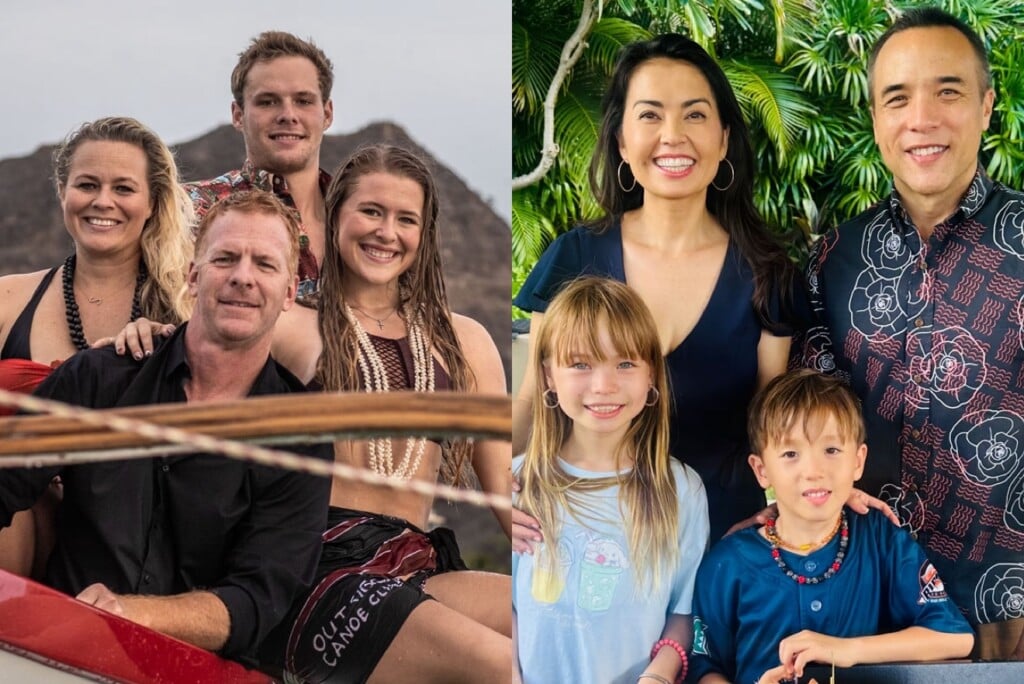
A recent photo of de Nies with her husband Kent and their kids, Kaya and Kenzo. Photo Courtesy: Yunji de Nies
PARENTHOOD, PRESENCE AND PURPOSE
She once asked a friend, a high-powered executive, about his secret to parenting. “He said, ‘I just showed up to everything.’ This sounded like a movie or something! When his son scanned the crowd, he would be there. And I thought, I want to do that too.” She wanted to show up for her children in a way that her parents didn’t have the luxury to do for her.
Although being a working mother inherently requires choice and sacrifice, de Nies feels it’s important for her children to see that she’s intellectually engaged with her own interests and that she cares about her community.
De Nies’s career has been shaped by family—her parents and her children—in unmistakable ways. She says with a laugh, “I feel like my heart tripled in size, right? It’s like the Grinch.” Raising her own children allowed her to gain a newfound appreciation for her parents, now better understanding their challenges and sacrifices. This empathy has also deepened her career as a journalist, approaching every story with a bigger heart, just like the Grinch’s when he realized the true meaning of Christmas.
“I’ve learned I’m pretty strong,” she says. “I think if you’re a mom, you could pretty much handle anything.”