Rekindling Ancient Hawaiians’ Sailing Skills Among Today’s Youth
Pua Ka ‘Ilima's charter sailing trips off Hawai‘i island's Kohala coastline help support educational voyages for island youth, teaching them about reefs, marine habitat and Hawai‘i's voyaging history.
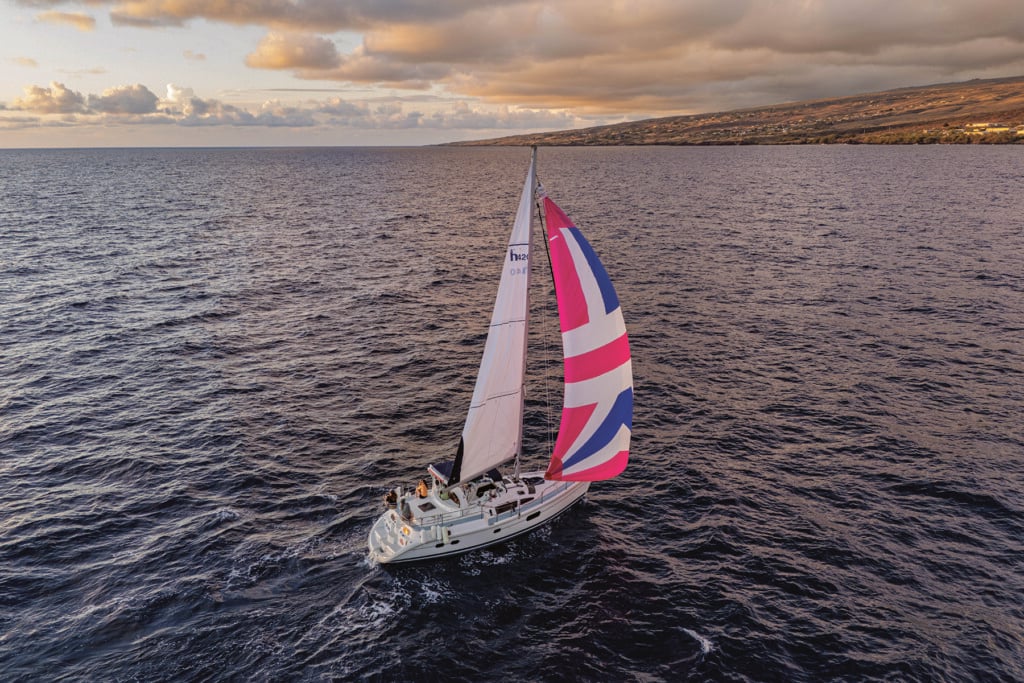
As the froth and churn of waves smack the sailboat’s hull, Captain Pablo cuts the engine on the 42-foot Pua, which suddenly tilts sharply to the port side under power of trade winds that fill two bulging sails. Five passengers, the captain and one crew member feel the sharp tug of nature’s harnessed energy as the sailboat slices through the brilliant blue waves off Hawaiʻi island’s Kohala Coast. Captain Pablo smiles broadly and looks out at the horizon. He’s been here a zillion times, and it never gets old.
“For me, it’s just a sense of freedom and a release of all the stresses and pressures that are going on in your daily life, relationships, work and all that,” says Pablo. His real name is Paul Allen, but in a playful nod to a maritime culture of seamen assuming nicknames, he transforms into his nom-de-bateau persona the moment he steps onto the boat.

Paul Allen, a.k.a. Captain Pablo, takes the helm and enjoys a sense of freedom when the winds fill the sails.
Pablo’s mission today is to run a Pua Ka ʻIlima charter excursion out of Kawaihae Harbor in South Kohala. Proceeds from these four-hour sailing trips help pay for the Kohala Sailing Foundation’s free Keiki Sailing Program for Big Island youth. The foundation coordinates with schools and nonprofit programs to connect youths ages 11 to 17 with the Hawaiian maritime heritage on the vast ocean that surrounds them. So far, more than 200 youths have taken part.
“Our mission is teaching sailing, seamanship and leadership while building personal, nature-connected relationships,” Allen explains. “Also, we’re introducing marine career paths and promoting environmental conservation and stewardship – really to build a relationship with the wind and the water.”
Despite Hawaiʻi’s long tradition of sailing and canoeing, many residents today have few opportunities to experience this link to their past. Allen, and foundation co-founder Captain Ralph Blancato, who has logged more than 62,000 blue water miles from Alaska to New Zealand, want to change that.
“Most of them are strong swimmers and have spent a lot of time in the water, but most have not sailed, which is a part of them we’re trying to awaken, especially for the Hawaiian kids,” says Allen. “A lot of them have lost that connection to sailing. Before motors, ancient Hawaiians, that’s how they got around. They paddled a lot in their canoes, but if they could sail, they sailed their canoes.”

On this voyage, crew member Jamie Nease turns the winch to raise the main sail.
Learning the Ropes
The keiki sailing excursions are not just leisurely pleasure trips, although there’s plenty of fun along the way. They learn first-hand about the art of sailing, the importance of marine and reef life around the Islands as well as rules to stay safe on the water. The excursions include specialists who teach the children about migratory whales and the importance of sharks to the marine environment. A UH marine scientist also talks about natural and manmade dangers to coral reefs around the archipelago.
As if on cue, while Allen is describing the program, a young Humpback whale surfaces about 100 yards away and repeatedly slaps its fin on the water surface.
“He’s giving us a high five,” Allen says, pausing, and the passengers silently observe as we glide past.
Each child takes turns driving the boat, trimming or grinding the sails. They learn to tie ropes that are critical to controlling the sails and securing the boat to the dock. They learn about the complicated mix of winds that are especially variable along this coastline due to trade wind eddies, katabatic winds racing down the sides of Kohala and Mauna Kea mountains, and the weather signs that might signal it’s time to head back to shore.
“We’ll go out a bit and look at the wind direction and strength, and I’ll ask the kids which way they think we should sail. We’ll talk about it, and I’ll have the kids come up with a plan.”
Some of those sessions are led by 21-year-old Ruby Mandini, who participated in the keiki program and is now helping the crew and also instructing the youths.
“I kind of direct them and show them what lines to pull” to raise or lower the sails, Mandini says. While the captains run the boat, “I run around and make everything move with the kids. Going over the parts of the boat, any knowledge I have with sailing, I’m always sharing it with the kids.
“I’ve grown up trying to learn a lot about the reef, the ocean and diving. When I get a chance, I try to teach them some reef educational things too,” supplemented by reef reference books on board.
Before they tie up to a buoy and go for a swim, Mandini gauges the youths’ knowledge and then teaches them something new. “I love the water portion of our sails, because we can put all that knowledge into effect, so when we jump in the water, I point out all of the things we were talking about and send them on a hunt to find their own fish.”
When Mandini is not at sea in her role as a deckhand, she works as a preschool teaching assistant, a land-based passion of hers. But she confides: “I want to always have a hand in being on the water.”
Eleven-year-old Ikaia Fuertes remembers his outing fondly because it was the first time he’d been on a sailboat. “I like sitting on the edge of the boat and letting my feet hang over the edge,” he recalls, although he says the ride got a little “bumpy” when it cut through the waves. “We got to jump off the side of the boat and go swimming too,” he says. “I saw yellow tangs and other fish.”
Although he’s been swimming in the ocean many times, the introduction to sailing left a lasting impression on Fuertes who says he’d like to go sailing again — and that’s one of the program’s goals.

Photo courtesy of Pua Ka ‘Ilima
Hawaiian Way Echoes Through Time
A connection to sailing traditions in the Islands goes back through the ages. Interest in Hawaiian sailing origins surged in the 1970s due to the efforts of the Polynesian Voyaging Society, which seeks to perpetuate the art and science of ancient Polynesian exploration.
“The canoes that brought the first Hawaiians to their island home had disappeared from earth. Cultural extinction felt dangerously close to many Hawaiians,” the society’s website states. It set out to recreate those vessels and launched the Hōkūleʻa, or Star of Gladness, a double-hulled sailing canoe that attracted global attention when its crew sailed in 1976 from Hawaiʻi to Tahiti using only the stars, currents and natural elements for navigation to complete the 2,600-mile voyage.
Since then, it has completed many other trips, confirming “revelations of how our ancestors navigated across the open ocean, found islands and settled Polynesia,” the society states.
Although the Pua is fully equipped with the latest instruments and is built with modern materials, the mission of the Kohala Sailing Foundation is sympathetic with that of the Polynesian Voyaging Society.
“We’re trying to teach the Hawaiian way,” Allen says. “Especially for the Hawaiian kids on the boat, it’s part of who you are. A lot of times when we experience things that are in our DNA but aren’t familiar to us in our lifetime, it can be awakened. If we can reach a couple kids that way, it’s really important.”

Photo Courtesy of Pua Ka ‘Ilima
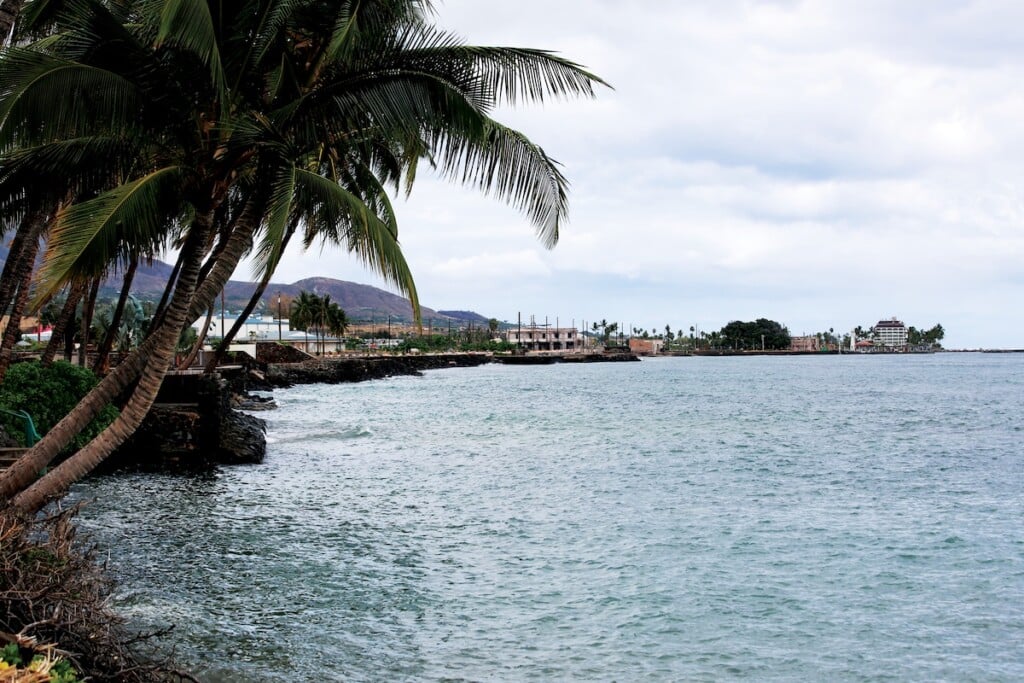
The Kohala Coast played an important role in Hawaiian history, and for many decades, water routes provided the main way to get from one place to another.
To the north of Kawaihae Harbor lies the former Hawaiian village of Lapakahi, now a state historical park featuring stone foundations and reconstructed wood and thatched structures used by the inhabitants of the ancient fishing village.
Allen explains that its location was determined by important geographical features that took into account prevailing trade winds that blew steadily, and sometimes hazardously, through the ʻAlenuihāhā Channel that separates Maui from Hawaiʻi island.
“Coming from Maui, you can sail the whole way to Lapakahi, but further this way, the wind drops off and gets shadowed because of the mountain, and you’ve got to paddle a lot more,” Allen explains. “So that place is really important for that, they could launch from there.”
As she turns the winch to let out the main sail, Pua crew member Jamie Nease relates her own love of the ocean and her deep respect for the variable winds and currents around the Hawaiian archipelago that can pose deadly risks to the untrained.
She formed the Wahine Makani Foundation, a nonprofit that promotes traditional Hawaiian sailing canoe racing for competitive women. The elite teams cross the state’s most challenging ocean channels, starting with the ʻAlenuihāhā Channel. “We cross every channel in the island chain, as well as partially circumnavigate each of the islands,” Nease says.

Photo Courtesy of Pua Ka ‘Ilima
Passing a Torch, and Skills
Allen’s passion for sailing started at an early age, and he wants to share that love with the next generation. It also helped him steer away from other temptations when he was younger.
“In my early 20s, I went down a pretty dark path, and I realized it was interfering with my sailing, and sailing was what I loved more than anything,” Allen recalls. “So, I just stopped hanging out with those people, stopped partying and all that stuff, and totally straightened myself out, all because of sailing. I feel really strongly about what an anchor it can be in your life.”
It’s a passion he wants to instill in others. At the first meeting with children in the keiki program, Allen asks about their prior water and boating experience.
“They’ll say, ‘I’m on the swim team, I’m a lifeguard, I’ve been paddling my whole life, I’m a free diver,’ and I say, ‘Okay, you guys are going to be the ones saving me if we get into trouble!’ Most are really strong swimmers.”
Others who haven’t been in the water or have less confidence are equipped with life jackets and are closely monitored.
Once the boat is moored at a buoy, the group splits into those who are more adventurous and want to snorkel and explore the reef with an adult guide, and others who jump off the boat into the water and stay a bit closer.

Deep connections are made with each keiki voyage. One group of youths from the nonprofit Kahua Paʻa Mua impressed Captain Pablo from the moment they showed up at the pier.
“Those kids were so cool,” he recalls. “They stood on the dock, all lined up, and gave a Hawaiian chant requesting permission to board the boat. And at the end, they lined up along the dock again and gave the thanksgiving chant to us. Those are the kinds of kids we’re trying to target: They’ve never been sailing, they haven’t been out on the water much, maybe on a fishing boat. Showing them a little bit about sailing, that you can get around this way, too, teaching them about the reef and things like that. It’s really important.”
Young or old, passengers share a universal thrill when the motor is shut off and the silent power of the wind takes hold, propelling the hull through the waves at exhilarating speed.
“I see it in people, their physical reaction when I turn off the motor,” Pablo says. “There’s a big exhale of relief and they go, ‘ahhh, that’s nice.’ It’s a feeling of peace.”
Pua Ka ʻIlima Team

Ruby Mandini, who graduated from the keiki program to become a deckhand, shares her knowledge of reef stewardship before the youths enter the water. Photo Courtesy of Pua Ka ‘Ilima.
Captain Pablo and Captain Ralph are joined by a small but dedicated number of crew members on their voyages. Allen’s wife, Lelja Bratovic, manages reservations for Pua Ka ʻIlima and the foundation, as well as payments, the website and other administrative duties. Bratovic juggles her work for Pua Ka ʻIlima with a career as a global conflict resolution mediator, including experience across five continents as co-founder and president of Global Majority, which promotes peaceful resolution of conflicts through education and dialogue.
Captain Pablo, too, has another life when he’s not taking out charter groups or keiki sails. He owns Four Winds Canvas and Shade LLC, and he’s a record-holding blue ocean racer. Several times a year, he flies to California or other locations for world-class competitions.
Among other records, he and his crew set the fastest time from Hawaiʻi to Yokohama, Japan, at seven and a half days in August 2023, cutting the prior record of about 13 days.
Captain Pablo’s intensely competitive spirit is masked behind a relaxed demeanor and cool confidence. No matter the urgency of quickly adjusting ropes to raise or lower sails, his ready smile and calm voice keep those around him focused on their duties. It’s a style that puts everyone on board at ease.

Photo courtesy of Pua Ka ‘Ilima
For keiki who feel the tug of sailing and want to get more practical experience, Allen directs them to a number of sailing clubs in Kona, Hilo and Kawaihae on the Big Island. He says the Waikiki Yacht Club on Oʻahu, among others, also have junior sailing programs.
“What I want to do – I have a lot of experience coaching and racing,” Allen says. “I want to take some of the kids who are a little more switched on to sailing, and start taking them out on small boats, like one-on-one or two kids.”
For those youths who catch the bug, there’s a lifetime of skills to hone, all while carrying on a tradition that brought Hawaiʻi’s first inhabitants to the Islands.
“It’s easy to enjoy,” Allen says, smiling and scanning the waves as the sails grab the wind. “You come out here on a warm day on a small boat, and you’re planing around and getting wet. That’s pretty fun.”
A Friend of the Reef Is a Friend of Mine
Sailors on the Pua also learn a little local history about a rock ‘n’ roll music legend’s love for Hawaiʻi. In the 1980s and ’90s, Jerry Garcia, the lead guitarist and vocalist of the Grateful Dead, was an avid scuba diver in Hawaiʻi, especially along this western coast of Hawaiʻi island, which he visited many times. During Garcia’s hundreds of dives, he observed the damage that was being done to coral reefs from boats dropping anchors.
He saw the potential of setting up a system of permanent moorings that dive, snorkel and sail charter boats could tie up to instead of dropping anchors that were repeatedly tearing into the coral reefs.
“I dive the reefs off the Kona Coast, and I see the damage that anchors can cause…some of the coral is so fragile that if you touch it, it breaks,” Garcia said in testimony at the Board of Land & Resources Penalty Hearing on Day Use Moorings in 1990.
“The only point of view that I have is the point of view of any other citizen of the United States. And I think you can do yourselves a favor and make Hawaiʻi look good and just approve this thing.”
The measure was approved by the state, and Garcia and the Grateful Dead made a “sizeable contribution” to get the mooring system started. Today, a statewide network of 220 moorings is managed by the Malama Kai Foundation in partnership with the Department of Land and Natural Resources.
“So, every time we tie up to the moorings, we say, ‘Thanks Uncle Jerry!'” Allen says, laughing.