Restoring Hope in Housing
Two pilot programs are helping Hawai‘i families overcome the financial barriers standing between them and a place to call home.
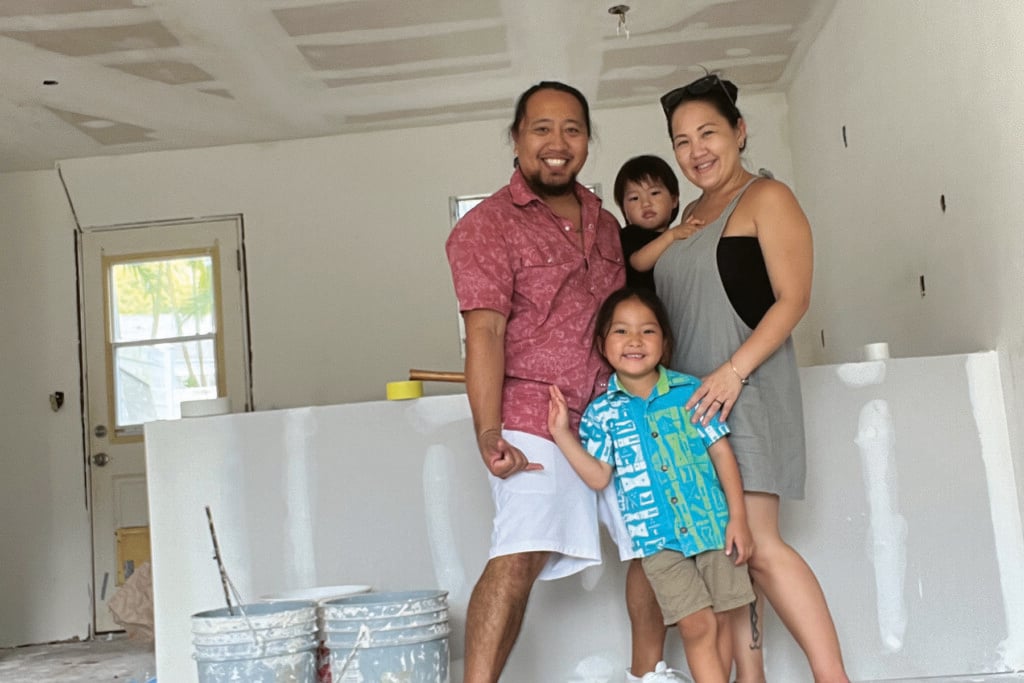
One evening last February, a single social media post stopped Dane Fujiwara mid-scroll. What he saw became the unexpected spark that would help him achieve a long-held dream that feels increasingly out of reach for many local families: homeownership in Hawaiʻi.
“I found the AHO program on social media late one night and the program hadn’t opened yet,” Fujiwara says.
Still in its pilot stage today, the Access to Home Ownership program is run through the Office of Hawaiian Affairs (OHA) partnership with American Savings Bank. Launched in early 2025, it aims to counter the growing outmigration of Native Hawaiians by removing key financial barriers to buying a home.
Although 61.6% of Hawaiʻi households owned their homes in 2024, Native Hawaiian ownership was lower, at 58.4% as of 2017. Meanwhile, Hawaiʻi’s median home value has climbed to nearly $808,200, a steep barrier for first-time buyers.
These market conditions limit Native Hawaiians’ options disproportionately. Instead of buying, they often rent or live in older, less secure housing, which undermines the stability, wealth accumulation and intergenerational security that come with homeownership.
“The major barriers to homeownership are the down payment and closing costs, income qualifying, and the monthly mortgage payment,” says Billy Pieper, American Savings Bank senior vice president of strategic partnerships.
AHO reduces the ongoing costs for new homeowners by using OHA-pledged funds to guarantee portions of a mortgage. Deposit-backed mortgages typically use funds from the homeowners’ savings or a relative’s savings as collateral, rather than just the home itself. But in this case, the OHA provides the collateral, and that eliminates the requirement for mortgage insurance payments, which are typically required for loans with low down payments. That cost reduction makes homeownership more attainable.
Fujiwara and his wife are both educators, and they and their two boys were living with family before finding a place to rent.
“We tried to do our best to save when we could and try to be ready. I think that there are so many people in similar situations as we are in who are just trying to make ends meet and live a simple life,” Dane Fujiwara says. “But reality here in Hawaiʻi is that it’s challenging for young Hawaiian families to raise their children here.”
The Fujiwaras’ previous attempts to buy a home failed.
“There are so many variables that go into purchasing a home. And unfortunately, we were really learning on the go with the different things that one needs to have to even prequalify for a loan. From gathering all the necessary documents and having them ready to present at the right time is time-consuming,” he says.

AHO PROVIDED A SOLUTION
In June, the Fujiwaras moved into their new home in Kāneʻohe. He credits OHA’s staff with guiding them through each step and their loan officer at American Savings Bank, who helped them navigate the loan process.
Nearly 20 Native Hawaiian families statewide purchased homes through AHO in its first nine months.
“We chose the name AHO intentionally,” says Poni Askew, OHA director of economic and business resilience. “In Hawaiian, aho means cordage — the strong, flexible line that binds a traditional hale together. It’s what gives structure, resilience and connection to a home. In that same way, this program serves as the cord that helps Native Hawaiian families anchor themselves to place, to ʻāina, and to future generations.”
AHO is structured as a revolving program, which means the money that supports one participant’s mortgage is eventually put back into the AHO fund to support other homebuyers.
That happens when a borrower pays down their mortgage to the point where the mortgage’s remaining principal is 80% or less of the house’s assessed value. “(Then) OHA’s deposit tied to that loan becomes unencumbered and is released back into the pool to support the next family,” Askew explains.

WHILE AHO OPENS DOORS TO HOMEOWNERSHIP, ANOTHER PILOT PROGRAM HELPS RENTERS.
Aloha United Way’s 211 helpline is a statewide connector, linking residents and organizations to resources that strengthen health, education and financial stability. The line is dominated by housing-related calls.
“We started thinking, what part can 211 play in really finding a way for folks to access housing or to move the needle along this big thing,” says Jennifer Pecher, AUW vice president of 211 community response programs.
Affordable housing is a challenge nationwide, however, Hawaiʻi’s needs are greater than anywhere else, says Nora Guerra, senior vice president of community lending solutions at Guild Mortgage Co., a national mortgage lender that specializes in residential home loans.
“In many states — California, Texas or Washington — families struggle with the cost of entry into homeownership due to rising prices and limited supply,” Guerra says. “Yet, Hawaiʻi stands apart because 40% of households live below the ALICE threshold,” which refers to families that are asset limited, income constrained, and employed. That means they have little or no savings and live from paycheck to paycheck even though the adults in the household may be working multiple jobs. One major car repair or lost job can lead to eviction and even homelessness.
In coming up with strategies for Hawaiʻi homebuyers, Guerra has looked at numerous housing studies from the state’s Department of Business, Economic Development & Tourism, the Holomua Collective and the University of Hawaiʻi Economic Research Organization.
“While the working-age population is flat, multigenerational and co-buying models are growing, signaling a shift in how families are redefining ownership,” Guerra notes. “Rather than giving up, people are finding new ways to sustain stability by pooling resources, building ADUs (accessory dwelling units) and prioritizing flexibility.”
AUW helps clients seeking attainable housing at all levels, whether they’re looking to own or rent, so they don’t move to the mainland.
“This is the big goal that we all have and that is to get people into homes, to get people to stay here, to keep our people here,” Pecher says.

Both buying a home and finding a rental can take a lot of time. Add to that the strain of learning about and navigating all the steps and requirements. Recognizing this challenge, AUW developed an affordable properties pilot program to match clients with housing options based on their incomes and the area median income (AMI) in their neighborhood. 211 works with Hawaiʻi Affordable Housing Properties, a property management company.
Pecher says many callers are unaware that they might qualify for affordable rentals. To find out, 211 begins with data collection: household size, income, contact information. “At that point, our system will generate their AMI, and pull up qualifying property records,” Pecher adds.
AUW’s program pre-screens clients before referring them to specific properties. Once a client matches with a property, 211 doesn’t stop its support.
“It’s kind of what happens on the back end that’s really important with this program, and that is the follow-up,” notes Pecher. “We have the ability and the capacity to call the client back. And then we’re able to mitigate any kind of barriers.”
Pecher hopes AUW can eventually be a one-stop shop for affordable rental housing information. In the meantime, AUW is collecting feedback from clients who have received help from the pilot program to identify any “pukas.”
“It’s our way of not letting folks fall through the cracks,” she says.
AUW also hopes to expand its platform into a Hawaiʻi affordable housing resource portal, where people can easily access state, county and other housing assistance programs.
“We need the inventory in the system, and then we also need the funding to build the ramp to get there,” Pecher says.
AUW is also in discussions with the state’s Hawaiʻi Housing Finance & Development Corp. to build a universal rental application, which would significantly streamline the process for thousands looking to rent.
AUW President & CEO Michelle Bartell believes that both pilots are examples of creative solutions designed to restore hope in housing through greater access. “And they are programs that can be replicated and scaled for even greater impact,” Bartell added.
“What’s meaningful about AHO is that it’s not charity; it’s a practical solution built on shared responsibility,” Askew notes.
“There is no silver bullet to solving the out-migration crisis but that’s no excuse to stop trying,” Pieper adds.
And for families like the Fujiwaras, these innovations aren’t abstract. They’re the difference between staying in Hawaiʻi or being pushed away.