Report confirms on-shore fishermen catch a lot of fish
Researchers confirm those guys with the fishing poles on the shore are collectively catching a lot of fish
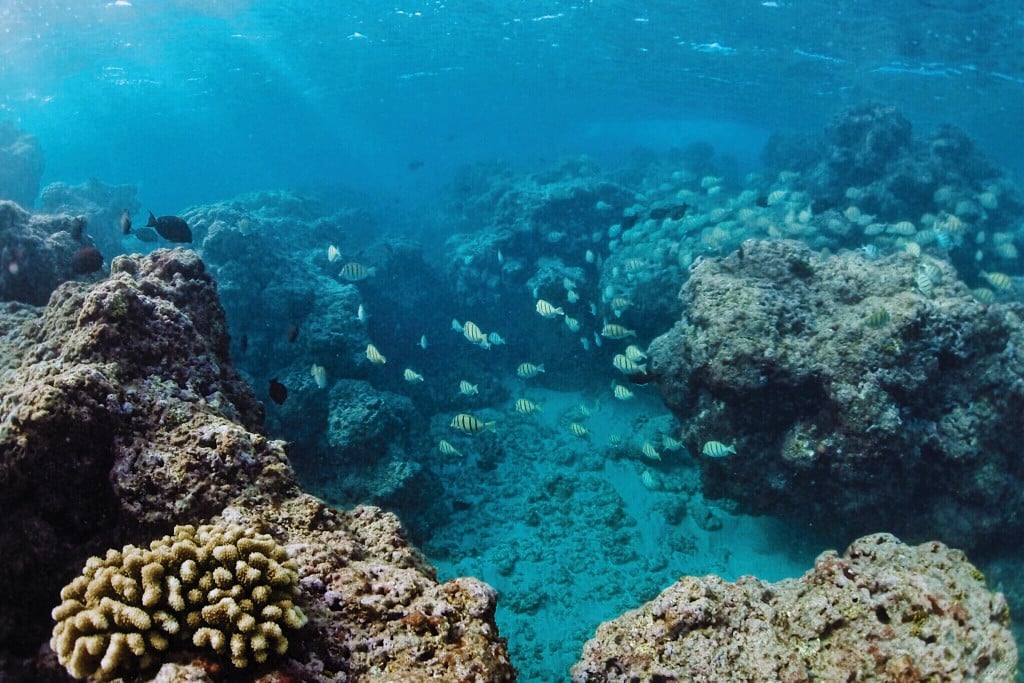
A new study calculates the economic value of Hawaii’s shoreline fishery, and it’s not manini.
In terms of food value alone – researchers looked at fish caught for consumption, not tourism or aquarium collecting – Hawaii’s reefs are worth around $10 million to $16 million a year. The big surprise: Most of that value is generated by so-called “recreational” fishermen.
“What’s interesting is that the most prevalent supply chain in these reefs is the short trip from the fisherman or the fisherwoman right to their home plate,” says Jack Kittinger, a marine scientist with Conservation International in Honolulu and a co-author of the study. “Despite us being a developed economy in the United States, that tradition of going to the sea to feed yourself is still quite common here, and we can’t let that get lost in terms of the value it provides.”
The researchers combined state and federal catch data with a value-chain assessment to quantify the dollar value of the fishery. While the deep-water fishing industry around the islands has been well studied, this is the first time researchers have estimated the economic impact of all the rod-and-reel, throw-net, spearfishing and gathering activity along Hawaii’s shorelines and in its coral reefs. The researchers also used interviews to report some of the “services” provided by the fishery that are harder to quantify – such as recreation, the value of practicing a cultural tradition and time spent with family.
“We tried to express the value of the fishery in multiple ways, because different people value it in different data sets,” says Kirsten Oleson, an ecological economist at UH and a co-author of the study. “For some it’s the value-added, for some it’s food and for some it’s that they get to go fishing with their grandchild and share the knowledge that their grandparents shared with them.”
The paper was published Aug. 3, 2017, in the scientific journal PLOS ONE.
According to the research, commercial fishermen land around 1.1 million pounds of fish annually, generating $3 million in value. But the noncommercial catch is three times that amount: an estimated 3.3 million pounds. That’s worth between $7 million and $13 million – depending on whether you count the seafood’s landing or market value – that ends up being traded, shared or simply brought straight home for dinner. Recreational fishermen also harvested a much wider variety of species.
The researchers found that reefs are important to Hawaii’s food security, providing an estimated 7 million meals per year. That was a surprise to Kittinger. “Yeah, the number of meals, jeez,” he says. “The number of meals is almost equivalent to the number of tourists we get each year.” Around 5 million of those meals come from recreational fishermen.
The data used in the study “existed in bits and pieces,” and researchers pulled it together from different sources to get a complete picture, says Shanna Grafeld, an ecological economist at UH Mānoa and lead author of the study. “Looking at the totality had not been done before,” she says.
To estimate the total catch, they used commercial fishing data from the state Division of Aquatic Resources, voluntary purchase reports by fish traders and local survey data on noncommercial fishing from NOAA’s Marine Recreational Information. Then they tracked the flow of fish from catch to consumption, assessing its monetary and nonmonetary value at every step.
“This is the first time it’s been done in Hawaii,” Kittinger says. “And it’s probably the most comprehensive study of its kind in coral reefs on the planet – and believe me, we looked.”
Another tasty data set: a small but robust “cooler trade” in reef fish imported from elsewhere in the Pacific. Researchers surveyed passengers arriving from Pacific islands at Inouye International Airport in Honolulu and looked for travelers with coolers. Based on voluntary interviews, they estimate that around 82,000 pounds of reef fish are imported each year, or 1.8 percent of the local catch, of which around 51,000 pounds is carried as luggage by passengers on commercial flights from Micronesia. During holiday and graduation seasons, they found the import of Pacific reef fish increased by 25 percent.
By searching more than 2,000 customer photos and reviews on sites such as Yelp, they also found evidence of Hawaii reef fish being sold at fishmarkets on the Mainland, but didn’t have enough data to quantify the export. “We kind of scratched the surface of that in this project, but that whole undocumented import and export of reef fish all around the Pacific and from Hawaii to the Mainland is something I’d like to do more work on in the future,” Grafeld says.
Russell Sparks, an aquatic biologist at the Department of Land and Natural Resources Division of Aquatic Resources on Maui, who was not involved with the study, says he’s not surprised that recreational fishing far exceeded the commercial catch. The study points to the importance of working closely with communities at the local, grass-roots level to manage coral reefs and keep them healthy for the future.
“The commercial harvest of nearshore resources is actually fairly small,” he says. “The bigger issue is the noncommercial use, and the importance for residents, communities, the cultural value, the sharing value, the subsistence value. To highlight that, I think, is important.”
Matt Ramsey, Hawaii director of Conservation International, says he hoped that by assessing the fishery’s value, the study could help inform future management decisions by both policymakers and the public.
“What I hope comes from this is that people see perspectives they may not have been aware of,” he says. “A fisherman loves to fish, but he may not think, ‘Hey, I’m contributing to the economy,’ or, ‘I’m having this positive impact.’ And for people who don’t fish, I hope they see that fishing is not only an impact on the resources, but it’s also actually a benefit if it’s done properly.”