Honoluluʻs Homeless Crisis May Be at a Tipping Point
An ambitious interagency push aims to dramatically expand housing and homeless services and help unsheltered people move off the streets.
On a late June morning on North Hotel Street in Honolulu’s Chinatown, until recently the epicenter of the state’s homeless crisis, a 67-year-old homeless woman is being eased onto an ambulance cot stretcher. Her lower legs are mottled with cellulitis, a bacterial skin infection that can turn into sepsis without antibiotic treatment.
Robert Lau, an emergency medical technician with CORE, the homeless outreach unit of the Honolulu Emergency Medical Services, talks with her as he gently slides her into the back of the vehicle. She’s heading to a free clinic in Iwilei, the Hawaii H.O.M.E. Project, which is run by supervised students at UH’s John A. Burns School of Medicine. “We try to be patient, welcoming and reassuring,” says Lau, who joined the team in 2024.
About half a dozen members of CORE, which stands for crisis outreach response and engagement, and a similar number of Honolulu police officers trained in crisis intervention, are spending several hours in the historic district coaxing unsheltered people into facilities with medical care. It’s a large group of uniformed officials, but they’re purposefully unintimidating, moving on foot in an unhurried manner. Their vehicles are parked nearby, with lights off.
Near the intersection of Hotel Street and Nuʻuanu Avenue, several team members are working with two homeless people, both agitated. One is a 38-year-old man, shirtless, in grey nylon pants. He’s tugging at the stretchy fabric and making jerking motions, while June Sua, a CORE field supervisor, talks with him. Soon they’re chuckling together, though his speech is hard to comprehend.
Across the street, another 38-year-old homeless person, a woman, is shouting and gesturing wildly. She’s clearly unwell, though it’s less clear from what. She has no identification and isn’t known to the group, but some of the CORE members think methamphetamine use could be driving her erratic behavior. The highly addictive drug is prevalent on the streets, says James Ireland, the director of the Honolulu Emergency Services Department and a medical doctor.
Ireland writes up an MH-3 form that allows them to transport her for an involuntary psychiatric evaluation. The CORE team assures her that she isn’t in trouble, but she’s also not free to go. She’ll be sent to the state Department of Health’s Behavioral Health Crisis Center on Iwilei Road, a new facility that opened in 2024 as part of a coordinated state and city effort to get unsheltered people the help they need, and to relieve pressure on the psychiatric units at The Queen’s Medical Center and Adventist Health Castle. Nearly half of Oʻahu’s homeless population is unsheltered, which is linked to devastating physical and mental-health consequences, high costs borne by individuals, local communities and state resources.
The woman seems to accept this and calmly enters the emergency vehicle, where a paramedic and emergency medical technician take her vitals. Most patients are given an anti-psychotic pill that dissolves under their tongue to help them calm down, says Ireland.
By late June, about 70 people had been sent to evaluations through the MH-3 program, which rolled out in January after the passage of Act 219 in 2025. Similar to law enforcement’s MH-1 program, the new law gives CORE a mechanism for compelling people to be evaluated when they’re a danger to themselves or others due to suspected mental illness or substance abuse, says Ireland. Without it, he says, their work had been hobbled because most people with severe mental illness say they don’t need help.
About an hour after the woman’s first contact with the CORE and HPD crisis-intervention teams, the emergency vehicle leaves for the crisis center, followed by a police car to make sure she doesn’t try to bolt. For the 10% who don’t go willingly, they’re handcuffed and transported by police car, with a medical vehicle in tow. No one has violently resisted so far, says Ireland.
Once there, she’ll be held for up to 24 hours while being evaluated and stabilized, and as staff searches for an appropriate place to send her next. Ireland says she might go to the Institute for Human Services’ shelter for women and children in Iwilei, the county’s HONU mobile triage shelter in Kapolei, or one of the new kauhale villages launched by the state.
“They try to find somewhere that’s not North Hotel Street,” says Ireland. He’s been frustrated to see people released back into the streets once the drugs wear off, only to be re-transported for evaluation when they’re using again. To break the cycle, Ireland is trying to get facilities to notify CORE when a patient is ready to be transported to their next destination.
Meanwhile, the shirtless man, who has been talking with Sua and a number of police officers for about half an hour, is now walking on his own toward the CORE medical van. A background check shows he suffers from a “triple whammy” of drug addiction, mental-health issues and a traumatic head injury, says Ireland.
As he lies down in the van, his lower legs are exposed, showing deep, infected wounds. Injuries like this are common, says Ireland, and dangerous too. Untreated, they can lead to amputation, which qualifies as an “imminent” danger to himself, legally defined as 45 days. The vehicle soon takes him for treatment at The Queen’s Medical Center on Punchbowl Street.
From there, he’ll probably transition to the HONU triage center, where he can stay for several weeks until more stable housing is located. For the shirtless man, Ireland thinks that could be an adult residential care home, which are small group homes regulated by the state Department of Health, or, more likely, adult foster care in a residential home, which is a program run by the state Department of Human Services.

CORE members prepare to transport a 67-year-old woman for medical treatment. Photo: Cynthia Wessendorf
“A WIN WITH AN EXCLAMATION POINT”
By late morning, the CORE and crisis-intervention teams begin heading toward Bishop Street, where the downtown lunch crowd is filling the sidewalks. A 73-year-old man in a wheelchair and a 38-year-old woman are sitting under the shade of an overhang. Neither is behaving erratically, but she has soiled herself and needs help. Both have hospital bands on their wrists from a recent visit to an emergency room.
Sua gets on the phone to try to secure two beds, as the pair say they’ll only go together. She hits the jackpot, as two are newly free at the Leʻahi Behavioral and Medical Respite, a 24-bed section of Leahi Hospital. The unit opened in 2024 through a collaboration among city and state agencies and the service provider North Shore Mental Health.
The CORE team helps them into a vehicle, where they’ll first stop at the crisis center so she can shower and change clothes, and both will be screened for Covid and tuberculosis. Staff from the medical respite will then drive them to the Kaimuki facility.
“This is a win with an exclamation point,” says Ireland. “It’s worth the extra time. These are high utilizers of ER,” an expensive option that’s ill-suited for providing the ongoing care and services that many unsheltered people need. Medical respite is a comfortable place to recover physically and mentally, and a crucial step on the route to stable housing.
Shortly after noon, the team continues walking through Chinatown, searching for a well-known resident with severe schizophrenia and a history of exposing herself. Ireland holds photocopies of others to search for as well, though the streets have far fewer homeless people than in the recent past, when hundreds roamed and slept in the district, many drawn to the River of Life Mission’s now-disbanded meal program.
At the end of the four-hour shift in Chinatown, six people have been moved from the streets into facilities with medical care and a raft of social services. Three were willingly transported, and three were legally required to go using the MH-3 pilot program. Before the program started, only one of every 20 to 30 people at risk of harm would accept services, says Ireland.
To be sure, not all homeless people suffer from substance abuse or mental illness. In fact, a majority in the most recent count lost their homes because of job loss, other economic hardship or unaffordable rent.

CORE members and HPD officers trained in crisis intervention persuade a homeless man to accept assistance. Photo: Cynthia Wessendorf
COLLABORATION BRINGS NEW APPROACHES
Involuntary interventions such as the MH-3 program are on the rise nationally, and they can be controversial. One study found dramatic differences in the frequency of involuntary psychiatric holds across 25 states from 2011 to 2018. At the low end was Connecticut, with 29 admissions per 100,000 people. In contrast, Florida had 966 admissions per 100,000 people, pointing to a potentially overzealous application of state law.
In Hawaiʻi, as in Florida, homeless people sent for evaluation by CORE must be released in less than 24 hours if they’re deemed safe, though physicians can impose a longer involuntary hold. The consensus among the state’s homelessness leaders is that it’s not an abuse of their civil rights; instead, leaving them on the streets, “screaming at the sun and walking in traffic,” as Ireland puts it, is the abusive move.
“These are individuals who are now able to access the medical care that they need, so they can clearly make decisions in their best interests. Before, their mental illness drove them to have a hard time making these next decisions,” says Jun Yang, the coordinator of the Statewide Office on Homelessness and Housing Solutions, which manages the state’s Kauhale Initiative.
Connie Mitchell, the executive director of the Institute for Human Services (IHS), points to the legal doctrine of parens patriae, meaning “parent of the country,” which allows the state to act as a guardian for minors and adults who are unable to help themselves. Using family court, her organization has legally compelled people to seek treatment for mental-health or substance-abuse issues that threaten to imminently harm themselves or others.
In September, CORE’s MH-3 pilot program became permanent. The team will begin methodically rotating across Oʻahu’s eight police districts, while also focusing on spots where the homeless congregate, says Ireland. CORE operates during the daylight hours of 7 a.m. to 7 p.m., when most shelters take admissions, and handles an average of 239 calls or requests each month, according to EMS spokesperson Shayne Enright.
“Our focus is on helping the homeless,” Ireland says, “but we also understand that the community has a right to feel safe in their neighborhoods. They have a right to feel safe at beach parks. Businesses have a right to conduct their business unimpeded.”
He hopes to hire more medical professionals who can legally send people for evaluation, and the HPD crisis-intervention team that accompanies CORE is hoping for more dedicated staffing, says Corbin Matsumoto, a sergeant and head of the department’s new crisis-intervention team. He’s also trained about 300 officers in understanding mental illness and using de-escalation tactics in crisis situations.
“There used to be a heavy enforcement attitude toward homeless individuals,” says Matsumoto. “With de-escalation, we’re trying to be empathetic toward that person’s situation. Even if they’re yelling at us, we’ll say, ‘I see that you’re upset. I want to talk to you and know your situation and how we can help.’” That gentler script has resulted in more people accepting services or housing, or more likely to agree the next time, he says.
This collaboration among medical, outreach and law enforcement professionals is one piece of the city and state’s ambitious response to the homeless crisis, an effort that accelerated after Honolulu Mayor Rick Blangiardi took office in January 2021, followed by Gov. Josh Green in December 2022.
“They both had the same agenda, which is homelessness and affordable housing. They’ve made their voices heard, and they’ve been incredibly involved. I’ve never seen this level of collaboration between the city and the state before on this issue,” says Laura E. Thielen, the executive director of Partners in Care, a coalition of nonprofits, government agencies and community advocates working to help the homeless.
The coordinated approach has led to the sharing of funding, personnel and public land. It’s led to nearly a thousand kauhale units in 26 villages being built across the Islands. Hundreds of police officers have been trained in crisis intervention. Medical respites for the homeless and a behavioral-health crisis center have opened, and the CORE team is set to expand its reach.
Aiding the effort every day are hundreds of social workers, who HPD’s Matsumoto says “are braver than us,” fanning out into the streets and shelters to connect people to a complex web of services for stabilizing, treating, housing, training and even repatriating Hawaiʻi’s homeless population, all with their own complex needs.

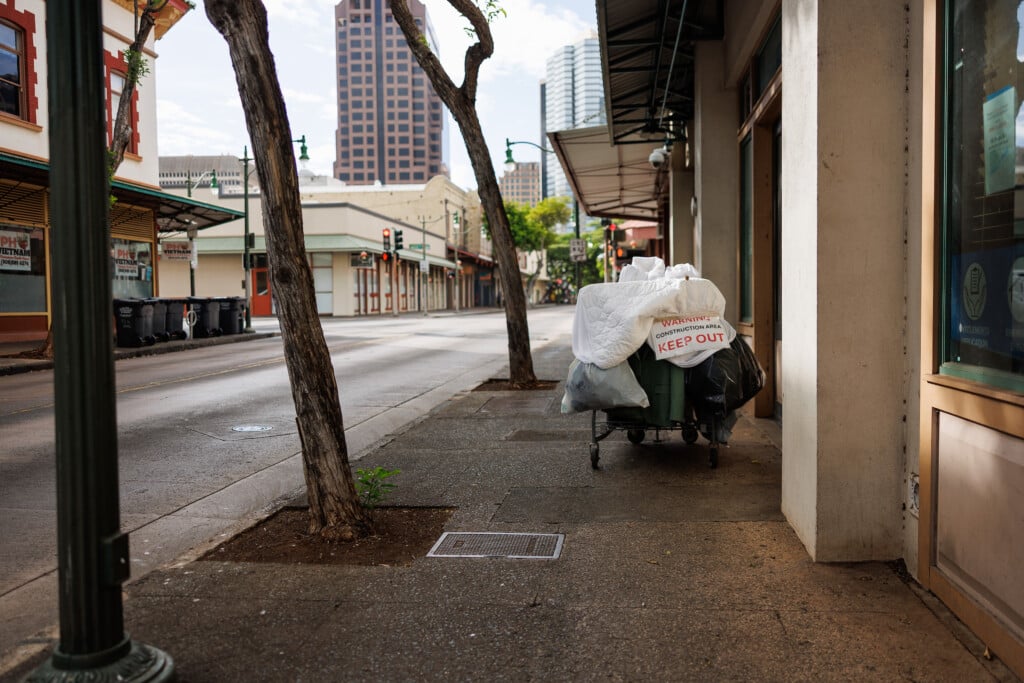
A lone, neatly arranged collection of possessions remains on North Hotel Street. Photo: Aaron Yoshino
UNSHELTERED NUMBERS SHIFT
Hawaiʻi’s homeless crisis has plagued the state for years, particularly in Honolulu, where a growing unsheltered population has triggered waves of angst, anger and some performative vigilantism. In 2013, a state lawmaker made national news by repeatedly sledgehammering run-down shopping carts abandoned in Waikīkī by homeless people.
In 2014, Honolulu’s first sit-lie ban was enacted, which initially covered Waikīkī sidewalks but quickly expanded to storefronts and commercial districts around Oʻahu. Encampments were dismantled and possessions crushed in garbage trucks, while homeless numbers kept rising. At the same time, another insidious trend developed: the number of unsheltered people began to increase while the number in shelters dwindled.
By 2016, huge encampments filled the streets of Kakaʻako, dozens of tents lined up inches away from the Kalaniana’ole Highway in Waimānalo, and hundreds of people had set up makeshift structures at the Waiʻanae boat harbor. Video footage from the Associated Press shows the tragic situation, as Hawaiʻi’s high housing costs and low wages reached a breaking point. (bit.ly/3T4P2xB)
Oʻahu’s homeless numbers peaked in 2017, at 4,959 people, with nearly half living unsheltered, based on a federally mandated point-in-time count, which is widely viewed as an undercount. The point-in-time count happens on a single day in January and serves as a baseline for funding decisions. On Oʻahu, the count is overseen by Partners in Care, and on the Neighbor Islands by Bridging The Gap Hawaii.
Two years later, in 2019, the percentage of people who were unsheltered overtook the percentage residing in shelters, a trend that reached a high point in 2024. In the count that year, 4,494 people were counted as homeless, with just 1,728 in shelters and 2,766 unsheltered, or 62% of all homeless people.
The dire situation had already prompted newly elected Gov. Green to issue an emergency proclamation on homelessness in January 2023, leading to the launch of the Kauhale Initiative, which are villages of tiny homes built on public land. The initiative has sidestepped much of Hawaiʻi’s slow, often dysfunctional regulatory environment in the interest of speed and results after years of stasis.
“I couldn’t sit still when everybody across the state tells me homelessness had to be addressed. That’s why I’m taking aggressive, deliberate action, week after week,” says Green, in an interview. “I’m not going to wait while the problem continues to hurt us.”
By the 2026 count, those efforts were paying off. Hawaiʻi still has one of the highest per capita homeless rates in the nation, an estimated 6,402 people across the Islands among a total population of about 1,432,820, or 0.45% homeless. On Oʻahu, where 70% of the homeless live, the total number ticked up 1% from 2024, to 4,539, but fell by 2% on the Neighbor Islands.
But encouraging news emerged as well. For the first time since 2018, the number of sheltered people, at 2,331, exceeded the unsheltered population, at 2,208. Far more homeless people than in the recent past have a place to stay rather than living rough on sidewalks, in brush land or in their cars, ducking out of sight.
The demographics of the homeless population have also shifted, and not all for the better. Among unsheltered people who were interviewed in the 2026 point-in-time count, 63% said economic hardship such as job loss and unaffordable rent pushed them into homelessness. These financial challenges were overlain with disabling conditions, mental health issues, chronic physical illness, substance abuse, which 60% cited as contributing factors of homelessness, or 5% more than in 2024.
“There’s a lot of folks who obviously have a severe mental illness or a drug-use issue, or both, so it’s a different type of person who is experiencing homelessness,” says Thielen, comparing the situation now to her earlier years as an outreach worker.
Many are older and sicker, with some showing signs of advanced dementia, says Ireland. In the 2026 Oʻahu count, 698 were kūpuna aged 60 and up, a 45% increase in total numbers in just two years. At the opposite age range, the number of homeless keiki rose 24%, and the number of adults and children living as families rose 19% since 2024.
Native Hawaiians are disproportionately represented in the Oʻahu homeless count, at about 31%, and 33% of all unsheltered, chronically homeless individuals surveyed live in the West Side district stretching from the tip of Kaʻena Point down to Kapolei.
The point-in-time count also includes a steady stream of newcomers, mostly from the continent, who fly to Hawaiʻi and fall into homelessness. Mitchell of the IHS runs a state-funded repatriation program that helped return 121 people in just the first six months of 2026. Each year, roughly 500 out-of-state people become homeless, about half of whom are repatriated. The program ensures there’s support back home so they won’t end up homeless again, she says.
The constellation of challenges facing the homeless population, and the constant flow of people falling into homelessness, from lost income, eviction, mental illness, prolonged drug use or just the romantic notion that paradise awaits at the end of a one-way flight, makes the need for intensive services and housing innovations more urgent than ever.

According to the annual point-in-time count, Oʻahu’s homeless population has remained more than 4,000 since 2010, with a slight drop during the pandemic as government spending and eviction moratoriums were in place. But the number of sheltered versus unsheltered homeless made an ominous shift in 2018 as the unsheltered population surpassed the sheltered. The trend continued until the January 2026 one-day count, which showed a 20% drop in unsheltered homeless and a 35% increase in the number staying in shelters (72%) and transitional housing (28%) since the last count in 2024. On the Neighbor Islands, overall homelessness decreased 2%, but unsheltered numbers increased 2% over 2024 numbers. Source: Partners in Care 2026 Point-in-Time Count Community Report for Oʻahu.
KAUHALES: BREAKING OLD MODELS
In June 2023, Hawaiʻi’s Kauhale Initiative showcased its first completed project, and probably its most visible. Pūlama Ola Kauhale consisted of 10 tiny homes set up in the parking lot of the state Department of Health on Punchbowl Street, across from The Queen’s Medical Center. The village served as a medical respite for discharged patients found lying on the sidewalk, some with oozing wounds and paper prescriptions in their pockets, but no money and nowhere to go.
From that temporary pilot project, the number of kauhale units and villages has proliferated across the Islands. In just two years, about 900 individual units have opened in 26 locations. The immediate goal is to have 30 villages covering every region across the state, including two or three on the Waiʻanae Coast, and then to increase the size and capacity of each by 20%, says Green.
While tiny-home villages are growing in cities across the mainland, the number of kauhale villages in Hawaiʻi, and the speed of construction, are unusual. The governor says he is determined to add capacity to the system, a missing component of prior efforts.
“They [previous administrations] didn’t do the fundamental thing, which was to build villages,” he says. “The kauhales are why we saw a decrease in unsheltered homelessness statewide, at 13%. We saw a decrease of over 20% on Oʻahu, and we saw a decrease of 90% in Waikīkī. It’s absolutely working. Homelessness can be addressed if people don’t try to stick to the old playbook, which hasn’t worked.”
The name kauhale means a group of houses comprising a home. It was chosen by the late Twinkle Borge, an outspoken homeless advocate and former leader of Puʻuhonua O Waiʻanae, a once-sprawling encampment by the boat harbor that’s now mostly moved to permanent homes in Waiʻanae Valley. (See “This Waiʻanae Community Had a Home but Not Housing. Soon They’ll Have Both,” Hawaii Business, August 2026.)
Kauhale units are compact and come with electricity, a bed, storage shelves and small pieces of furniture. Villages have shared bathroom and shower facilities that provide individual privacy, community spaces and outdoor areas, and an abundance of assistance. Beyond the practical benefits, the kauhales offer a small community with others who share similar life experiences.
“Where our kauhale program works really well is the support around the person, and visioning together and planning for the future about how they see their life ahead,” says Yang from the Statewide Office on Homelessness and Housing Solutions. “When people come into a kauhale, the trajectory of their life has now forever changed.”

ʻAʻala Respite and Urgent Care Center on North King Street includes a 30-unit kauhale village. In addition to medical assistance, residents receive help getting IDs, benefits, job training, drug-abuse treatment and other services. Photo: Aaron Yoshino
Costs are free or low, in the $250 to $600 range, depending on income. Case managers work with residents to recover vital documents and file for untapped benefits, such as social security or Medicaid, as well as connect them with medical care. It’s a stable place to recover and rebuild their lives, with no end date when residents need to move out.
The tiny homes are much faster to construct than traditional housing, in part because of their simplicity and in part because they’re being built under emergency orders. And they’re far less expensive to construct. The average unit, including kitchens, bathrooms and community spaces, costs $99,000, says Yang. The tiny house alone costs an average of $17,000 to $22,000 per unit. Installation and infrastructure improvements add to the overall cost, he says, but grants from private foundations offset some expenses. And intangible savings, such as the cost of unnecessary EMS calls and hospitalizations from residents, are significant.
Units are in high demand, says Yang. Many residents come through the homeless outreach program run by the Institute for Human Services, and placement depends on needs. Some kauhales are for kūpuna, some are for families, for veterans, or for people with mental-health issues, addictions and physical ailments. Some allow pets and others don’t.
A large village of 64 modular units, Kīpūola Kauhale, which opened on Maui near the Kahului airport, focuses on economic mobility. In the spring, the nonprofit HomeAid Hawaiʻi partnered with BIA Hawaii to bring its six-week, full-time pre-apprenticeship program in construction to kauhale residents and the broader Maui community.
Of the 11-person cohort, five lived at the kauhale, of whom four graduated and three were offered jobs immediately. “This is a way they can get a skill set, get a job and become part of the economy, while empowering themselves as well,” says Roseann Freitas, the CEO of the nonprofit trade organization, which offers the free program around the Islands.
Most participants had previously worked in hospitality, an industry still pummeled by the wildfires. They received OSHA-30 certification, first-aid and CPR training, training in construction mathematics and blueprint reading, and hands-on practice in basic construction.
“None of us truly knew how it was going to be received by the Kīpūola residents. Would they like it? They did, and that’s the bigger thing because when others see that, then you start to get momentum,” says Freitas. She’s organizing another six-week training at the site in 2027.
Residents at other kauhales are also working and earning wages. “They’re saving money and planning for the future, and these are two major things that are really, really almost impossible to do if you’re unsheltered and on the street,” says Yang. “When you have a place where you can lock the door, and you have security for your body and your belongings, you can start planning what’s going to happen tomorrow and next week.”

Photo: Aaron Yoshino
ARE KAUHALE RESIDENTS HOMELESS?
Kauhale residents are counted as sheltered homeless in the point-in-time count, though their housing situation is far more stable than an emergency shelter, which has a move-out date of a few months, or transitional housing, which are group settings for limited stays or financial assistance to offset market rents for a set period of time.
But if you have a small house with furniture and a lock, clean bathrooms and showers, ready access to health care and social services, a neighborhood of people you relate to, and a comfortable place you can stay indefinitely, is that still homelessness? Or are these tiny-house communities something more solid and lasting, the first real home that many have known in years?
Opinions differ among the people interviewed for this story, with many viewing kauhales as a bridge to permanent housing. But the governor believes they’re a different breed altogether, one that breaks the traditional model of housing the homeless.
“It’s a fundamental mistake to describe an individual in that setting as homeless,” says Green. “They are now in a village, and anyone who visits one of our kauhales will see that this is a community. We’re moving the Overton window of how people view things. It takes time for new ideas to catch on, but that’s what’s happening here.”
A kauhale is often preferable to other housing options, he says. “You have to meet people where they are physically, psychologically and spiritually, and most individuals who have been unsheltered, wrestling with addiction or mental illness, are not ready to go into traditional permanent housing like an apartment. I personally spoke with hundreds of individuals on the street who told me they would rather be with their peers than put into an isolated apartment.”
Mitchell from the IHS, which provides services for four kauhale villages, agrees. “We’ve put people in housing and sometimes they’ve popped out because they’re so lonely. It’s important to feel a sense of belonging and a sense of connectedness to others. That’s when a lot of people begin to heal and strengthen themselves, and to move on in their lives.”

Inside a kauhale unit, where residents can stay indefinitely. Photo: Aaron Yoshino
FUNDING CUTS AND CRITICISM
The January point-in-time count showed a 20% drop in the number of unsheltered people on Oʻahu, but that’s just a fraction of what the governor expects in the future. By the end of his first term, Green says he’d like to see a 50% drop in homelessness, and another 50% at the end of a nearly guaranteed second term. But these aspirations are expensive to achieve, and they’re at risk of stalling.
On the federal level, the U.S. Department of Housing and Urban Development, which will distribute $4.1 billion nationwide in fiscal year 2026 to combat homelessness, has taken a turn against the long-standing “housing first” model, which advocates getting people into housing and then bringing them support services. HUD states on its website that “the experiment failed Americans by warehousing the vulnerable without results.”
The federal agency takes issue with programs that provide “permanent supportive housing” for people who aren’t able to support themselves, while it plans to funnel funds into “transitional housing,” which are short-term subsidies for rental units and short-term group housing, often up to two years. HUD also wants to see people drug-free, mentally sound and financially independent, quickly.
Transitional housing works for people who are healthy and earning enough to afford market rates, but many won’t get there, says Thielen of Partners in Care. “People think that $1,800 a month is affordable and it’s really not, especially for those in the service industry, which is a large part of our population.” Without more truly inexpensive housing, “I see a large number of people falling back into homelessness because they can’t afford to live on their own, putting aside all the issues they’re dealing with,” she says.
On the state level, the Legislature, for the second year in a row, withheld funding for the Statewide Office on Homelessness and Housing Solutions. Yang says he and his team of three have taken salary cuts and are operating without an office budget. Policy and database projects are also on hold.
The Legislature ordered an audit of the office’s Kauhale Initiative and its lead developer, HomeAid Hawaiʻi, which triggered warnings that the office’s “control environment” was too lax to effectively monitor costs. One kauhale village, Alana Ola Pono, which was constructed in Iwilei before electrical hookups had been installed, was heavily criticized for the high costs of initially operating with generators.
But the governor notes that one person stuck in a hospital for four days costs the same as running a generator for a month. If 50 people are now getting medical care and stable housing, he says, the cost savings far exceed the expenses of a short-term, off-grid solution. “All that money is saved. All that suffering is saved. All the extra administrative resources for EMS are saved,” says Green. “The auditing process hasn’t caught up to the new premise of how to deal with homelessness.”
The mobile triage center HONU, which is the first stop off the streets for nearly a thousand people a year, and often the best chance to climb the ladder to a more stable life, had $3 million cut from its budget. Edward “Ted” Hayden, who oversees HONU, says plans to open a second center are on hold because of the loss, but funding has been secured for the single location.
Another $5 million in state funding was cut for ʻAʻala Respite and Urgent Care Center, which treats some of the sickest formerly unsheltered people, including for drug addictions and behavioral-health issues. The center also runs a kauhale so that patients who are stabilized can continue receiving housing, medication management and other services.
Before killing SB 3276, the bill that would appropriate ʻOhana Zone funds for HONU and the medical respite, an exasperated Sen. Joy San Buenaventura announced to the Senate Committee on Health and Human Services: “The Statewide Office on Homelessness and Housing Solutions is not in the business of providing medical respite. This is for the Department of Health. They are supposed to be providing homes.”
City and state officials have promised to step in with funding for ʻAʻala medical respite when it runs out in the fall of 2026, says Scott Miscovich, the president and CEO of Premier Medical Group Hawaii and a physician, who runs the program.
At the city level, the CORE homeless outreach division of the EMS has been threatened with both funding cuts by the Honolulu City Council and being relegated to a community-outreach role, a function that’s handled by social workers at the Institute for Human Services and other nonprofits. The threats came amid a city audit of CORE that was suspended because of the division’s shifting focus and fragmented data systems.
In a story published in Honolulu Civil Beat on July 8, Councilmember Val Okimoto said, “CORE leadership should definitely take a break, identify best practices and pursue a path that best utilizes taxpayer resources to get individuals safely off the street and into stable housing.” The critique makes the common assumption that successfully housing chronically unsheltered people is a quick and simple matter.
Other programs are being targeted as well. Mitchell from the IHS says funding from the state Department of Health has been shrinking for its medically assisted detox center, ʻImi Ola Piha, and threatening the organization’s ability to continue it. Matsumoto from the HPD says funding to expand his four-person crisis-intervention team, which accompanies CORE on MH-3 initiatives, has not materialized.
The governor pushes back hard on many of the “petty criticisms,” political squabbles and squeezing of funds. “Any change of course right now would be shortsighted and, honestly, politically motivated,” says Green.
He says he welcomes audits, constructive criticism and good ideas, and he’s open to course corrections as needed. But he bristles at cursory funding decisions based on short-term results and “the same old tired complaints levied against a totally new system. … It takes years for people to heal when they’ve been chronically homeless for a decade. It takes years to get off methamphetamine. It takes years to break the cycle of poverty.”

Inside ʻAʻala Respite and Urgent Care Center, where homeless patients are treated for heart conditions, hypertension, kidney disease, substance-abuse disorders and other ailments. Photo: Aaron Yoshino
A REFUGE FOR THE SICK
From streetside, ʻAʻala Respite and Urgent Care Center still resembles the abandoned bank branch it once was before being purchased by the city for $8.4 million in 2023 as part of its future redevelopment plans for Iwilei. The repurposed medical respite on North King Street opened eight months later as a joint project of the Blangiardi and Green administrations.
Inside, the transformed space is cool and calm. Thirty-two beds, separated into men’s and women’s areas, line the sunlit room, while the back area houses urgent-care stations and long tables for staff. The resident therapy dog, Penny, a friendly Labrador owned by staff physician Michael Dukelow, wanders the space on her leash.
Bentos prepared by residents of the Kāneʻohe rehabilitation center Habilitat are stacked on a cart for lunch delivery to patients, as well as residents of the 30-unit kauhale village set up in the parking lot, away from the street. Fencing protects the village’s perimeter and security guards monitor the center 24 hours a day. The dangers of street life feel far away.
“There’s true comfort here,” says Miscovich, who oversees the medical respite. Patients tell him that their favorite aspects of the clinic are safety, respect and three nice meals a day. “They won’t be kicked out after 30 days. There’s no end date here, so it reduces stress,” he says.
When people come in off the streets, they typically have years of accumulated health problems, such as hypertension and “blood sugar that’s out of control,” says Miscovich. They’re treated for these ailments and others, such as wounds, heart conditions, kidney disease and substance-use disorder, most commonly from methamphetamine and alcohol.
Unlike many programs, ʻAʻala is a clean-and-sober facility, meaning patients must agree to undertake its detox program, which includes medications to blunt withdrawal symptoms and addiction cravings, and an outpatient day-treatment program in the community. After a week of detox, most continue on, but about a fifth give up and leave, he says.
Some of the elderly residents are sleeping soundly at a mid-day visit. They look far too old and frail to have recently been living on the streets, on their own, but the point-in-time count shows kūpuna making up about a fifth of Oʻahu’s homeless population.
The ʻAʻala facility is usually full, but as beds free up, patients are admitted through CORE, EMS, hospitals and even a few walk-ins. Very sick patients might transition to hospice, palliative care or a skilled nursing home, while healthier residents who have been treated might move to the kauhale village out back. About 28 have been reunited with their families following an elaborate, multi-step reintegration process, “which from my standpoint is the largest success we can have,” says Miscovich.
The financial goal is to keep them out of expensive emergency rooms for non-life-threatening conditions, and to reduce emergency calls. Ireland of the Honolulu EMS and CORE says the first 30 people delivered to the medical respite were responsible for “hundreds and hundreds” of 911 calls in the six months prior to admission. One person had called EMS 280 times in the past two years.
Miscovich estimates that the savings from reduced EMS calls, emergency room visits and Medicaid costs add up to nearly $40 million in the two years since opening. “The ROI on a facility like this is through the roof, let alone the number of excess deaths we would have had,” he says. His medical group also runs the nearby Pūnawai Medical Respite, a comprehensive, level-4 respite to help homeless people recover from acute illness or injury.
At ʻAʻala, Program Director Janet Nguyen coordinates with staff and caseworkers from Catholic Charities to keep everyone on track. The work goes beyond medical needs and includes chaperoned car rides to therapeutic programs and job training; requests for emergency Medicaid, birth certificates, Social Security cards and EBT cards; and applications for subsidized long-term housing, which can take one to three years, says Nguyen. The long stretch of time is used to help people prepare for a more independent life.
She helped one patient get a voucher to rent an apartment before he was ready, she says. Three days into his lease, he was found passed out on the front lawn; an eviction notice was promptly tacked to his door. Recently, she says quietly, he was found huddled in a doorway, dead. It was a bitter reminder that recovery takes time and resources.
Nguyen also helps keep residents in line, explaining their obligations and what’s at risk if they return to their old lives and habits. As someone who was once incarcerated and had substance-abuse issues, Nguyen understands how easy it is to spiral, and how hard to reemerge. With her warm but authoritative manner, she usually coaxes compliance to the facility’s rules.
Outside, where the kauhales are situated, shade screens block the hot sun in the corridors between homes. The village includes modern restrooms and showers, including some that are accessible to wheelchairs, as well as washers and dryers, picnic tables, exercise equipment and a gathering place where, among other events, a former resident leads Bible study.

Ron lives in a tidy kauhale on the grounds of ʻAʻala medical respite in Iwilei, where he is getting his life in order after years on the streets. Photo: Aaron Yoshino
Ron lives in one of the kauhale units, a neat room with a bed, a ceiling fan and a mosquito screen at the front door. He says he’s glad to be there, with nice showers, bus passes and rides to appointments, and a small income from a maintenance job. In his 50s and well dressed, Ron says he’s come a long way since his life unraveled and he lost contact with his wife and family.

Andrew found a home at ʻAʻala’s clean-and-sober facility and trained to become a certified nursing assistant. Photo: Aaron Yoshino
Another resident, Andrew, is just 26 and has recently trained to become a certified nursing assistant. He’s working with Nguyen, who’s encouraging him to continue with his training and move up the health-care ladder and into financial independence.

Richard Kaai, who was homeless as a child and young adult, now serves as director of homeless services at Waikiki Health. Photo: Aaron Yoshino
HARD CASES AND HOPEFUL PROGRESS
“Homelessness is the final outcome of a lot of losses,” says Mitchell from the IHS. For Richard Kaai, the director of homeless services at Waikiki Health, those losses came as a 13-year-old child when his “broken family” dispersed and left him behind.
“I was a kid, living in the alleys of Chinatown,” he says. He stayed there for years, in the 1970s, before moving to the beaches of Ala Moana and eventually to the IHS men’s shelter, his first step out of homelessness. “I saw rapes, I saw people getting beaten up, I saw people shot, all before I was 18. I lived on the street so long I was in survival mode. It was more than traumatic.”
He estimates that the majority of unsheltered people have similar feelings of desperation and depression as he did, and they often turn to alcohol and drugs to cope. “There’s a lot of shame and fear, and a lot of anger. The system failed me, my family failed me, my so-called friends failed me. Nobody helped me, and they just get stuck in that anger.”
Old friends and acquaintances from his youth occasionally check into the Keauhou emergency shelter on Isenberg Street, near Old Stadium Park, and are surprised to see him in charge. Sometimes he is too, and he has to remind himself how he got there.
Through caseworkers at the men’s shelter, Kaai got therapeutic services and was trained to use computers. He landed a tech job with a social-services nonprofit, which soon sent him in the field to do outreach after seeing how well he related to clients. Over time, he worked his way up to his current job at Waikiki Health.

The emergency shelter. Photo: Aaron Yoshino
The emergency shelter, which opened in 2020, houses 74 adults in spare private rooms, mostly for singles. The three-story walkup blends into the Mōʻiliʻili neighborhood and has racks full of bicycles and easy access to bus lines. Daily dinners are brought in and served by community groups.
Keauhou imposes few rules beyond not hurting anyone and not damaging the property, which is clean and well-maintained. They also must meet with “navigators” who help them recover documents, connect with work programs and locate housing. Waikiki Health handles many of the medical and behavioral-health issues.
The low-barrier, short-term facility accepts most of its admissions through CORE, HONU or as walk-ins, says Kaai. Some people have been kicked out of their houses for behavior issues and use the shelter as a base to get back on their feet. Others just had bad breaks and ran out of money. The shelter’s low cost, from nothing to $320 maximum, helps them work and save.
“Not everybody is downtrodden,” Kaai says. He points to Keauhou’s most successful data point: 48% of everyone who exits the shelter moves into permanent housing.
Oʻahu’s largest shelter system is the Institute for Human Services, which has about 600 beds at 18 distinctly different sites, says Mitchell, including a medical respite, a house for veterans, a kauhale for people who’ve completed substance-abuse treatment, kūpuna dorms in its traditional shelters for men and women, and a transitional shelter for people who’ve left prison.

Artwork by residents of Kumu Ola Hou in Iwilei, an innovative new shelter for people with cognitive issues. Photo: Aaron Yoshino
One of its newest and most innovative projects is the Kumu Ola Hou transitional shelter for people with cognitive impairment. Opened in 2025 at the city’s new Iwilei Center, the IHS partnered with the Brain Health Applied Research Institute for the shelter’s ingenious design, which are tiny homes organized around a comfortable living room, all inside a large interior space. Of those who’ve completed the shelter’s therapeutic program, none has returned to homelessness, says Anton Krucky, the director of Honolulu’s Department of Community Services.
The City and County of Honolulu has worked on dozens of housing projects, including Iwilei Center, where Kumu Ola Hou operates, revamping existing properties or buying new ones, then coordinating with service providers, often funded by the state. All told, the city has opened about 950 beds in the past few years, though the number is fluid, says Roy Miyahira, the Honolulu director of homeless services. Because resources are now frequently shared between the city and state, about 400 of those beds are included in both city and state counts.

Photo: Aaron Yoshino
In addition to housing, the IHS has a state contract to handle homeless outreach from Moanalua through the urban core and up the windward side to Turtle Bay. A dozen case workers seek out unsheltered people, building relationships and nudging them bit by bit into housing. Another dozen workers focus on chronically homeless people who have been repeatedly arrested or sent to hospitals for mental-health evaluations.
Until recently, the homeless used to congregate in Waikīkī, but only 90 remain, according to the January point-in-time count. Many moved into shelters after police enforcements, but others resettled in the outskirts of the district, says Mitchell, whose organization partners with Waikiki Health, the Waikīkī Business Improvement District and the HPD to help deal with “some of the really hard cases, where they’re just stuck there, mentally ill.” Those involved in criminal behavior, including “preying on other homeless people,” are arrested.

The new Kōkua Command Center aims to connect unsheltered people with appropriate services and shelters more quickly and efficiently. Photo: Aaron Yoshino
REPAIRING A LEAKY PIPELINE
At the Honolulu Department of Community Services’ new headquarters on North School Street, Krucky oversees the new Kōkua Command Center. He stepped into the department’s leadership role in 2021 after a long career in business, and he was instrumental in launching CORE, the homeless-focused division of the EMS.
Long desks face a set of large monitors, each showing maps and dashboards with available beds. His team is trying to bring order to the complex pathways between unsheltered homelessness and the next steps, including HONU, hospitals, medical respites and the vast range of shelters and kauhales.

Anton Krucky, Director of Honolulu’s Department of Community Services. Photo: Aaron Yoshino
The command center will use data to “bring organizational pieces together,” says Krucky. “We’ve been working on breaking down jurisdictional silos, whether that’s the city, the state, the Department of Transportation, or the DLNR (Department of Land and Natural Resources). It will bring organizations together to do operational activities.”
In one scenario, says Krucky, the command center would run operations for encampment removals, using drones to survey the site, artificial intelligence to analyze data and outreach workers to encourage people to move to a shelter, while service providers would prepare for incoming clients. That done, police officers trained in crisis intervention would handle enforcement, CORE would transport people with medical and mental-health needs to appropriate facilities, and the Department of Facilities Management would tag and store left-behind possessions.
But he’s hitting against the culture and focus of nonprofit service providers, who look at the nuances of individual clients’ needs and how best to help them. Partners in Care, for example, maintains a homeless management information system that tracks every interaction between a client and 69 agencies and nearly 200 service providers. Thielen is pushing to have the data incorporated, but Krucky says that won’t happen, citing federal law that prevents sharing sensitive health information.
For now, city, state and nonprofit leaders continue to meet weekly, trying to streamline the homelessness-response system. At the center of much of the activity is HONU, which stands for homeless outreach and navigation for unsheltered persons. This 24-hour intake facility is made up of large tents with hygiene stations, currently set up at the Kapolei “musubi lot.” Hayden, who oversees HONU, affectionately calls his staff “professional campers” for the long days and nights they spend on this plot of grass near Satellite City Hall.
HONU houses 40 to 60 people at a time, with many new arrivals delivered by CORE, EMS or the HPD, but the shelter also has its own transportation service that picks up people anywhere on the island if they’re willing to go. More than half of the 5,100 people who’ve passed through HONU over the past six years have been placed in permanent living arrangements, according to its website.
Despite all these efforts, across the entire spectrum of government and nonprofits, the wild card is individual choice. Are people who aren’t a danger to themselves and others willing to accept shelter and services? Can they trust those offering help, and recognize how it might improve their lives?

Roy Miyahira, Honolulu Director of Homeless Services. Photo: Aaron Yoshino
Often, they don’t, says Miyahira. He still sees a few homeless people on the Mapunapuna streets who had previously lived in a floating encampment in the Keʻehi Lagoon area. The encampment was removed by police enforcement in April, in an operation overseen by his department. Only eight of the 25 people living on boats and along stream banks agreed to go to HONU, he says, and several more went to the medical respite at Leahi Hospital or to Hale Mauliola, a collection of shipping-container homes on Sand Island.
Of the 70 people involuntarily sent for mental-health evaluations by CORE in the first six months of 2026, about a third have remained off the street, says Ireland. “We wish it were higher, but it’s a really good number,” he says. Some are in nursing homes and foster care, where their medical, mental health and substance-abuse issues are being addressed, he says. Others walked away at the end of the brief hold period, back into unsheltered homelessness.
The pathway to homelessness starts in the family and happens slowly, says Miscovich from Premier Medical Group Hawaii. In his decades practicing as a doctor in Windward Oʻahu, he’s seen hundreds of families broken apart by untreated mental illnesses and drug addictions, leading to family members leaving or getting kicked out of their homes. He says he signed more than a hundred adoption papers for grandparents needing to take responsibility of their grandchildren after their adult children no longer can.
But finding help for these kinds of serious problems can be hard. “We are not adequately treating mental illness in this state at all,” he says. “And where do we send people with severe addiction? It’s a ghost town.”
STILL THE METH CAPITAL
Substance abuse disorders in Hawaiʻi are on par with mainland states, but the drug of choice, after alcohol and marijuana, remains an outlier: methamphetamine, also known as ice. In the early 2000s, the state became known as the nation’s meth capital, a status that slipped from the spotlight but never went away. “Meth is a slow-moving but continual epidemic,” says Tom Davidson, a recently retired psychiatric nurse at the Hawaiʻi State Hospital.
The drug is used across incomes, but some of its most visible impacts can be seen among the homeless population, who seek out the euphoric high to escape emotional, sexual or generational trauma, or just to stay awake on dangerous streets, says Mitchell from the IHS.
Davidson, who spent 28 years at the state hospital, says users stop sleeping and eating for days at a time, compounding the physical and mental impacts of methamphetamine. Habitual use can also lead to extreme cardiovascular issues. “I’ve seen 30-year-olds with the heart of 78-year-olds,” he says, and they’re prone to strokes and can be wheelchair bound.
He estimates that more than half of all admitted patients are unsheltered homeless, and many are experiencing methamphetamine-induced psychosis, marked by paranoia and hallucinations. While many meth users have cycled in and out of the state hospital over the decades, the number of people brought to the admissions unit easily doubled after the passage of Act 26, says Davidson.
Many are still high on meth when they’re admitted, he says, and nearly all are homeless and charged with petty, nonviolent misdemeanors such as “criminal littering,” “park closure violation” or “criminal jaywalking,” he says. “It’s like a dragnet for the chronically mentally ill homeless.”
Before the law passed, homeless people jailed for misdemeanors and suspected of having mental illness, which could render them incompetent to stand trial, would wait weeks for an evaluation. The 2020 law, designed to reduce severe overcrowding in the prison system, required much quicker evaluations and triggered diversions to the state hospital. Those with bench warrants from previous law-enforcement encounters are taken straight to the hospital, skipping the jail step.
But all this effort usually ends in the same place, which is back on the streets. If they’re found fit to go to trial, judges generally throw out the charges, says Mitchell. If they were deemed unfit, their cases are dropped and they’re free to go.
“Act 26 was a disaster for both us and the patients who were arrested,” Davidson says. “We bore the consequences with skyrocketing admissions, but we had to discharge the vast majority of these folks after five days, or sometimes a little longer.”
Upon discharge, patients are often given some money that the staff has collected among themselves, and they’re offered transportation to the IHS intake office. Most say no, they want to smoke ice again, so they’re given a ride to the nearest bus stop.
LONG ROAD FORWARD
If homelessness was easy to fix, it would have already been solved, says Ireland from the EMS and CORE, “and not only in the City and County of Honolulu, but in major cities all across our country.”
It’s certainly not been fixed in Hawaiʻi, but unsheltered homelessness is significantly, visibly reduced in the urban core, as more and more troubled, destitute and injured people are being housed and cared for. Sustaining the trajectory requires resources, funding and communication.
As innovative new resources are added to older programs, the linkages between all the moving parts need strengthening, says Mitchell of the IHS. She says more information sharing among the nonprofits would prevent duplicating services, and more communication between nonprofits and government agencies would help people more steadily move toward housing and healing.
“I think the big question is, have we built a continuum of services where every program that does treatment is responsible for making sure that person is going to get to the next step and that they continue down the road?” she asks. “It’s really about Hawaiʻi building out a full system of services so they’re not going to end up back on the street.”
The governor says funding homelessness prevention and housing, such as more kauhale villages, is a “fundamentally sound investment,” which is a message he continually shares with other governors and federal partners. “People on the street lose three decades of life. When they are under a roof of any kind, their health is restored to about baseline and their costs drop by about 70%, so there’s an enormous benefit, both socially and economically.”
“From a Hawaiʻi perspective, it’s a values question,” he says. “It is the embodiment of showing aloha to people who are struggling and suffering.”