Their Work Is Demanding But Rewarding
Social workers face overwhelming caseloads, low pay and long workdays. But they know their work is essential to local people and their families. Here, four of them explain why they've kept going for so many years.
When life becomes too hard to handle on your own, social workers often step in to help. But social work itself is demanding — emotionally, psychologically and physically — and the pay is low compared to other professions.
So why do so many social workers dedicate their entire careers to this field? Hawaii Business Magazine asked some of Hawaiʻi’s most respected social workers what they do and why they do it.
Michele Navarro Ishiki

Michele Navarro Ishiki is a licensed clinical social worker who is the founder and executive director of Piha Wellness and Healing, a nonprofit on Maui.
“Growing up, I always wanted to be a teacher,” Michele Navarro Ishiki says. “But as a social worker, I feel like I get to do more than teach. I’m fulfilling a childhood dream — teaching people how to live and how to identify areas in their lives that need improvement.”
In 2025, Ishiki received the Public Citizen Award from the National Association of Social Workers for her efforts to create safe spaces for healing on Maui, including for survivors and first responders after the 2023 wildfires. The award honors individuals whose accomplishments exemplify the mission, values and dedication of professional social work.
Ishiki, born and raised in Pāʻia, Maui, faced many challenges early in life. At 18, she became a young mother after entering a difficult relationship, which later led to struggles with meth addiction and periods of incarceration. Today she says one of her proudest accomplishments was graduating from the Aloha House substance abuse treatment program, then working her way up to become the center’s clinical director.
“Being able to help people, knowing that my life experience — although I don’t share it directly — gives me a level of insight that is powerful. I may recognize things they’re experiencing or feelings they’re having, but I never make it about myself. It’s always about the person or people I’m helping.”
Through her work, and especially in the aftermath of the fires, Ishiki recognized a gap in services for Native Hawaiians seeking culturally responsive care on Maui. This realization led her to found Piha Wellness and Healing, a nonprofit composed primarily of licensed professional Native Hawaiian practitioners.
Ishiki says she manages 50 to 60 cases per month, working with individuals and families while also collaborating with partner organizations. She says she’s motivated to be a healer for her community.
She acknowledges the work can be demanding and emphasizes the importance of self-care to maintain balance.
“If we don’t take care of ourselves, there’s burnout,” she says. “When you’re feeling [fatigue], it’s important to step back, because you can become a detriment to the very population you are committed to serve.”
Even after nearly 26 years in social work, Ishiki says, there are moments when she feels out of place. During those times, she reminds herself of her purpose and that she may not always be the right fit for every client.
“I have a responsibility to do a soft handoff to another provider who can help. I don’t take it personally. I’m not made for everybody.”
She describes her approach as giving everything she can, even if the need for healing never fully disappears.
“If we could erase all trauma, we truly would be out of a job. But trauma affects everyone differently. I envision a healed community, and my goal is to help as many people as possible find healing — for themselves, their families and their loved ones.”
Ishiki, a licensed clinical social worker and board member of the National Association of Social Workers Hawaiʻi, has earned bachelor’s and master’s degrees in social work from UH Mānoa.
She says it was gratifying to receive the award from the National Association of Social Workers.
“I’m truly humbled, especially knowing I was chosen by my peers and colleagues, not just across our state but nationally. While we don’t do this work for recognition, it does mean something to know that the work I do is meaningful to others, to my community and to my people.”
Jocelyn “Josie” Howard

Photo Courtesy: Michelle Mishina
Jocelyn Howard grew up in Micronesia on the island of Chuuk, where traditionally women have been the primary caretakers for their families because men were often absent while fishing or attending meetings on other islands. She says that feeling this responsibility inspired her to pursue a college education in Hawaiʻi.
After graduating with a bachelor’s degree from UH Hilo, Howard worked in the private sector before joining the state Department of Health. There she became familiar with government systems and policies, which helped shape her perspective and purpose.
“That was also when Micronesians were taking a lot of blame — being labeled as the problem, the newest group in Hawaiʻi that people said was causing issues.”
In addition to her bachelor’s degree, Howard has a master’s in social work from UH Mānoa. She’s been in the field 15 years now, and it hasn’t always been easy.
“The hardest part was honestly being who I am while going through a system that doesn’t see you for who you are or recognize your individual needs, especially those shaped by your cultural background and values,” Howard says.
“That was the toughest part, particularly during my graduate program. In social work, we’re taught that empathy is essential — that understanding people is at the heart of the work. Yet that’s also where I experienced firsthand how rigid the system can be and how difficult it is for it to show empathy toward people from different cultural backgrounds.”
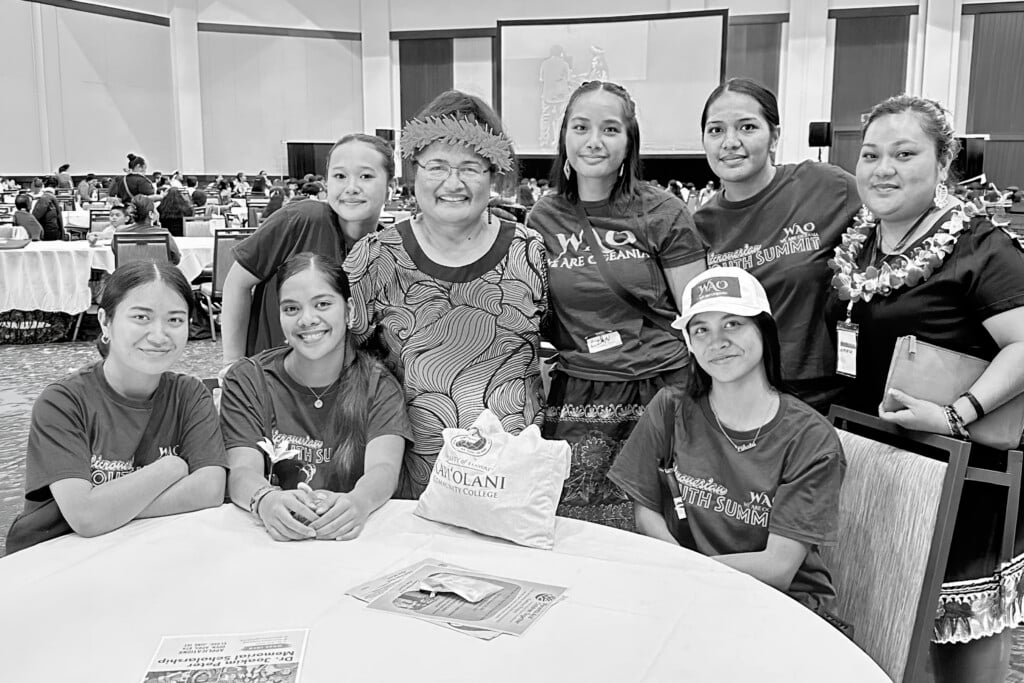
She is currently CEO of We Are Oceania, a nonprofit she co-founded that supports people in Hawaiʻi by combining their cultural knowledge with new skills to help them become self-sufficient. She received the Health Equity Champion Partner Advocate Award on behalf of the organization at the Asian & Pacific Islander American Health Forum last year.
Howard describes an incident involving a Micronesian youth who was shot by police in 2021 as a pivotal moment in her career.
“It gave me the courage to stand my ground and be more intentional about my work. I started asking myself: What is the impact? How can we be more effective? How do we prevent something like this from happening again?”
Howard says the incident highlighted a deep sense of disconnection among young people. They were detached from society, lacked relationships and felt unseen, she says, and it also revealed a fractured relationship between communities and law enforcement.
“It became clear to me that there was a need to build trust between my community and the police department. I helped initiate efforts where officers came out to church groups and community spaces to tell stories and discuss how we could work together,” she says.
“That case gave me the wisdom, clarity and courage to keep pushing for change and for stronger, more human relationships.”
Throughout her career, Howard says, she has managed demanding caseloads, ranging from about 60 to 120 clients while serving as a program coordinator at Goodwill. She notes that serving one person often means supporting many more.
“An individual is connected to so many others. Sometimes they’re the decision-maker for the family, so when you help one person, you’re really helping everyone around them.”
While much of her work centers on Micronesian communities, Howard says her services extend beyond them.
“That’s what I love about being a social worker. We speak a universal language, and that language is compassion, along with respect and humility,” she says.
At We Are Oceania, many people seek help with housing, over disputes with landlords, evictions, unsafe conditions and more. In one recent case, Howard says, a housing dispute went to court and was dismissed because the home was deemed uninhabitable.
“So the work goes far beyond helping someone find another place to live. You help them find a lawyer, file a case, translate legal letters, organize documents and keep track of receipts. In many ways, you become a teacher, guiding people through systems they’re navigating for the first time.”
Hawaiʻi’s spirit of aloha, she says, gives her plenty of hope for the future of social work in the Islands.
“There are so many people here who care deeply about justice and equity, regardless of cultural background. Social work is really a state of mind. It’s about sharing values, valuing humanity and valuing people. I see that spirit in Hawaiʻi, and I feel blessed to learn from and work alongside my colleagues.”
Keith Kuboyama

Keith Kuboyama is seen at last year’s Institute of Violence, Abuse & Trauma Hawaiʻi Summit.
Keith Kuboyama’s passion for working with youth was inspired by his mother, an elementary school teacher who often stayed late to care for children whose parents were working and didn’t have childcare. After earning a biology degree from the University of Iowa, he acquired a master’s in social work from UH Mānoa.
“Early in my career, I worked with youth in care — those who were adopted or in need of foster placement. That experience made me realize the critical need to support this population. My focus became helping children develop coping strategies, empowering them to find their voice and advocating for their own needs. We also taught practical tools they could use during times of stress.”
Kuboyama is a licensed clinical social worker serving individuals facing challenging circumstances such as poverty, abuse, neglect and mental illness. He has spent 46 years in the field, beginning as clinical director at Family Programs Hawaii and eventually serving as executive director until his retirement in December 2024.
He was awarded the 2025 Jonathan Won Child Maltreatment Prevention Award by the Institute on Violence, Abuse & Trauma. The award honors individuals who exemplify Jonathan Won’s dedication and recognizes outstanding achievement in preventing child maltreatment.
Kuboyama recalls a particularly impactful case.
“I can think of one youth who experienced significant early abuse. She struggled greatly during adolescence, often acting out, punching holes in walls, kicking and destroying property. She participated in several community programs but was unable to stay in most of them. Eventually, she was placed in a residential program on the mainland designed for youth with more challenging behaviors,” Kuboyama recalls.
“Throughout this time, I was her social worker, consistently supporting her through her teenage years. Over time, she began to trust that there was a stable, reliable person in her life. Through that consistent relationship, she stabilized and is now thriving. She has a child, started her own business and even donates a portion of her business proceeds to support youth in care. Seeing someone overcome adversity and choose to give back is one of the greatest rewards in this work.”
Kuboyama says one big misconception about social work is that workers are primarily there to take children away. Instead of just intervening at a crisis point, the work has evolved, he says.
“Now, we focus on providing support and preventive services, helping families before they even enter the system. For those already in the system, we work to provide educational assistance, community resources, financial help and housing, so families feel supported rather than threatened.”
Gaining trust, particularly with youth who have been hurt or abused, can be challenging. Kuboyama describes his approach: “When I first meet a youth, I ask, ‘Can you do some of this work?’ Often they say, ‘I don’t know.’ I follow with, ‘Whose life is this, yours or mine?’ Usually, they answer theirs. Then I ask, ‘Who should work harder, you or me?’ I explain that taking control means they have to put in the effort.”
Kuboyama says federal government cuts to social services and resources make it harder for families to get the support they need, increasing stress and challenges for both youth and communities.
“We’re already seeing a decline in support for social work and services for families and youth. When these support systems are reduced, family stress increases because they struggle to access the help they need to function and eventually thrive. As these cuts continue, the impact is felt not just by families, but also across the community.”
Kuboyama says caseloads are often overwhelming and, while training is essential, it takes time away from working directly with families.
Compensation is another challenge, as is self-care. He recalls working long days, sometimes from 6:30 a.m. to 6 or 7 p.m., including weekends, yet often only being paid for a standard 9-to-5 schedule.
Kuboyama knew Jonathan Won, the man whose name graces the award he received.
“He did incredible work in the community. He was such an inspiration to many of us younger social workers through his work with Prevent Child Abuse Hawaii and other organizations. Having an award named after a role model like him makes you pause and think, ‘Wow, I hope I can have that kind of impact on a community.’ That’s the kind of legacy that makes a career feel truly worthwhile.”
Kanani Dias

Kanani Dias has 20 years of experience as a social worker. On the side, she teaches fitness and wellness classes, specializing in hula and Tahitian dance.
Social work isn’t just a career for Kanani Dias, it’s personal. While growing up on Kauaʻi, she was on the receiving end. After her father died, a social worker would regularly visit her home and one in particular, “Aunty Nalani,” didn’t feel like an outsider.
“Looking back, I realized how hard it must have been for my mom,” Dias says. “But to me, Aunty Nalani felt like family. She didn’t just check in once, she watched us grow from when I was about 10 through high school. Every year she’d take us school shopping, picking out clothes and talking about how we were feeling. At the time, I didn’t even realize she was a social worker. She just felt like support.”
That early experience shaped Dias’ path. She earned her master’s in social work from UH Mānoa in 2001, and later worked at the Hawaiʻi Department of Human Services and several community organizations. One of her most meaningful moments came when she worked alongside Aunty Nalani at the Queen Liliʻuokalani Children’s Center in Honolulu, which has since closed.
“It was surreal, full circle, to be able to do the same things she did for us,” Dias recalls.
Like many in the field, she’s faced burnout. “At that point, I didn’t even have kids of my own — I had just gotten married. I thought, ‘There’s no way I could have kids and do this job.’ You’re constantly wondering if you made the right decision. It definitely caused burnout, not just for me, but for many in child welfare and protective services.”
To stay grounded, Dias turned to dance — a source of comfort long before her professional life — and created the dance fitness studio Tiare Fit. “Growing up, hula and Tahitian dance were huge parts of my life. Even on the day my dad passed away, I was dropped off at Tahitian practice. It wasn’t running away, it was how I worked through my grief. That grounding still matters to me.”
In 2020, Caregiver’s Heart Hawaii named Dias as Social Worker of the Year for her dedication to helping people.
In her role as a social health coordinator at HMSA and now at Mālama Ola Health Services, Dias focuses on holistic well-being, meeting clients where they are and supporting their goals. Whether helping someone manage diabetes, reduce substance use or find stable housing, she emphasizes realistic plans and long-term progress.
“At first, it can feel like you didn’t do enough,” she says. “But stepping back and seeing things from the client’s view helps you create achievable steps. Problems that develop over years can’t be fixed overnight.”
One of Dias’ most vivid memories involves a client diagnosed with cancer who chose to suffer alone, though she had family. Dias validated her autonomy while gently preparing her for what might come next. Months later, a chance encounter at a medical appointment opened a moment of trust. The client, seeing someone familiar, finally reached out to her family and spent her final days surrounded by loved ones, comfortable and at peace.
“That’s the work,” Dias says. “It’s not always about fixing everything, it’s about walking with someone until they’re ready.”
At Mālama Ola, Dias carries a heavy load for even the most dedicated professionals. “There are just too many cases per worker,” she says. “We need balance, and we need to advocate for ourselves and for the people we serve. Sometimes clients need a different worker, and that’s OK. What matters most is that they get the support they need.”
Dias worries about the future of social work in Hawaiʻi under the current presidential administration, because she knows the need won’t disappear.
“You only realize you have a calling for this work once you’re in school or in the field, surrounded by others doing it. Even if federal loans vanish or the profession changes, the need will still be here. We hold our breath and hope people continue to step up. The generation that trained me is retiring, but the need remains.”