This Wai‘anae Community Had a Home but Not Housing. Soon They’ll Have Both.
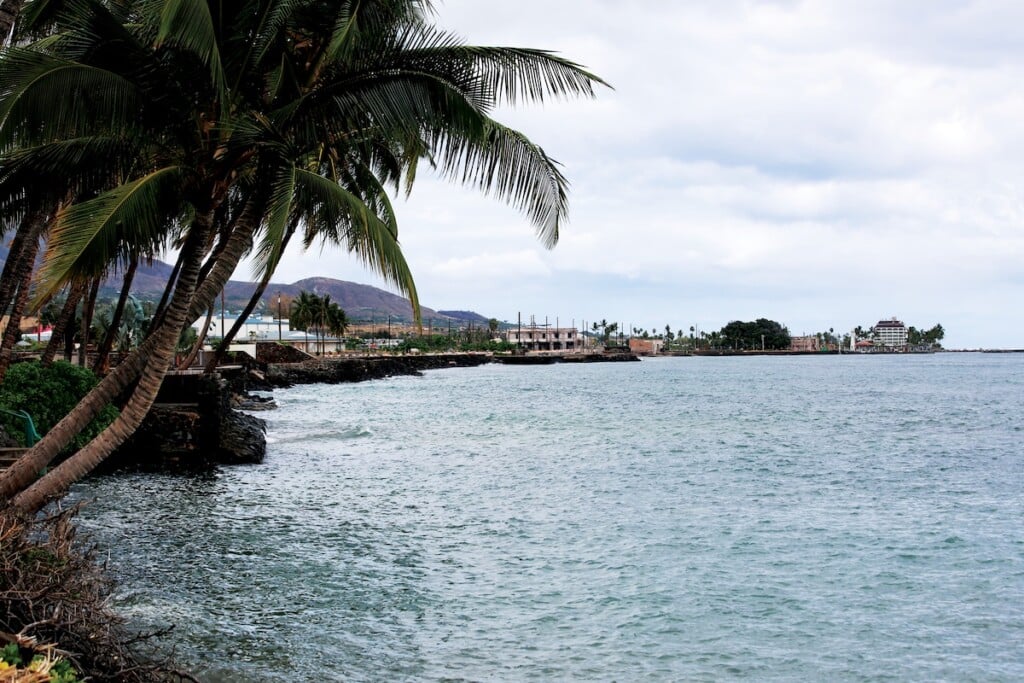
Carrying on the mission of their late matriarch, Puʻuhonua O Waiʻanae is relocating its community from tents on state land to housing on purchased property. They have until Oct. 16 to complete the move and clean up their former site.
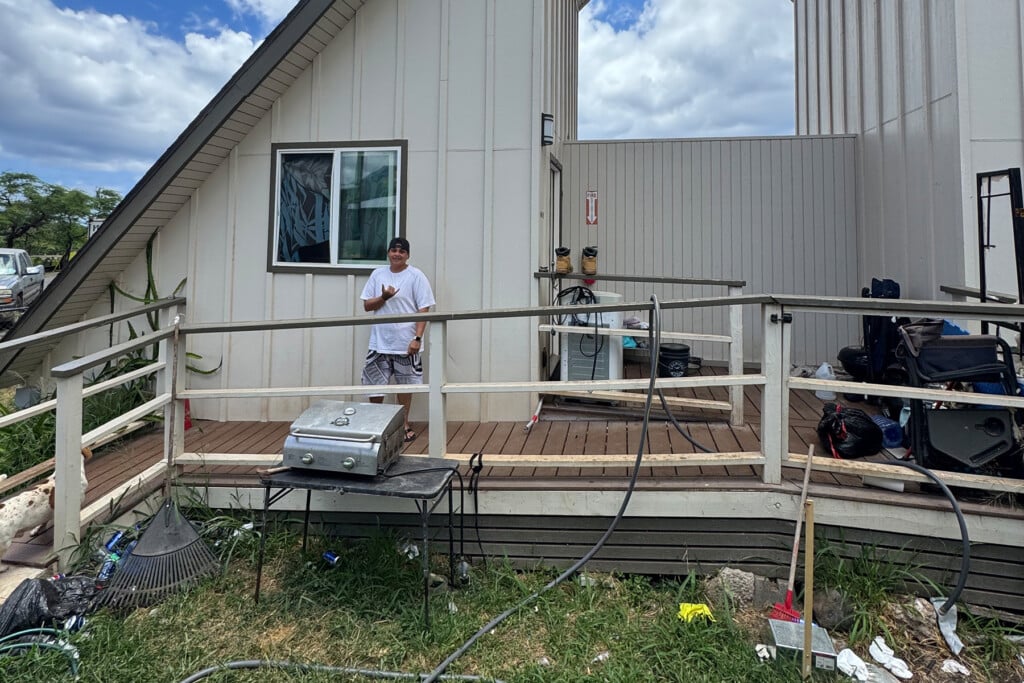
It was an audacious idea that brought together public officials, civic leaders, corporate donors and activists alike: pool resources, chip in expertise, donate houses, tents and labor, build roads and set up electricity to create a community where some 200 people without houses could relocate from an encampment of makeshift shelters and tents.
An informal public-private partnership that evolved organically, the project is nearing an Oct. 16 deadline to move the remaining 25 or so people from Puʻuhonua O Waiʻanae near the Waiʻanae Small Boat Harbor to live in tiny houses 2.4 miles up the road in Waiʻanae Valley. The 19.5 acre site was purchased in 2020 with $1.4 million raised by the nonprofit offshoot Dynamic Community Solutions, including donations from individuals and companies alike, all with implications for future models to address houselessness.
“We’re doing something so unbelievable,” Twinkle Borge, the community’s beloved advocate and leader, told me in August 2023, a year before she died. She had been the driving force to create a self-governing structure and rules within the encampment. Following complaints from neighbors and after pressure from the city and state to move away from the harbor, Borge helped negotiate terms of the community’s relocation.
“We never thought that we could raise $1.4 million [to buy the parcel of land], but we did,” she said then. “It took us time, but we did.”
Two years after the loss of their leader, the Puʻuhonua O Waiʻanae community is working to fulfill Borge’s final wish: “Bring them forever home.”
She won’t see the project’s finish line, but others have picked up the reins. All told, some $10 million in cash, grants, construction, donated labor, material and services has been poured into the project. Although that includes some federal funds and local officials lent assistance, most credit the community with being the driving force.
“It’s amazing to see that a group can come together and can organize themselves and their finances in a way to be able to purchase property, to be able to say this is going to be a place where we are going to call our future home, and they’re taking major steps in that direction, and it’s really encouraging to see that they’re there,” says Jun Yang, the governor’s homeless coordinator at the Statewide Office on Homelessness and Housing Solutions.
“As an administration, we want to see it succeed, and so when they contacted the state, I think that the departments and those involved have been trying to figure out how to make this work, because we’ve been wanting to see a successful transition from the site.”
Yang says Gov. Josh Green’s meetings with Borge while he was still Lieutenant Governor helped shape the Kauhale Initiative, a concept built around modest private units, shared amenities and communal accountability.
Although the creative and pioneering approach has parallels with the Community First! Village in Austin, Texas, which Green toured in 2018, Hawaiʻi’s efforts to address the intractable problem of homelessness are shaped by its unique Hawaiian history.
Puʻuhonua O Waiʻanae had tendrils reaching back to ancient Hawaiian customs but is rooted in the very modern byproduct of capitalism that leaves some without jobs, a social safety net and homes: create a place of refuge, puʻuhonua, where those in need can live, build community, regroup and set out again into society.
The plan required concerted efforts on many fronts. In February, U.S. Sen. Brian Schatz of Hawaiʻi secured $2 million in federal funding to build out critical water, sewer and road infrastructure at the valley site. The $10 million total also includes a $300,000 Grant-in-Aid from the state and a $400,000 forgivable loan from Hawaiian Community Assets, according to Dynamic Community Solutions founder and president James Pakele.
Pakele credits a targeted capital campaign committee for raising the remaining balance from private charities and individual donors. The funds went a long way thanks to a massive network of pro bono labor and donated materials. While Paʻaluhi Builders served as the primary contractor for the tiny homes, Royal Construction handled the infrastructure and road work, and Trinity Management oversaw project management and construction scheduling.
Critical design and engineering work came entirely pro bono from architecture firm G70, civil engineer Craig Arakaki and architect Andrea Aegerter. Foundations Hawaii secured material donations and provided free labor for the first phase of foundations, while the National Guard pitched in during two separate multi-month deployments to assist with infrastructure and secondary foundations.
Private sector partners also stepped up to build individual structures. AC Kobayashi donated the labor for Borge’s house before her death, while HomeAid Hawaiʻi, Hale Partners, S&G Construction and Prometheus Construction provided specialized building support.
Pakele says many others also contributed service, products and labor.
“The community-based self-help model that was inspired by Twinkle Borge was an alternative to government-sponsored stopgap solutions for the homeless population,” says Bob Bruhl, president of Tradewind Capital, who helped coordinate business community involvement. “It’s meant to be a model of one solution that’s needed in a host of many to attack the larger issue at hand. … Hopefully it inspires others to realize that, why not again? Why not them, and the government, too, to get behind initiatives like this?”
Working With the State

Photo: Ryann Noelani Coules
The state, which owns the harbor property, has supported the effort by granting the village a grace period to build infrastructure, relocate residents and restore the original site rather than resorting to a forced eviction.
An initial deadline of November 27, 2025, was delayed to April 30, 2026. Following the devastating aftermath of the Kona low storms, that date got pushed back again to June 25, 2026. In mid-June, Puʻuhonua O Waiʻanae requested one more extension, which the state granted, setting the final deadline for October 16, 2026. Not everyone was happy with the delay, however.
Following that extension, Sen. Samantha DeCorte (R-District 22) criticized the delay: “The land was purchased years ago,” she said at a press conference. “The transition plan has existed for years. The deadlines have come and gone. The resources are available. It’s time to go.”
In June, the Puʻuhonua O Waiʻanae Overseers Council, which includes Borge’s nephew Kala Paishon, highlighted its efforts toward meeting its commitment:
“Using our own labor, vehicles and machinery, and bins paid for through our nonprofit, we have removed more than 60 dumpsters, 35 cubic yards each, for an estimated total of 300 tons of trash from the Harbor property at no expense to DLNR [Department of Land and Natural Resources] or the state. That work continues.”
Acting DLNR Chair Ryan Kanakaʻole stresses that Puʻuhonua O Waiʻanae’s achievements were self-driven rather than led by the government.
“POW long operated as a place of refuge and collective responsibility, rather than an encampment of houseless individuals,” he says. “Their willingness to collaborate, to acquire land on their own, and remain together as a self-governing village can certainly be emulated by others. However, I don’t currently see this as a model that can be adopted by government to address houselessness. It appears to work best when people are willing to do the work for themselves.”
A Race to Meet the Final Deadline
With the clock ticking, Pakele of Dynamic Community Solutions ordered an additional 30 pop-up units from China to ensure every resident has housing in time. These Continest units take about 90 days to ship to Hawaiʻi but can be assembled in just 50 minutes, a fraction of the time it takes to build traditional tiny homes.
Pakele says about two dozen residents may need additional time until their units arrive. “So it’s an extension,” Pakele said, “but it’s an extension for a very small amount of people until the units get here… [which] are already ordered and paid for.”
Pakele notes that while the long-term goal is to provide permanent tiny homes for everyone who wants one, the immediate priority is simply getting a roof over everyone’s head.
“If we get more funding to build out more permanent structures, then we’ll do that, and that’s awesome, but that can be a long-term goal,” he explains. In the meantime, the pop-up units get “everybody a roof that is not a tent, and it gets them off of the state property, and it gets them onto our property.”
Unlike permanent tiny homes, which are designed for single occupants or couples, the pop-up units offer flexibility, they can easily be linked together to create larger living spaces for families.
Life in Waiʻanae Valley
Jasmine Feliciano was the first resident to move to the valley in 2021. She says she became houseless at 17 after her grandfather died and her grandmother abandoned her, so she started “living at Wahiawā District Park, fending for myself.” In 2014, her cousin invited her to live with him at the harbor.
At the time, Feliciano was struggling with addiction. But when her cousin introduced her to Borge, everything changed.
“That lady saw right through me,” she recalls with tears in her eyes. “She could see me going downhill. She’s the one that gave me a purpose.” Borge entrusted her with a leadership position at the village, which motivated Feliciano to turn her life around. “I stopped doing what I was doing,” she says and has been sober ever since, going on eight years.
Because Feliciano had a background in construction, she helped clear the raw land after the nonprofit purchased it. “I would come up every day from down there and work. Build whatever that lady wanted,” she said, noting she built tables, framed overhead covers, and handled the caulking and painting.
Borge took notice of her commitment. “I guess she saw that I was putting in the work. She asked me, ‘Are you ready to come home?’ And I looked at her, ‘Like in a house?’ She said, ‘Yeah, I have a unit ready.'” She jumped at the offer. “So that very same night, I started moving myself, and then came back the next morning, cleared my camp, because Mama [Borge’s nickname] always said, when you move, you clear your home. We all clean our own. So that’s what I did.”
As more residents have joined her in recent months, Feliciano has spent a lot of time talking her new neighbors through the transition. “They had their doubts at the beginning,” she said, “but as they stay [here], they say, ‘Wow, you’re right.’ I say, ‘Yes, of course it’s better than staying in a tent.'”

In addition to tiny homes, the mauka village features shared amenities such as communal kitchens, bathrooms and laundry areas, like the kitchen space pictured here. Photo: Ryann Noelani Coules
Beyond offering fortified shelter, the new location boasts several amenities that were completely unavailable at the harbor. These include communal laundry areas, kitchens and bathrooms equipped for full plumbing and electricity, though work is still underway to connect the entire village to the grid and utility lines.
At the harbor, residents are limited to designated times at the public outdoor showers built for boaters, facilities that offer no walls for privacy and only dispense cold water. In the valley, they have access to curtained stalls with reliable hot water.
“We have water up here, we have electric, we have an ice machine,” says villager Kalala Kalua. “You know that our residents love that because the Waiʻanae sun hits different.”
For Feliciano, the greatest upgrade is security. At the harbor, she explains, you were “always being worried that somebody’s gonna go in your tent” and steal your belongings, forcing you to “start over from scratch. … Up here, you can lock the doors and feel safe.”
Pakele notes that rent for each unit, which is primarily built for a single occupant or a couple, is $250 per month, including utilities. Because the nonprofit bought the land outright, they do not need to worry about paying off a mortgage, nor is there a landlord trying to turn a profit. According to Pakele, that $250 purely covers operational costs, like “electric, water, maintenance fees and insurance that we got to make.”
Paishon estimates that 70% of Puʻuhonua O Waiʻanae residents have jobs, while a good portion of the remaining 30% are elderly, disabled, children or dealing with mental illness. While most residents should be able to cover rent through their paychecks, Social Security or disability benefits, the village has a built-in safety net for those who struggle to find the funds.
Mirroring the rules at the harbor, the valley village requires residents to complete eight hours of mandatory community service each month. “If you go over your eight hours, then that can go towards your rent,” Feliciano explains. “We try to work with our people that don’t have income, so that way they’re not stressing.”
‘It’s Bittersweet’
Although residents generally look forward to the upgraded features of the new village, many are reluctant to leave the harbor.
“For a lot of people, it’s bittersweet. And it takes a little bit of trust,” Pakele says. “A lot of the folks that we work with, they’ve been let down so much over the years, so many times they’ve been like, ‘could this be true?’ and then rug pull.” He says some residents need extra reassurance that “you’re not going to get rug pulled” this time.
It’s also hard for them to let go of living at the harbor because Borge so effectively built a community there that feels like home for the villagers.
“Someone who’s been here 15 years, you think it’s easy for them to uproot all the memories that they’ve built here?” asks Paishon.
He emphasizes the trauma of being forcibly removed from spaces that houseless people so often face. “I don’t like using the word sweep, I’d rather use removal, because growing up as a child, when my parents go ‘sweep that up,’ it would mean the trash on the ground or the ʻōpala that’s left behind,” Paishon explains.
Paishon prefers gentle nudges over a heavy-handed approach. “I understand people are afraid to move because they cannot let go of the memories here,” he says. “But it’s okay. You gotta go.”
Until Borge’s vision is fully realized, Paishon offers words of encouragement to his neighbors hesitant to take the leap: “The greatest thing about moving up there is we can make more memories, and I’ll be right there beside you.”