Trial and Error: A Young Professional Looks at Work and Life
"Get Comfortable Being Uncomfortable"
Studies have found that fear of public speaking is more common than fear of sharks, heights and enclosed spaces.
I’m no exception.
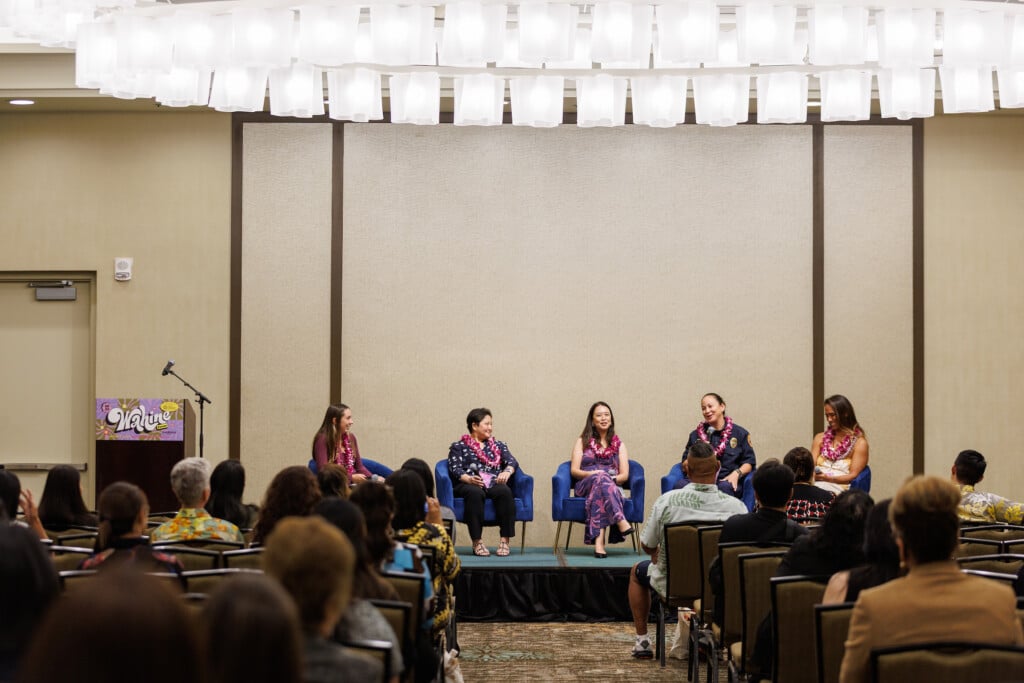
But I challenged myself to lead and moderate a panel for the first time at Hawaii Business Magazine’s Wahine Forum on Oct. 24 in Waikīkī.
My anxiety about getting on a stage before close to 100 people grew steadily as the event drew nearer. Though most of my past public performances – including countless school presentations and several plays – went well, I found my mind wandering to those times when I drew blanks, then panicked and stumbled over my words when I tried to recover.
I feared I might embarrass myself again. To counter that, I consciously shifted my focus away from my nerves and homed in on the excitement of leading such a badass panel.
Inspired by the “Women Who Save Lives” feature I wrote for the October issue, three panelists were women I profiled: Melanie Keolanui, battalion chief of operations at the Hawaiʻi County Fire Department; Dr. Lois Chiu, chief of neonatology at Kaiser Permanente Medical Group; and Kapua Chang, a lifeguard and rescue watercraft operator for the City and County of Honolulu. I was also delighted to add a panelist, Dr. Kris R. Kawamoto, interventional cardiologist at The Queen’s Health Systems.
Several of their insights dealt with navigating stressful circumstances, some of them with far higher stakes than public speaking. Kawamoto says she stays calm in life-or-death situations by thinking through all the possible scenarios ahead of time, which helps her perform best under pressure.
“I go through every algorithm in my head of a potential complication that can happen during the procedure so that when it happens, I just kind of rely on muscle memory,” she said at the event, likening it to athletes who “visualize” their races right before they start. “So from the beginning to end, from the start line to the finish line, you visualize what’s going to happen.”
That’s what we did to prepare for the panel discussion itself. A few days before, I met with the panelists on Zoom to go over logistics and rehearse the flow of our session – start with introductions, discuss the main topics, then end with an audience Q&A. The prep session ensured things went smoothly during the actual session, with an organic but structured conversation. Knowing we were all on the same page eased my nerves a bit, and I was encouraged by all of us being in it together.
In the session, rescue watercraft operator Chang offered another insightful take on preparation: “I try and make sure that I’m constantly putting myself in uncomfortable situations throughout my time training. You want to get comfortable being uncomfortable.” That might mean she has to hold her position amid 25-foot waves “and just sit there getting smashed … and being comfortable with that.”
Preparing for and moderating that panel discussion was the perfect test case for me to apply the collective wisdom of these women. By leveraging Kawamoto’s rigorous preparation and embracing Chang’s core tenet – we must get comfortable being uncomfortable – I turned a nerve-racking experience into a success.
The message for any professional looking to grow is the same: Do the scary thing but prepare first. Take it from me, there’s no better feeling than being proud of that effort.