West Maui Advocates Seek to Make Water a Public Resource
As West Maui recovers from fires and storms, residents call for public control of water systems—aiming to restore stream flow, protect the island’s future and honor ancestral stewardship.
This is one of an occasional series of stories published in conjunction with Hawaiʻi Community Journal.
West Maui and Lahaina are at a vital tipping point — with funding slowly trickling in to support rebuilding efforts and homes beginning to be developed one by one, the question on many residents’ minds is how West Maui will be sustained for the future.
At the center of discussions is wai — or water, a sacred part of the ecosystem in Hawai‘i.
County officials aim to develop new water sources in West Maui, including wells planned in Launiupoko and Honolua, along with the $16 million federally funded Kahana Well project. Discussions focus on expanding recycled water in the area, as well as Lahaina’s water infrastructure and firefighting capacity, all while officials work toward securing oversight of the area’s more than 100-year-old water systems.
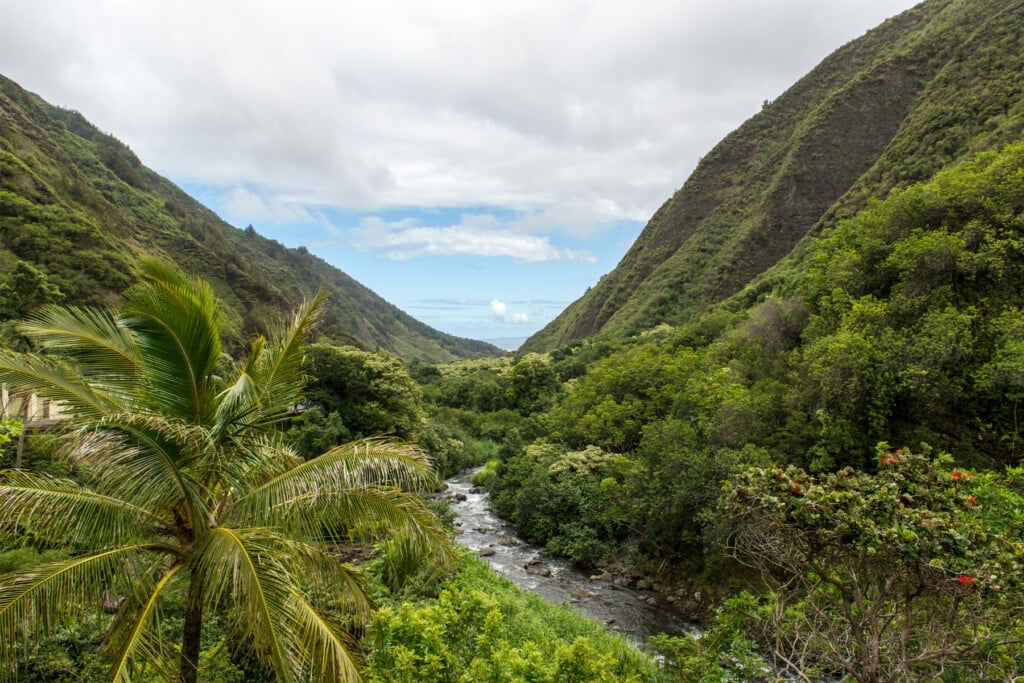
Archie Kalepa, whose family has kuleana land in Kahoma Valley, knows what can happen when streams are allowed to flow naturally. (These are lands granted to Native Hawaiians who live on and cultivate them under the 1850 Kuleana Act). After a decade of community-led advocacy, streamflow in the valley returned after almost 130 years of plantation-led diversion. There, the first kalo plant in a century was replanted in the old taro fields, with marine life such as ‘ō‘opu returning as well. In 2018, the state Commission on Water Resource Management set a formal instream flow standard to support “native stream animals and traditional and customary practices.”
But advocates say the stream was in danger of running dry in 2019 because of a lapse by the private infrastructure manager West Maui Land Co.
For Kalepa and others, the lesson is twofold: Stream restoration works, but only if there’s accountable, public stewardship first. They favor putting water into public trust, managed by the county rather than by private entities, he says.
Stream diversion causes long-term impacts on both the surrounding ecosystem and the communities that depend on it, and without accountability, change cannot be made.
“It’s when we begin to divert water from one place to another place – we’re living outside of our means,” Kalepa says.
He adds that stream restoration is vital to ensuring the long-term health of the area’s aquifers.
For decades, water has been diverted in West Maui. From water infrastructure developed by what came to be known as Maui Land & Pineapple Co. beginning in the 1900s for agricultural purposes, to expansion that grew in the 1970s, water has been tapped for commercial and real estate purposes, arguably beyond capacity.
Today, West Maui’s water infrastructure managers, West Maui Land Co. and Maui Land & Pineapple Co., face new criticism from homeowners and golf course operators.
One such resident concerned with the current oversight is Eddy Garcia, a West Maui farmer who has been posting on his social media that heavy storm damage in March was exacerbated by prior water management decisions affecting stream flows that led to flooding and damage.
Despite repeated efforts to communicate the issues he has faced on his agricultural lot in the Olowalu area near historical petroglyphs, he says he has received little to no support to help solve these problems over the years.
In an emailed statement, Race Randle, CEO of Maui Land & Pineapple Co., said: “For over a century, MLP has been committed to building and responsibly managing critical water infrastructure on Maui. The extreme weather we’ve experienced recently — from Maui’s driest year on record to severe flooding — requires shared responsibility to make our communities more resilient. We are currently working with the County of Maui to advance solutions that will benefit our community, including significantly increasing water storage in West Maui and the transfer of private water systems to public system integration.”
A spokesperson from West Maui Land Co. did not respond to a request for comment.
Garcia agrees that transferring oversight may be a viable solution to the ongoing problems he’s facing.
“Get it in the hands of the people,” he says. “If it’s in the people’s hands, there are experts and resources, and it can be taken care of.”
Garcia also agrees that returning to the old ahupua‘a system is not just helpful, but wise.
“The Hawaiians had a perfect agricultural system. They had a system that went from the source of the water, all the way down to the reef system,” he says.
“These systems were perfect when they were intact,” he says. “The old agricultural companies drastically interrupted this. And when the old developers bought from the agricultural companies’ land that they didn’t actually own, that they were leasing, then they really didn’t do what they were supposed to do. They didn’t take into consideration that these systems were set up for the water flow.”
Kalepa says county officials and decision-makers should also consider the knowledge of elders and support a value-first mindset.
“You could have an engineer with a master’s in engineering, but you take that one kūpuna, and that kūpuna is a grandmaster in area knowledge. We have to put those together and come up with something better than the Westernized way of thinking,” he says.
And instead of “building back better,” ask ourselves, “what is better?”
“Is it better for me or better for the place?” he says. “We have to get back to the original management methods that at one time allowed us to manage those lands within the ahupua‘a system. The answers to the future lie in our ancestors’ past. We have to take heart and pay attention to what that is.”
Kalepa says recent heavy rains that caused flooding and forced evacuations may reflect new climate patterns that require thoughtful planning.
“Any successful voyage in the last 2,000 years was built on a good plan,” he says. “Coming up with a good sail plan for the canoe of Lahaina is super important to the success of the next seven generations.”