Hey Bartender! Serve Me Another Craft Beer!
Hawaiʻi's craft beer market is bucking a national trend in declining sales, for now at least. Local breweries say island drinking habits, creative new flavors and the steady demand among tourists for local brews has made the difference.
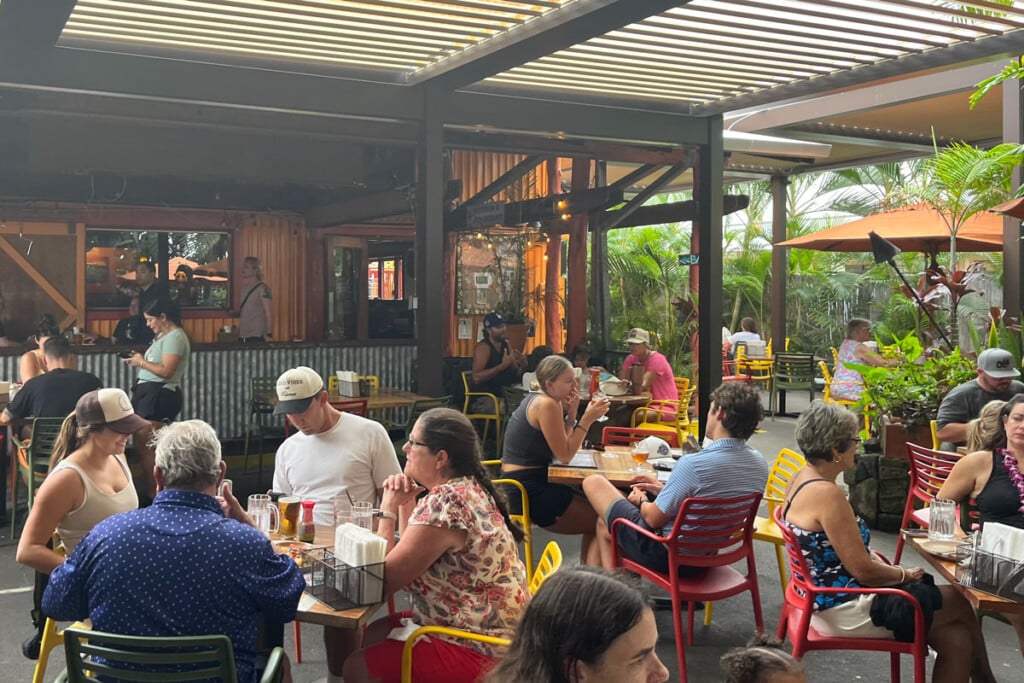
It’s pau hana on Aloha Friday at the Kona Pub, and you’d better have reservations. Locals and tourists vie for seats at the bar, at indoor tables and at others under umbrellas in the outdoor lanai surrounded by the lush greenery of Hawaiʻi Island.
There’s a buzz of lively conversation as waiters serve freshly brewed craft beers from the Kona Brewing Co. kettles nearby. Try Backyard Batch, Pinkboots with Fir, Dad Joke IPA (made from corn… get it?), a seasonal Lilikoʻi Kea Witbier, Pipeline Porter, Big Al’s Blonde Stout… As dizziness sets in, a waitress offers a menu with even more options: Traditional lagers and IPAs and of course wine, spirits, as well as Kōlea Sparkling Hop Water, and non-alcoholic beers and soft drinks.
The exhaustive options reflect the promise and the peril of today’s beer industry.
Faced with consumers’ fickle loyalty amid ever-expanding beverage options—plus growing numbers who have stopped drinking altogether—beer consumption across the country has started to slump. Last year was the first time since 2005 that more breweries across the nation closed than opened.
Hawaiʻi brewers, including Kona Brewing Hawaiʻi and its larger rival Maui-based Craft ʻOhana—are hoping they can continue to buck the trend.
“No one seems to be drinking only one thing anymore,” says Garrett Marrero, CEO and co-founder of Craft ʻOhana, parent of a family of brands including Maui Brewing Co. “I think more than ever we have promiscuity in the drinker world, right? There’s just a shift in that. No one sticks to one core beverage. We make beverages that people want to drink, and we’re not beholden to any one beverage.”
As the froth comes off the mainland craft beer market, Hawaiʻi’s brewers are hoping that Island-style drinking habits, and a steady infusion of tourists who are eager to sample a local brew, can keep the taps flowing.
Brewers across the nation are facing worrisome signs. Output from craft brewers, which represent about a quarter of total beer market sales, fell about 4% in 2024 after a prior decline in 2023, according to the Brewers Association, even though overall revenues picked up 3% in the year due to price increases and shifting consumption patterns.
“The overall beer industry is having a rough go of it, and craft brewers—so recently the vanguard of the category—are getting the worst of it,” writes Dave Infante in his Hop Take column for industry website VinePair. Craft beer sales have declined for the past two years after two prior years of mostly flat sales, he notes.
“More than half of the aggregate brewing capacity across the country is slack, built to service growth that never materialized.”
While the beer industry as a whole generates $471 billion a year, craft brewers on the mainland are scaling back production in response to declining demand. Hawaiʻi brewers contributed $347 million of that total last year, with output of nearly 179,000 barrels, association figures show.
Craft breweries in Hawaiʻi are watching the trends, and the drinking habits of a new generation who are eagerly sampling a flight of beverages. Some companies are targeting drinkers who prefer non-alcoholic beverages. They’re being forced to adapt to changing tastes.
Hawaiʻi’s top brewers say their production is still steady or growing, but the field is also shrinking, with 26 craft brewers, down three from the prior year. The Brewers Association ranks two among the nation’s top 50 craft producers—Craft ʻOhana at No. 17 and Kona Brewing Hawaiʻi at No. 37.
Whether Hawaiʻi’s brewers can continue to buck the national trend is uncertain.
“Consumer habits are shifting fast, and breweries need to keep up,” writes the Brewers Association’s staff economist Matt Gacioch in an online newsletter. “Understanding these shifts isn’t just good business, it can be the key to staying relevant in a rapidly evolving beverage landscape.”

THE BIGGEST PRODUCER IN THE STATE
To that end, Kihei-based Craft ʻOhana’s brands, including Maui Brewing, offers beers, seltzers, sodas, and ready-to-drink mixed beverages.
Like many others on the Brewers Association’s list of top craft producers, Craft ʻOhana is more than just a brewery; it packages brews for delivery to places across the state and also sells its beer and seltzers in 26 other states.
The group produced 80,000 barrels this year, split between cans and kegs, the company says. With many distributors in 26 different states and a wide range of beverage choices, Craft ʻOhana plans to consolidate some of its mainland distribution sites to focus on Western states—California, Oregon, Washington and Nevada—which, along with Hawaiʻi, account for 95% of its business.
Rather than “downsizing,” Marrero prefers to call it refocusing sales, pulling out of states, such as Georgia, that don’t have strong partnerships, and producing closer to its core market.
“It’s maybe a misnomer to say we’re pulling out of states because we’re just not really even in them,” he says.
“We’re not unique, seeing what’s happening in the world,” Marrero says. “I mean, for us, beer consumption is still up. Our beer sales are still up. You look at the overall market, and beer growth has slowed, and some drinkers are switching.”
Compared to the alcohol market in 2007, during the last brewery lull, there were fewer options available. Now consumers can stroll into a store and have choices ranging from hard seltzers to non-alcoholic and ready-to-drink cocktails, in addition to traditional wine and spirit options.
As a consumer, Marrero says, despite his love of beer, he found his own tastes changing. Now, he, too, reaches for different types of alcohol to match different occasions.
One national trend that started before the pandemic but accelerated recently is non-alcoholic beer, although it’s less pronounced here on the Islands. Maui Brewing launched a non-alcoholic beer in 2022, but it is no longer sold due to production issues. Non-alcoholic beer can spoil, so consistently producing a safe and correct batch takes a lot of effort. Marrero says the company is working with a partner to bring back canned non-alcohol beer in the next 9 months.
“I don’t see it as being a huge market here in Hawaiʻi,” Marrero says. “Just because we’re a little different than the mindset in the mainland, but I do see an occasion for it.
“The volume of non-alcohol beer sold in Hawaiʻi is so minimal that no one would ever invest the money necessary to do it in a high-quality, safe and responsible way. It’s just something that working with a partner is the only proper way to do it.”
“We’re the top local beverage alcohol brand,” he says. “So, we’ve seen that success. We’re actually retrenching, where we’re going to pull out of a bunch of states that just don’t necessarily make sense for us to be in at the moment.”
In the next six months, every beverage the company produces will be created and canned in Hawaiʻi, then shipped to the mainland and across the state.
Marrero says he looks forward to returning to a more straightforward sales approach.
“We’re excited to lean into that and continue to innovate and make the highest quality locally produced beverages available, and we’ve got the right team to do it, the right supplier partners, and the right wholesale partners. We’re looking forward to the next 20 years.”

Bartenders serves draft beer at Big Island Brewhaus in Waimea. Photo Courtesy: Ken Wills
MAKING BEER IN HAWAIʻI
For its part, Kona Brewing Hawaiʻi is turning to a series of limited-edition and seasonal beers, expanding on the annual Octoberfest offerings. This year it added a passion fruit flavored Lilikoʻi Kea Witbier. Its marketing campaign served up all the allure of exotic islands: “Brewed with tropical passion fruit (lilikoʻi), grains of paradise, and coriander, this crisp and aromatic Witbier is as refreshing as the landscapes that inspire it—capturing the lush beauty of Kauaʻi’s rugged coastline.”
That’s a mouthful, but waiters say it sells well, especially among tourists.
“There are a lot of challenges with beer, as with the entire alcohol industry. None of it’s new, but it’s certainly different in that consumers are telling us they’re thinking about alcohol in a different way,” says Katie Feldman Lefsrud, Kona Brewing Hawaiʻi VP of Sales & Marketing.
She says consumers in Hawaiʻi still show a lot of love for locally made craft beer.
“There’s a lot of passion for it, but the category is still seeing pockets of growth where I think it’s harder to find in the mainland, and that’s because there’s so much innovation still in the category here. And you know, beer plays a role on a hot day on a beach, no matter who you are. Consumers here in Hawaiʻi, whether you’ve lived here a long time or visiting, just interact with the craft category differently and in a much more engaged way.”
Kona Brewing, which is the state’s oldest craft brewery, began in 1994 and has operated as an independent company for the past five years. The majority of its beer is brewed in Kailua-Kona on Hawaiʻi Island.
The brand on the mainland is owned and managed by Anheuser-Busch and shares the same name. Those are brewed in the mainland, except for the Kona Big Wave, which is exclusively made in Hawaiʻi.
“There are a couple packs that we cannot make on our own. So, we do ask some other brewers in the mainland to make those for us. They’re specialty packs, like our variety pack, we just don’t have that capability. So, they make those.”
“The one here on Hawaiʻi Island is the beating heart of our brand, our brewery, and we’ve seen pretty consistent traffic. Of course, as tourism ebbs and flows, so does the traffic here.”
“We’ve been delivering on what we expected this year to be, and we think for the year, we’re going to end up in a really, really positive place.”

GEN Z DRINKING TRENDS
One trend among Gen Z drinkers is a move toward more health-conscious choices. They also spend less on alcohol than older cohorts.
“The challenge for Kona Brewing, and for all craft breweries, is younger consumers are not walking away from beer altogether,” she says. “It’s just maybe they’re making sure that they’re alternating more often with a non-alcohol option, or that instead of going out for five nights a week, they’re going out for two. Beer absolutely has a role.”
Kona Brewing’s goal is to reach production of 85,000 kegs by 2027, says Feldman Lefsrud. Another marketing effort is a tie-in sponsorship of sporting events and live music, including the Big Island Blues & Brews Festival.
“I think our opportunity to connect with our communities has always been a pillar of Kona Brew, and you’ll see us continue to connect with the surfing community and other organizations throughout the state, where we can really connect with our neighbors in a more meaningful way.”
Some smaller craft breweries go heavy on “local” atmosphere at their taprooms and pubs, trying to draw regular customers in by creating a friendly, neighborhood feel. At some pubs and taprooms, dogs are welcome to belly up to the bar alongside their human sidekicks.
“There’s nothing better than enjoying a delicious IPA, or any beer!, while hanging out with your beloved pup,” says Hawaiʻi Island resident Diane Fuller, who brings her dog Coco when she and her husband Leo Fullner stop for a refreshment.
She said both Big Island Brewhaus in Waimea and Ola Brew Kona Taproom staff are especially welcoming to customers with dogs. “Several of the staff dote on dogs and give them water and special attention,” she says.

Photo Courtesy: Aaron Yoshino
LOOKING ABROAD, ADAPTING TO NEW TASTES
“I’ve always, always seen that Hawaiʻi’s five to 10 years behind trends that you usually see on the mainland,” says Geoff Seideman, co-founder of Honolulu Beerworks. “That being said, I think the shift here I’ve seen has been for more local.
“Unfortunately, you tend to see what happens on the mainland happen here as well. But because our market, especially in the stores and even in bars and restaurants, is not saturated with local because there aren’t that many local breweries, I think there’s still room for people to be opening up and kind of filling that void of having enough choice.”
Honolulu Beerworks, now located in Kalihi, is focused on wholesale manufacturing. It operates a tasting room and taproom, but when it moved from its Kakaʻako location to Kalihi, it gained more space to produce.
The company is behind on its production plan. Seideman says the company reached maximum capacity at its former location in 2018, but when it planned to start moving out, the pandemic hit. Now the company is returning to the momentum he wishes had happened five years earlier.
The company started moving everything to the new location about two years ago. However, since it is still actively canning and kegging at the old location, Honolulu Beerworks is continuing to transfer kegs to Kalihi.
“Moving away from Kakaʻako, which used to be this heavily tourist area, and having our tap room here, we really didn’t have any expectations where it would be,” he says. “It’s almost like this is a bonus that people come and hang out and stuff like that. But we’ve been surprised. It’s actually been pretty steady, which we’re enjoying.”
Honolulu Beerworks discovered a large following in Japan. In 2014, Seideman was asked to judge at a beer competition in that country. He joined the event in 2015 and brought Honolulu Beerworks to the beer festival, which takes place alongside the competition and features trained judges who teach beer tasting.
Seideman says that in its previous location, 30% of the business came from Japanese tourists before Covid. By tapping Japanese social media pages and a website, the company is slowly building its market in Japan.
In the future, Seideman says they plan to create a sweet tea, collaborating with other companies and brewing for smaller breweries.
He says it’s crucial to keep adapting to changing markets and tastes.
“When I was 14, I was itching to drive. When I was 16, I was itching to get out of the house. At 18, at college, you’re like, ‘alright, I’m drinking.’ And I think it’s changed” for the younger generation, says Seideman.

Dogs are welcome at some taprooms, like Ola Brew in Kona, where staff show them special attention. Photo Courtesy: Diane Fuller
THE COST TO CAN
Hawaiʻi brewers, along with their mainland counterparts, are also seeing rising costs associated with tariffs.
In June 2025, President Donald Trump increased tariffs on aluminum to 50%, saying it would boost U.S. competitiveness by making imported steel and aluminum more expensive. Most of the increased cost is being passed on to consumers through higher prices on goods that contain aluminum.
“I think Hawaiʻi is unique in that we have a can plant here that serves the state. Ball has done a great job of insulating us as much as possible, given our size. We do participate in buying futures and such, so we can shield ourselves from price increases,” says Marrero from Craft ʻOhana.
The lids, or the pieces used on the tops of cans, were historically excluded from Section 232 tariffs in 2018. The most recent adjustment added them to the list, and all brewers in Hawaiʻi will see a meaningful increase in the cost of those ends.
“No one’s immune to it,” Marrero says. “I spend a lot of time in government affairs, and we’re continuing to work on solutions. But this is certainly where scale has an advantage.”
While he didn’t share the exact amount that tariffs will affect prices, he says the pennies per unit could add up to hundreds of thousands or millions of dollars over time. Marrero and other local business owners met with Hawaiʻi U.S. Senator Mazie Hirono to discuss the impact of tariffs on their bottom lines.
For Honolulu Beerworks, the lids are causing a 35% increase in production costs. But Honolulu Beerworks and Craft ʻOhana say the cost of cans has remained unchanged so far.
“But you know, we’re always on edge waiting for what’s going to be the next thing that’s going to increase,” Seideman says. “Because obviously, like everybody, we can’t absorb everything. Some of it has to be passed on to the consumer.”
As the administration’s tariff policies change, the brewers also adapt. Seideman and other local brewers say they control what they can and adjust to outside factors.
Says Marrero of Craft ʻOhana: “It’s constant change. I think that’s one thing I can always count on – tomorrow’s gonna be different. It’s been that way for 20 years, and I don’t expect that to change.”