Trump’s Immigration Crackdown
The Things We Can't Unsee
At Hawaii Business Magazine, we have a responsibility to report on issues affecting the business community across the state—employers and employees alike, as well as their clients and customers.
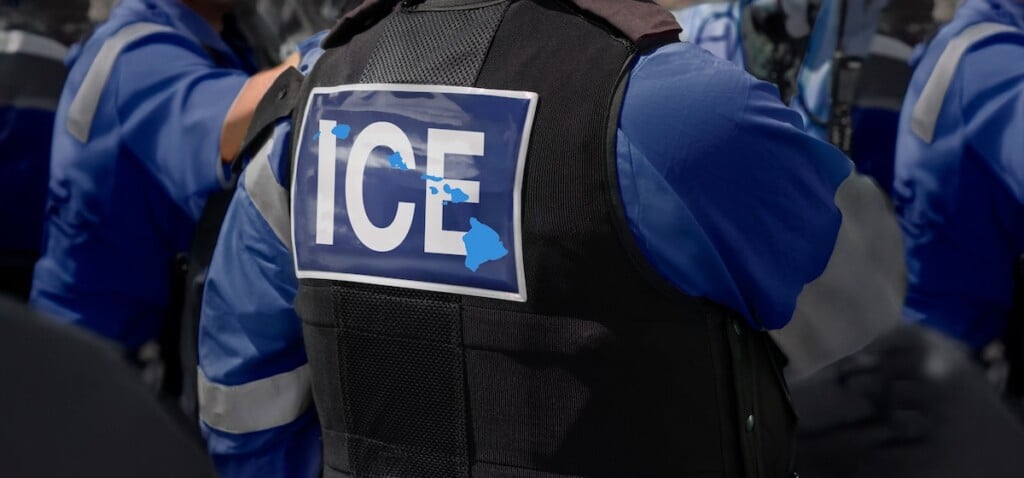
That responsibility led us, in August, to launch one of our most significant multi-media initiatives: the Hawai‘i I.C.E. Map. The map allows people across the Islands to report and track the locations of Immigration and Customs Enforcement agents operating in our communities. The volume and urgency of those reports underscore how deeply these enforcement actions are affecting workplaces, families and neighborhoods throughout Hawai‘i.
Nearly every day, we witness shocking cruelty on the streets of America—including in our own neighborhoods here in Hawai‘i. Video after video circulating on social media shows burly I.C.E. agents wrapped in combat-style protective gear assaulting, tackling and pummeling ordinary citizens. Some are protesting the militarization of their communities; others appear to be nothing more than bystanders.
Adding a grotesquely theatrical accessory to camouflage uniforms, bulletproof vests, tactical gear, and assault rifles, agents pull knitted ski masks and nylon balaclavas over their faces. Administration officials claim the masks are necessary for protection. Yet they were not in danger until they began violently confronting people in their homes, workplaces and on streets. Rising public anger toward these extra-legal I.C.E. actions may well boil over, and sending ever more agents into communities can only inflame tensions.
Public anger toward I.C.E. did not begin this way. Most Americans initially supported the stated goal of removing dangerous criminals. But the masks came on before any credible threat became evident—perhaps in anticipation that these actions would provoke resistance.
While protests have been largely peaceful, I.C.E. tactics have been consistently cruel and violent. Videos show agents blindside-tackling elderly people merely standing on sidewalks; ripping others from their cars, including a woman who told them she was disabled; smashing the window of a man’s car at a gas station and beating him into unconsciousness—or worse—despite no sign of resistance. Transparency and accountability have become collateral damage.
In Minneapolis, the violence reached an unmistakable and horrifying extreme. Resident Renee Good’s last words heard on video recordings were, “That’s fine, dude. I’m not mad at you.” She was answered with a bullet fired at her through the windshield by agent Jonathan Ross, who then fired two more shots through a side window, including a fatal one to the head, according to an autopsy report. If that were not enough, he delivered a final verbal slur: “Fucking bitch!”
Less than three weeks later, Border Patrol agents killed another Minnesota resident, Alex Jeffrey Pretti, an intensive-care nurse whom agents pinned down on the road and then fired multiple bullets into his back. With no evidence, Vice President JD Vance and White House aide Stephen Miller immediately tried to impugn Pretti’s character, calling him a “domestic terrorist” who came there to “massacre cops.” It turns out Pretti was helping another woman who had been shoved by agents, just as in his job he took care of U.S. veterans. In assessing officials’ credibility, these actions also cannot be unseen.
These are the actions of poorly screened and poorly trained agents who have learned they are accountable to no one except Department of Homeland Security Secretary Kristi Noem—who herself demonstrated ignorance of the constitutional principle of habeas corpus during congressional testimony, a safeguard that protects people from unlawful detention.
These are also the actions of callous agents following the orders of a Justice Department that shut down an investigation into border czar Tom Homan, who reportedly was caught by the F.B.I. on video accepting a bag containing $50,000 in cash.
And in a bitter irony, these are the actions of agents who appear to know less about First Amendment protections than the newly sworn-in citizens they so often detain. Immigrants are tested on their knowledge of U.S. law before becoming citizens. How many I.C.E. agents lacking basic civic knowledge would qualify?
The President insists these agents are removing dangerous criminals to keep us safe. But our eyes show us something else. We see foreign-born neighbors seeking asylum or citizenship being dragged from courthouses where that legal process is unfolding. We see children forcibly separated from their parents. We see hard-working, tax-paying employees questioned about their accents and where they were born. We see U.S. citizens denied basic rights and detained for no reason other than the color of their skin or an agent’s suspicion.
These are the things we see—and cannot unsee—regardless of official explanations. Time and again, authorities reflexively defend their agents’ actions before examining the evidence. Investigations work harder to discredit victims than to hold lawbreakers accountable.
The world is watching, and America’s standing has been gravely damaged—perhaps permanently. The strength of the United States lies in its unique design as a country of immigrants and our strong rule of law. Hawai‘i’s business community depends on that rule of law being applied fairly and uniformly. When that fails, we fail as a nation.
In that context, the Hawai‘i I.C.E. Map is not merely a reporting tool; it is a record. It exists so that the business community and the public can see patterns, share information and bear witness. Once these realities are documented, they become part of our collective memory—and they cannot be unseen.