The Conductor Who Doesn’t Need to Speak: Colbert Matsumoto, One of Hawai‘i’s Most Consequential Leaders
In honor of Asian American and Pacific Islander Heritage Month, Hawaii Business Magazine spotlights one of the state's most consequential leaders, Colbert Matsumoto, whose quiet, disciplined approach to leadership continues to shape institutions, mentor the next generation and redefine what influence looks like in Hawaiʻi.
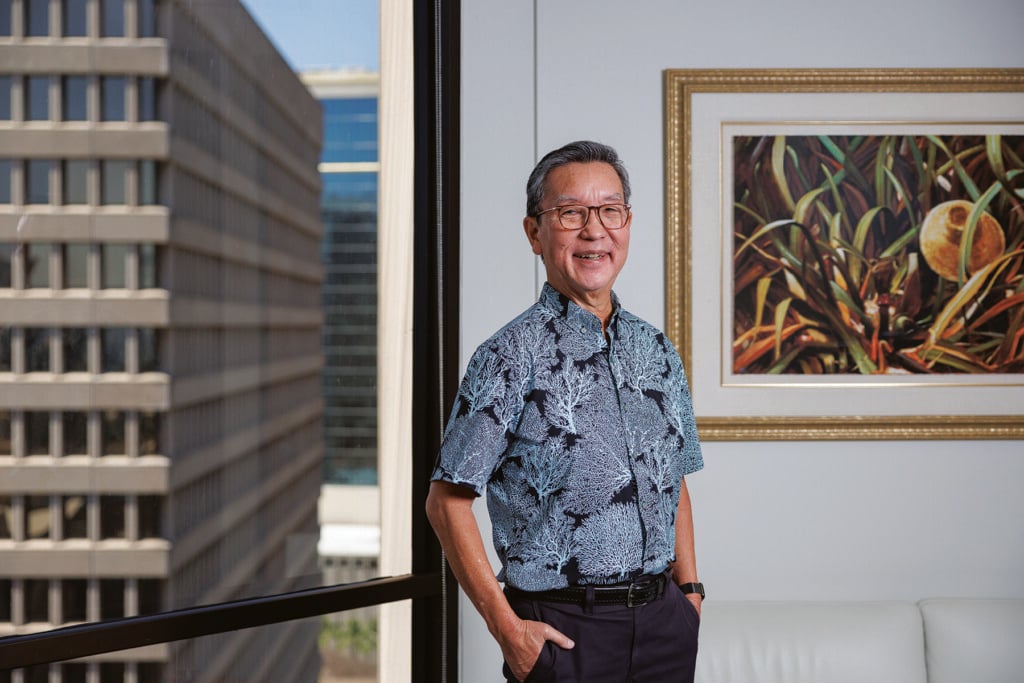
At our first meeting eight months ago, Tradewind Chairman Colbert Matsumoto brought along one of his mentees, Chris Fong, to talk about the revitalization of downtown Honolulu. Matsumoto didn’t speak much himself; instead, he let Fong outline the ambitious projects Tradewind was leading.
“Good leaders listen. They don’t always need to talk,” Matsumoto said in a follow-up interview.
Matsumoto is candid about the role his cultural identity plays. “My background has had a very strong influence in terms of my success,” he says. He describes a fundamentally different approach to decision-making with a focus on long-term outcomes and business relationships. “I think Asians tend to be much more holistic in terms of how they look at things, as opposed to having a linear, logic-based approach.”
In Hawaiʻi, where nearly half of all leadership positions in business, government and civic life are held by Asian-American or Pacific Islander individuals, that perspective resonates not just culturally, but practically, shaping the way institutions are guided and communities are served.
At the center of that approach is listening — not passive, but active, intentional understanding as well as humility. “They don’t always try to stand out,” he adds, “but they can do things very well, even if they are not recognized for it.”
Being Zen
Discipline has been a theme in Matsumoto’s life for as long as he can remember. After he passed the Bar Exam, he spent time at a Zen monastery in Kalihi Valley, a six-month period that profoundly shaped his approach to leadership. Daily meditation, rigorous routines and deep introspection taught him patience, focus and the quiet power of observation.
During this period, he shaved his head — a visible commitment to shedding distractions and embracing a more intentional way of living. It reflected an inner transformation, which involved learning to listen before speaking, to act with purpose rather than impulse.
“I had heard about the teacher (at the monastery), Tanouye Tenshin Rotaishi, who was an accomplished martial artist, but also a Zen teacher,” he told PBS Hawaiʻi in an interview in 2015. “I had trained in the martial arts when I was a kid growing up, and so, you know, I had an interest in it. But I had also realized that Zen was the philosophical underpinnings of Japanese martial arts and so, I wanted to learn more about that. That’s why I asked him if I could train with him at his temple.”
That practice now permeates every boardroom meeting, fundraising campaign and mentorship conversation he undertakes.
He often describes leadership as being like a conductor of an orchestra. “You have different sections,” he says, “each with a different role and each with different strengths performing a symphony.”
Leaving Law for Island Insurance
Long before Tradewind, Matsumoto built his career in law, practicing for two decades before making a pivotal shift in 1999. At the height of his legal career — fresh off high-profile work as court master overseeing the Bishop Estate — he made an unexpected decision: He walked away.
His role at Bishop Estate placed him at the center of one of the most consequential and controversial chapters in Hawaiʻi’s modern history. Appointed to conduct an independent review of the trust’s operations, Matsumoto was tasked with examining allegations of mismanagement within one of the state’s most powerful institutions. What began as a technical legal assignment quickly escalated into a sweeping investigation.
The findings were stark. His report detailed governance failures, conflicts of interest and systemic issues that called into question how the trust was being run. The organization was then estimated at $6 billion to $10 billion, making it one of the largest charitable trusts in the nation, stewarding assets for Native Hawaiian education. The work carried enormous pressure, with implications reverberating across Hawaiʻi’s legal, political and business communities.
Matsumoto understood the stakes in real time. Doing the job thoroughly meant inviting criticism — and potentially alienating powerful interests. There were moments he considered stepping away.
Instead, he stayed. The report became a catalyst for sweeping reform, ultimately leading to significant changes in governance and restoring public trust in the institution. It also cemented Matsumoto’s reputation as someone willing to step into difficult, highly scrutinized situations and see them through with rigor and independence.
Preserving a Local Institution
Riding on that momentum, Matsumoto ended his legal career in 1998 and became chairman of Island Insurance in 1999.
“At the time that I made that decision, my law practice was actually peaking,” he says. “I had just finished my work as a court master for Bishop Estate, and I had just been the recipient of all this publicity about that work — it raised my prominence.
“I was on the front page of a newspaper on multiple occasions. I left because Island Insurance was my client, and I knew that Island Insurance at that time was struggling.”
Island Insurance needed a touch of the Matsumoto magic. At a time when many Hawaiʻi-based firms were being absorbed by mainland corporations, Matsumoto saw something at risk beyond a single balance sheet — the preservation of a local institution.
“The thing that I feel most satisfied about is my leaving my law practice to join Island Insurance,” he says. “I left because I wanted to help play a role in making sure Island Insurance remained a locally based company.”
The move was not without risk. He had never run an insurance company, and his legal career wins were at an all-time high. But Matsumoto’s trademark for problem-solving and playing as main “conductor” led him to identify and recruit executives who understood underwriting, risk and operations.
Island Insurance stabilized — and then it grew. Matsumoto helped strengthen its position as a locally owned and managed company in a highly competitive industry. Just as important, it maintained its identity, continuing to serve Hawaiʻi’s businesses and residents with a level of local connection that larger firms could not easily replicate.
“That whole experience was a very remarkable, satisfying and fulfilling experience,” he says.
But Matsumoto was already thinking beyond insurance, recognizing that both the industry and Hawaiʻi’s broader economy offered limited growth. Rather than look outward to the mainland — a path that had proven to be risky for other Hawaiʻi companies — he looked inward.
Using Island Insurance’s surplus capital, he helped launch Tradewind Capital as an investment platform focused on local opportunities: Hawaiʻi-based businesses, real estate and ventures tied to the community.
Tradewind invested selectively, often in companies navigating transition, providing not just capital but strategic guidance and long-term partnership. What emerged was not just an investment firm, but an ecosystem that reflected Hawaiʻi’s unique economic and cultural landscape. On its website, the firm says it targets “companies with EBITDA of $2 million to $10 million, ideally with an established and defensible market position, unique or proprietary products or services or cost advantages.”

Colbert Matsumoto helped raise $9 million in an effort to save the Japanese Cultural Center from foreclosure.
Saving the Japanese Cultural Center
One of Matsumoto’s defining moments came when the Japanese Cultural Center of Hawaiʻi faced financial ruin. The nonprofit, a cornerstone of the Japanese American community, was on the brink of foreclosure in 2002. Closing its doors would have meant losing not just a building, but decades of history, memories and community programs.
Matsumoto stepped in as a strategist, mentor and listener. Over months of careful outreach, coalition-building and hands-on management, he helped raise $9 million, securing the Center’s survival and sparking a revitalization.
“It wasn’t just about the money,” Matsumoto says. “It was about understanding everyone involved — the staff, the donors, the community. Listening first, acting second. That’s how you create lasting change.”
All told, Matsumoto reflects that philosophy more than ever — not playing every note, but ensuring the next generation knows how to.
Fong, Matsumoto’s mentee, says, “Colbert has an innate ability to see opportunity where others may not, and to thoughtfully connect ideas and people in ways that create something entirely new. He has taught me to embrace new ideas with courage, supported by diligent planning and disciplined execution.”
Fong, who serves as a Senior Investment Associate at Tradewind Capital, where he is a member of the real estate acquisitions and asset management team, says: “Even at this stage of his career, he remains deeply committed to building for the future, with a focus on shaping a better path forward for the next generation.”
Asked about what he wants his legacy to look like, Matsumoto says, “I don’t aspire to be remembered. The important thing is what we do in the moment.”