Protecting Public Employees From Harassment, With Lessons for the Private Sector, Too
After nearly a decade-long campaign seeking government protections against threats stemming from workplace duties, employees may finally get state help in obtaining temporary restraining orders and other anti-harassment procedures.
In response to rising threats and assaults against employees in the Department of Education and other agencies, state lawmakers sent to the governor two bills that would establish protections for public workers facing harassment or physical violence.
If enacted into law, one measure would for the first time authorize the state Attorney General to assist threatened education workers, including sports officials at DOE facilities or public charter schools, to obtain a temporary restraining order against aggressors. A separate bill would make harassment a misdemeanor, punishable by up to 1 year in jail and a $2,000 fine.
Previously, the department often resisted moves to restrict harassing parents or others while requiring employees to handle those cases as private matters, including hiring their own lawyers. Political support for the bills changed after a violent attack on Moanalua High School Assistant Athletic Director Natalie Iwamoto on Dec. 4, 2025, was captured on surveillance video and circulated widely online.
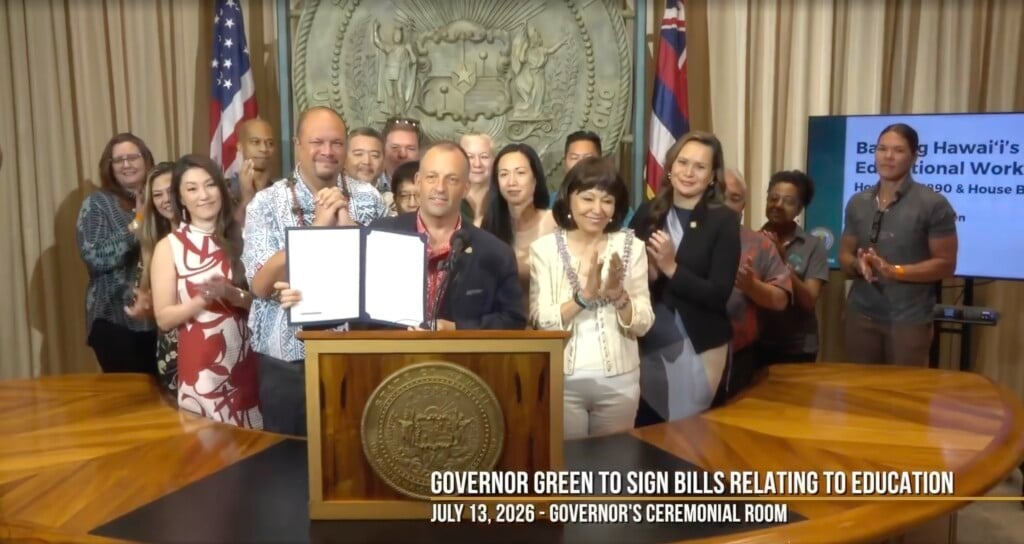
Gov. Josh Green did not tip his hand on whether he planned to approve or veto the bills. In a statement, his office said: “The governor will carefully review these bills and other legislation enrolled to him. Decisions relating to these bills will be released at the appropriate time. As the nation’s only physician governor, Governor Green has seen firsthand and treated injuries suffered by victims of violence. He does not condone violence of any kind, physical or verbal.”
If the governor takes no action, the bills will become law within 45 days.
Osa Tui Jr., president of the Hawaiʻi State Teachers Association, which represents more than 13,000 teachers, said: “We appreciate the advocates who have worked on this bill’s language for many years, and we find it important to note that this legislation provides clarity and accountability when harassment occurs and requires the State Department of Education to act.
“When educators and staff face harassment or threats without clear protections or consistent response procedures, it affects not only employees but also students and school communities.”
Private Sector Impact
The new standard could reverberate in the private sector as well. Although not binding on private companies, the bills reinforce the legal concept that employers are responsible for the safety of workers while doing their jobs.
“However, it manifests itself, workplace violence is a major concern for employers and employees nationwide,” according to the U.S. Occupational Safety and Health Administration website. It defines workplace violence as “any act or threat of physical violence, harassment, intimidation, or other threatening behavior that occurs at the work site.”
While teachers and other employees in education often have the most direct interaction with the public, threats and actual violence have been increasing across the nation against judges, healthcare workers and others. Nationwide, about 750 violent acts in all sectors resulted in fatalities in 2023, according to the latest available government records.
“Workplace violence is one of the most serious — and often underappreciated — safety challenges facing American businesses,” says Building Security Services, which provides corporate security protection.
OSHA places responsibility on employers to establish a zero-tolerance policy toward workplace violence. “The policy should cover all workers, patients, clients, visitors, contractors, and anyone else who may come in contact with employees,” it says.
It’s Been a Long Time Coming
For one former DOE employee who helped draft the Hawaiʻi bills, their passage of the bill was bittersweet but also a potential watershed development that could change the way the state bureaucracy handles threats to government workers while on the job.
“I feel that a weight has been lifted, a weird sense of exhaustion, like mentally and physically being in a kind of heightened level of anxiousness – a kind of trauma response,” says Lindsay Chambers, a former DOE communications director, who endured years of threatening comments, emails, social media posts and phone calls from an aggressive parent before she decided to leave her job for the private sector.
She says she didn’t get support from DOE administrators, and that it took the recorded violent attack on Iwamoto to change the state’s position. The current bills are the culmination of a four-year legislative campaign to codify the department’s responsibilities.
“For years, the department’s position was essentially that when a DOE employee is harassed by a member of the public, it is treated as a ‘personal’ matter rather than an issue the institution itself needed to address,” Chambers says. “In both my situation and Natalie’s, we had to hire our own attorneys to pursue TROs. This reinforced the idea that the responsibility was being pushed onto individual employees.”

Department of Education Superintendent Keith Hayashi | Credit: Hawaii News Now
DOE Superintendent Keith Hayashi did not respond to an emailed request from Hawaii Business Magazine to his office or to a text to his executive assistant seeking comment. Iwamoto declined to comment.
For years, the DOE has pushed back on legislation to strengthen employees’ legal protections. In January 2024 testimony before the House Committee on Education, Hayashi said: “We do encourage our employees, if they are harassed, to file police reports. I do know of instances where our employees have sought to seek temporary restraining orders on individuals. … there is a process in place where our employees work through that. In seeking a temporary restraining order, it is through the individual capacity.”
Chair Justin Woodson pushed back, responding, “I think, heaven forbid, if there’s a complaint or if something was brought to a superior’s attention, [and] something happens to that employee, I believe my understanding of the law is that you are liable.”
Hayashi responded by saying he would have to seek legal guidance before commenting further.
Nearly a year later, Hayashi advocated against provisions in a similar bill during review by the House Judiciary & Hawaiian Affairs Committee, opposing use of state funds to cover the costs of serving temporary restraining orders and hiring attorneys.
“These are private legal matters that involve personal rights and responsibilities, and funding such actions with public resources may violate constitutional restrictions on the use of public funds for private purposes,” he said.
At the same hearing, Chambers testified that she was left on her own despite being asked to file a TRO for her team of employees against an aggressive parent who had a long history of threatening behavior.
“My family and I were thrown into the line of fire because the DOE lacks a standardized response procedure when educational workers come forward to report incidents of harassment,” Chambers testified. “When employees under my supervision raised safety concerns about this perpetrator, DOE leadership was unprepared and repeatedly failed to act, even after multiple reports.”
Less than a year later Iwamoto was attacked, and Hayashi subsequently issued a permanent trespass notice, banning two individuals from all public school properties. “No one’s safety should be jeopardized while doing their job — especially at a school event meant to support students and bring the community together. Our employees deserve to feel safe,” he said in a statement. “This cannot happen again.”
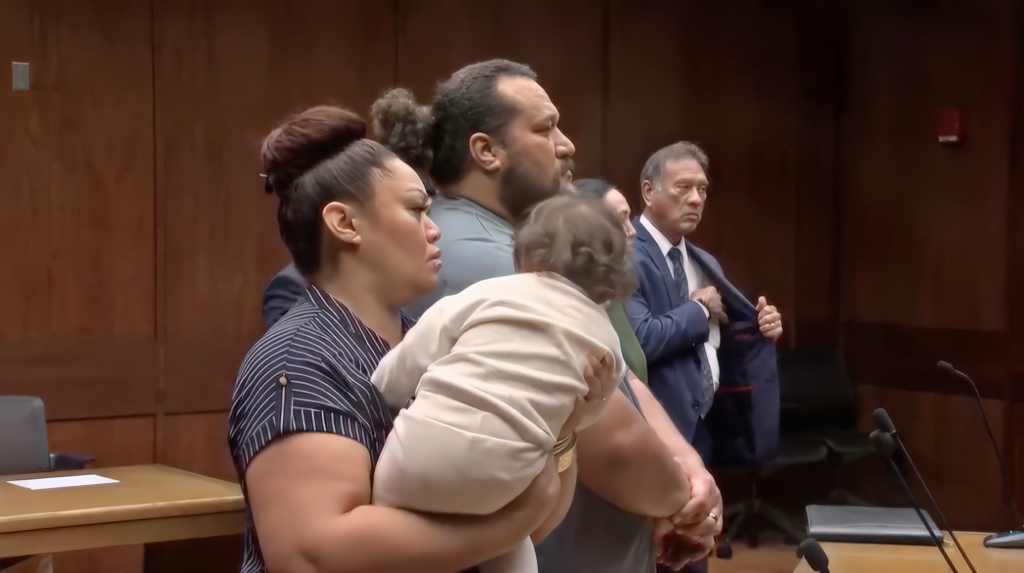
The video of the incident shows Iwamoto approached by a large man while she was standing outside after a basketball game. The man forcefully hits Iwamoto and shoves her to the ground where she suffered a concussion. He was later identified as Aukusitino I. Noga Jr., a prison guard who is 6-feet, 1-inch tall and weighs 310 pounds, and his wife Jamielee Noga.
That turnabout gave Chambers hope. “What stood out in [Iwamotoʻs] case was that the DOE ultimately imposed a lifetime ban on the perpetrator once the public backlash became impossible to ignore,” she says. “That demonstrated to me that stronger institutional action was always possible.”
Chambers, who says she now feels much safer in her private sector job, adds that she was contacted by more than 20 other government employees with similar experiences after her story was featured in a Honolulu Star-Advertiser article.
“When I testified I often asked, ‘what will it take for things to change?’” Chambers recalls. “I was worried nothing would be done until someone was killed. It is definitely a situation where leaders dragged their feet until someone was horrifically attacked.
“Beyond the actual harassment and assault, there is also ‘institutional betrayal,’ which occurs when an institution fails to prevent harm or does not respond to reported safety concerns, compounding an already traumatic experience. Just because there may not be visible physical injuries does not make the abuse or harassment any less severe.”