Pung! Clicking Tiles and the Business of Mahjong
At tables across O‘ahu and around the state, women are quietly building something more than mahjong hands — they’re building networks, businesses and above all, camaraderie.
There isn’t much happening on Nuʻuanu Avenue just south of Beretania in Honolulu’s Chinatown on a Tuesday night. My destination is only a short walk from Mark’s Garage, but even so, I find myself glancing over my shoulder. The block is eerily quiet.
Then I reach 1164.
At a bright oasis in the dark, I step through the door of Native Books. It feels less like entering a shop and more like crossing into a portal to another world. Bustling noise, tiles clicking, happy chatter, plates filled with abundant potluck offerings. The room is alive with energy.
A week before, I had never so much as held a mahjong tile. Three days later, I arrived at my friend Rachel’s mahjong lesson, unsure whether the game would even click with my brain. My seven-year-old son has tried countless times to teach me chess, and it simply refuses to stick. To my surprise — and delight — American Mahjong took hold. As complicated as it seemed, I followed along. I even somehow won. I stared at my tiles, cross-checking them with the card. “Wait — mahjong?”
But that experience didn’t translate to my Chinatown foray at all. Rachel had coached us through every move, and I was surrounded by other women who, like me, had never even heard the word “pung.”
Suddenly, I’d entered the world of mahjong in Hawaiʻi. It’s more than a game. It’s also an excuse for people to come together to match wits, execute strategy, interact socially and share uncommon cultural experiences. In Hawaiʻi, with nearly 5% of its population ethnic Chinese and 37% Asian, the game that originated in China is now widespread. It has quickly spread beyond Asian communities to become a global trend.
Interest in mahjong has surged in the last two years in Hawaiʻi and across the nation, although the market size is difficult to discern because so much goes unrecorded. “Primary growth drivers encompass rising disposable income, extended leisure time, escalating game popularity, and a growing number of Mahjong venues,” according to Data Insights Market. Global estimates of the market range from $1 billion to $3 billion, with annual growth rates ranging from 3% to 8%. The U.S. contributes a rising segment as interest spreads across ethnic groups and among new players within millennials and Gen Z, as well as older generations.
Mahjong is a microcosm of the business community distilled into four chairs. It forces players to decide upon a strategy and commit, be aware of competitors’ hands and pay attention to what is discarded. On the table and in life, players need to be flexible, react quickly and, most importantly, work with what they’re dealt.
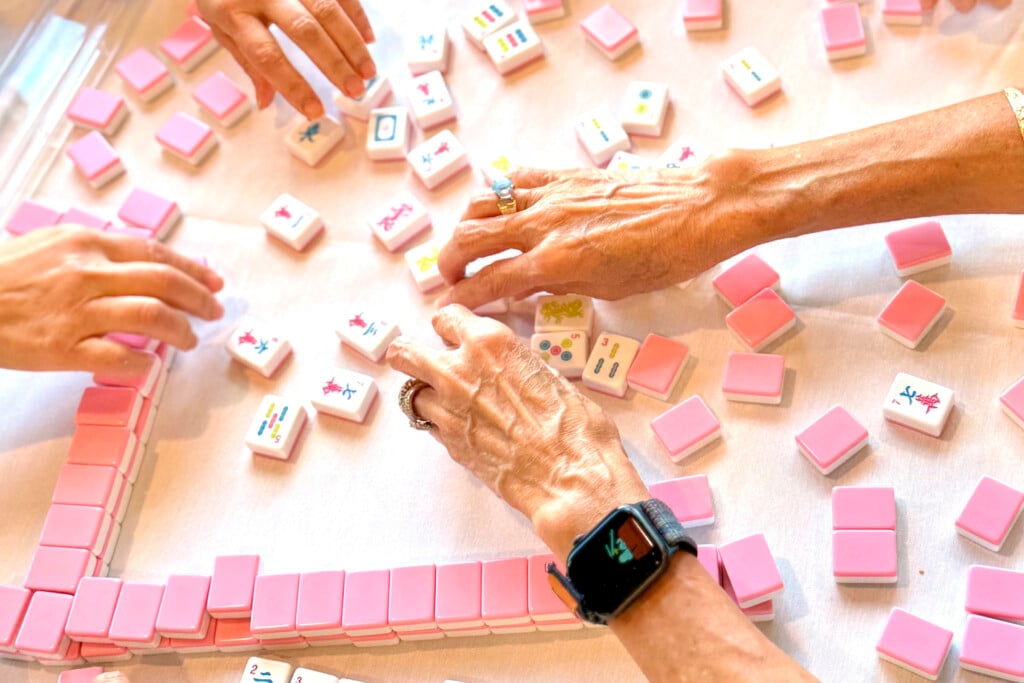
American mahjong is played with a set of 144 tiles of different categories and colorful designs. Each player starts with 13 tiles and takes turns drawing and discarding tiles to combine them into sets, with rules along the way governing the process. The first player to complete a winning hand calls out “mahjong.”
At the Table
I’m about to ride solo — seated at a table of mahjong regulars, without my official adviser.
I pause near the entrance, not knowing where to go or what to do, suddenly feeling like the new kid on the first day of school trying to figure out where to sit in the cafeteria. Every seat at every table is full.
A woman with a kind smile asks if I need help. I explain that I am new to mahjong and that this is my first time playing in Chinatown.
She nods, then walks over to one of the tables and gestures in my direction. Four pairs of eyes look up at me. I smile uncomfortably and muster up a lame wave. One woman stands up to make room while the others introduce themselves.
“So are you a first-timer here?” a woman with white-and-gray speckled hair and a bright red aloha shirt asks.
I nod.
“Just call me ‘Honorary Kūpuna,'” she says with a laugh. Her name is Barbara.
“Have you played mahjong?” Lani asks kindly.
“Yes, American mahjong. For the first time the other day.”
They all look at me blankly.
“We play Chinese here. But no worries, we’ll help you figure it out,” Joy says.
I quickly discover Chinese mahjong is not only a completely different game, but it also comes with a whole new language. Cracks are characters, dots are circles, soap are white dragons. But I feel at ease with Barbara by my side, who kindly exposes her hand so I can learn from two sides of the table. They are surprised that I managed to get a ticket. These monthly gatherings, they tell me, sell out in 20 minutes. Lani has actually timed it.
I don’t leave with a win. But I walk away with a full stomach, the working knowledge of a new game and three new friends.
Not bad for a random Tuesday night.

Left: Mahjong player Rachel Bradley looks over her tiles while considering her strategy. Photo: Rachel Bradley | Right: Bonnie Fong calling “pung.” Photo: Kerri Meade
Building a Community
After learning how to play mahjong from a friend, Rachel Bradley, a real estate agent, was hooked. But when that friend moved away, Bradley was newly obsessed with the game — and had no one to play with. So she taught her husband and children, then began recruiting friends.
Still craving more of a community around the game, she hosted a mahjong gathering of her own. She texted 20 friends, and to her surprise, every one of them showed up — not only that; they were eager to try something new.
Looking around the room that first afternoon, watching friends mingle with ease, laughter mixing with the rhythmic clicking of tiles, she knew she had stumbled onto something special.
“Before mahjong, we might see each other quarterly for lunch or run into each other once in a while. It’s hard to maintain friendships from all your different groups,” Rachel says.
Of that original group, nearly everyone is still playing.
“I’d say 18 of the original 20 still come every week,” she says. “Only a couple have drifted away. We were all hooked.”
Organic Networking Engine
What started as a fun girls’ gathering experiment has become a standing game every Saturday at 1 p.m. Having a weekly commitment eliminates the hassle of scheduling, removing an obstacle that so often keeps people from making plans in the first place. Instead of trying to find a time, they’ve already made the time.
The games became an opportunity to include friends from all of her social circles. On any given Saturday, her living room fills with a cross-section of professional women: triathletes and paddlers, a mortgage broker, realtors, a physical therapist, a Google employee, a teacher, a jeweler, a financial planner and even a professional musician.
Bradley’s living room becomes a professional melting pot where credentials lose their weight. “It’s a leveler,” Rachel says. There is no hierarchy at the table. You’re simply playing mahjong.
As hands are built, so are bonds. Although business is the last thing on anyone’s mind, circles naturally begin to widen.
From Hobby to Side Hustle
One morning Bradley was paddling at Lanikai at sunrise and as she took in everything around her she thought, “If only there were tiles that looked like this water.” At that moment, her new business venture, Hale Mahj, was born.
Although Bradley is a full-time luxury real estate agent, she couldn’t deny this passion project.
She put pen to paper and drew the images for their signature set. Bradley wanted it to be representative of Hawaiʻi but something authentic that would speak to locals, not tourists. “I wanted natural resources more than cheesy tropical drinks.” The set would be composed of all natural elements: coconut trees for bamboo, sea urchins for dots, hula dancers for the winds.
She had been guilty of scrolling down a mahjong rabbit hole and discovering that entrepreneurial women all over the world were creating their own mahjong tile sets in endless styles and palettes — colors with playful names like Peach Fuzz, Lilac Sachet and Lemon Drop, alongside themed sets like Secret Garden, Miss Cowgirl and Nantucket. Even a set called Dirty Mahj, which featured rather cheeky, risqué images (most certainly not your grandmother’s tiles).
The same way the clothes you wear or the books on your shelf say something about you, now your mahjong tiles can, too.
Since Bradley’s son, Henry, had just quit his job, she immediately appointed him CEO. He researched Chinese commerce platforms and then spoke directly to factories in China that make tiles, outlining costs and timeline. Her two other children are also involved in the venture: Sky manages Hale Mahj’s Instagram account, and Wyatt teaches mahjong lessons.
Bradley is planning a vacation to China with her husband, Scott. Learning that one of their stops was only 10 minutes from the factory producing her mahjong tiles, she contacted them — and was invited for a private tour. Her hobby had unexpectedly become part of the adventure.
For an empty nester who says she “cried every day for a year” after her youngest left home, Hale Mahj has become far more than a business for her. Mahjong has brought her family around the table — and into business. For the Bradleys, the family that plays together now works together, too.
Local Businesses Hopping on the Mahjong Trend

Cori Weston & Sandy Fong celebrating their opponents winning hand at Waiʻalae Country Club. Photo: Kerri Meade
“Covid changed the whole business model of what a coffee shop was,” Liz Schwartz, owner of Talk Kaimuki, says. Before the pandemic, people stopped in briefly for a drink before heading to the office. After Covid, many were working remotely and lingering at tables for hours, often buying just one drink. Schwartz found herself wondering how she would keep the business profitable. “What will people spend money on?” she asked herself. The answer was clear: alcohol.
She rebranded the space from Coffee Talk to Talk Kaimuki. When the café closes at 4 p.m., it transforms into a cocktail lounge at night, reshaping the business to adapt to changing times.
The idea for a mahjong night came after Bradley hosted a small daytime gathering at the café. Schwartz thought, “We should turn this into an evening event.”
Talk Kaimuki recently hosted its first Mahjong Night, open to experienced players and those who are “mahj-curious,” with a $40 ticket that included two drinks. The night was a complete success. With only two weeks to organize, the event drew 40 people. People are “doing something they love, with an energy that’s completely different from a regular Friday night,” Schwartz says. Attendees were “mostly women from all walks of life. There wasn’t a singular demographic.”
Social connection remains the common thread. “People want a reason to gather,” Schwartz says. She recalled one woman, a retired lawyer who had spent most of her life focused on her career and now found herself without a social circle. She learned to play mahjong and found one.
Why It’s Hooking Professional Women
Although mahjong is played socially and competitively by men and women alike around the world, I found it has a particular appeal for women in Hawaiʻi.
Overwhelmingly, when I asked women what they love most about mahjong, the answer was social connection. They used many words to describe it: “camaraderie,” “social,” “friend time.” At the core of all of them is the same idea — togetherness.
Another aspect is the friendly competition. “I’m surrounded by really smart women,” Rachel says, “and they’re all up for a challenge.” Every time you’re dealt a new hand, you have to figure it out. It’s like a different puzzle every time.
Of course, every woman at the table wants to be the first to declare “mahjong.” But the competitiveness has a different tone — fun rather than cutthroat. When someone calls it, there’s a burst of pride and excitement that’s shared by the three other women at the table. The celebration feels genuine. There are no empty “good job” or “way to go” clichés. Anyone could have won the hand, and someone was always going to. But when it’s you, there’s still a small sense of surprise — almost magic.
Mahjong also forces players to be fully present — a rare gift in a multitasking, technology-driven world where many people easily spend four to five hours a day on their phones. The game demands mental sharpness and a tactile focus that requires your full attention. If your mind is still lingering on a coworker’s response to your idea at yesterday’s staff meeting, you might miss a joker swap or discard the wrong tile. Mahjong offers a chance to set aside the stresses of everyday life. “The worst thing you can have is a terrible hand,” Rachel says.
Ironically, Bradley is not a game person. “I will not go to a card night. I will not play any board games. I’d rather die than play Monopoly for 10 hours. But this game, I don’t know what it is, perhaps because it’s a mix of social, tactile and strategy all at the same time, is just really unique and interesting.”
Mahjong Sisters
On Monday afternoons, more than 20 women gather in the grand ballroom at Waiʻalae Country Club to play mahjong, where floor-to-ceiling windows frame the Tiffany-blue water outside. Bonnie Fong, the group’s founding member, wanted to create a gathering point — a way for more members of the private club to meet and mingle. When she floated the idea, the answer came back quickly: mahjong. “Regardless of the level you’re at, you can play and have a great time,” Fong says. “And mahjong is a great way to build camaraderie.”
The women invited me to their tables, and before long, they were drawing stories out of me. They knew about life with my three boys, why I chose to marry my husband, and my childhood growing up in New York. The conversation was punctuated by the steady rhythm of mahjong chatter: “I almost had seven sisters.” “She’s a good feeder.” “Seven bamboo.”
Yet the talk never disrupted the game. Instead, the two moved together with a natural rhythm. The women seemed to enter what psychologist Mihaly Csikszentmihalyi famously called a flow state — complete immersion in an activity, carried effortlessly by the current of time.
Two hours later, I walked away feeling as though I had gained several new aunties. I wasn’t treated like an outsider. They welcomed me in the same way they treat one another.
“We call each other mahjong sisters,” Myrna Murdoch says.
And I felt like one of them.
Rewriting Expectations
Although the women at Waiʻalae Country Club show up week after week, they’re always mixing up the tables and meeting someone new. One afternoon, Myrna Murdoch sat across from a woman she’d never met. They started out as strangers, but by the final hand, that had changed.
“A random mahjong game has turned into what might be my next trajectory in life,” Myrna says.
As they were all getting to know one another, she mentioned to Murdoch that she is a Dean Emerita of Pepperdine University.
“I always wanted to get a Ph.D.,” Myrna admitted.
Without skipping a beat, she replied, “Well, why don’t you?”
Long after the game was over that day, those words lingered for Murdoch. “I couldn’t get it out of my mind. Why don’t I just do it?”
Murdoch has since submitted her application to Pepperdine University’s Leadership & Change Ph.D. program, backed by a letter of recommendation from the same woman who inspired her to take the leap. When I asked Myrna why she chose to pursue that particular program, she replied simply, “I think the world needs it.”
It’s not just professional women building networks. Women across generations are doing it, too.
In an age bracket where most people are settling into a quiet routine, Murdoch defies that story. “At 70, time carries a different meaning. I measure it not by how much remains, but by how intentionally it is used. And a doctoral program offers purposeful structure allowing me to be examined critically and translate into knowledge what I spend my whole life doing. I don’t need the prestige or authority that a Ph.D. confers. I would like to contribute something meaningful if there’s time left.”
Culture & Connection

Left: Sandy Fong Photo: Kerri Meade | Right: Photo: Getty Images
Each woman has her own story.
When Barbara Luksch joined the Peace Corps, her assignment was a community health development project in a very rural part of the Philippines that had no electricity or running water. There was nothing really to do socially other than talk story.
But they played mahjong.
Feeling a bit lonely, and eager to interact with the local people, she said, “If you could teach me, I’d love to play.” She remembers, “Before the sun set, you could walk around this small village and you would hear the tile mixing, and you could just go in and either join or watch. So this is how I learned mahjong.”
Mahjong was her entry point into an entirely new culture, and a new way of life.
Joy Zambarrano was born in the Philippines and moved to Hawaiʻi when she was six years old. Growing up in Kalihi, she spent endless hours at friends’ houses as a teenager. On Friday nights around 10 p.m., the elders would pull out the mahjong tiles.
When she came back the next day, the same group would still be there.
They hadn’t gone home. They had been playing all night.
“We’d be watching MTV or just hanging out,” Joy recalls, “and you would hear the tiles in the background. That sound will always be embedded in my head.”
Years later, mahjong came full circle for Zambarrano. After living in Brooklyn for more than two decades, she returned to the Islands and finally learned how to play — and was instantly hooked.
Growing up in Kaimukī, Sandy Fong doesn’t remember a life without mahjong. Much of her childhood unfolded at her grandmother’s house, who was the matriarch of her family and a talented mahjong player. With nine children of her own, the house was always full. “And that’s how I learned it. When my auntie or mom would take a bathroom break, I had to fill in.”
Her grandparents were from a village in southern China, and she emigrated to the U.S. when she was about 10. Although the details are fuzzy, the memories are not. She carried with her the culture of her youth, including mahjong. Fong remembers visiting her grandmother’s Kaimukī home, snacking on Chinese puff rice and mochi crunch while the clatter of tiles formed a constant hum in the soundtrack of her childhood.
She didn’t love the game when she was a child, “but now I appreciate it. I don’t think I would have known it if it weren’t for my grandparents. And because of that, I love it.”
Perhaps that’s really why so many are drawn to this game that dates back to the 1800s. It gives us everything that we didn’t consciously know we needed — a chance to disconnect from distraction and reconnect with what really matters.
Mahjong is undeniably rooted in community. You’re not just learning your opponents’ tells, but most importantly, their stories. While you’re building your tile walls, you begin to let down your own.
When you sit down at a table, you become a wind — north, east, south or west. In Chinese tradition, the winds represent the cardinal directions, the seasons and balance. Symbolically, this is what mahjong offers: the quiet reminder that we are part of something larger than ourselves.