Leadership Conference: Business Improves When Employees Feel They Matter
Matthew Emerzian urges business leaders to make human connection a priority, saying strong workplace cultures begin by letting employees know they are important.
The biggest payoff for business owners might just be free: Let employees know they matter.
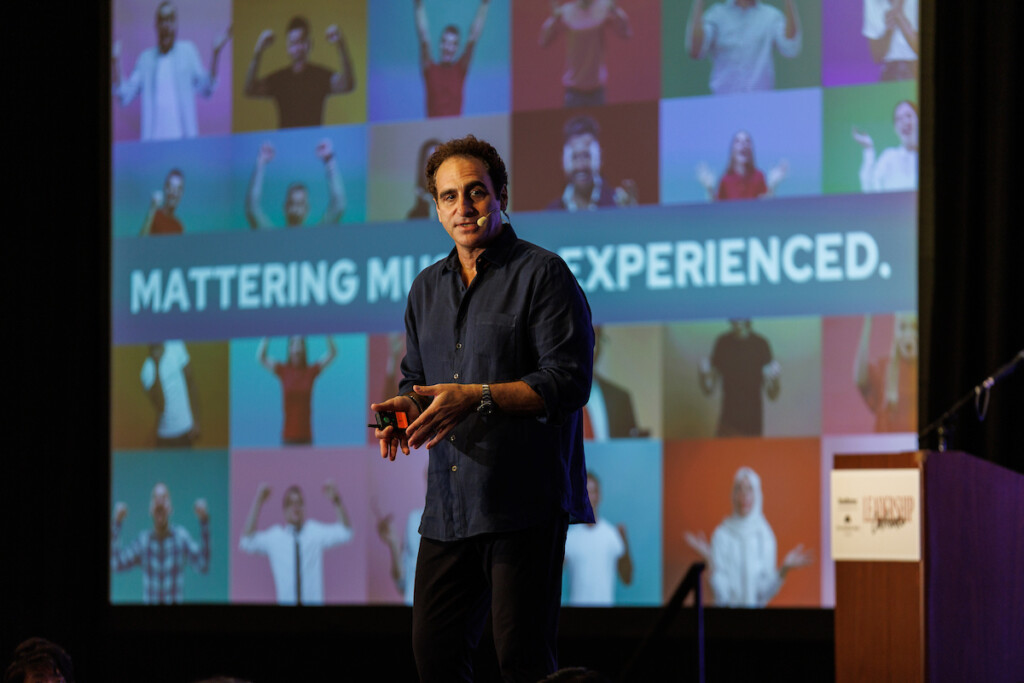
That was the message Matthew Emerzian delivered to business and community leaders at the 2026 Hawaii Leadership Conference, presented by Hawaii Business Magazine and First Hawaiian Bank on Friday, July 17, at the Hilton Hawaiian Village.
Emerzian, founder of the nonprofit Every Monday Matters and author of You Matter: Learning to Love Who You Really Are, told about 500 attendees to rethink leadership by prioritizing something that’s often overlooked in the workplace: Helping people feel valued.
“Companies are just people,” Emerzian says in an interview following his keynote. “It’s a bunch of people brought together to work toward a common goal. If we get the people right and we get the environment right where they feel like they can thrive, all of a sudden the organization will thrive.”
Emerzian opened his keynote with a personal story about his father, who died on the same day his latest book was published. Before every speech, his father would tell him, “Break a leg.” Emerzian said hearing the same words from a Hawaii Business Magazine staff member moments before taking the stage reminded him of his father and immediately grounded him in what he called Hawaiʻi’s spirit of aloha.
Before founding his nonprofit, Emerzian described a career path that included selling candy, teaching elementary school, leading swimming lessons and working in the music industry. Along the way, he joked about a series of “father-son conversations” with his dad, who questioned each career change. The stories highlighted a larger point: His path to finding purpose was anything but normal.
Drawing from his experiences in multiple careers all while overcoming anxiety and depression, Emerzian described how his understanding of success changed after experiencing a severe panic attack at age 31.
The turning point came after his therapist encouraged him to spend every Saturday serving others instead of focusing only on himself. Later, after founding his nonprofit and while speaking to a group of incarcerated men and women, one inmate told Emerzian no one had ever told him he mattered. The encounter reshaped Emerzian’s mission.
“We all want to know that our life matters,” he told conference attendees. “We all want to feel seen. We all want to feel heard. We all want to feel loved.”

Emerzian says organizations and businesses often devote attention to metrics and financial goals while overlooking the very people responsible for achieving them.
“When someone doesn’t feel like they matter, they don’t feel like they have value,” Emerzian says. “They don’t feel like they have worth. They don’t feel safe to contribute. When you wake up every single morning not feeling like you have value, it’s really hard to show up and provide any sort of value at work.”
Rather than viewing employee well-being and business performance as competing priorities, Emerzian believes they go hand-in-hand.
“Yes, we live in a capitalistic country, and businesses are there to make money,” he says. “But you can do that in a way that also honors the humanity of the process.”
Emerzian also addressed one of today’s biggest concerns in the workplace: artificial intelligence. While many worry AI could replace their jobs, he says the technology should instead allow people to spend more time doing the work technology cannot.
“I actually see it’s the opposite,” Emerzian says of fears that AI will replace people in the workplace. “There are a lot of things AI can do just fine because it frees us up to do the things only humans can do.”
He acknowledged the uncertainty surrounding AI but says leaders have an opportunity to actually reinforce employees’ sense of purpose during a period of dramatic technological change.
“The sentiment of, ‘You just want me to learn AI so you can replace my job.’ That struggle is real for the individual,” he says. “But I think there’s room for both AI and an employee who truly feels like they matter to coexist in the workplace.”
Throughout the keynote, Emerzian encouraged attendees to find simple ways to connect with others, something he says is lacking in the world. He joked that people spend hours sitting shoulder-to-shoulder on airplanes without ever introducing themselves and often ride in elevators in complete silence, despite standing just feet apart. He says those everyday moments are opportunities to make someone feel seen with something as simple as an introduction, a compliment or a meaningful question.
While his address drew applause for its inspiration, Emerzian says there are tangible things leaders can start doing immediately – and it won’t take sweeping initiatives. Instead, it begins with small and consistent actions: greeting employees, making eye contact and checking in before meetings.
“You can’t go into a culture and teach trust,” Emerzian says. “You just have to show up every day in ways that build trust.”
Emerzian emphasizes that those simple actions will reinforce the kind of workplace culture he hopes leaders will continue to foster long after the conference ends.
“People are thirsty for connection,” he says. “They’re looking for purpose and meaning again. Work can be the place where people find that, if we choose to create an environment where people feel like they matter.”