The Disappearing Affordable Condos of Honolulu
Escalating maintenance fees, aging buildings, strict occupancy rules, and high mortgage rates are squeezing middle-income buyers out of Honolulu's condo market. Can the city build its way out?
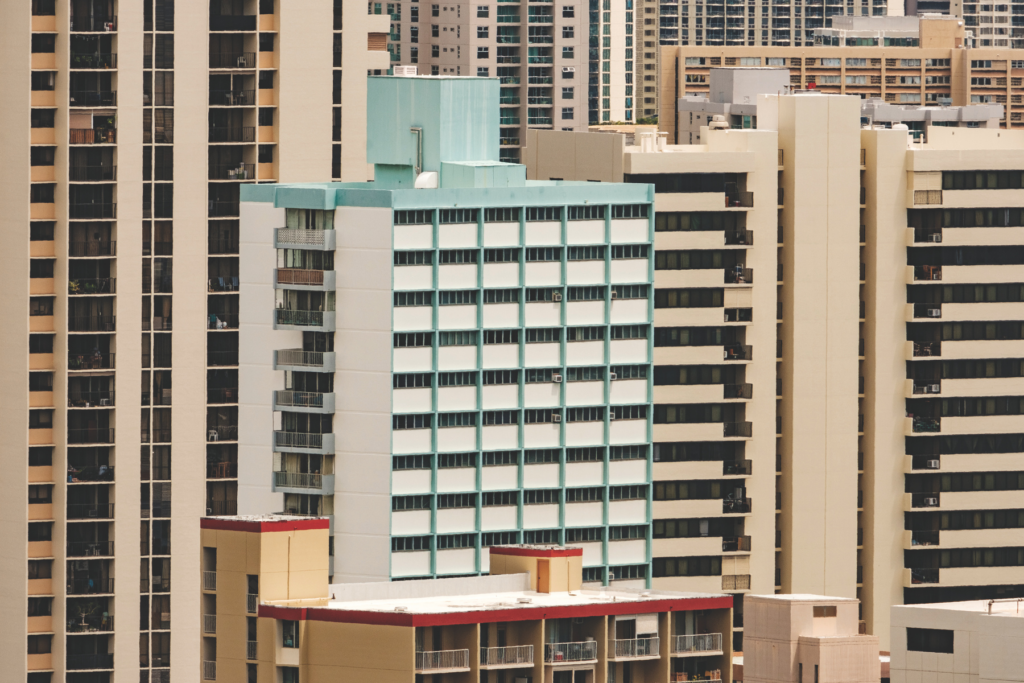
Shortly after volunteering to be board chair of a five-building, 37-unit condominium in Hawaiʻi Kai, Mark Marabella discovered he was living in a time bomb. The 1970s buildings, like hundreds of others in Honolulu, are falling apart.
“I had no idea what I was getting into,” says Marabella, a senior consultant in quality improvement for the healthcare industry. “I get texts all the time about sprinklers, leaks, mold, wood rot, spalling — everything that’s going wrong with the property.”
Marabella inherited a pile of deferred maintenance issues and a management executive who didn’t keep lists of vendors, rarely answered emails and managed to give a $55,000 deposit for new roofs to a company without a license. The latter was discovered when the permit was declined; it took a year to get the deposit returned.
He’s dealing with problems with lighting and irrigation, while putting a plan in place to tackle major repairs on the 53-year-old buildings: painting, tenting for termites and the re-roofing project that was delayed. He’s also working with a plumbing company to try to extend the life of the drain lines and dodge having to replace the system.
To pay for it all, he’s in the unenviable position of overseeing two increases in condo fees, which now break the $1,000 mark, as well as a one-year assessment of nearly $300 a month to beef up reserves. Before that, fees were low, but little got done. “Now we’re in a world of hurt. It’s so bad that it keeps me up at night,” he says.
In addition to repair costs, the condo association’s hurricane insurance policy, through Lloyd’s of London, shot up almost 500% at the height of the insurance crisis, from $51,555 in 2023 to $247,824 in 2024. By 2025, the cost had settled downward to $148,086.
To his relief, the former management executive quit and a far more capable one has replaced him. In talking with other boards, the consensus is that property management companies aren’t the problem. “The only thing that makes a difference is if you have a great management executive. A great one makes the property run well and a bad one ruins your life,” he says.
Marabella says he’s determined to get the property and finances in good shape, but it’s been a difficult two years getting up to speed, with almost no assistance from former board members or the property management company. While the burden has fallen on one volunteer, “we have to turn it around and work together as a group,” he says, hopefully.
In less hopeful moments, he considers selling his unit and renting an apartment, thus passing off the headaches to a landlord. For all their benefits of larger spaces and decent prices, as condominiums hit the half-century mark, the bill comes due.
Like Marabella, tens of thousands of condominium owners feel trapped paying far more than they budgeted, while others struggle to find newer units they can afford, and that won’t bring future surprises.
How Did We Get Here?
Honolulu real estate hit a point of no return in 2022. The median price for a single-family house jumped above a million dollars that year, even as mortgage rates rose almost three percentage points over the 12-month span, dampening the frenzied pandemic-era market. Today, rates remain high, sales activity is subdued, but the price of a house just keeps rising.
Condominiums, in comparison, are a bargain for middle-income residents. About half the price of a house, they offer a foothold in Hawaiʻi’s formidable real estate market and its promise of upward mobility. With the average rent for a tiny studio in Honolulu exceeding $1,500, and a 1,000-square-foot apartment at more than $3,500, condos give renters a chance to funnel their monthly payments into an asset.
But purchasing a condo comes with financial traps. Many of the gleaming new buildings rising across the urban core tap state incentives in exchange for reserving a selection of reduced-priced condos for middle-income residents. Units, however, can be pricey, minuscule and saddled with strict occupancy rules.
The more affordable options are condos from the building boom of the 1960s and ’70s, which are priced right but can come with failing pipes and maintenance fees topping $2,000 a month. Then there are the condos that were never built. A promising “workforce housing” model, for example, that brought thousands of new units to the market, at decent prices, was abandoned nearly a decade ago.
While efforts are underway to help middle-income buyers, prices seem to continually outpace stagnant wages. Many housing experts say the best way to push prices down is simply to increase supply, at all price points. “We’re never going to get where we need to be in affordability unless we build a lot more housing,” says Justin Tyndall, an associate professor at the UH Economic Research Organization (UHERO) and UH Mānoa’s Department of Economics.
But can Honolulu build its way out of this mess?
A Housing Crunch
Condos may be cheaper than a house, but the median condo price on Oʻahu is still hefty, at $510,000, according to March data from the Honolulu Board of Realtors. That’s only topped by California and some Mountain West states, where a growing population competes for a limited supply of housing.
That same dynamic of too many people vying for too little housing has played out in the Islands for a century. Newspaper clippings from the 1930s bemoan a housing crisis caused by an influx of U.S. Navy personnel and their families, according to a history of the crisis published in Honolulu Civil Beat. Each decade brought more alarmed headlines, more bold ideas, and more pushback from lawmakers, developers and residents.
One historical data point remains telling. According to the U.S. Census Bureau, the number of permits for privately owned housing units fell dramatically from 1960, when 8,129 permits were issued, to 2023, when just 3,791 were issued — even as the state’s population more than doubled. Throughout the 1960s and ’70s, more than 10,000 annual permits were routinely issued, with a high mark of 18,599 permits in 1974. In the 1980s, permitting numbers remained high but a gradual slide had begun.
By the 2010s, new home construction was only a third of what it was in the 1970s, according to UHERO’s Hawaiʻi Housing Factbook 2025. The current decade is expected to see even less building, making it the least productive period since the 1940s. Restrictive zoning, meanwhile, confines residential housing for Hawaiʻi’s 1.46 million people to just 4% of the land and favors the sprawl of single-family houses. The result is both a severe lack of housing and some of the highest prices in the nation.
While single-family houses dominate many housing discussions, and the real-estate dreams of would-be buyers, condominiums are a critical part of the housing supply in urban Honolulu and pockets of the island’s suburbs. The State of Hawaiʻi Data Book 2025, produced by the Department of Business, Economic Development & Tourism, counts 167,412 condo units in Hawaiʻi in 2023. Among structures with three or more units, not all of which are condos, the data book says 80% are on Oʻahu.
And condos aren’t just for vacationers and affluent people wintering in their second homes. Statistics collected by Title Guaranty Hawaii show that 83% of all properties sold on Oʻahu in 2025, both condos and houses, went to local buyers, mostly for long-term occupancy. Short-term rentals were banned outside Waikīkī and a handful of smaller resort areas in 2022.

Source: Honoulu Board of Realtors, based on MLS residential resales data.
This Old Condo
Many of Honolulu’s condos were built before the slowdown of the 1990s, and they’re a mixed bag. These older structures can be stark and drab, bearing hallmarks of Stalinist architecture: slabs of unadorned concrete, with small windows and low ceilings. But others are brighter, with private lanais, roomier interior spaces and softer touches such as ornate concrete breeze blocks. They’re often hundreds of thousands of dollars less expensive than newer condos. For example, a 923-square-foot, two-bedroom, two-bath unit at the Moana Pacific on Kapiʻolani Street, built in 2007, was listed for $775,000 in mid-March. A slightly smaller unit with a spacious lanai at the Punahou Towers on Dole Street, built in 1973, was priced at $430,000.
But these aging structures are also showing the impact of salty air and spotty upkeep. Cast iron drainage pipes that last for a century in some climates are failing after three or four decades, says Jeff Sakamoto, a vice president and commercial real-estate loan officer at First Hawaiian Bank who helps condo associations with low-interest loans for major repairs. Exposed, unpainted concrete flakes and cracks as water is absorbed, requiring expensive spalling repairs. Other costly work includes elevator modernization, new roofs and fire-sprinkler installations.
All of this work, coupled with rising insurance premiums, has led to rapidly escalating maintenance fees, also known as homeowners association dues. Sales data collected by the Honolulu Board of Realtors shows the average maintenance fee in February was $1,051. ʻEwa Gentry, Mililani, Salt Lake and Hawaiʻi Kai have seen some of the sharpest increases, according to sales data tracked by UHERO.
Over the past decade, condo fees have jumped 70%, accelerating over the past three years, says Aaron Tangonan, president of the Honolulu Board of Realtors. “When repairs are delayed, costs rise and drive up insurance premiums for the building, which then leads to high condo fees, creating a cycle,” he says.
Even basic units are hit with high fees. Real-estate listings advertise a 600-square-foot condo on Lunalilo Street, near the freeway, with fees of $1,316. A 925-square-foot cinderblock walk-up near the Japanese Cultural Center has maintenance fees of $1,531. A 959-square-foot unit in a mid-rise condo on Ala Moana Boulevard in Waikīkī has fees of $1,715. All were built in the early 1970s.
Amanda McCann, a Realtor with Hawaiʻi Modern Realty, says she has listings in Waikīkī that languish on the market because of high homeowners association fees: “You can get a nice two-bedroom for $550,000, but then the HOA is $1,400 and there’s going to be an assessment for another $300, at least. You’re paying close to $2,000 a month, and that becomes a problem of not being able to afford it.”
At current mortgage rates, even a $600 monthly maintenance fee is the difference between buying a $400,000 condo or a $500,000 condo, which can mean one bedroom instead of two, says Tangonan. Rising maintenance fees, along with the prospect of special assessments to fund big projects, are keeping buyers on the sidelines, afraid to invest in a money pit.

The Central Ala Moana on Kapi‘olani Boulevard opened in 2021 with 202 market-rate units and 310 income-restricted units. UHERO estimates that 500 homes were freed up in Hawai’i in the three years after the condo opened. Photo: Aaron Yoshino
Fear of Hidden Fees
Ruth Rodrigues is one of them. In January, she was devastated to learn that the owners of her rental house in ʻĀina Haina planned to sell it. She, her husband and four-year-old daughter were told in January they needed to find a new place to live, with a deadline at the end of March.
This was not the first time the family had been displaced by a landlord wanting their property back, an expensive ordeal requiring a deposit, the first and last month’s rent, and cleaning and moving costs. But she had hoped to stay for many years as she loves the house and the neighborhood, so much so that she tried to negotiate with the landlord to sell the house to her family.
But nothing worked. The preapproval letter she received for a bank loan was in the low $600,000s, not nearly enough. She searched, without luck, for gap-funding programs to help local house buyers, or tax incentives for sellers to keep their houses in local hands. She investigated the state’s affordable-housing programs, but she and her husband, both public-sector employees, earn too much.
Defeated, she began looking for a condo in Hawaiʻi Kai, where her mortgage preapproval would cover a two-bedroom unit at the 20-story Mauna Luan towers, built in 1975. Rodrigues says she was seriously considering the condo despite the maintenance fees being nearly $1,500 a month, a financial stretch. The biggest obstacle, however, was a coming special assessment for window replacements, the sum unknown.
“I don’t think we can pull the trigger and sell half our life to fit into a condo, then pay the homeowner’s fee and risk the assessment,” she says. “I don’t want to be a horror story. We lock in and then it’s, ‘hey, we need $50,000 more.'”
Rather than deal with the financial precarity of buying a condo, Rodrigues decided to hunt for another rental house, remaining one of the 40% of Oʻahu households who rent. In mid-March, with nothing yet secured, her preschooler had started telling her mother that she was heading to an open house to look at rentals and would follow up with an email, the anxiety fully absorbed.
Insurance Crisis Averted
In March 2025, media reports began warning about a secret Fannie Mae “blacklist” of condominium associations without enough insurance to cover the full cost of rebuilding. Fannie Mae wouldn’t back up home mortgages for these condos, and owners struggled to sell. The list included hundreds of Hawaiʻi condominiums that couldn’t find or afford skyrocketing hurricane insurance, driven up by costly natural disasters in Lāhainā and across the country.
Scott Saiki, the Hawaiʻi insurance commissioner and former House speaker, had learned of the problem earlier and drafted legislation to reactivate a Hurricane Iniki-era insurance program, which filled the hole left by private insurers fleeing the market. The fund had been dormant since the early 2000s.
It took Gov. Josh Green’s August 2024 emergency proclamation to address the crisis, and a second legislative vote in 2025, to bring back the Hawaii Hurricane Relief Fund. The state insurance plan is designed for condo associations that have been turned down by at least two Hawaiʻi-licensed insurers and covers secondary insurance up to $140 million, says Saiki. Condos need private insurance to cover the first $10 million of losses.
The initiative was successful. Since opening on June 24, 2025, until early March of this year, the fund had received 286 applications and written 98 insurance policies, representing $2.38 billion in insured value. One 44-story condo in urban Honolulu saw its hurricane premium drop from $266,000 to $143,000, says Saiki. “We weren’t sure what to expect, but were pleasantly surprised,” Saiki says.
Those 98 policies don’t tell the whole story. The HHRF issued 269 quotes in the first eight months, and condo associations are using them to negotiate lower premiums from private insurers, he says. “We cap an agent’s commission fees on the HHRF side, which incentivizes them to go with the private side.”
“Just the fact that the HHRF was revitalized helped the insurance market to reduce rates, and that’s a good thing,” says Sue Savio, the president and owner of Insurance Associates Inc., which handles the majority of Hawaiʻi’s condo associations. She says premiums had spiked about 300% for her clients, and are significantly cheaper now.
While the state insurance agency doesn’t monitor the so-called black list, Saiki asked a local lender about their experience. He was told the lender had 190 underinsured condos at the height of the crisis, and only 33 were still underinsured. Of the 157 that purchased full insurance, 60 got HHRF policies and 97 got policies through private insurers.
By stabilizing insurance premiums, the state fund has helped condos funnel the savings into maintenance problems, another accelerator of ever-climbing costs.
Leaky Pipes and Other Problems
For most condo buyers, paying monthly fees might feel like a fair exchange for someone else taking on the hassle of maintaining the property. But it’s not always that easy.
Condos are self-managed through a volunteer board of owners, and almost no one wants the pile of extra work, with no compensation and lots of legal risks. Governance, meanwhile, can be dull but potentially deadly, as the world witnessed when a Surfside, Florida, condominium collapsed and killed 98 people in 2021.
Assuming there are enough willing and able condo owners to form a governing body, dysfunction can prevail: acrimonious board meetings, maintenance issues ignored to save money, anger when fees are raised, and big assessments levied on unsuspecting owners when major problems derail 30-year budget projections.
“Even if there’s a reserve study and you fix things every five or 10 years, the costs keep going higher so you’re not adequately reserving anyway,” Savio says. She sympathizes with board members who are reluctant to raise fees, but advises them to be business-minded. “You have no choice,” she tells them. “You have to maintain this building and these people’s assets. Generational wealth is your real estate.”
About 45 years ago, Savio bought a condo on the Ala Wai Canal for $45,000 on a school teacher’s salary. At the time, condo associations didn’t think about long-term maintenance issues and stockpiling reserves, she says. Now, these old condos are more valuable than they once were, which adds insurance costs, and they have far more problems, contributing to more claims and higher premiums and deductibles. Maintenance accounts for about 60% of insurance costs, with hurricane insurance making up the rest.
Savio has seen the good and the bad of condo maintenance. On the positive side, she represents an old three-story walk-up in Makiki that takes care of potential problems in advance and has a $5,000 deductible. “I haven’t seen a $5,000 deductible in 20 years,” she says. “They’ve never filed a claim, nothing ever seems to go wrong.”
On the other extreme, she works with a condo in Waikīkī that has regular water leaks and damage claims. “Their premium rose from $235,000 a year to $1.2 million, and the deductible rose from $25,000 to $100,000 because of bad pipes,” she says. She recommends getting a bank loan to fix problems rather than paying insurers.
Sakamoto from First Hawaiian Bank says $100 million in repair loans are given to condo associations each year, from his bank and others. The low-interest loans can be paid upfront or over the useful life of the component being fixed. “We don’t want the maintenance fees to increase more than 25%, but they can double,” he says.
Before writing a loan, Sakamoto looks at how much the repairs will raise maintenance fees and whether fee-payment delinquencies exceed 10%. The bank also prefers a high concentration of owners living in the building. These factors influence the bank’s decision, “but we try to help every association,” he says. “It’s a community service.”
Reserve studies may suddenly change, but they’re still crucial for buyers, says Tangonan from the Honolulu Board of Realtors. “It lays it all out,” he says. “The buyer can see what is scheduled and how much of that project is funded through their reserves. Those play bigger roles in understanding what you’re buying when it comes to condos versus just having a home inspection.”
Some condo buildings do very well with governance and fees, and some don’t, says Lee Wang, the executive director of Housing Hawaiʻi’s Future, a nonprofit housing research and advocacy group, and a Realtor. “We should be studying what is working on the buildings that do [well,] because it’s not a one-off. It is a trend that is replicable.”

Lee Wang, the executive director of Housing Hawai’i’s Future, on the lanai of his 1970s condo in Makiki. His organization advocates for increasing the housing supply and loosening rules around reserved units in new condominiums. Photo: Aaron Yoshino
Saiki says the condo self-governance model needs to be revisited, especially as the city grows denser with high-rise condos. He stops short of wanting government intervention but says the ad hoc system in place now needs improvement.
“There needs to be a focus on governance and management of condo buildings,” Saiki says. “On the board level, the property management level and the unit level, each has a responsibility to maintain their properties and finances over the long term.”
Unlike older buildings, new condominiums have far fewer problems and more modest fees, especially ones without swimming pools or fancy amenities. Until recently, developers were producing well-priced, lightly regulated condos that many middle-income people wanted. The model didn’t last.
Death of “Workforce Housing”
The two towers rising 46 stories high at 801 South Street in Honolulu house more than a thousand simple, no-frills condos, with unassigned parking and limited amenities. The condos were created by Marshall Hung, who oversaw similar projects in Salt Lake, on Young and Waimanu streets, and at the Chinatown border on North King Street.
When the towers opened in 2015 and 2017, three-quarters of the units were reserved for people making up to 140% of the city’s median income. These buyers were required to live in their units for two years, but there were no further restrictions on reselling or requirements to share equity with the state.
Dubbed “workforce housing,” a two-bedroom, two-bath unit sold for about $515,000 when the first tower was completed. While not cheap, in the resurgent real-estate market after the slowdown of the Great Recession, 801 South Street was a good deal for a new unit in the vicinity of downtown. Demand was so strong that a lottery was held to pick the buyers.
But the project was also plagued by criticism. A handful of well-connected people had snapped up reserved units that lottery winners declined. Opponents complained that buyers would flip their units after the two-year occupancy was up. A nearby condo association sued the developer for blocking their views.
The controversy ended in a predictable result: no more workforce housing like this one has been built in the urban core. In 2018, soon after the second tower opened, the Hawaiʻi Community Development Authority, which oversees development in the Kakaʻako area, changed its reserved-housing rules to discourage low-restriction workforce projects.
“It was the quintessential building that I think we’re looking for,” says Wang from Housing Hawaiʻi’s Future. “Young people love it. The maintenance fees are relatively low. It’s in a great location, with efficient floor plans and few amenities, which means low ongoing costs. And the barrier to get in was very low.”
Despite fears that units would be flipped, the project actually worked as designed. Wang’s nonprofit housing group studied who was residing at the South Street towers in 2022, and found that the majority of units were still occupied by the original owners. About 2.7% of units were sold each year, and most of the rented units were priced below the recommended rate for affordable apartments and occupied by people making between 80% and 120% of the area median income, currently pegged at $121,600 to $182,400 for a family of four.
“Your nurses, teachers, engineers and police officers are still living there, and the ones who left were able to move up the housing ladder,” says Wang.
The survey data on 801 South Street also showed that 86% of owners said they would not have purchased a condo, or would be hesitant to purchase, if equity-sharing had been in place. State buyback programs for owners who didn’t fulfill the occupancy rules were also unpopular, but less so, with 72% saying no or maybe.
As of late March, a handful of condos were for sale, with the priciest two-bedroom units listed in the $800,000 range — an increase driven up by the scarcity of affordable condos in the area, says Wang. He says it’s an argument for building far more workforce condos that prioritize local people and “dig us out of this housing deficit.”
“We are looking at the economic impacts of not supporting our workforce, which you see with local businesses and government agencies having trouble with staffing,” he says. “Because no matter how much or little you’re being paid, the cost of housing is outweighing the benefit of staying.”

The two towers of 801 South Street were developed about a decade ago for local people making less than 140% of area median income. Most of the original residents still live in their units, despite fears they would be quickly flipped once the two-year occupancy requirement expired. Photo: Aaron Yoshino
Reduced Prices, But Strings Attached
In place of the light restrictions of the “workforce housing” model, a tangle of rules was imposed on developers in 2018. They’re so complex that smaller developers are sidelined, says Tyndall from UHERO, “because they just wouldn’t have the lawyers and lobbyists and industry professionals to navigate these types of programs.”
Three distinct agencies currently oversee the reduced-price, reserved condos that are produced under Honolulu’s inclusionary zoning policies. Each agency has its own set of rules for developers and buyers. Broadly, the Hawaiʻi Community Development Authority (HCDA) oversees development in the Kakaʻako district. The Hawaiʻi Housing Finance and Development Corporation (HHFDC) offers financing and incentives for affordable housing initiatives across the state. The Honolulu Department of Planning and Permitting (DPP) waives fees and relaxes rules for projects.
Among their differences, HCDA requires developers to reserve 20% of units for people in the 80% to 140% area median income range in exchange for circumventing density rules and receiving some exemptions. The HHFDC, on the other hand, requires at least 50% of units be reserved at reduced prices for people in that income range.
Reserved condos are priced based on preset terms of “affordable,” determined by the U.S. Department of Housing and Urban Development. For a single person in Honolulu earning the median income of $106,400, and with a mortgage rate of 6%, a condo unit should cost no more than $435,900. For a family of four, under the same conditions, the unit should be capped at $622,700.
In exchange for creating reserved units in their new condo projects, HHFDC offers developers a suite of incentives through the 201H program, including expediting development, relaxing density and height rules, waiving building permit fees, and eliminating general excise taxes when 60% of units are set aside at reduced rates for qualifying local people.
Condo buyers, meanwhile, have their own set of rules to navigate. They need to make enough money to get and pay back a substantial mortgage, but not so much that they exceed 140% of area median income. They must also commit to living in their reduced-price unit for 10 years, though some projects have 30-year requirements.
If owners leave before the occupancy requirement expires, they must sell their unit back to the agency for a small profit or at cost. After the buyback period ends, they can sell on the open market, but must share some of the equity with the agency, though equity-sharing rules differ.
Despite these limitations, thousands of local people have bought new condos in high-rises and mid-rises at below-market rates. In the Ward Village area, for example, much of the new housing is luxury — for some, an unexpected and undesired metamorphosis of Kakaʻako’s industrial roots. One oceanfront penthouse sold for $40 million. Another building’s transparent, cantilevered infinity pool hovers 75 feet above the sidewalk.
But pockets of reserved housing have been set aside in the area’s high-end buildings, and new towers are dedicated to local middle-income people. Ulana, a 42-story condo built by the Howard Hughes Corp. under HCDA rules, opened last year with 697 all-reserved condos. A similar tower, Ke Kilohana, set aside 87% of the 424 units for the reserved-housing program. Both have amenities such as decks, gyms, and co-working and party spaces.
Recent high-rise condominiums developed through the HHFDC include Kapiolani Residence, opened in 2018; The Central Ala Moana, opened in 2021; and Ililani in Kakaʻako, which opened in 2024 with one bedrooms starting at $477,500 and two bedrooms at $582,100.
The Central Ala Moana was an interesting case, says Dean Minakami, HHFDC’s executive director. The developer, Samkoo Pacific, intentionally chose to work with the agency to bring middle-income units to market. “They had the zoning to just build a luxury tower, and it would have sold fine. But their leader at the time, Timothy Yi, wanted to do an affordable project instead,” he says.
Other condo projects, however, have run into trouble, such as The Block 803 Waimanu, where dozens of mostly studio apartments failed to sell, and loan repayments to the HHFDC went unpaid. The Flats at Sky Ala Moana, developed under city DPP rules and opened in 2023, offers 10-year and 30-year occupancy restrictions. Only 30 of the 84 reduced-priced units have sold, and of the remaining 54 unsold units, 37 have 30-year restrictions.
It bears repeating. Buyers are expected to stay in units as small as 290 square feet for 30 years. As Tyndall from UHERO says, “Who would possibly know where they’re going to be in 30 years, and whether their housing needs have changed?”
A Condo of Her Own

Linda Lierheimer, a professor of history at Hawai’i Pacific University, stands near a 3-D model of Kuilei Place, scheduled to open in late 2027. She reserved a reduced-price condo in the 1,005-unit development; it will be her first home purchase. Photo: Aaron Yoshino
At the Kuilei Place sales office at the Ala Moana Center, Daniel Nakamura, a sales associate and Realtor at Compass, taps a screen and a tiny window brightens on a large model of the 1,005-unit condominium, now under construction in Mōʻiliʻili. The lighted unit is reserved for Linda Lierheimer, a history professor and director of the honors program at Hawaiʻi Pacific University.
About three years ago, she put 5% down to hold a 735-square-foot unit, including the lanai, with two bedrooms and 1½ baths, located on the 18th floor. The reduced price was locked in at $625,000, plus an estimated $480 in monthly maintenance fees.
For context, the average market price for one of the few unclaimed one-bedroom units is about $833,000; the average price for a reserved one bedroom is significantly less expensive at $557,000, says Nakamura. He bought a condo himself, at market rate since he already owns property, and says the entire sales team bought units as well.
All condo units share the plush amenities, which include swimming pools, a playground, karaoke room, gym and dog park. “There’s no second-door, upstairs/downstairs, which is not a good community feeling,” says Nakamura, referring to condos where full-price buyers have separate facilities.
When the condominium opens at the end of 2027, the current estimate, Lierheimer will take possession of the first home she’s ever owned, just before reaching full retirement age. “I’ll be a first-time homebuyer at 66, but that’s what Hawaiʻi does to you,” she says.
She has decades of experience as an educator and administrator but only recently broke Honolulu’s median-income threshold for a single person. Her two grown sons are working outside the Islands, but through much of their early years, she was divorced and financially strapped, paying rent and household expenses alone.
Luckily, she inherited a chunk of money that allows her to put down the maximum upfront payment, totaling a third of the condo price. That drops her mortgage to a more manageable size she can handle. “Without the inheritance, I would not be able to afford it on my salary,” Lierheimer says.
She’s excited to have a pristine new home, with air-conditioning in the summer heat and sunset views from the lanai. And she plans to keep working full time until she’s 70 and live in the apartment at least through the 10-year requirement. The extra bedroom is for visitors, including her sons. She hopes one of them might occupy the unit one day, or that they’ll sell it as their own inheritance — minus a portion of the equity that must be returned to the HHFDC, which the agency invests in other projects.
Developers Squeezed
Minakami from the HHFDC says he was pleased to see Kobayashi Group, the developer of Kuilei Place, branching out of the luxury market to tackle a project with 60% of the units reserved. But it comes with serious risks.
For one, the project started under a cloud of criticism, as 124 inexpensive rental units were razed in the scruffy eastern edges of Kapiʻolani Boulevard to make way for the “affordable” condominium. Minakami knows the affordable label causes people to balk, but says it’s a matter of perspective: “A $500,000 condo might sound like a great deal for certain households, but for others it’s beyond their reach.”
Then there’s the risk of extended delays between conceptualizing a project and actually building it. Delays are often the result of Honolulu’s notorious permitting times, which grew even longer after a new software system was rolled out in 2025. Nothing has improved since then, says Tyndall of UHERO.
Delays add to the cost of construction and materials, and ultimately to the price of the units. “Even if we can provide financing for a project, if the permits are delayed by two years, the costs go up,” says Minakami. “Then all of a sudden the price is not feasible unless they get more financing.”
Rising interest rates mean some prospective buyers will no longer qualify for a mortgage when it’s closing time. Minakami works with developers to push down their prices so that buyers can get bank loans and pay their monthly bills.
For Kuilei Place, the HHFDC provided zoning and fee waivers to the developer, but no financing. Instead, construction financing is 100% private, says Minakami. “You’re putting all the risk on the private sector, so they have to make a certain return to pay back their investors.”
New Housing Models Afoot
As the balancing act to build affordable units grows wobbly, the HHFDC is turning to new models and innovations. The agency is now working with developers to lower construction costs with panelized housing and other modular technologies. Minakami says a pilot program will launch later this year using fabricated components from Japan’s Daiwa House Industry.
The agency is also working on a rent-to-own model. The HHFDC plans to develop small, mid-rise condos using government funding and delivering “decently sized units” without a lot of amenities to keep the maintenance fees low. Tenants would have a portion of their rent set aside as equity to purchase the unit after a set period of time, Minakami explains. He says his team is actively looking to acquire “shovel-ready” land to build a rent-to-own prototype, which is harder than expected given that infrastructure is often missing and some parcels are better suited to high-rise developments.
As for building taller structures, the HHFDC is closely watching what happens with the Hawaiʻi Community Development Corporation’s leasehold pilot project in Kakaʻako. The group wants to use one of its parcels, at 873 Kapiolani Boulevard next to Ward Avenue, as the site for a 99-year leasehold condo — a Singapore-style model long championed by state Sen. Stanley Chang. The project had stalled around the question of whether a permanent ban on renting units would make the project unappealing for buyers. At press time, a bill to relax leasehold restrictions faced a final vote in the Legislature and was expected to pass.
After years helping developers and buyers thread the narrow needle of Hawaiʻi’s affordability rules, Minakami praises the pared-down restrictions of 801 South Street. “It’s a great prototype for the kind of housing that we need. They’re decent units, they’re well-built, they don’t have a lot of frills, but most residents are fine with that. I know a number of folks who are very happy living there.”
Will Restrictions Be Loosened?
Beyond legislative changes to the leasehold project, a major housing-reform bill had unexpectedly passed in the Legislature and was awaiting the governor’s approval at press time. Among its provisions, House Bill 1740 would replace lengthy occupancy rules with a one-year requirement for reserved condo units, and units could only be resold to qualified local buyers.
If enacted as expected, it could be a controversial move, and is resurfacing fears that surrounded the 801 South Street condos. An April 8 column in Honolulu Civil Beat argued against the bill, saying affordable units would be flipped for profit after the year was up.
But many younger people drawn to urban life chafe at the restrictions. “What we’re hearing from homebuyers and developers is that the 10-year period is a hard sell,” says Minakami. “If you’re a first-time homebuyer, you’re often younger, you’re starting out in your career, and you don’t want to be stuck in a one bedroom for 10 years knowing you might get married and you might have kids.”
Wang from Housing Hawaiʻi’s Future agrees. “Hawaiʻi’s restrictions have really done their part to drive this into the ground. Folks are delaying getting married, delaying having kids and making strange life choices because housing is dictating the storyline for them.”
McCann, the real estate agent, says she advises clients to be mindful of the occupancy restrictions before committing to buy as she’s seen some people get into difficult situations. One was a divorcing couple at the tail end of their 10-year occupancy requirement. Rather than sticking it out for one more year and selling with most of their equity, they couldn’t bear the thought of it and left with nothing.
“They really lock you in,” says McCann. “You don’t get any of the freedom that you would from the open market. You’re not allowed to have a tenant in there. And if you sell it, you don’t get your full appreciation.”
Ten years ago, people queued up to apply for affordable-condo lotteries. For example, when Howard Hughes Corp. opened the lottery for reserved units at Ke Kilohana, Wang says there was “lots of appetite,” with 4,000 to 5,000 applications. Keohou Place, another Kakaʻako condo built by local developer Stanford Carr, set aside 20% of the condos under HCDC rules. More than 500 applications were submitted for 84 reserved, reduced-price units. “There were a lot of disappointed families,” Carr told Hawaii News Now.
He’s now working to develop an ambitious project in Kakaʻako in conjunction with Kamehameha Schools. Kauhina would include reserved and market-rate condos, affordable rentals, street-level commerce, outdoor gathering spaces and lots of amenities. It’s the first project that uses three separate HHFDC programs to make it financially viable, says Minakami. But the project faces headwinds. Average mortgage rates have risen to nearly 6.5%, more than two percentage points since 2017, before the 2018 restrictions. Construction costs rose 5.7% in Honolulu last year, according to the consulting firm Rider Levett Bucknall. That figure is expected to accelerate as inflation rises and the entire world faces an energy shock.
In place of long lines of hopeful lottery applicants, Kauhina’s sales team and local real-estate professionals are hard at work trying to drum up enthusiasm among prospective buyers.
Climbing the Housing Ladder
New condos, even those that set aside units for middle-income people, can be too expensive, for too little square footage. But these units have a downstream effect, which is to free up older housing stock that’s less expensive.
In a November 2025 working paper, UHERO researchers Tyndall, Limin Fang and Emi Kim looked at how it works in real life. The team tracked where people were living before they moved into The Central Ala Moana, a 400-foot glass tower on Kapiʻolani Boulevard, near the entrance to the mall, with 202 market-rate units and 310 income-restricted units reserved for local middle-class people.
The vast majority of new owners moved from housing across Oʻahu, which was about 40% cheaper per square foot than their new condo units, says Tyndall. He and his team were able to directly identify 180 homes that were vacated when local people moved into The Central, and they estimate that at least 500 total homes were freed up in the three years after the condo opened. In a twist, those moving to market-rate units usually vacated their previous homes, creating more available housing. Those moving to reserved units freed up less housing as family members often stayed in the properties, but the vacated supply was more affordable.
“We shouldn’t just look at the price tag of brand-new condominiums because they tend to be fairly expensive,” says Tyndall. “It’s more about whether we’re pushing up the overall supply of housing, which filters through the market.”
Tyndall, like a wide range of housing advocates, argues that the housing supply is still far too low, and new construction is constrained by too many rules. “We make it very expensive to build new condominiums, in large part because we require developers to charge lower prices on a lot of the units, which make projects less feasible,” Tyndall says. “We’re ending up with less housing than we would have, and then stifling this filtering effect.”
“Most people never live in new buildings, whether for rental or purchase,” he says. “If we want to extend broader affordability benefits, it’s more about how many units can we bring online.”
The Reluctant City
Urban Honolulu is a small city with a big skyline. High-rises line the southern coast, from the hotels of Waikīkī to the glitzy condos of Kakaʻako to downtown’s office towers. Building an even denser city is an efficient way to house more people in a finite space, confined by topography and zoning laws. But not everyone likes the idea of a vertical city on the sea.
“I think Hawaiʻi has yet to find a consensus of what a future looks like here,” says Wang from Housing Hawaiʻi’s Future. He was disappointed that a bill to remove parking requirements beyond the urban core died in the 2026 legislation session. Parking mandates add to the high cost of housing and contribute to car-centric development — even when 40% of Oʻahu households have one car, and 8.4% have none, according to U.S. Census Bureau data.
Despite broad support, Wang says the bill’s death is “a microcosm of this ongoing argument of whether we have visionary policies, or are we okay knocking bills like this down so that we can keep things exactly how they are?”
Before moving to Honolulu, Tyndall lived in Vancouver, where the SkyTrain system is very similar to Honolulu’s Skyline. All through the city and into the suburban areas, enormous 70-story complexes of multifamily housing have been developed along the train lines, he says.
“And here we seem to be debating whether we should allow six stories around these stations. We’ve spent all of this money on a transit system that would really be better optimized for very high-density development,” says Tyndall. “The local animosity about taller buildings trickles through to the City Council, so there just really seems to be no political appetite to build denser.”
Resistance blocks development at every juncture, which Tyndall has documented in report after report. It leads to permits taking three times the national average. In Honolulu, the median processing time for multifamily permits is 554 days.
It leads to some of the most restrictive regulations on multifamily developments in the nation, including asking developers to pay for roads, sewers and electrical infrastructure in exchange for permit approvals. Regulations add an estimated $387,000 to the price of the average new condominium unit, or 58% of the overall market price — more than construction and land prices together, according to UHERO.
It shows up in opposition to relaxed parking requirements, hostility toward workforce housing projects such as 801 South Street, and an unwillingness to develop clear “by-right” approval policies for projects that conform to zoning and building codes.
It triggers dire state projections that tens of thousands of new housing units are needed by 2027, with little hope of materializing, and the ongoing phenomenon of young adults living in their childhood homes or heading to the continent.
Wang’s grandparents, parents and in-laws all bought houses in Mililani. But that was an aspiration for older generations. Today, the price of a house is out of reach and Oʻahu’s far-flung suburbs are unappealing for many younger people, says Wang, as well as an inefficient use of land and resources. Instead, they’re moving to smaller spaces in town, including the old condos.
“Young people today are very pragmatic and realistic,” he says. “I just want to get something that I can call my own, and that ends up being in the city. It ends up being denser and being fiscally sustainable.” For Wang, it’s a condo in Makiki, built in 1976.
Where to Find Help
Hawaii Hurricane Relief Fund: State-issued insurance for condo associations denied by two private carriers; covers secondary insurance up to $140 million, with private insurance required for first $10 million in losses. bit.ly/4cdY0Qg
HI C-PACER: State financing program for clean-energy upgrades and major condominium repairs. bit.ly/47Ya6dF
Condo Board Resources: Hawaiʻi Department of Commerce and Consumer Affairs offers information on budgeting, reserve funding, fiduciary duties and governance. bit.ly/4dJPQjC
Hawaiʻi Condo Living Guide: bit.ly/48Adiwd
Hale Kamaʻāina: State mortgage program for first-time homeowners; low-interest loans, with $3,000 toward closing costs for early participants. bit.ly/4dNlyN1
This is HOME: American Savings Bank mortgages for buyers in 80%–140% AMI range; low down payment, low interest rate, reduced closing costs. bit.ly/425ZFBh
Condo Repair Loans: First Hawaiian Bank, Bank of Hawaiʻi, and other banks and credit unions offer low-interest loans to qualifying condo associations for major repairs.