EXCLUSIVE: Clash of Hawaiʻi’s Healthcare Titans: Leaders Disagree on Best Path Forward
HMSA, HPH CEOs are rebutting frank criticisms about their proposed combination, addressing specific community concerns over potential service cuts, staffing layoffs and a diminished focus on primary care.
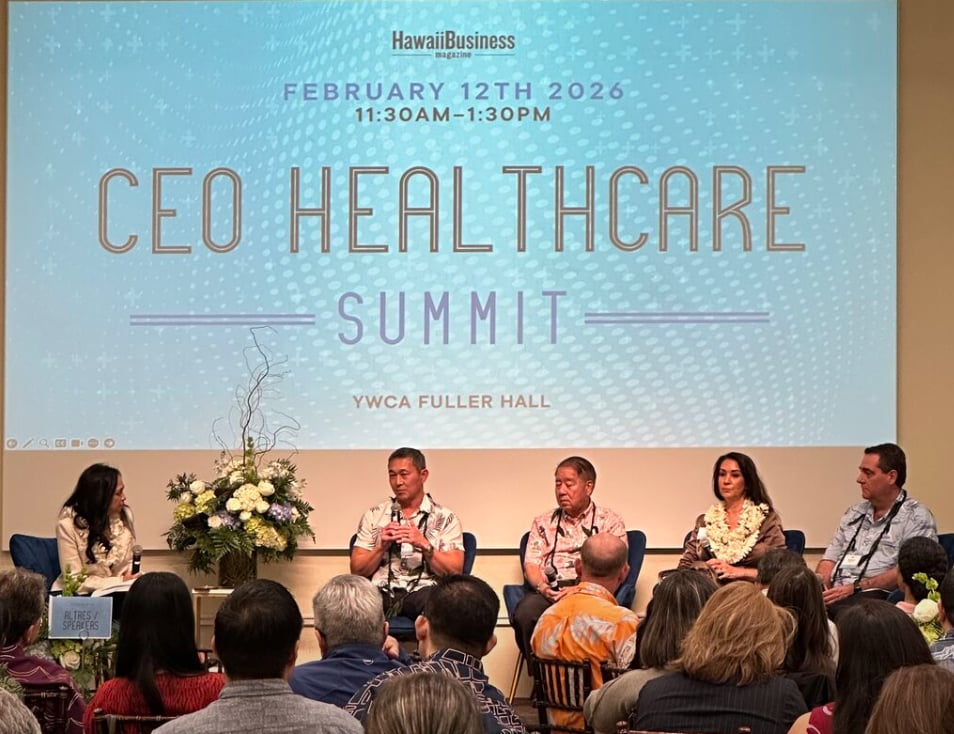
Addressing a crowded room of Hawaiʻi executives, The Queen’s Health System’s top leader didn’t mince words about the proposed HMSA-HPH merger that could fundamentally reshape medical care in the Islands.
“I feel that this is like the Trojan horse story,” Jason Chang, president and CEO of Queen’s, warned. “Sounds great, it’s a gift—but once it’s behind the doors, you don’t know what’s inside, and there’s a tremendous amount of risk.”
Chang was joined onstage by Mark Mugiishi, CEO of Hawaii Medical Service Association (HMSA), Ray Vara Jr., president and CEO of Hawaiʻi Pacific Health (HPH), and Vicky Hanes, COO of Hawaiʻi Island Community Health Center. The four executives debated the proposed integration of the state’s largest health insurer, HMSA, and major care provider HPH at Hawaii Business Magazine’s CEO Healthcare Summit on Feb. 12.
As regulators review the formation of a new nonprofit parent organization, to be called One Health Hawaii, Hawaii Business Magazine Editor-in-Chief Jennifer Ablan moderated the panel discussion by the state’s health executives, who sparred over whether the deal signifies a rescue of a failing system or a threat to competition.
The debate crystalized into two sharply divergent visions for the future. Mugiishi compared the promise of One Health Hawaii to Amazon’s operational efficiency: “A platform that integrates the consumer, the seller, and the supply chain… creating the best experience and the lowest prices. Imagine that experience in healthcare; that’s what we hope for our family and friends.”
Chang rejected the analogy as misplaced and flawed. While acknowledging Amazon’s success, he urged the audience to consider the collateral damage. “Look at what happened to all the local vendors and local retailers around Amazon,” he countered. He instead proposed healthcare leaders revisit “Plan B,” an alternative model that favors inclusion over integration. The solution to Hawaiʻi’s healthcare woes “can’t be isolationist,” Chang concluded. “You have to work with everybody. I’m proposing that Plan B is the better option.”
The discussion grew tense during an exchange between Vara and Chang, when Vara pointed out that a similar alternative had been on the table years ago—and that Queen’s opted out of it. Chang responded candidly: “That was my predecessor. And I would say that if we could really go back and do that again, that was the wrong move. We should not have walked away from that table.” However, that deal “still excluded everybody else in the community.” His remark drew attention to past missed opportunities, while underscoring how long the integration debate has been simmering.
HPH’s Vara framed the proposed combination as a necessary response to a “broken” and “unsustainable” landscape where health systems are losing money and employer costs are skyrocketing. “The current status quo state, without significant disruption or intervention, is much more scary,” he said.
Chang, representing Queen’s, argued that such integrations typically lead to higher prices and reduced choice. He also warned that in a market of only 1.4 million people, such a move could isolate other providers.
“Vertical integration means you take two organizations… and you put them together, which then creates a firewall — a wall between everybody else,” Chang said. “If you think about the disruption that’s needed in Hawaiʻi today, it’s not to create segregation, it’s actually to create more partnerships across the entire span.”
Vara countered that Chang was referencing for-profit integrations that differ from the proposed local nonprofit model.
“In those markets where you have nonprofit, local organizations coming together… you find results consistent with what we’re talking about—bending the cost curve, creating better access, minimizing administrative burden and creating capacity that otherwise doesn’t exist,” Vara said.
Vicky Hanes of the Hawaiʻi Island Community Health Center, one of 13 primary care providers across the state, shifted the focus to the front lines of care. She said primary care receives less than 5 cents of every healthcare dollar spent in the country. Spending more money on preventative care would result in less demand for the much more expensive care that is the mainstay of the companies in the proposed merger.
“I think a part of this conversation is about, where are we bending that cost?” Hanes asked. “I think if you can focus on bringing resources into the primary care system … giving them good preventative care, all the vaccines, all the annual wellness visits, giving them all of their care gaps, getting all of that stuff checked out so we don’t end up in a situation where we’re totally upstream in the hospital, high-cost procedures, specialty care up the wazoo, that’s the conversation I want to bring to the table.”
HMSA and HPH have projected that the partnership could generate over $2 billion in savings over a decade. HMSA’s Mugiishi said that as a nonprofit, One Health Hawaii is designed so that savings are reinvested back into the community: “It gets reinvested, number one, in bending the cost curve so that you, the employers, have a slower rate of increase of your premium dollars.”
Mugiishi said that the “unleashed value” of the deal lies in a planned aggressive shift toward prevention. “The value that is going to be unleashed is in the proper coordination of care that happens at the primary care level that makes sure that people with chronic diseases don’t progress, people who are healthy don’t progress to chronic disease,” he explained. “That’s where you actually save money. So if you take that care coordination and you invest in that, that’s where you’re going to find the largest amount of the savings.”
Beyond premiums, Mugiishi argued this capital would allow for strategic investments to “sustain the ecosystem,” such as expanding the provider footprint on neighbor islands and utilizing technology to bridge the urban-rural gap to specialists like neurologists.
However, for Chang, the “pencil out” simply doesn’t justify the optimism. “The devil is in the details,” he warned. While HMSA and HPH tout billions in potential savings, Chang argued that a realistic analysis suggests the savings are significantly lower—a discrepancy he fears will eventually be bridged by service cuts and layoffs.

Vicky Hanes, COO of Hawaiʻi Island Community Health Center, addresses panel. PHOTO: Aaron K. Yoshino