Inside RISE at UH Manoa
The center’s goal is to be a catalyst for positive change – supporting innovation, entrepreneurship, economic diversification and resilience for Hawai‘i
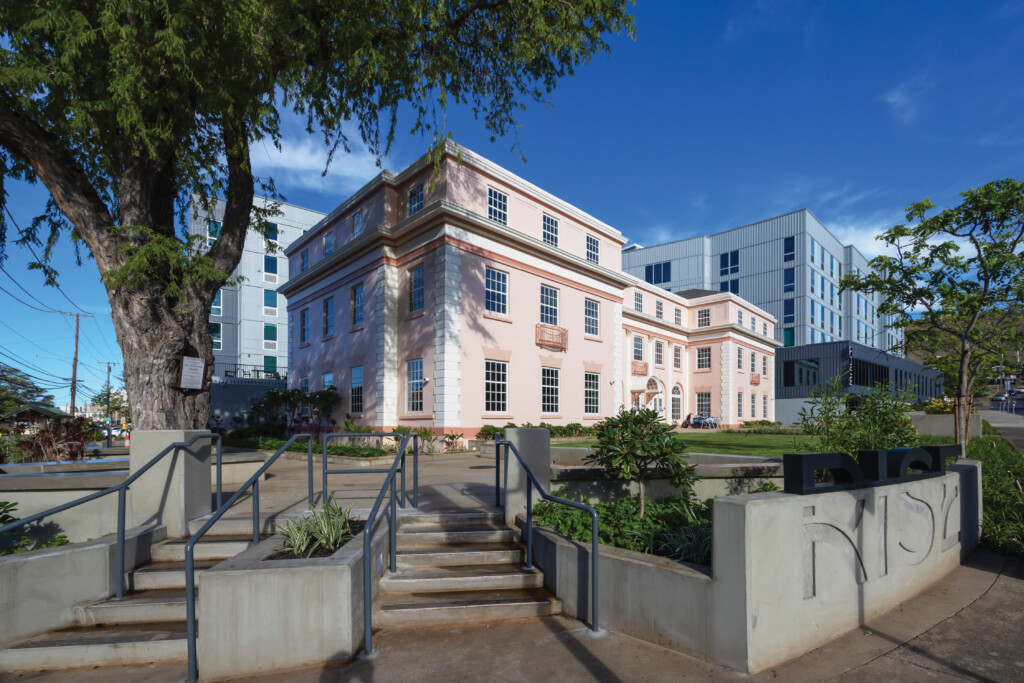
After a ragged opening, Mānoa’s RISE Center is now fulfilling its mission: providing a space where students from all majors can live, learn and work together, collaborating on new ideas and maybe launching startups – all in the spirit of entrepreneurship.
It’s in the name: the Residences for Innovative Student Entrepreneurs, now the Walter Dods, Jr. RISE Center in recognition of philanthropist and former First Hawaiian Bank CEO Walter A. Dods Jr.’s $5 million donation to the Pacific Asian Center for Entrepreneurship.
Lauryn Johnson, a journalism major from Tacoma, Wash., moved into the center in August 2024, and like others I spoke with, she’s glad she chose RISE. She says she was on the waitlist and went through four sessions of the Student Housing Services waitlist before securing a spot.
She worried at first that RISE might not suit her, but that’s in the past. “I really do love living here and I wouldn’t take it back. I was really looking forward to meeting people in the building. Being in such a large community means you’re bound to find those ‘gems,’ the kind of people you really connect with.”
Lenox Covington is a computer science major who is involved with PACE, the guiding force behind RISE from its initial concept to the present. Covington has lived at RISE since it opened two years ago.
“Living here is pretty expensive. … But with a PACE scholarship, it comes out to about the same, or maybe just a little more than the freshman dorms,” he says.
“And this building is way newer and nicer, with a full kitchen and AC, unlike the dorms. The rooms are tiny for the price, though. If you have a double room like me, you can high-five your roommate from your bed.”
His overall assessment? “Living here has been great. I renewed mainly because of PACE and the people that make up the programs. Even as a nonbusiness student, I think PACE is like the CS networking cheat code,” he says, using programming jargon to suggest an inside path to knowledge, connections and success.

Photo courtesy: Savvy Andrews
Students make the space special
RISE, which cost $70 million to build, is modeled after the Lassonde Studios, a residence for student entrepreneurs, innovators and creators at the University of Utah. The residence’s motto is “Live. Create. Launch.”
“What we learned from Utah when visiting was that it’s the students who make the space special. They’re the ones who activate it and bring it to life,” says Sandra Fujiyama, executive director of PACE.
“That’s why it was so important to us to have students living in the space. It’s also why our team doesn’t have permanent desks or offices here.” Instead, team members are based at the Shidler College of Business, across University Avenue from RISE. “That was our way of making sure the students, who are closest to the space, would be the ones to truly activate it,” she says.
Susan Yamada, chair of PACE’s board of directors and a Shidler alumna, spearheaded RISE’s creation. It was developed through a public-private partnership involving UH, the UH Foundation and Hunt Companies.
Construction costs were financed using tax-exempt bonds, which are being repaid with revenue from student dormitory fees. No taxpayer funds were used.
The six-story dormitory now has housing for 374 students plus shared spaces.
It is managed by B.HOM Student Living, a company that says it manages more than 30,000 beds at 34 universities nationwide. The programs on RISE’s coworking floor are run by PACE.
“In the first year, students from every school and college on the Mānoa campus lived at RISE,” Fujiyama says. “It was so cool to see business students living next to engineering students, next to computer science, nursing and even art students. That kind of diversity was exactly what we were hoping for; it’s something we’re really proud of.”
Covington, the computer science major, just hit the one-year mark with an internship facilitated through PACE. “All kinds of cool people pass through here [PACE] – tech founders, venture capitalists, professionals in almost every field,” he says. “For my first software engineering internship, I actually met my boss through an event I got invited to through PACE … and I just hit my one-year mark with the company.”
We saw the tremendous impact
Nearly a decade ago, the UH Foundation looked to buy the Charles H. Atherton YMCA – home to 53 apartments and 80 beds for UH students – after it was put up for sale. After the planned purchase, UH’s student housing office would renovate the property and turn it into a UH dormitory. The mortgage would then be paid off gradually. But estimated costs turned out much higher than anticipated and the project stalled.
That’s when the idea for RISE emerged. After touring universities across the country and learning about entrepreneurial living-learning communities, Yamada and others saw a chance to bring something new to UH Mānoa.
“We saw the tremendous impact these communities had, not just on the university ecosystem, but also on the larger community,” says Krystal Lee, who was part of the project from concept to completion and now serves as a program manager at PACE.
“We knew this had to be a public-private partnership. The university had no money to spend on construction for this building.”
There were plenty of challenges along the way. “One of the biggest hurdles we had to overcome was that this property wasn’t part of the campus map,” so zoning had to be changed, Lee says.
Neighborhood board and City Council meetings followed. “Fortunately, the community and students showed up in support” and rezoning was approved.
Everything was fresh
RISE – UH Mānoa’s first new student housing construction project since 2008 – opened in time for the fall 2023 semester. On the day I moved in, I got my room key from two women sitting at a plastic table in the “lobby” – then just an open space with little furniture and unpolished floors. The place was bare and unpainted, with no wall art or even signs pointing to bathrooms and elevators.
But the halls were spotless and everything was fresh – and I was ecstatic to be on the ground floor, literally, of something new and exciting.
RISE offers a mix of private and shared one- and two-bedroom apartments. Instead of en suite bathrooms, each of the mauka and makai wings has several individual-use private bathrooms for residents. There is also a communal kitchen and lounge, with a shared laundry room on every floor.
The second floor features an amenity deck and a PACE coworking space of 10,000 square feet – a bit bigger than the size of two basketball courts. Near the lobby are places to store bikes and surfboards, as well as moped parking.
When I moved in, there was no paved walkway or lawn out front – just dirt, bright orange cones, caution tape, a small excavator and a work team.
“We seriously didn’t have soap or trash cans in any of the bathrooms for months, and no janitors at first. Thankfully we have them now, because without them, the place would be a mess,” says Covington.
“Last year, the fire alarms were going off constantly – almost every single day, sometimes two or three times a day. This year, though, things have been a lot better.”

Photo courtesy: Savvy Andrews
Higher fees among the changes
During that first move-in week, I stood in the crowd as one of just two community ambassadors – B.HOM Student Living’s version of resident assistants – tasked with building community in the new space.
My job, simple at first, seemed like the perfect position for a people-person like me.
I served as a liaison between residents and the management team. I helped build a vibrant atmosphere and sense of community by planning floor meetings and events, supporting residents, and helping with day-to-day duties. I worked office shifts, gave tours, helped with marketing and leasing, and handled after-hours calls involving things like lockouts and noise complaints.
The first month was rough: 13 calls in one horrible night from residents locked out of their rooms, and complaints about students playing their music too loudly. But I got the hang of it. The 50% rent discount helped – but that had to be negotiated with B.HOM from the original 20% discount.
A few months after the start, we were fully staffed with six community ambassadors to help the general manager, assistant manager and leasing consultant. Their mission and mine was to provide great service and keep residents satisfied.
Choosing to live at RISE was one of the best decisions I’ve made. It’s something I’d say while leading newcomer tours – and I meant it.
But management changed and my job requirements did too, again and again. Building rules affecting everyone also changed: Moped parking went from free to paid, resident vehicle parking was no longer available for purchase, the $350 room transfer fee warped into $500, and the $30 lockout room key charge jumped to $175.
Says Covington: “I paid the $500 transfer fee just to switch rooms – it’s insane. All the managers had to do was clear the vacant room for move-in and hand me the key. I have no idea why the charge was hundreds of dollars.”
Improvements made along the way
I lived and worked in RISE for a year and four months until I resigned in December 2024 to focus on my journalism studies and this internship with Hawaii Business Magazine.
I had watched the building grow into what it is now. Residents are constantly coming and going, a coffee shop is being built in the lobby, foosball tables and grills have been set up in common areas, new resources are available in the PACE space on the second floor and cameras are up in the hallways. And, of course, cockroaches are finding their way into the kitchens that residents didn’t keep clean.
Jayda Pandes, a resident and PACE leader since RISE opened, recently became a community ambassador too.
“It’s not an easy job, especially as a full-time student, but it is convenient. I’m able to live where I work, take a nap in between shifts, get to know and help my neighbors,” Pandes says.
As with many residents, RISE helped me find my community and my best friends. It became an anchor for me, somewhere I could call home, especially after transferring to UH from California State University, Sacramento, and having to rebuild my college life in a new place with new people.
RISE grounded me as I adjusted to a new university, making new friends and living half an ocean away from my family in California.
Johnson, the resident who moved into RISE on its one-year anniversary, says the rent of $1,300 to $1,700 a month for a 121-195-square-foot room is worth it, mainly because of the center’s proximity to campus. Plus, she is more comfortable in a shared space than living alone. (Rent has increased every year and meals are not included.)
Six student-run programs
The PACE Leaders program began when RISE opened. Its leaders bring life to the building through six student-run initiatives: the Calvin Shindo Student Venture Fund, Entrepreneurship Live, the Maker Program, PACE Ambassadors, Kalo Grants and Level Up Workshops. PACE Leaders scholarships range from $1,000 to $6,000 a year.
The innovation and entrepreneurship facility, powered by PACE, includes a startup incubation space, conference rooms and photo booths, a classroom, maker spaces, a recording studio, an event space and prototyping equipment. All are free to students of all majors from across all 10 UH campuses.
“The program’s mission is to help students develop an entrepreneurial mindset while in school, because we feel that entrepreneurship at its core is about solving problems,” says Lee, the PACE program manager. “So if you can develop that mindset – while being creative, collaborative, building critical thinking skills and communicating effectively – we believe that skill set will take you far no matter what career you go into, whether that’s business, government, health care, education or anything else.”
Jonavan Gonzalez is a graduate student and PACE Leader. “I chose to live at RISE because I’m well involved with PACE, and this housing just made the most sense for me. Professionally, I’ve grown a lot – I’ve networked with like-minded people and have gotten more engaged with campus life since I now live right here and no longer have to commute,” he says.
“I’m always downstairs at PACE, and what I love about living here is that throughout the day, I can head upstairs to my room for some privacy and recharge when my social battery runs out.”
PACE says its 15 programs help students develop skills as leaders, creators, collaborators and communicators through hands-on experiences and wraparound support.
Its initiatives include Innovate 808 – a weekend event where students pitch solutions to challenges posed by local companies – and accelerator programs in which UH innovation students mentor visiting peers on complex Hawai‘i issues.
Another is the annual UH Venture Competition. Tate Goodman, a PACE Leader and a finalist in that competition and a winner of another, says the center has always supported him and his startup, Pacific Carbon.
“My co-founders and I applied for the $1,000 pitch at PACE’s Kalo Grants Live Pitch Event and were fortunate enough to win. It really helped us jump-start our venture,” Goodman says.
“PACE is such a valuable hub. If you’re an entrepreneur, it’s 100% the space for you. If you’re looking to start a business, you won’t find a better spot at this university to do it.”
The vision for RISE came into sharp focus during the Covid pandemic, when it became clear how vulnerable the Islands are, Lee says.
“That really reinforced the need to build something like this. Our long-term goal here at RISE is for this space to serve as a catalyst for that kind of positive change – supporting innovation, entrepreneurship and ultimately, economic diversification and resilience for Hawai‘i,” she says.