The Club That Connects Hawai‘i
For 175 years, The Pacific Club has helped shape the Islands by bringing together generations of business, civic and community leaders
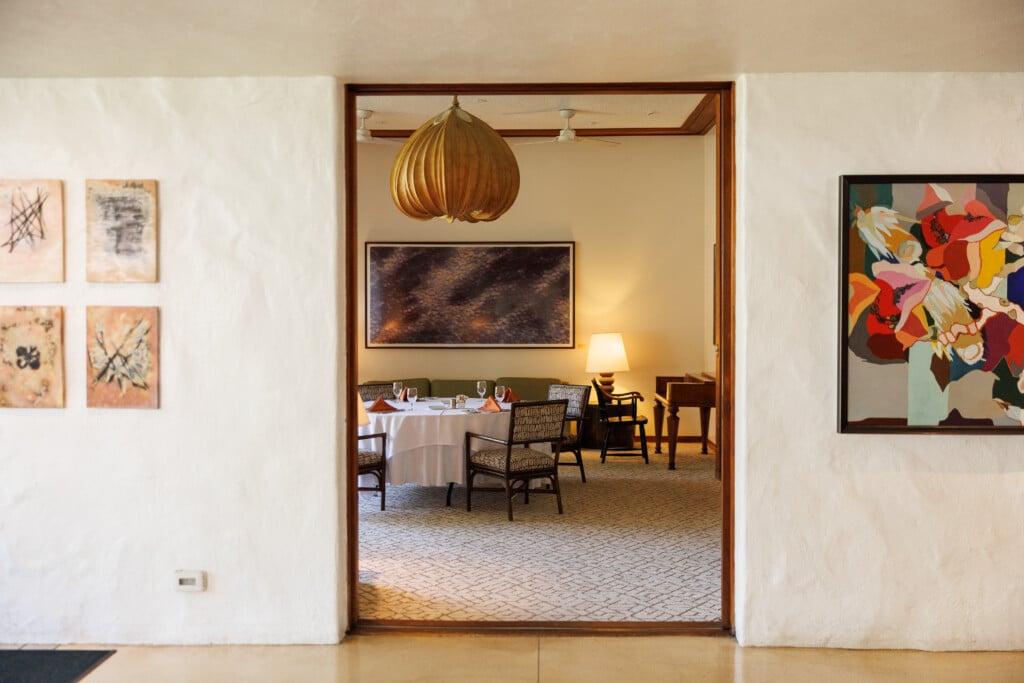
During a typical weekday lunch at The Pacific Club’s dining room, executives at one table discuss a company’s future, and at another, nonprofit leaders plan their next big fundraiser. Attorneys, architects, educators, entrepreneurs, bankers and politicians are scattered here and there arranging deals, proposing innovations, defusing crises and building relationships that might last a lifetime.
Similar scenes have played out for generations at The Pacific Club.
As it celebrates its 175th anniversary this year, the private club at Queen Emma Street and Vineyard Boulevard continues to fulfill its main purpose: bringing together people who help shape Hawaiʻi.
A History of Building Trust

The Pacific Club’s clubhouse in 1960. Photo Courtesy of The Pacific Club
Long before emails, phones and Zoom, personal and business relationships were built on something simpler, people sat down with each other and talked, often while sharing food and drinks.
That was The Pacific Club’s original purpose, says club historian Caroline Bond Davis.
In 1851, Hawaiʻi was still an independent kingdom, and Hawaiian, not English, was the predominant language of government, commerce, education and diplomacy. That year, a group of British businessmen in Honolulu created what was then known as “The Mess,” a place where members could speak and read English.
“They first gathered everybody’s English reading material because they were so hungry to read in English,” Davis says. “Then, naturally of course, they established the bar.”
The place quickly evolved into a club for men of all nationalities, including two of Hawaiʻi’s kings, and in 1892, its name was changed to The Pacific Club.
Throughout Hawaiʻi’s history, from kingdom to republic to U.S. territory to statehood, the club was a place where prominent men could nurture friendships and business ties. And to ensure fellowship among members, Davis says club rules discouraged discussions of politics and religion inside the clubhouse.
“It was a place for business and camaraderie,” she says. “If people wanted to argue politics, they were asked to take it outside.”
Businessmen gathered over lunch, dinner, coffee, drinks and cards. Bridge, poker, cribbage and hanafuda weren’t just games; they were intimate opportunities for members to gauge others’ character before doing business with them.
“You learned about the people you were sitting across from,” Davis says. “Business relationships are lifelong relationships, and you don’t want to be in one with somebody you later find you’re not comfortable with.”
A Living Room for Leaders

The Pacific Club’s library in 1960. Photo Courtesy of The Pacific Club
The club changed with the times, though sometimes slowly. After decades of exclusion, men of Asian ancestry were allowed to join starting in 1968 and women were accepted as members beginning in 1984. Card games are less common today as are alcoholic drinks with lunch. And families with children are now welcomed more than ever. Still, the club remains the meeting place for many of the state’s most influential leaders.
“The history of the club is really intertwined with the history of Hawaiʻi,” says Raj George, the club’s 175th anniversary committee chair. “A lot of club members have had influential roles in terms of business, government and civic leadership.
“You have formal or informal meetings happening at the club. You have connections being made, partnerships developing, and it serves as a living room for the business, government and community to get together,” he adds.
Member Elyn Yao recently spearheaded the committees responsible for recruiting new members.
“You can certainly network at a variety of different events across town,” she says. “But I think what sets The Pacific Club apart is the history and the generations of members, [the] relationships that are built here and last forever.”
She says those long-standing connections create opportunities for collaboration outside of traditional business settings.
“The Pacific Club was synonymous with ‘That is where business happens,'” she says. “It’s conversations that are not necessarily even started in the boardroom. It’s over breakfast at The Pacific Club.”
175 Years of Change

The Pacific Club’s current library, much of it unchanged for decades. Photo: Aaron Yoshino
The club is the oldest private club in the United States west of the Mississippi and surviving 175 years required frequent change.
And no one understands those changes better than Lesley Brey.
When she became the club’s first female president in 2013, her installation was recognized as a historic milestone. But Brey never saw it that way; being first, she says, “meant more to other people than it meant to me.”
For her, the milestone was just another necessary step for the club.
“I wanted us to get past this,” she says, recalling that period. “Someday, the first woman, the first Asian, the first short person, it won’t be a thing anymore. That would be my fantasy.”
Her presidency that year came with many challenges, including from those who still didn’t believe a woman could do the job. But there were even greater challenges after she was elected: Years of deferred maintenance had left the aging clubhouse in need of expensive repairs. Structural problems hidden behind walls and ceilings revealed even greater issues once renovations began.
Over several years and multiple presidencies, club leaders grappled with difficult decisions, like how to fund the expensive improvements, with added assessments paid by existing members or with loans whose costs would also be passed on to future members. There were heated meetings and frustration among members, and a few left the club. But Brey believes those difficult conversations ultimately preserved the club and allowed it to remain resilient.
“My job was to finish the construction and heal the membership,” she says.
“Now we’re looking at projects that never would have been possible if we hadn’t bitten the bullet back then.”
The club has evolved in another important way. Today it extends well beyond business. On any weekend, families gather around the pool, children play on the lawn and members frequent the pickleball and paddle tennis courts.
Holiday brunches, Easter celebrations and Thanksgiving dinners have become traditions for many families, making the club as much a social gathering place as a professional one. The main dining room remains the heart of the club, but there are two other dining areas and you can eat next to the pool too.
George says the club’s ability to adapt, while staying true to its traditions, has kept it resilient.
“Each generation serves as a steward of the club, preserving what makes it special while ensuring it continues to evolve,” he says.
The Next Generation

The Pacific Club’s lobby. Photo: Aaron Yoshino
Yao joined The Pacific Club after returning home from the continent, where she spent decades working for Microsoft, Cisco and Hewlett-Packard. She says it wasn’t about finding another networking organization, it was about finding community.
“I immediately felt at home,” she says.
Working remotely after moving back to Honolulu, Yao sought a place where she could connect with Hawaiʻi’s business community. But what she found at The Pacific Club was something much broader.
“I felt like it was the intersection between business and community leaders,” she says. “There are so many different walks of life.”
As chair of the Membership and Next Generation committees, she says the club’s history, mission and diversity are the biggest attractions for prospective members, whose recruitment has become one of the club’s highest priorities. And when it comes to recruiting, she says, perception is the main challenge.
“The club shouldn’t be perceived as being only for an older generation,” she says.
Today, 30% of the club’s members are younger than 50, which points to the efforts of Yao and others to attract emerging leaders. In just four months, the club also surpassed its goal of adding 175 new members during its anniversary membership campaign and now has a growing waiting list for new members.
“It wasn’t about increasing membership,” Yao says. “It was about bringing in the future leaders of Hawaiʻi. The club continues to thrive because each generation brings their own unique experiences.”
Another recruitment goal was to bring in people from different industries. Diverse perspectives and careers among members, she says, are some of the club’s key strengths. It also means a more robust internal governing body of volunteer leaders.
The club is run by its members, who serve on committees that oversee virtually every aspect of the club, including operations, events and projects. Elections for key roles like president and vice president are held each year.
Place, Space and People

The Pacific Club’s clubhouse. Photo: Aaron Yoshino
The club’s 175th anniversary committee adopted three guiding ideas to govern their planning: place, space and people.
For “place,” George points to the club’s historic site and its connection to Princess Kaʻiulani, the heir to the Hawaiian Kingdom at the time it was overthrown. The princess was born on the property and lived there as a child, and for decades after The Pacific Club purchased the estate in 1927, her childhood home served as its clubhouse.
For “space,” he points to today’s clubhouse.
“I think what defines the club more than anything is Vladimir Ossipoff as the architect of the current clubhouse,” George says.
Ossipoff is Hawaiʻi’s most famous architect and the clubhouse he designed, opened in 1960, is one of his most celebrated works, a reflection of Hawaiian “inside-outside” design. For George, the holistic design succeeds on so many levels.
“The whole experience, from when you pull into the driveway, walk through, go to the dining room and out, is really his vision,” George says.
He says the building fosters relationships, with every detail designed with intention.
“If you’re going to position yourself as a gathering place, you need to have a place that facilitates conversation, interaction that is inviting, that’s welcoming, that helps people open up and connect with each other.”
The Heart Behind the Club

Mildred Bulosan, The Pacific Club’s dining room manager, who’s worked at the club for 54 years. Photo: Aaron Yoshino
While George says place and space are significant, neither can function without the people. The club’s 1,391 active members and 152 staff are undoubtedly its heart, and no one embodies that more than Mildred Bulosan, known by most as Aunty Millie or simply Mama.
She began by bussing tables 54 years ago and has been managing the club’s dining room for decades. She knows members by name, as well as where they work and their favorite lunch orders. And she knows their children, too, many of whom are now members themselves.
“I’ve seen generations grow up here,” she says. “I’ve seen children of members years ago now become club presidents.”
Bulosan has seen the club’s dramatic evolution. She started work at the club before women were even allowed in the main dining room during the main lunch hour. Then, she watched as women became members and then club leaders. But through multiple general managers, club presidents and thousands of members, she insists one thing has never changed.
“This has always been my second home,” she says.
Even now, at age 75, she struggles to imagine retirement and life after The Pacific Club.
“I don’t know what I’m going to do when I leave this place,” she says. “I’ve seen a lot here, a lot of people and a lot of changes, but it’s always been a community. No matter the members, the president, it’s always been family.”
The Next 175 Years

The Pacific Club’s crest. Photo: Aaron Yoshino
It seems that no matter which member you talk to, they all come to the same conclusion: The Pacific Club has survived by adapting to political, social and technological change, while never wavering from its mission.
“It has to continue being a place where people care,” Davis says. “It needs to be more than a place that people use, it needs to be a place where people belong.”
Aunty Millie agrees. As she looks across the dining room she manages, she speaks to the heart of the club, the people, and expresses a feeling that many members and staff share.
“The members, the club, this is my family,” she says tearfully.