The Trash on Hawaiʻi’s Beaches Tells a Global Story
Tons of plastic trash wash up on Hawaiʻi beaches every day. Forensic scientists using chemical analysis and other means to trace the sources say 80% is abandoned fishing gear from global fleets in the Pacific. Hereʻs what comes next.
Like a gyrating solar system casting particles across the universe, the Great Pacific Garbage Patch swirling near Hawaiian waters litters archipelago beaches with tons of floating plastics every day.
More than 200 tons are collected and processed each year by the Center for Marine Debris Research at Hawaiʻi Pacific University in Honolulu, with a goal of recycling much of it into products that can be added to asphalt, or sold as construction lumber boards or souvenirs at popular tourist outlets.
That sounds impressive. But the patch floating between Hawaiʻi and the California coast – about double the size of Texas — contains an estimated 100,000 tons of debris, and at the current rate of recovery, it will take more than 500 years to remove what’s already there, assuming nothing more is added.
“Unfortunately, this removal and recycling thing is a beast that we don’t see ending anytime soon,” says Jennifer Lynch, director at the center. “Five hundred years maybe, but by then there will be other problems. How many generations is that?”
That might discourage some who value the singular attraction of Hawaiʻi as a pristine Eden about as far from polluting industrialized countries as one can get. Despite container-loads of marine debris literally dumped at her office door, Lynch radiates optimism and determination.
She and her team of researchers have traced the bulk of the garbage to tens of thousands of mainly Asian fishing vessels that have been discarding or losing nets and gear in the Pacific. Over the years, ocean currents push the debris toward Hawaiʻi and the West Coast where it gets tangled together in the Great Pacific Garbage Patch. So far, the center has had mixed results in shutting off the flow.
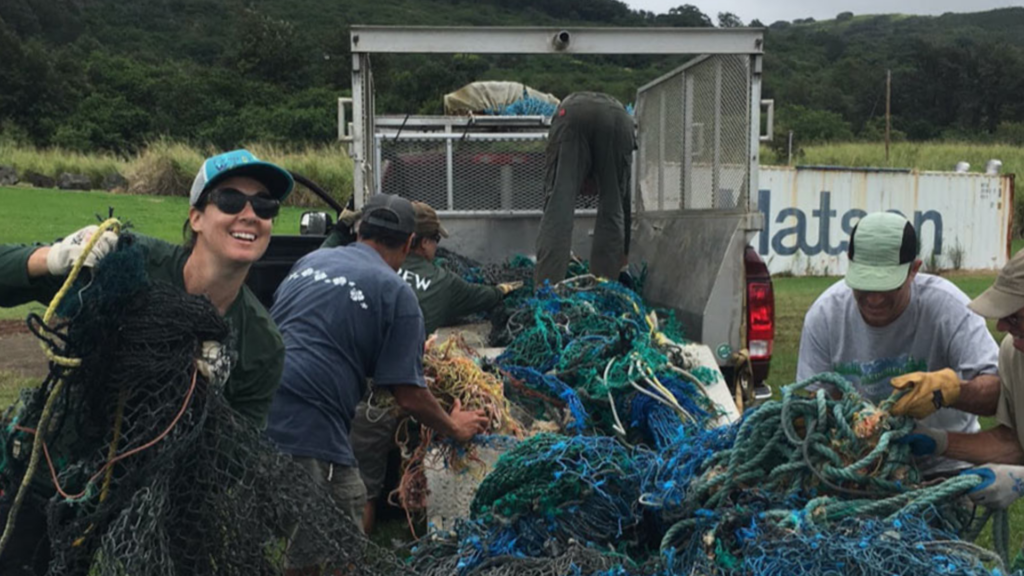
The center’s mega-plastics team of sleuths, located near Sand Island in Honolulu, collects debris from beach cleanups conducted by independent conservation groups on most islands, from a bounty system of payments to fishing fleets that collect floating plastics as well as from annual excursions to the Northwestern Hawaiian Islands.

Photo by Aaron Yoshino. Floats recovered from the ocean in various stages of decay.
Untying a Tangled Knot of Nets
Eighty percent is what Lynch calls “derelict fishing gear,” mainly nets that were discarded at sea or snagged on the bottom and separated from the vessels. These float freely around the ocean for years, becoming tangled with garbage and even fish, turtles and other marine life.
After inspecting the items for more than a decade, the center’s researchers can confidently identify the types and origins – the bulk is trawling nets from foreign fishing fleets.
The vast majority of fishing fleets spreading their trawling nets across the Pacific are Chinese. Nearly 60,000 vessels, in fact, according to the center’s analysis of data made available by Global Fishing Watch. The country with the next largest fleet is Vietnam, with about 15,000 vessels, followed by the U.S., with 2,000.
Lynch will gladly take you into the weeds of their research. “The amount of evidence that we have is outrageous,” she concedes.
“When you look at the main Hawaiian Islands, most of the events that we remove out of the ocean that are fishing gear are conglomerates, which are tangled messes,” Lynch says, comparing it to a drawer full of necklaces.
“If you shake it, you’re going to open the drawer and they’re going to be tangled together. Same thing for nets and ropes in the ocean. Waves are doing this, they knot together and they’re not going to separate. They’re going to continue to grow. So, the conglomerates are growing to be bigger and bigger monsters before they wash ashore in Hawaiʻi.”
Fortunately, most of Hawaiʻi’s beaches are not affected by the drifting mass of floating debris. Because of currents that move the garbage patch in a cycle to the north and east of the Islands, the heaviest concentrations wash ashore on the windward shores of the main Hawaiian chain and some of the islands of the Northwestern Hawaiian Islands.
“You can’t walk on it,” Lynch says of the garbage patch. “It’s just a higher concentration of floating debris. I have stood on our windward shores and seen the garbage patch because we are inside of it. It washes up on our shores. Four years away, four years near us. We’re just finishing a period of it being near us.”
To be sure, the ocean debris is not confined to the Great Pacific Garbage Patch. Jim Scancella, a retired ships officer for UH research vessels that have been on voyages across the ocean, says it’s ubiquitous.
“I’ve been through the main shipping lanes, and they were littered with debris, but we also went to some of the most remote places and still you’d see plastics,” says Scancella about his voyages over three decades working in the Pacific. “As big as the Pacific is, the garbage is everywhere.”
Once the debris is collected and in researchers’ hands, the hard investigative work begins. The aim is to trace it back to the source in hopes of appealing to those nations to shut off the flow. The giant nets, floats and other fishing gear drift for years, pushed by ocean currents in predictable patterns.
Lynch knows that because she and her team have become ocean sleuths, tracing back the debris to manufacturers and sometimes specific vessels by analyzing types of nets, the color of floats, brand names and manufacturers’ codes and other markings still visible on some debris. A team of five employees at the center’s microplastics laboratory in Waimānalo can even pinpoint the exact chemical makeup of the plastic polymers used to construct the debris.
“So we know when we find netting that’s nylon, it’s either purse seine or gillnets. Those are totally different vessels, totally different target species, totally different locations in the ocean. A different fishery than trawl netting,” Lynch says.
“Trawl netting is our number-one marine debris by mass that washes into Hawaiʻi. Those are made of high-density polyethylene (HDPE) and they are sewn into these gigantic tubes that get pulled behind a boat midwater, or bottom, or top, and it catches everything out in the sea. Knowing the polymer gets us to which fishing industry. We’ve been able to narrow down that the majority of the marine debris is this HDPE netting that we can point back to trawl fisheries.”
Although the vast majority of fishing fleets are foreign, the Trump administration in April rolled back protections for the Pacific Islands Heritage Marine National Monument (PIHMNM) that were put in place during the George W. Bush and Barack Obama administrations. The new executive order restores access for American fishing vessels to the waters between 50 to 200 nautical miles offshore from islands within the zone.

Numbers of trawling vessels registered by country that fish in the Pacific.
Links to Specific Vessels
In one example of the center’s tracking abilities, Lynch describes markings on floats that washed up in Hawaiʻi, which showed a 5-digit code that could be tracked to an individual vessel.
One marine scientist in Taiwan has made the search easier. She’s created the Marine Fisheries Handbook of West Taiwan, a detailed guide linking the codes to specific vessels. She created the handbook over years of picking up debris in Taiwan and tracing it back to its sources.
“Here in Hawaiʻi we find these and look up the 5-digit code and, here we go! The code is the code of the Chinese fishing boat, for example, this number … corresponds to a fishing boat in Fujian. If you enter the 5-digit tracking number into a ship tracking app, Global Fishing Watch, which I did, you can track that ship’s location. So I entered this number in, and I find it’s ‘Suganyu’. It was flagged in China. The last time it was active in the Global Fishing Watch was in 2014-2015 and it was fishing with set gillnets.”
Further analysis of fishing nets that use nylon versus high-density polyethylene, or braided versus non-braided and knotted or unknotted all help trace the materials back to the source.
So far, the center has had discussions and cooperation with fishing and government representatives from South Korea, Japan and Taiwan, which Lynch said is already far advanced in taking proactive measures to reduce derelict fishing gear from any of its vessels.
Discussions with China, which has the largest fleet, have been limited to a group of eight environmental professionals who visited the center last July as part of the U.S. State Department International Visitor Leadership Program. Rather than creating confrontation, Lynch says that as a scientist she prefers a cooperative approach. She feels more comfortable sharing information with other scientists who can appreciate the data and work within their own governments to find mutually beneficial solutions.
“Asian non-government nonprofits or governments are already working on this derelict fishing gear issue,” Lynch notes. “If it’s washing up here and impacting us, it’s impacting them too. They’re actually doing something about it, and they’re coming to say, ‘Is it really ours? We already have prevention in place. Do we need to do more?’ The answer is yes.”
China is a ʻBlack Hole’
While Lynch was investigating trawling nets, Carl Berg, senior scientist at the Kauaʻi chapter of the Surfrider Foundation, decided to focus on another type of fishing gear that started washing up on Kauai’s shores – black plastic cones that detach from eel traps.
“We collected nearly 22,000 on our beaches” on Kauaʻi, Berg says. “My friends tell me yeah, they’re on the beaches of Japan, South Korea, Taiwan and the beaches of the West Coast. They are ubiquitous and dangerous.”
“One of the little eel trap cones is about 50 grams. Each eel trap has the potential to break down into 3,000 microparticles. All of those things have toxic chemicals in them,” he says.
He received a grant to study the problem from the Global Ghost Gear Initiative, an international consortium seeking to solve the problem of derelict fishing gear. “Their interest is in fishing gear that continues to fish after it’s lost,” Berg says. “It’s called ghost gear, it’s sitting on the bottom but it’s still catching. It’s like having another fisherman in the fleet. It’s taking stuff out but nobody gets the benefit of it. And in many cases, it not only catches eels but crabs, lobsters and many other things get caught in it.”
The findings of his investigation were published in March in an article in the Oceanography & Fisheries Open Access Journal.
While approaching fishing industry groups and governments in Asia, he discovered that South Korea in particular was well aware of the problem and has taken concrete steps to reduce ocean pollution. Nonprofit groups there have instituted an educational program to increase awareness among the general public and the fishing industry.
While those initiatives seem promising — and he’s had cooperation from officials and fisheries in Taiwan and Japan as well — Berg has had less success reaching out to China, which has an eel industry on par with South Korea’s.
“How much is being thrown away, are they regulating it?” Berg asks rhetorically of China, while stressing the importance of reaching out in a culturally sensitive way. “It’s a total black hole. I made all these contacts — low level scientists to the head of the Chinese Academy of Sciences who had been in Hawaiʻi. I’ve had no acknowledgement of my emails.”
The information office for China’s cabinet, the State Council, did not respond to an inquiry from Hawaii Business.
Berg is hoping to educate the public in Hawaiʻi as well. “People are cognizant of how dirty our beaches are,” he says. “We’ve gotten to the point where we say, we’ve got to do something. People can do something,” he adds – “something as little as picking up debris off the shore while walking on the beaches. The simple act of picking a cone off the beach, throwing it away, they could save a monk seal or turtle.”

Photo credit: Aaron Yoshino. Debris delivered by containers to CMDR
Floating dFADS
Even more debris is picked out of the ocean by fishing vessels sent to intercept so-called drifting Fish Aggregating Devices, or dFADs. These devices have become a preferred method of catching tuna for fleets supplying Bumble Bee and StarKist tuna brands, among others.
Two global tuna fishing associations that regulate operations in the Pacific allow some 50,000 of the drifting devices to be released into the waters each year, with nets dangling roughly 200 feet below the surface, Lynch says. Once set adrift, they attract tuna and other fish underneath, and when sensors show enough fish have collected around them, retrieval ships – “they are huge factory ships” is how Lynch describes them — are sent to pull up the seine nets, bringing in as much as 30,000 pounds of fish in a haul.
Sounds simple, but there are problems, according to Lynch. The dFADS are made mostly of plastic. dFADs become marine debris when the fleet loses them or abandons them once they drift beyond international fishing grounds 10 degrees north of the equator.
“The moment one of these goes beyond 10 degrees, they’re not chasing after it, it’s gone. … It’s estimated that more than 90 percent are lost or abandoned – and this is LEGAL,” she says, exasperated.
Because the tails of netting hang down 200 feet, once they drift toward shallower waters surrounding islands and atolls, they can snag on the coral and rip up the bottom as waves and currents pull them along.
“They’re snagging and toppling and barreling like a big bulldozer across our coral reefs, and they’re endangering marine wildlife,” Lynch says.
One bright spot is that each is equipped with a satellite beacon, so they can be tracked. Once they drift above 18 degrees north latitude, The Nature Conservancy, working in cooperation with the center, is alerted and can direct local fishing boats to retrieve them.
The center pays $1 per pound of debris retrieved, and at 150 pounds each, it’s not worth going out of the way for most long-line fishing boats, Lynch notes. But they also get to pull in any fish under the devices, which can be very lucrative. By recovering these devices, they also prevent further damage to the fragile reefs around the archipelago.
Two tuna industry associations govern fishing in the Pacific — The Western and Central Pacific Fisheries Commission and the Inter-American Tropical Tuna Commission.
The IATTC, in an emailed statement, said it has “a dedicated program of work to reduce FAD losses and abandonment, increase their recovery, and promote the use of biodegradable FADs through binding measures.” It sets vessel limits on FAD releases and recovery allowed per season but not overall global fleet limits. For the region of the ocean it governs, it says: “All FADs used in the eastern Pacific Ocean must be non-entangling — meaning no netting materials may be used in either the surface or subsurface structure.”
The WCPFC did not respond to an emailed request for comment.

Photo by Aaron Yoshino. Fishing net plastic recycled into prototype trinkets by Lei Wili Plastic Recycling LLC.
From Trash to Treasure
With the debris in hand, the center’s strategy is two-fold: One, to trace the bulk of the problem back to the sources in hopes of cutting the flow, and two, to create recycled materials from part of the plastic that is recovered, thereby limiting what gets sent to landfills or is incinerated. Lynch says current policy priorities are often misguided.
“So are we going to ban single-use water bottles because of our marine debris problem? It’s not going to fix it,” she says, answering her own question. “Are we going to argue with our state legislators about reducing plastic imports into the state to fix our marine debris problem? It’s not going to fix it. So, my argument is: Let’s put some laser focus on where the problem is, and it’s derelict fishing gear that’s not ours. We don’t use trawl nets in the state of Hawaiʻi. It’s illegal.”
Besides identifying the source of some of the debris, the center’s chemical analysis has allowed the team to divide the materials into those that can be recycled – essentially nylons and high-density polyethylene — and those that will be either incinerated at Oʻahu’s H-POWER facility to make electricity or sent to landfill with other island waste.
Mafalda de Freitas, a marine biologist and the center’s mega-plastics program director, points to a 40-foot container just outside the warehouse door that is partially filled with marine debris collected from Hawaiian waters and beaches.
“When stuff comes in, we offload and sort it into what we can recycle and what we can’t recycle. Whatever we can’t recycle, either because it’s a blend or it’s the type of plastic that we don’t have the technology to recycle, we place in the bin for Radius Recycling to take to the H-POWER incinerator,” she says.
She likes the idea of turning plastic waste into electricity but recycling it into useful products is even better.
“What we would like to do is divert plastic from the incinerator and convert plastic into products that people can use, so for example plastic lumber, then you can make fencing, picnic tables, anything you can use lumber for you can use the plastic lumber for that instead and build structures,” de Freitas says.
They’re already working on that idea. They sent 200 pounds of shredded plastic to a Nebraska organization that successfully created 52 durable, 10-12 foot plastic lumber boards.
“They were better than some boards made from post-consumer plastics…. Hahaha, I’m so competitive!” Lynch laughs. “They’re stronger, better and now that we know that it physically can be made and that the product works for its application, let’s get those machines here.”
Architects and construction industry representatives have told them their clients would be interested if the center could produce the boards. Acquiring the machines to make the boards would also make it one of only 42 plastic recycling facilities in the country, and locating it next to a material receiving facility would make it even more rare.
In her business plan, that would save money by eliminating the need to transport materials from the receiving center to the recycling center. The potential is huge. Of the 200 tons retrieved each year, Lynch estimates 40 tons can be recycled.
Another form of recycling involves turning the plastic nets into plastic objects that tourists and locals might buy.
Judy Journeay, owner of Lei Wili Plastic Recycling, which recently moved into the warehouse with the researchers, has proof that a recycling program can work. Holding green plastic turtles, coasters, keychains, dolphins and combs that came out of her plastic molds, she displays early prototypes of the wares she’d like eventually to sell as souvenirs in tourist-friendly shops.
“I just got started. It’s a lot of trial and error,” she says while holding up a turtle without a head. “It’s a learning process, it’s evolving,” she adds, laughing. But her progress has been rapid, and now she is experimenting with color mixes and standardization that will allow her to mass produce each item.
“My intent is not to sell at a craft hobby level,” Journeay says. “My intent is to have enough stuff to start talking to people about replacing the plastic souvenirs that are in the ABC Stores, that are in Target and Walmart, with ones that we can produce locally out of our own beach waste, our own household waste, paying people here to make the souvenirs here, to sell them here and keep that money here in the economy rather than buying more trinkets from China made of new plastic.
“So, it’s one source of new plastic that we can try to stop,” she adds with determination. “That’s the thing. You can’t just recycle, you have to do the reduce part.”
Journeay has been planning this venture for a long time, starting from a concept she had many years ago while she was a high school science teacher. Over time, the idea began to take shape.
“I met people who had machines that they weren’t using, and so that’s how I got the machines, but once I had the machines, I didn’t have a place to put them,” she says, encountering the struggles of startups. “And then I met Mafalda and Jenn, and they said come here.”
The transition from the shredded plastic parts that the Center for Marine Debris Research can provide to attractive plastic items that tourists and local residents alike might purchase is an intricate process. It’s also expensive to get started.
“Right now, this is all out of my pocket,” Journeay says. “This is just the start to show what can be done with the material that we pick up off of our beaches. If someone here can take that and make money, then we should do that here. It’s about people as much as it’s about plastic. It’s at the proof-of-concept stage.”
Adds Lynch: “The proof is in people’s hands today.”
Yet another recycling project is to turn the plastic waste into an ingredient used in making asphalt roads in Hawaiʻi. In fact, in a sustainable paving project contracted by the state Department of Transportation, more than 1,000 pounds of recycled plastic was shredded and added to the mix of asphalt that Grace Pacific’s crews laid down on roads in ʻEwa Beach in 2024.
The center’s microplastics research laboratory in Waimānalo is conducting tests to determine whether any of the polymers leach out of the asphalt into the rock bed and soil underneath. If it passes those tests, the department might contract to expand the plan, Lynch adds.
“So we are replacing some of the polymer that we already put in our asphalts with this used polymer,” Lynch says proudly.

Photo courtesy of Hawaiʻi Wildlife Fund. Collected garbage airlifted from Lānaʻi beach cleanup.
The Tyranny of Funding, A Ticking Clock
With all of these promising developments, the center’s efforts could come to a halt this year. That might demoralize others, but Lynch seems undeterred. In fact, intrepid is a good word to describe Lynch, who is racing against time with global and national forces aligned against her – and Hawaiʻi.
Almost all of the center’s work has been financed by federal funding — the National Oceanic and Atmospheric Administration, the Department of Transportation and the National Institute of Standards and Technology — and much is set to lapse in coming months.
In 2025, Lynch lost her own federal job of 22 years as research biologist when Elon Musk took a chainsaw to federal programs and President Donald Trump decimated funding for many science-related programs.
“There’s a whole lot of different organizations out there that are all about to die because of our federal grant situation, including us,” Lynch says. “Donors need to step up because it’s all dying real fast. It’s going real, real, real fast for the nonprofits. We have a ticking clock.”
As a result, Lynch talks with a sense of urgency for anyone who will listen. And she comes ready with facts, lots of facts, as well as the determination of someone who believes in what she says.
Lynch has made amazing progress in the seven years the center has been in existence, and she wins accolades from a wide spectrum.
“It’s an incredible idea,” says Mariane Uehara, director of fundraising and strategic communications at Re-use Hawaiʻi, which has a goal of turning Hawaiʻi’s waste into reusable products and green jobs.
“There’s probably high demand in Hawaiʻi, especially to make lumber for decking or planter boxes and things. We think it would be a great idea to use ocean plastics from Hawaiʻi, creating jobs, with locally made products.”
Uehara says the nonprofit hasn’t yet committed to selling any of its products.
Lynch finds herself in the awkward position as a scientist trying to take on additional roles as entrepreneur, public advocate and fundraiser.
“Five million dollars is our fundraising goal,” Lynch says, as if she were reporting to a board of directors. “That would get us a long way toward our goal” to cover warehouse space, machinery purchases, salaries and operating expenses.
The main challenge, she says, is space. Currently forced to pay $5,000 a month for the warehouse, they are looking for new space while acknowledging there are limited spaces that could provide the right zoning for small-scale manufacturing as well as handle the electricity load needed for recycling equipment.
“What really stands between us today and doing it is the warehouse,” she says. “We have the money to buy the equipment. We have a federal grant to buy the equipment. But why are we going to buy the equipment when we don’t yet have a place to put it?”
Using her best scientist-turned-businesswoman sales pitch, she holds out hope that Hawaiʻi residents and charities who share the center’s goals might help fill the gaps left by vanishing federal funds.
“If we had a donation of $2 million or a warehouse, if someone wants to own some industrial property in Honolulu and have it be used for the good of society, we would be a very good tenant!
“It’s a saving-the-planet venture while also creating some sort of circular economy that somewhat fuels a part of this,” she adds. “This is a public service…. If we can recycle this marine debris, we can easily recycle our other solid waste here in the Hawaiian Islands. If we can do it for the hardest materials, we can easily recycle milk jugs and yogurt containers.”

Photo credit: Mark A. Johnson. Raven Brazee and Alice Birnbaum pull hundreds of plastic particles out of rock crevices.
A Dystopian Image of Hawaiʻi as a Receptacle for Ocean Waste
By Ken Wills

Photo by Mark A. Johnson. Hawaiʻi Wildlife Fund beach cleanup lead Alice Birnbaum shows bag of plastic microparticles removed from crevices.
Can this really be in Hawaiʻi?
It’s the first reaction visitors have when they approach the garbage-strewn beaches of Hawaiʻi island’s southeastern coastline. Several times a month, volunteers trudge across lava and dirt paths to reach remote beaches near the southernmost point of the United States. As they approach the shoreline, many struggle to make sense of it.
The reactions are not an appreciation for Hawaiʻi’s boundless beauty but rather the agony of seeing long stretches of shoreline littered with tons of garbage, mostly plastics of all shapes and sizes and colors.
“The long drives to a remote region of the island with limited development coupled with the dichotomy of trash from humans around the world is pretty shocking at first observation,” says Megan Lamson, president and program director of Hawaiʻi Wildlife Fund, which organizes the cleanups.
It has removed more than 400 tons of debris since it began operating in 2003. The cleanup zone stretches primarily along a 10-mile section in Kaʻū from Ka Lae at South Point up past the famed green sand beaches to Kamilo Beach. Additional debris comes from Kona-based fishing boats that bring in floating lines, ropes, floats and nets. Last year’s haul was a record 65,440 pounds, Lamson says. That year marked the end of the cyclical period when currents push the patch closest to the Islands, and now it is moving further away but will keep returning.

Left Photo by Rachel Sandquist. Right: Courtesy of Hawaiʻi Wildlife Fund
In tandem with other organizations, similar cleanups occur throughout the year on the windward shores of the state’s other main islands, as well as annual excursions to the Northwestern Hawaiian Islands archipelago. Much of the collected debris is sent to landfill, but about a quarter – mainly large fishing nets tangled with all sorts of other garbage — is shipped to the Center for Marine Debris Research on Oʻahu.
Nineteen-year-old Raven Brazee, an Ocean Science and Biology student at the University of Hawaiʻi-Hilo, recalls the first time she went on a cleanup at Kamilo Beach as part of a class project.
“I thought how crazy is this?!” she says of her visit two years ago. “There’s so much plastic, you can’t get your head around it. At the end of the day, the people who were piling up nets had to leave huge mounds to be picked up later because it couldn’t all fit into the trucks we had. It was so frustrating.”
On a recent Saturday cleanup on a different section of the coast, Brazee was joined by her parents, Jen and Brendan, whom she “roped in” to help because they own a pickup truck. They now share family time every month or so at the beach cleanups.
The 15 volunteers on this mile-long stretch, ranging in age from 6 to 60-something, declared the section relatively “clean” compared to what they’d seen previously at Kamilo and other areas. Still, after a few hours they hauled out about a dozen large sacks full of mostly microplastic pieces – everything from toothbrushes to bottle caps to eel trap covers to combs to pipes and ropes and bottles and myriad particles of multicolored plastic in various shapes and sizes mixed in with the rocks and sand.
“This doesn’t accurately depict what it’s normally like,” declares Jeff Pollard, a Kona resident who has been volunteering every month for about a year. “Usually there’s big stuff that you can’t even pick up. Maybe the storm washed it away, but it’ll be back or on another beach.”
Pollard, who moved to Hawaiʻi island from Virginia, says he feels a responsibility to help.
“I’m of the belief that coming to the Islands as a transplant, you should do something to offset your impact,” he says. “A lot of people talk about taking care of the land and sea, but not that many do something about it.”

Photo credit: Mark A. Johnson. Hawaiʻi Wildlife Fund volunteers pick up trash
The beach cleanups are also social events, with volunteers sharing stories about things that washed up on prior events.
Breana Rich says this marked her 53rd beach cleanup since she moved to Hawaiʻi from California. “I tell my friends that if they want to see me, they should come join me at a beach cleanup.”
Rich and several others say the experiences changed their outlook when shopping. Some stopped buying items in plastic containers or with lots of plastic wrapping.
“Everyone should do it at least once,” Rich says. “It makes you re-evaluate the things you buy. It also makes you realize you don’t need as much as you think you did.”
Six-year-old Daelin Rain Logsdon-McGuire, who came with her mother Ashlie, eagerly searched out small pieces of colorful plastic that she intended to turn into a mosaic artwork. “I also found a black piece that I’ll use to make a bow and arrow design,” she declares.
Art projects are one way that beach cleanup leader Alice Birnbaum uses to spread the message in schools about plastics pollution. When she’s not at beach cleanups, she visits schools around the island, combining her roles as ocean environmental educator and artist.
“Art is another form of recycling,” Birnbaum says. “It gets the kids very inspired.”
The lead environmental educator for the cleanup, Stacey Breining, joined Raven Brazee around a crevice in shoreline lava rock that revealed a mother lode of … plastic particles.
As the two scooped out handful after handful of multicolored bits, someone suggested a portable shop vacuum might be more efficient.
“I can’t tell you how many times I’ve cleaned out this hole,” Breining says. “Every time we come back, it’s full.”
Although this day’s haul is mostly small particles, cleanups typically yield big, bulky objects that can only be hauled away by the truckload.
“Primarily they are these large fishing net bundles,” Lamson explains. “Of those, only a certain percentage — because of the right mix of polymers — are we able to recycle into local infrastructure projects. We wait to fill a 40-foot container, which is about 10-12 tons, and ship it over to Oʻahu annually.”
From there, the center led by Jennifer Lynch sorts through the waste and begins forensic research on its composition and sourcing before shifting some of it to a recycling track, which even proponents acknowledge have tradeoffs.
“It took us a long time to get into this mess — post-World War II the plastic industry boom just overshadowed any health issues or environmental issues related to plastic,” Lamson says. “So, we’re slowly starting to move into other more sustainable options” such as biodegradable materials.
But every option has drawbacks. Incineration turns solid waste into air pollution and ash; landfill just piles up and sometimes leaches into the soil or water table; recycling often doesn’t happen properly or consumes other resources.
“We’re the most isolated archipelago in the world,” Lamson notes. “For the most part recycling things means to ship it really far away, so there’s energy, water, power. You have to do life cycle analyses on every single product.”
“The best solution,” she says, “is to turn off the tap and stop using plastic altogether, but that’s very dreamy.”

Photo credit: Mark A. Johnson. Brendan, Jen and Raven Brazee make a family outing to pick up debris.