Turning Passion Into Profit: How Hawai‘i Entrepreneurs Are Building Businesses at Local Markets
Whether a side hustle or full-time pursuit, these ventures are vital in coping with Hawai‘i’s steep cost of living.
In Hawaiʻi, where the cost of living far outpaces the national average, many residents are finding creative ways to make ends meet.
While the average salary in Hawaiʻi of $65,042 is nearly on par with the U.S. average of $66,622, according to the latest U.S. Census Bureau data, life here comes with a much steeper price tag. In fact, Hawaiʻi’s cost of living is 82% higher than the national average, based on 2025 data from the Center for Regional Competitiveness.
Struggling against these economic pressures, many locals in Hawaiʻi have sought out opportunities to earn extra income by marketing products created from their interests and skills.

Angela Kaina and her husband, owner of Mauna i Kai Designs.
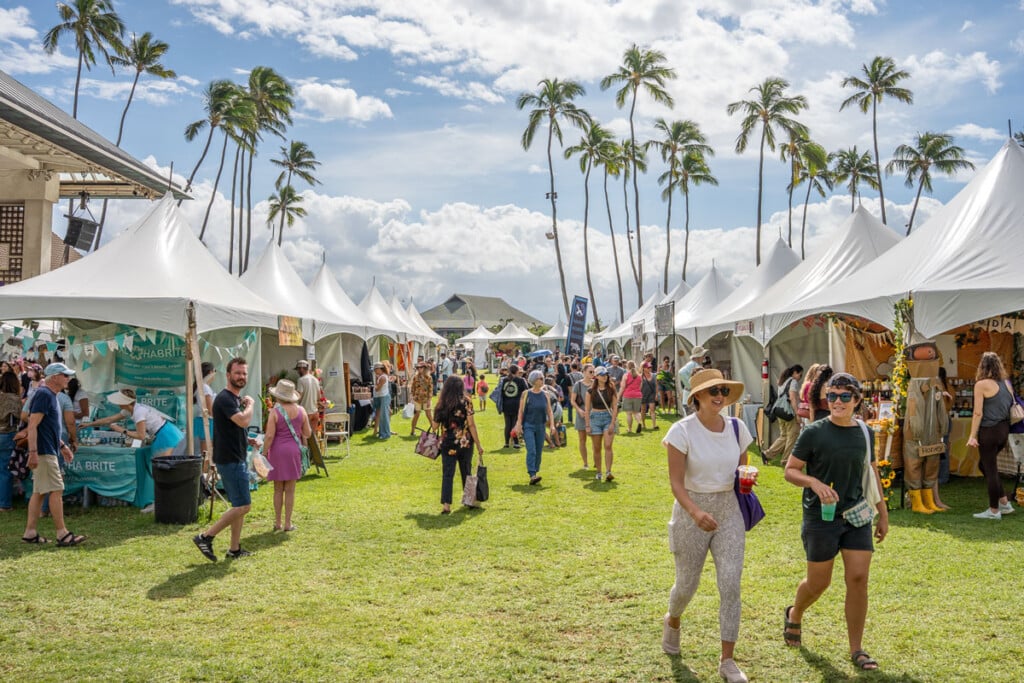
In one emerging trend, small business entrepreneurs turn a passion into income at farmers markets, craft fairs and events across the island where they can sell jewelry, clothing, snacks and other crafts.Angela Kaina, owner of Mauna i Kai Designs, launched her jewelry business with her husband and daughter as a way to build generational wealth and to stay rooted in Hawaiʻi.
Although it began as a supplement to her main job, the business now demands the commitment of a full-time work.
“I feel like you gotta have a side hustle to be able to survive out here in Hawaiʻi,” Kaina says. “From marketing, to hand-making jewelry, to drawing up our next designs, to writing social media, to managing our website, to fulfilling orders and prepping and running events—it’s probably 40 hours a week that we invest into this business.”
Like Kaina, Kori Lau of Beads and Things by Kori is no stranger to late-night product creation as a business owner, mother and caregiver for her father.
After graduating from the University of Hawaiʻi with a bachelor’s degree in fashion merchandising, Lau turned her love for tinkering with jewelry and clothing into a self-run business that allows her to work from home.
Now, 40 years in the making, her business has evolved to be a full-time gig.
“I worked part-time before, and then when I had my kids, I did the business full-time so that I could stay home with them,” Lau says. “I start late, maybe 9 p.m. or 10 p.m., and then through [the night], I just work.”
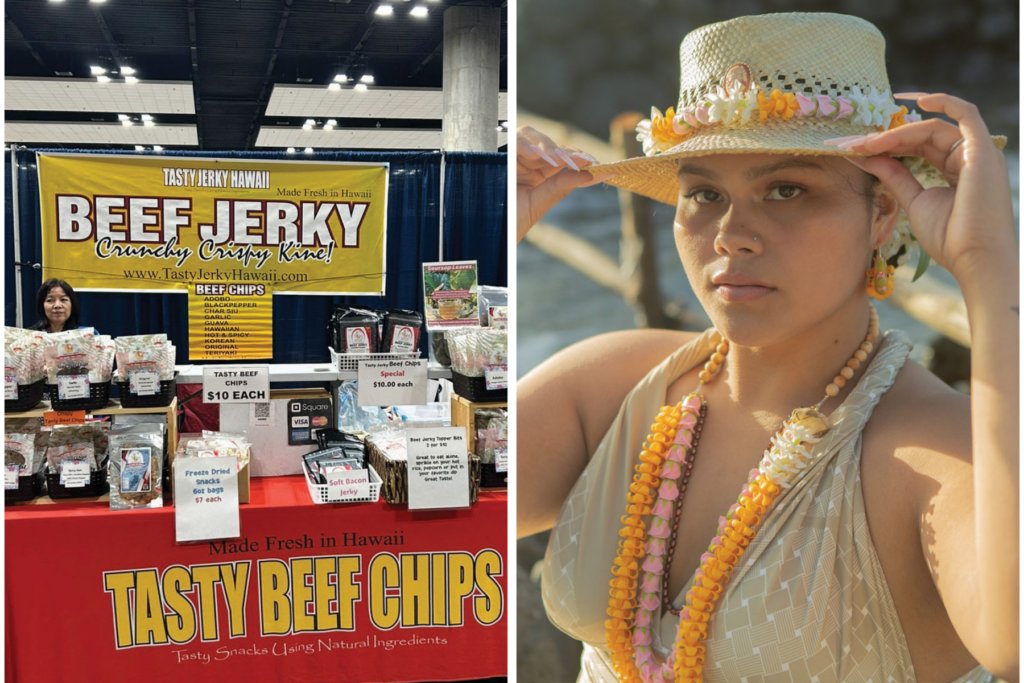
For Ivan and Debra Kung, co-owners of Tasty Jerky Hawaii, their business began small, selling beef jerky as a distributor for relatives at their son’s football games. Then, community members encouraged the couple to experiment with crispy-style jerky and sell it at local craft fairs.

For Ivan and Debra Kung, co-owners of Tasty Jerky Hawaii.
Now nine years into business, Tasty Jerky Hawaii has 14 different flavors of crispy jerky, USDA food safety and inspection certification and a storefront in Mililani Shopping Center.
“This past year, we got into different stores and now we’re all over the place – in Foodland, Don Quijote, Times Supermarket and 7-Eleven,” Ivan Kung says.
Even as their business grows, craft fairs and events remain essential for building connections with local customers and other businesses, a top priority for the Kungs.
According to Yuan Justin Perez, co-owner of streetwear brand Project Sora, with business partners Addison Velasco and Christopher Tang, craft fairs have become so popular that there seems to be one every weekend, with vendors selling any niche you can imagine.
Fortunately for him and fellow local entrepreneurs, Perez says the public loves to support local vendors if given the opportunity.

Yuan Justin Perez, co-owner of streetwear brand Project Sora, with business partners Addison Velasco and Christopher Tang.
“We thought starting online would be easier and we would get a couple of sales here and there, but for such a small brand, you can only go so far, unless you get really lucky,” Perez says. “But I think what clicked for us was when we did the markets and realized, hey, people really like our stuff, they just don’t see it enough.”
According to Rella Dwiggins, events coordinator at Island Craft Fairs and Events, there has been a dramatic increase in vendors attending her events, each with a diverse business story.
“For 70% of my vendors, this is their full-time thing,” Dwiggins says. “I would say 20% have a main job and this is their hobby, and the other 10% are on the verge of quitting their main job and making this their full-time job.”
The inspiration for Island Craft Fairs and Events began from her experience as a vendor selling etched glass and sandblasted designs. For over 10 years, Dwiggins made her living from selling at local craft fairs around Oʻahu, until she had a falling out with a promoter in 2017.
“I decided, well, let me create an event that’s catered to the vendors, where everything we do is to make sure that they have a successful event,” Dwiggins says. “Somewhere people could showcase the passion that goes into their work, share it throughout the islands, and still be able to pay their rent at the end of the day.”
Island Craft Fairs and Events hosts roughly four events per month, or approximately 48 events every year. Their website serves as a one-stop hub for customers, featuring events across Kauaʻi, Oʻahu, Maui and Hawaiʻi Island, even those they’re not directly affiliated with.
Behind every event is a network of vendors, chosen through an extensive vendor application.
To participate in an event, every vendor must acquire a general excise tax license, which requires payment of taxes on any income earned, mandated by the State of Hawaiʻi. Similarly, food vendors are required to have a certificate of insurance and are recommended to obtain an additional special events permit from the Department of Health.
For Island Craft Fairs and Events, booth rentals range from $75 to $170, depending on size and tent inclusion, with rates reaching $220 for prepackaged or food-serving vendors.
A $50 refundable deposit is collected from each vendor to ensure they follow event guidelines, including setting up on time, being ready by the designated start, breaking down only after the final announcement and signing out at the end of the event.
“Our applications are lengthy because we want to inform the vendors on what the rules are, in case they don’t know, or in case previous promoters didn’t let them know,” Dwiggins says. “We have vendors reapply each time. When I book events, I normally book an entire year out, so [they] can check off which boxes of the months that [they] want to do and prepay for it that way.”
Dwiggins says her previous experience as a vendor is an advantage in producing vendor-driven events because she’s familiar with the challenges they face.
“I understood, being a vendor myself, you either could not drink any liquid throughout the event, or you’d have to hold it, or you’d have to make friends with people next to you, hoping that they’ll watch your booth while you go,” Dwiggins says. “Or, someone would buy a shot glass from me that was maybe $5, and they’d give me a $100 bill and wipe out my change. So we have staff that would be there in case you needed to run to the bathroom, and we bring change for the vendors.”
Business owners say preparation for a market begins well before the event day, which often includes hours of stocking inventory, moving storage equipment and perfecting booth branding and setups.
Prior to an event, Perez of Project Sora has his designs manufactured out of state, shipped and then repackaged with company branding.
“For this recent event, we had just a little over 500 [items] and we walked out with under 100 left,” Perez says. “One thing that I hate when prepping is carrying all the [inventory], but the cleanup is fun because it’s all light and you’re like, oh, that’s a good day.”
For many local vendors, these events are their entry into entrepreneurship, bringing both opportunity and steep learning curves.
As the creative behind Mauna i Kai Designs, Kaina has come to realize that standing out in a competitive space takes constant reinvention.
“I have to be able to create new things so that we can continue to have customers come back,” Kaina says. “Our first year in business, it was trial and error of learning the market, the different business strategies, what people love and how to price things right where it’s still affordable, but we’re still able to operate a business and be profitable.”
Despite its competitive nature, these business owners agree that what sets Hawaiʻi’s vendor community apart is the spirit of camaraderie among peers.

Kori Lau of Beads and Things by Kori.
Since founding Beads and Things by Kori in 1987, Lau has seen the number of local crafters grow significantly. While the community has expanded, she says it’s also become more tightly connected.
“I have a core bunch of friends, my best friends, who are also crafters,” Lau says. “We see all the same bunch of people every week, and we all talk amongst each other and support each other. We meet newbies that want advice from us – they call us the ‘original gang’ – so we give them advice on how to start and how to do the fairs.”
Each small business owner holds their niche in crafts, snacks, clothing and design, yet shares the collective goal to grow their business.
“We see the same faces all the time, and we’ve been with them from the beginning, so they know our struggles from nine years ago,” Ivan Kung says. “Whether they want to continue with just craft fairs or they want to grow and expand into retail, they all started as crafters [just like we did].”
Dwiggins recalls feeling the growing pains of her vendors firsthand when two were offered kiosks at Pearlridge Mall.
“I was getting fewer vendors, so I was upset about it, but I learned something within the last few months that I’m very grateful for now,” Dwiggins says. “The two vendors told me, ‘We have you to thank for it. Now we make a lot more money, but if it weren’t for you getting us out there, we may have never had this opportunity.'”
Dwiggins says her purpose now is not only to keep Hawaiʻi residents and small businesses here, but to help them grow.
For Dwiggins, if she can showcase these small business owners, and a vendor gains a new shopper and that shopper discovers a new brand, heads to their website, or comes back next weekend, then she did her job.