Making Climate Action Work for Hawai‘i
From clean energy financing to brave-space conversations, Climate Hawai‘i is helping businesses and communities see sustainability not as a sacrifice but as a strategy.
Climate Hawaiʻi says it aims to turn climate change awareness into action, advocating for sustainable solutions that are crucial to the future of Hawaiʻi and the world.
The nonprofit, launched in 2022 as the Hawaiʻi Executive Collaborative’s Climate Coalition, was rebranded as Climate Hawaiʻi in 2024. Now retired Alexander & Baldwin CEO Chris Benjamin and UH Mānoa professor Chip Fletcher were co-founders, and they now serve as chair and science adviser, respectively.
The organization says it looks to break down traditional barriers and foster transformative collaborations that pave the way for climate solutions.
“There’s a lot of opportunity here for Hawaiʻi to be a leader and demonstrate to the globe what sustainable solutions look like,” says Jeff Mikulina, executive director of Climate Hawaiʻi.
In its first year, it encouraged local organizations that signed a Climate Pledge to do carbon inventories by measuring their greenhouse gas emissions. Any organization can get a better understanding of its emissions by plugging their fuel and electricity consumption into the “Carbon Emissions Inventory Calculator.” The calculator is found under “Toolkits” on Climate Hawaiʻi’s website, www.climatehawaii.earth.
In the same place is the “Decarbonization Toolkit,” which launched in 2025 and offers customized strategies on how organizations can reduce emissions.

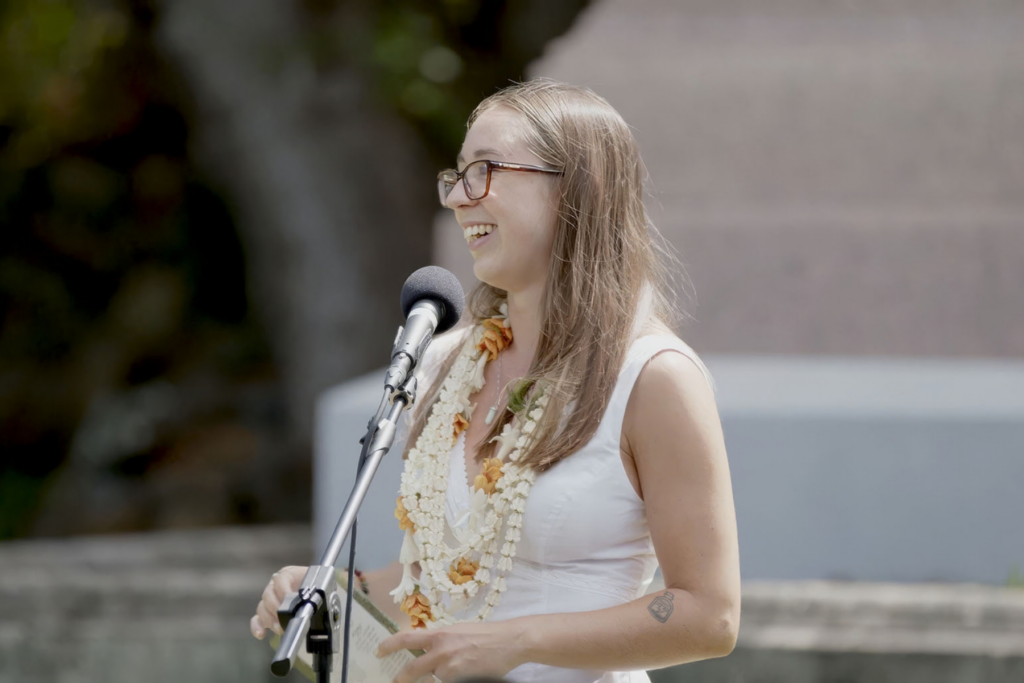
Kupu’s co-founder and CEO, John Leong, accepts the Non-Profit or Government Advocate award in 2025.
Promoting Climate Action
As a small organization, Mikulina says, Climate Hawaiʻi must limit its focus to a few issues. In 2023, it provided testimony at the state Legislature in support of funding for the Hawaiʻi Green Infrastructure Authority (HGIA), also known as Hawaiʻi’s Green Bank. Mikulina says companies that “you wouldn’t typically associate with aggressive climate action” also testified in support of the funding, which he calls a “real, positive step.”
“Climate Hawaiʻi actually was instrumental in helping us pass a bill” that would help underserved customers afford clean energy, says Gwen Yamamoto Lau, executive director of HGIA.
The Legislature approved $100 million in funding but that was decreased to $50 million by Gov. Josh Green to help balance the state budget. Yamamoto Lau says that HGIA was still grateful as the money lowered the energy burden for lower-income households.

Governor Josh Green signs a measure supporting Hawaiʻi’s climate goals. In 2025, Green established the Hawaiʻi Green Fee Advisory Council to help. fund wildfire mitigation and clean energy projects.
In August 2025, Green established the Hawaiʻi Green Fee Advisory Council, with Mikulina as its chair. After the 10-member panel of volunteers presented its proposed projects for the 2027 fiscal year to Green in December, he made minor changes and submitted it to the Legislature in January.
Brave-Space Conversations
Climate Hawaiʻi has now shifted its focus to having more “brave-space conversations” about difficult climate issues, bringing stakeholders together to reach a shared understanding.
“I think the best thing to do is have these discussions outside of (public) hearings,” Yamamoto Lau says. There, stakeholders with different perspectives can reach “some kind of compromise so that policies can move forward.”
Some topics of those brave-space conversations include shoreline management and utility rate securitization, which is used as a financial mechanism to manage the massive costs associated with climate change. By issuing bonds secured by a specific charge on customer bills, utilities can raise capital at lower interest rates to fund projects like wildfire mitigation and clean energy projects.

Elemental Impact and Climate Hawaiʻi meet about the 2025 Legislative outlook.
The next brave-space conversation will be about sustainable aviation fuel. Using a “drop-in jet fuel” that comes from biological sources instead of fossil fuel is a “key part of our decarbonization in Hawaiʻi,” since most of the state’s carbon emissions are from aviation, Mikulina says.
Hawaiʻi is “the perfect place to figure this out, because we’re so dependent on jet fuel to bring people here and to bring goods to Hawaiʻi,” he says.
Today, 24 states, the District of Columbia and Puerto Rico are committed to achieving 100% clean electricity, according to the Clean Energy States Alliance. Mikulina says “Hawaiʻi started that trend” in 2015 when it became the first U.S. state to legally mandate 100% renewable electricity by 2045.
He explains that Hawaiʻi is at the “tip of the spear for impacts,” where people feel climate change and shifting weather patterns acutely. He says Hawaiʻi could be a model for the rest of the world if it succeeds in its mitigation efforts, and that there is an “abundance of natural resources to tap into for energy.”

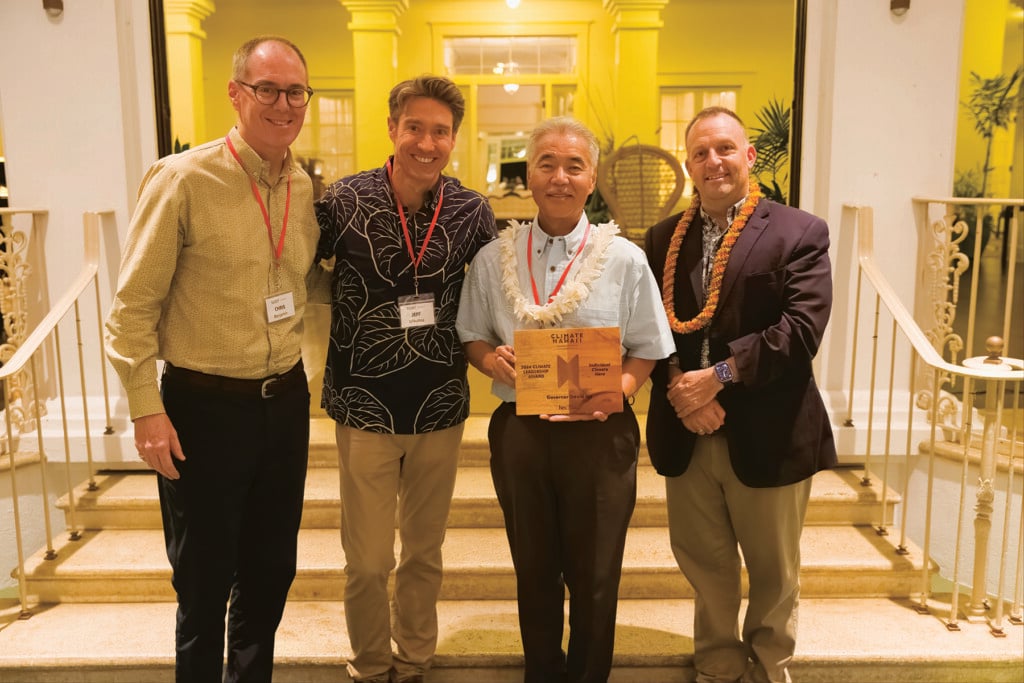
Attendees celebrate influential people and organizations at the 2025 Climate Leadership Awards.
Implementing Climate Solutions
Even though Mikulina says Hawaiʻi is “far ahead of the rest of the country,” it can be difficult to move from awareness to action when businesses are focused on immediate issues like revenue, staffing and profit. So he tries to present climate solutions in a win-win way.
“Historically, a lot of maybe business leaders or even community leaders viewed climate as like this other issue, as opposed to an issue that deeply impacts their business or their community,” Mikulina says.
But he says renewable energy can help cut costs. For example, Nohona Hale and Kahauiki Village — two housing projects on Oʻahu for low-income residents — have photovoltaic panels, resulting in lower monthly electricity bills.

Solar panels are a cost-effective, clean energy alternative.
“Clean energy isn’t a sacrifice, it’s really a strategy,” Mikulina says.
For two years, the organization’s annual Climate Leadership Awards have gone to people and organizations that drive climate action across the state. With the federal government cutting funding for environmental programs and disrupting state-level climate efforts, Mikulina says it’s more important than ever to celebrate successes.
“If we just go by default, then it’ll be disruptive, it’ll be expensive, it’ll be messy, we won’t have the workforce prepared for this new future,” he says. “We can do a lot better for our families and for our future.”