Japan’s Richest Man Came to Maui for Golf. He Got a Water War Instead.
Cast by critics as a villain in Maui's water wars, Uniqlo billionaire Tadashi Yanai says he's willing to contribute $40 million to help rebuild the island's aging infrastructure.
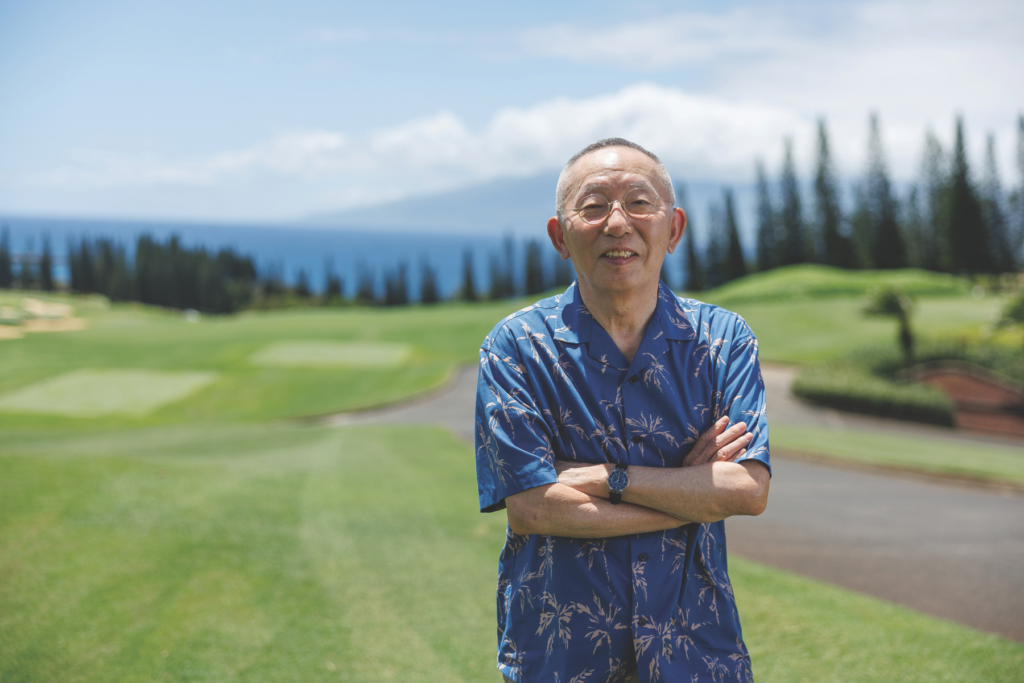
On a warm April afternoon in Maui, Tadashi Yanai, the billionaire founder of clothing brand Uniqlo, sits in one of his own aloha shirts discussing neither fashion nor his vast fortune.
He’s talking about water.
“Making money alone has no meaning for me,” Yanai says through a translator. “The money should support society and community. That is what I would like to do using my money.”
It is not the sort of statement one expects from Japan’s richest man — or from one of the world’s most influential businessmen, now cast by critics as a central figure in Maui’s escalating fight over a resource many residents view as sacred.
According to Forbes’ real-time billionaire rankings, Yanai and his family are worth an estimated $67 billion as of June 2026, making him the wealthiest person in Japan and one of the 35 richest people on Earth.
So how did the architect of one of the world’s most powerful retail empires find himself at the center of a Hawaiian island’s drought?
The answer begins on the fairways of Kapalua.
There, a dispute over irrigation has evolved into something much larger. Yanai’s Hawaiʻi company, TY Management, owns the Kapalua golf courses, whose lush fairways depend on increasingly scarce supplies. As drought conditions worsened, Maui Land & Pineapple — which controls much of West Maui’s water infrastructure — and state regulators pushed to restrict usage, igniting a conflict that now stretches far beyond the golf course.
The stakes reach well beyond the greens. What began as a fight over irrigation now touches jobs, tourism and one of Maui’s signature sporting events. Resort advocates say water shortages contributed to the cancellation of the PGA Sentry Tournament for a second consecutive year, putting at risk an event estimated to generate roughly $50 million annually for the island’s economy.
The controversy has transformed a famously private billionaire and avid golfer into the unlikely public face of one of Hawaiʻi’s most emotionally charged debates: Who gets access to a diminishing resource, and who gets to decide.
“I’m very sad, very sad and disappointed,” Yanai says of the tournament’s cancellation. “I am determined to bring it back to Maui.”

Close friend Hirotaka Takeuchi of Harvard Business School sits beside Tadashi Yanai, founder of TY Management. During the discussion, Takeuchi translated for Yanai. Photo: Aaron Yoshino
But Maui’s water wars did not begin with Yanai.
Their roots stretch back for more than a century. Beginning in the 19th century, sugar and pineapple plantations diverted streams through vast ditch systems, redirecting water away from Native Hawaiian kalo farmers and coastal ecosystems. The plantations eventually faded. The struggle over control of the water did not.
For decades, much of the infrastructure remained in private hands. Maui Land & Pineapple — the modern heir to the plantation era — continued to control key portions of West Maui’s reservoirs, ditches and delivery networks.
Then came years of drought, mounting legal battles and, in 2023, the devastating Lāhainā wildfire. Together, they intensified calls to place more of Maui’s water system under public control.
In May 2026, Maui County reached an agreement to acquire Maui Land & Pineapple’s water assets, a landmark shift that could reshape control of West Maui’s water for the first time since the plantation era.
The deal landed squarely in the middle of TY Management’s legal fight with the company, turning what began as a dispute over golf course irrigation and aging infrastructure into part of a much larger reckoning over land, water and power in Hawaiʻi.
Yet even that historic transfer left the central question unresolved.
Who should control Maui’s water future?
For some residents, the answer should never depend on the interests of wealthy investors or resort owners.
“Our island is dying,” says Maui resident Lauren Palakiko. “Our concern is not about billionaires playing golf. Our concern is how we sustain future generations.”

Pomaika‘i Kaniaupio-Crozier, Conservation Director for Pu‘u Kukui Watershed Preserve. Photo: Aaron Yoshino
Yanai’s Push to Rebuild the System
Kenji Yui, a senior adviser to Yanai and one of the architects of TY Management’s Maui water strategy, says the company had spent months quietly discussing its own partnership proposal with Maui County before the agreement with Maui Land & Pineapple was unveiled.
“We have been talking with the county for the past six months,” Yui says. The discussions have been about “if we can work together to jointly acquire MLP’s water system.”
But Yui acknowledged that Maui Land & Pineapple appeared to have an advantage over TY Management, remarking that “the county has direct communication with Maui Land & Pineapple because they have a historical relationship.”
Yui insists the county’s agreement with Maui Land & Pineapple changes little about Yanai’s broader ambitions in Maui.
Rather, he positions the billionaire’s involvement as an attempt to accelerate repairs to West Maui’s fragile water infrastructure using tens of millions of dollars of his personal stake rather than taxpayer money.
“If the county would like to reduce using taxpayers’ money, then it’s good for the community and for the county to work with TY,” Yui says. “Because TY can provide funding.”
Maui County has not closed the door on the idea, but its response was measured.
“We are always open to evaluating proposals that may benefit our community,” a county spokesperson said. “Maui County has engaged in successful public-private partnerships in the past, but any future partnership would undergo thorough review, including input from the Council and the community. Our focus will always be on ensuring any decision serves the best interests of Maui County residents.”

Native plants are being replanted along the ridgeline at Puʻu Kukui Watershed Preserve, helping restore and protect a critical Maui watershed. Photo: Aaron Yoshino
Yanai’s $40 Million Bet
Yanai has floated contributing somewhere between $30 million and $40 million toward repairs and upgrades to West Maui’s water system, though Yui describes those figures as rough estimates rather than hard caps.
Among the proposals under discussion: repairing aging reservoirs, fixing sections of the Honokōhau ditch system and building transmission lines capable of delivering “R-1” recycled wastewater to Kapalua, reducing dependence on stream diversions during droughts.
The proposal is closely tied to the future of Kapalua’s golf courses, which require substantial irrigation. According to Yui, water demand can reach roughly 1.5 million gallons per day during Maui’s hottest and driest periods, though actual usage fluctuates throughout the year depending on rainfall, humidity, weather conditions and growing seasons.
Yui says Yanai’s long-term goal is for all irrigation water used by the golf courses to eventually come from recycled wastewater or other non-potable sources, such as brackish water, rather than the Honokōhau ditch system.
“Just building a transmission line from the current wastewater treatment facility to Kapalua, at least it will take $20 million,” Yui says. Yui confirmed that the funding would come from Yanai’s personal fortune. “If the cost is reasonable for Mr. Yanai, then he will donate the money.”
Yui says the proposed recycled-water pipeline would serve not only the golf courses but broader irrigation needs in Kapalua. If alternative irrigation supplies can be secured for the area, he says, water currently delivered through the Honokōhau ditch system could potentially be redirected to other users, including Maui County and taro farmers.
Exactly how the remaining investment dollars would be spent remains unclear. Yui says discussions involving the county and other stakeholders are ongoing and that it is premature to assign specific amounts to projects such as ditch repairs, reservoir improvements or other infrastructure upgrades.
“It is safe to say he [Yanai] is willing to invest a substantial amount, millions of dollars, in improving the water infrastructure in order for an adequate water supply to be available for future generations,” Yui says. “That would save taxpayers millions of dollars.”
Yanai’s representatives point to previous investments as evidence that the company has sought to reduce water consumption rather than increase it. According to Yui, TY Management has invested approximately $10.3 million over the past decade in water-monitoring technology, irrigation-system repairs and upgrades, weather stations, soil-moisture sensors and other tools designed to optimize irrigation and reduce water use.
In 2019, TY spent an additional $12.6 million renovating the Plantation Course. According to Yui, the project included converting portions of the course to more drought-resistant grasses, installing a more efficient sprinkler system and reducing irrigated acreage by about six acres. Similar renovations had been planned for the Bay Course before water restrictions halted those efforts. The Bay Course is currently closed and not being irrigated.

Kenji Yui, a senior adviser to Tadashi Yanai and a key architect of TY Management’s Maui water strategy, and John Meier, president of the nonprofit Aloha Puʻu Kukui, visit Puʻu Kukui Watershed Preserve, where native species are being replanted along the ridgeline as part of longterm watershed stewardship efforts. Photo: Aaron Yoshino
Why Maui Matters to Yanai
Yanai says it’s a misconception to view him as simply a money-driven billionaire. Instead, he says his vision for Maui stems from a deep appreciation for the island, its people and its environment.
“I believe water should belong to the community,” Yanai says through a translator. “Not privatized.”
Under Yanai’s proposal, TY Management would ultimately transfer the upgraded infrastructure to a government agency or public entity at no cost.
Over time, Maui has become far more than a luxury destination or business investment for Yanai. Yanai and his wife visit the island regularly, golfing in Kapalua several times a year, and he says he has developed a strong personal attachment to the community and landscape.
“I love Maui,” Yanai says through his translator. “I would like to live here permanently someday.”
He says the island has also had a profound effect on his personal well-being.
“My health became much better after spending time in Maui,” he says. “The weather, the environment, the people — it is a very special place.”
Yanai says he hopes to support both economic opportunity and environmental stewardship in West Maui, particularly efforts tied to long-term water sustainability.
“This is not only economic development,” Yanai says through a translator. “It is also about the environment, including the water situation.”
Through TY Management, Yanai has already committed $2.5 million to Maui-related causes. That includes $750,000 donated in 2025 to local nonprofits such as Hale Makua Health Services and the Lahainaluna High School Foundation to help offset charitable losses tied to the cancellation of the PGA Tour’s Sentry tournament.
The company also previously provided $1 million for watershed conservation efforts, along with an additional $500,000 this year to Aloha Puʻu Kukui.
Following the Lāhainā wildfire, TY Management says, it funded 50 temporary homes for displaced residents. That’s on top of the offer to invest up to $40 million to modernize West Maui’s aging water infrastructure before eventually transferring the upgraded system to public ownership at no cost to the government.
Globally, Yanai and his companies have contributed hundreds of millions of dollars to humanitarian and educational initiatives, but he says Maui remains uniquely personal to him.
Golf, Water and Public Backlash
Yanai’s championship golf courses, which spread across hundreds of acres of Kapalua hillside, have increasingly become a symbol of Maui’s larger struggle over water, tourism and development.
As climate change deepens the island’s droughts and Native Hawaiian communities press legal claims to ancestral water rights, the debate has increasingly focused on West Maui’s aging ditch system — and on whether the shortages stem from drought, failing infrastructure or both.
To critics, dedicating scarce water resources to luxury golf courses, regardless of who finances the infrastructure, is difficult to separate from Hawaiʻi’s longer history of unequal land and water use.
The philosophical debate eventually hardened into a legal one.
In 2025, Yanai’s company, TY Management, sued Maui Land & Pineapple, alleging that the company neglected the aging Honokōhau ditch system that supplies water to West Maui, worsening shortages that threatened Kapalua.
“MLP has knowingly, and in violation of its promises and obligations to Plaintiffs, allowed the Ditch System to fall into a state of demonstrable disrepair,” the lawsuit states. “That disrepair — not any act of God, force of nature, or other external factor — is why users who depend on the system are currently without water.”
TY’s lawsuit points to what it says is visible evidence of that neglect. During a May 2025 site visit, TY representatives, consultants and county officials observed sediment accumulation at Diversion 770, debris clogging intake structures and damage to one of the development tunnels that historically supplied additional water to the system, according to court filings. TY also documented severe deterioration in the liner of the Village Reservoir, where large sections had cracked or detached.
Photographs included in the filings show sediment buildup at key diversion points, damaged gates, overgrown sections of the ditch system and deteriorating storage facilities. TY argues the images support its claim that aging infrastructure — not simply drought — has reduced the amount of water reaching West Maui users.
Maui Land & Pineapple rejects that characterization entirely.
“The reality is there’s been a very strong misinformation campaign,” CEO Race Randle told Hawaii Business Magazine in an interview conducted before Maui Land & Pineapple agreed to sell its water assets to Maui County. “Last year was the driest year on record in Maui. If the streams aren’t flowing, there is no water to divert.”
Randle argues the dispute is not about neglected infrastructure but the harsh mathematics of climate change, drought and limited storage capacity in West Maui’s isolated water system.
“When Mother Nature goes to an extreme,” he said, “there’s a lot of finger-pointing that happens very quickly.”
Yanai sees it differently.
“This is not a legal matter,” he says through a translator. “It is a human matter.”
Whether Maui County’s agreement to acquire Maui Land & Pineapple’s water assets will ultimately reshape the dispute remains an open question. County officials declined to speculate on whether the deal could help resolve the litigation between TY Management and Maui Land & Pineapple, noting that the case remains a private dispute between the two companies.
For now, the future of West Maui’s water system remains unresolved.
The county’s agreement with Maui Land & Pineapple is nonbinding. The litigation continues. And behind the scenes, county officials, private developers, Native Hawaiian advocates and Yanai’s advisers are still negotiating over who should ultimately control one of Maui’s most politically sensitive resources.

At Puʻu Kukui Watershed Preserve, native species, including ʻaʻaliʻi, a traditional Hawaiian healing plant, are being replanted across the hillside as part of longterm watershed stewardship efforts. Photo: Aaron Yoshino
When the Fairways Turned Brown
That question became impossible to ignore when the water restrictions reached Kapalua.
As supplies tightened, authorities sharply limited diversions from West Maui streams, reducing irrigation water across the resort community.
The Bay Course was forced to close. Water that once sustained its fairways was redirected in an effort to preserve the Plantation Course, home of the PGA Tour’s season-opening Sentry Tournament. Even that proved insufficient.
The fairways began to brown.
At Kapalua, where emerald greens had long served as a symbol of luxury Hawaiian tourism, large stretches of landscape turned brittle under conservation measures. Residents watched gardens dry out. Irrigation systems slowed. Golf operations shifted into survival mode.
For resort operators, the threat extended beyond aesthetics.
The Plantation Course hosts the Sentry Tournament, a global television showcase and one of Maui’s most important tourism events. Resort advocates say the tournament generates roughly $50 million annually for the island’s economy through hotel bookings, restaurant traffic, transportation services and visitor spending.
When the event was ultimately canceled, the effects rippled well beyond the golf course.
Hotels, restaurants, caddies, landscapers and other hospitality workers all depend on the winter tourism surge that accompanies the tournament. For many local businesses, the water dispute had become an economic crisis as much as an environmental one.
TY Management maintains that the shortages are not fundamentally the result of declining rainfall. The rain still falls on West Maui’s mountains, the company argues. The problem is that aging ditches, reservoirs and delivery systems were never adequately maintained to capture and move that water when it arrives.
Critics disagree.
But by the time the fairways turned brown, the argument was no longer confined to engineers, regulators and lawyers. It had become a public battle over water, development and who gets to shape Maui’s future.

Race Randle, CEO Of Maui Land & Pineapple Inc. Photo: Aaron Yoshino
Honokōhau Ditch System: An Infrastructure System Built for Another Era
The populated part of West Maui is a narrow strip of coastline pressed between the Pacific Ocean and steep volcanic mountains. Nearly every drop of fresh water that reaches its homes, hotels, farms and golf courses depends on a fragile network of streams, tunnels, ditches and reservoirs built during Hawaiʻi’s plantation era.
Long before Kaʻanapali became synonymous with luxury tourism, water shaped power on Maui.
Beginning in the late 1800s, sugar and pineapple companies diverted vast quantities of water away from Native Hawaiian communities and into plantation agriculture, transforming both the island’s economy and ecosystem. The systems allowed plantations to flourish for generations while downstream kalo farmers and coastal fishponds struggled for survival.
Many of those same diversion systems still define West Maui today.
The 11-mile Honokōhau ditch system — now at the center of the dispute between TY Management and Maui Land & Pineapple — was designed for a very different Hawaiʻi: one built around plantation agriculture, not climate volatility, wildfire risk and mounting development pressure.
Today, those pressures are intensifying.
According to the Hawaiʻi Annual Climate Report 2025, last year was the second driest year in Hawaiʻi’s 106-year recorded history, with statewide rainfall averaging just 42 inches — roughly 20 inches below the 30-year average.
Maui experienced its driest year on record. Hawaiʻi island recorded its second driest. By year’s end, 65% of the state was classified as abnormally dry or worse, while all of Molokaʻi experienced drought conditions. The most severe period came in February, when more than half of Hawaiʻi was classified as being in severe drought or worse.
For Maui Land & Pineapple, the explanation for the shortages is straightforward.
“When the streams aren’t flowing, there is no water to divert,” CEO Race Randle says. “That’s the reality.”
But TY Management argues the central problem is not the amount of rain falling from the sky.
The central question running through the dispute is whether West Maui is running out of water or losing its ability to capture, store and deliver the water it already has.

At Puʻu Kukui Watershed Preserve, native plants are being reintroduced along the hillside to stabilize the landscape and reduce erosion. The white structures are water storage tanks. Photo: Aaron Yoshino
The Unintended Consequences
In early 2026, organizers canceled the PGA Tour’s Sentry Tournament in Kapalua for the second consecutive year after uncertainty surrounding water delivery and course conditions made it impossible to guarantee tournament standards in time for the event.
For Hawaiʻi’s tourism industry, the fallout was far more than a sporting disappointment.
Jerry Gibson, president of the Hawaii Hotel Alliance and one of the state’s most influential hospitality executives, says the economic consequences could reverberate across the Islands for years.
“This whole thing, honestly, has affected us for years to come,” Gibson says.
The Sentry Tournament and the Sony Open, he says, have long served as Hawaiʻi’s most valuable annual tourism advertisements — two consecutive weeks of nationally televised images showcasing the Islands during winter on the mainland.
“You’re sitting in New York in January, and it’s freezing outside, and you see the surfers, the golf courses, the palm trees,” Gibson says. “You might get off the couch and decide to book a trip to Hawaiʻi.”
The immediate losses from the Sentry cancellation were estimated at roughly $50 million annually. Gibson believes the long-term impact could stretch far higher.
“You can’t just talk about $50 million,” he says. “This is hundreds of millions of dollars over time.”
According to Gibson, the PGA Tour explored relocating the event elsewhere in Hawaiʻi — and even to the mainland — before ultimately canceling it because no other course could be prepared quickly enough to meet tournament requirements.
“The courses need months of preparation,” Gibson says. “They couldn’t guarantee the water was going to be delivered like it was supposed to be.”
Yet Gibson rejects the idea that the crisis can be blamed entirely on one company or one drought.
“You can blame a little bit of nature because there was a drought at the time,” he says. “And you can also say communication should have been a lot better between everybody.”

John Meier, president of the nonprofit Aloha Puʻu Kukui. A former technology entrepreneur who began his career at Apple and later founded and grew software companies, Meier has volunteered at Puʻu Kukui for six years and has been involved in conservation efforts on Maui for the past decade. Photo: Aaron Yoshino
‘What MLP Has Done Is a Sin’
To Yanai, the picture looks very different.
“What MLP has done is a sin,” Yanai says at one point during our interview, referring to Maui Land & Pineapple. Yanai accuses the company of failing to maintain the aging ditch infrastructure needed to move water through West Maui.
Maui Land & Pineapple strongly disputes that claim.
“The system is functioning,” Randle says. “The issue is that there was no water in the streams to divert.”
Behind the increasingly personal rhetoric lies a more uncomfortable reality: Both sides may be arguing over a system that was never designed for modern Maui.
West Maui’s water infrastructure was built for another era — one centered on plantation agriculture, not luxury tourism, wildfire resilience and climate volatility.
Now engineers, developers and government officials are scrambling to answer a far larger question: How does an island community survive when drought becomes permanent?
For Randle, the answer begins with data.
“A drought is a scientific fact,” he says. “What really helps in discussions around water is good data — how much rain is falling, where it’s going, and how much water is actually available.”
Randle argues Maui’s crisis exposes a structural problem far bigger than Kapalua’s golf courses: West Maui simply lacks the storage capacity to survive prolonged climate extremes.
“In West Maui, we have roughly 10 days of water storage,” he says. “If it doesn’t rain, you’re relying on groundwater.”
That vulnerability has accelerated a growing push toward large-scale water recycling, expanded reservoir systems and even desalination projects.
Yanai, through TY Management, has proposed major investments in recycled “R-1” water infrastructure intended to reduce dependence on stream diversions. Maui Land & Pineapple says many of those ideas remain conceptual and subject to county approval.
“There’s no detailed proposal in front of us,” Randle says. “But recycling water is absolutely part of the future.”
Even critics of Kapalua’s golf operations increasingly acknowledge that Maui’s long-term survival may ultimately depend less on litigation than on engineering.
Across West Maui, crews are already expanding so-called “purple pipe” systems that carry recycled water for irrigation. County officials are studying additional storage reservoirs capable of capturing storm runoff during increasingly erratic weather events.
The stakes stretch far beyond golf.
“How do we achieve our goals with limited resources?” Randle asks. “That’s the real question.”

The Puʻu Kukui Watershed Preserve in West Maui, a protected native forest that plays a key role in sustaining the region’s water supply and ecological resilience. Photo: Aaron Yoshino
Locals Are Angry
As West Maui’s drought intensified, the fight over Kapalua’s water supply expanded beyond aging plantation ditches and into another politically explosive question: whether drinking water was being used to keep the golf courses alive.
Historically, Kapalua’s courses relied heavily on surface water diverted through the Honokōhau ditch system. But as stream flows dropped and regulators restricted diversions during the drought, attention shifted toward groundwater wells — potable water sources that many residents viewed as increasingly scarce after the Lāhainā wildfire disaster.
Environmental advocates and Native Hawaiian groups accused TY Management and Maui Land & Pineapple of relying on potable groundwater to irrigate the Plantation Course during the water crisis. Earthjustice, representing community groups before Hawaiʻi’s Commission on Water Resource Management, argued that the use of groundwater for golf-course irrigation violated state water permitting requirements in West Maui’s regulated aquifer system.
The controversy intensified after Commission Chair Dawn Chang issued correspondence in 2025 stating that water operators had represented groundwater as an existing source of irrigation water within the Kapalua system and that its temporary use could continue while permit applications were under review. Critics interpreted the letter as effectively sanctioning the use of drinking water for golf-course irrigation during a period of drought and water restrictions.
Chang later rejected that interpretation, saying the correspondence neither authorized nor directed new groundwater withdrawals but instead reflected information that had been provided to the commission regarding existing operations.
Chang will retire as Department of Land and Natural Resources chairperson and director on July 1.
TY Management also rejected accusations that it was improperly taking drinking water for golf irrigation, arguing that it did not directly control the underlying water sources flowing through the broader West Maui delivery network. The company says its long-term proposal centers on recycled “R-1” water infrastructure precisely to reduce dependence on both stream diversions and potable groundwater.
But after Lāhainā, the symbolism proved difficult to contain — and for residents like Lauren Palakiko, impossible to separate from a much longer history of dispossession and mistrust.
Palakiko, a Maui Realtor born and raised on the West Side whose husband is a kalo farmer, moves between the island’s luxury economy and its local communities. But on the question of water, she is unsparing.
“They were using the approval to irrigate with drinking water,” she says. She alleges that “they filled their reservoir with drinking water from our aquifer — depleting it within days. Those are our only safe, clean drinking wells.”
West Side residents, meanwhile, were restricted to watering their yards once a week. She recalls watching a nearby golf course run sprinklers at noon — peak evaporation time — close enough to the Lāhainā burn zone to feel almost provocative.
“It does feel like a slap in the face,” she says. “We are on drought restrictions and we are watering grass so billionaires can play golf.”
For many Maui residents, the image of green fairways surviving amid drought restrictions and wildfire trauma became emotionally inseparable from deeper fears about who would ultimately control Hawaiʻi’s increasingly scarce water resources.

Tadashi Yanai in May donated $500,000 to the nonprofit Aloha Puʻu Kukui toward the restoration work of the West Maui Puʻu Kukui Watershed Preserve. The latest gift brings the total contribution to Puʻu Kukui Watershed to $1.5 million since 2024. From left to right: Mari Poorman, Peacewinds; John Meier, Aloha Puʻu Kukui; Veronica Fernandez, Aloha Puʻu Kukui; Alex Nakajima, Kapalua Golf; Mr. Tadashi Yanai, TY Management. Photo: Aaron Yoshino
Who Gets the Water?
For many residents, the fight over water has become about something larger than golf, tourism or infrastructure. Three years after the Lāhainā wildfire catastrophe, water shortages have become psychologically inseparable from questions of public safety and survival.
Questions once confined to hydrologists and regulators suddenly became existential for ordinary residents: Who gets water during a drought? Who sacrifices first?
In Hawaiʻi, water has never been simply about water. It is land, sovereignty, history and survival flowing through the same streams.
Palakiko traces the conflict “when the plantations started diverting water out of the streams.” When the plantations shut down around 2000, she says, developers inherited the same diversion and water delivery system once controlled by sugar companies — but instead of replenishing the land, much of that water now flows into pools, resorts and manicured fairways.
The consequences, she argues, are now appearing underground.
The island’s freshwater exists as a fragile lens floating above ocean saltwater deep within the aquifer, and that lens is shrinking.
“You’ve got this bowl and all these straws — which are wells — all sucking from the same freshwater lens,” she says. “The salination is rising past the EPA’s threshold for safe human consumption. This is our water source. This is how we get our water.”
She also has not forgotten how some officials responded after Lāhainā burned.
“After we lost our town and our homes and our people, they were joking that we wouldn’t need to put salt on our food anymore because our water was already salty enough.”
For many Native Hawaiians, the modern fight over West Maui’s water cannot be separated from the plantation-era diversions that transformed the islands generations ago. Long before Kapalua became a global golf destination, communities downstream argued that diverted streams damaged traditional farming, fishponds and cultural practices.
Climate change has only intensified those tensions.
For some residents, the sight of green fairways during water restrictions symbolizes a familiar imbalance in Hawaiʻi — one where tourism, luxury development and outside wealth continue to shape access to finite island resources. Others argue the deeper danger lies elsewhere: an aging infrastructure system increasingly incapable of supporting anyone, regardless of who owns the golf courses.
Palakiko says both concerns are real, but she keeps returning to something more fundamental than litigation or infrastructure deals: restoring the natural water cycle itself.
She wants all streams restored from mountain to sea — mauka to makai. She wants the West Side reforested because healthy forests attract rain clouds, recharge aquifers and help sustain communities through drought.
“Our mountains are called Mauna Kahālāwai — the Gathering of the Water,” she says. “We were once the second wettest spot in the world. We have the ability to bring that back.”
Above all, she wants Native Hawaiian customary water practices treated not as a historical footnote but as the governing principle.
“Mālama ʻāina — take care of the land first,” she says. “Everything that depends on this land and water to survive comes before extracurricular activities, such as golf. I don’t really know any locals who would put a dollar before any of that.”