Working Together to End Homelessness
How partnerships are helping to address homelessness among veterans, Native Hawaiians, kūpuna, and youth.
Ending Homelessness Gains Momentum
The Built for Zero initiative has decreased Oʻahu’s veteran homelessness and is now expanding to other vulnerable communities.
For years, veterans cycled through Oʻahu’s homelessness system, moving between programs without finding lasting stability. Then, multiple service providers and organizations came together to compare notes on one veteran specifically. Each had a piece of the puzzle, what services he had used and what barriers had prevented him from securing housing.
By pooling their knowledge and coordinating their efforts, the group reconnected him with services through the U.S. Department of Veterans Affairs and ultimately helped him obtain housing.
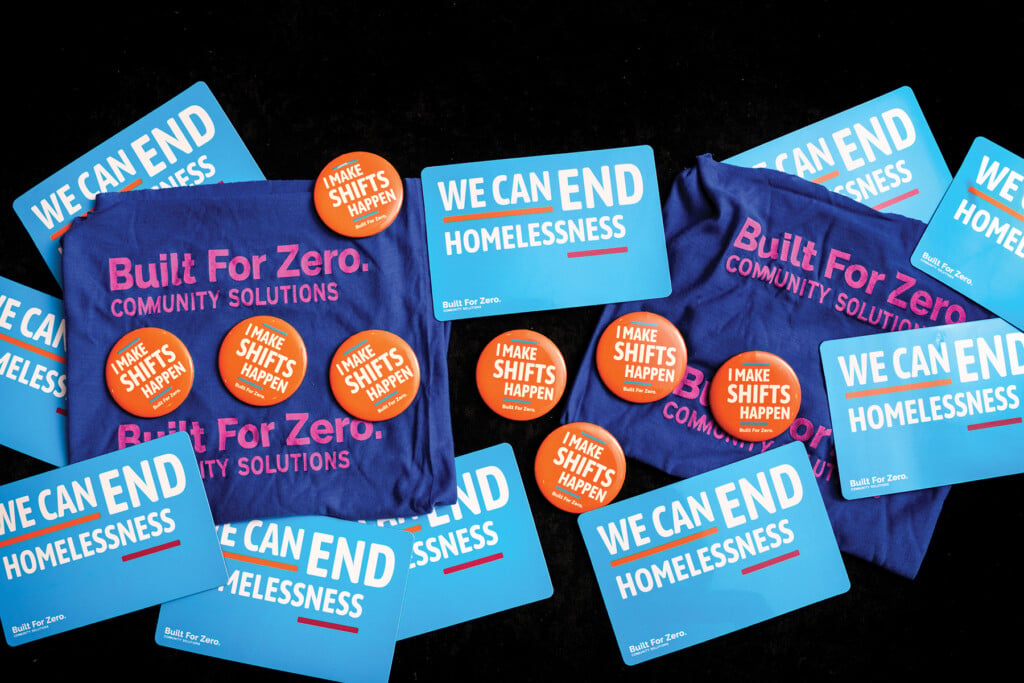
It’s the kind of outcome that has become more common under Built for Zero, a national initiative developed by the nonprofit Community Solutions that is focused on the goal of achieving “functional zero” homelessness, meaning it is rare or brief.
“The mentality arose where rather than count up to houses, we would count down toward ending homelessness,” says Chelsea Nelson, strategy lead for Large Scale Change at Community Solutions. “Many communities will start with veterans because they have a lot more access to resources from day one.”
The Built for Zero model relies on maintaining real-time lists of people experiencing homelessness and improving coordination across agencies to move them into stable housing through a faster, more targeted outreach. Once that foundation is set, Nelson adds, it’s natural for communities to pivot to another vulnerable population.

U.S. Vets conducts community outreach.
Built for Zero expanded to Honolulu in 2020 and then later to the entire island of Oʻahu in 2024 through a partnership with Partners in Care, Oʻahu’s homeless services continuum of care organization. As the backbone organization for the initiative locally, Partners in Care pulled together a network of local service providers, government agencies, and other stakeholders.
Kaiser Permanente’s partnership with Built for Zero began in 2020, supporting Partners in Care through funding, expertise, and other resources.
“Kaiser Permanente representatives will be at the meetings, and if there’s any assistance health-wise that needs to be addressed, we have that representative from Kaiser Permanente on the line, and they can help us figure out some of the basic things, like what a person can qualify for and then the actual housing navigation,” says Laura Theilen, executive director of Partners in Care. “We’re able to partner up with them and figure out housing assistance as well as additional services like home health care workers, so there’s multiple ways that Kaiser Permanente is involved.”
To date, Community Solutions reports there’s been a 68% increase in housing placements for vets.
One of the biggest factors in reducing veteran homelessness was improving the quality of the data itself. “We shrunk our name list by cleaning data, and then we figured out who are our top veterans were who need a higher level of care,” says Theilen.
By removing outdated records and identifying veterans with the most urgent needs, service providers were able to focus resources more strategically. Partners in Care worked with the U.S. Department of Veterans Affairs to shorten the time between referrals and housing placement.
“VA Pacific Islands, as the leading provider of veteran services and veteran permanent housing programs, was actively involved in the work from the very beginning,” says Lindsey Kaumeheiwa, coordinated entry specialist and licensed clinical social worker at the VA.

At a past Built for Zero conference, Lindsey Kaumeheiwa, a coordinated entry specialist and clinical social worker for the U.S. Department of Veterans Affairs, is pictured at far left.
Kaumeheiwa says the VA contributes housing resources, including temporary housing beds and housing vouchers, coordinates closely with community partners, and helped improve data quality, “ensuring no veteran fell through the cracks.” The effort also relies on regular case conferences that bring together the VA Pacific Islands and partners to identify barriers and problem solve solutions for veterans working toward housing.
The collaboration has produced measurable results. “Data from the 2026 Point-in-Time Count saw an 8% decrease in veteran homelessness since 2024 (247 to 227 veterans) and a 51% decrease since 2015 (467 to 227 veterans),” says Kaumeheiwa. The sharpest decline was among unsheltered veterans, whose numbers fell 39%, from 125 to 76.
The annual Point-in-Time count, conducted by Partners in Care, is a federally required count of people experiencing homelessness conducted on a single night each year.
Prior to Community Solutions’ involvement, there was not a concerted effort among service providers on how to move forward, says Kim Cook, vice president of clinical services at the homeless service provider U.S. Vets.
Now, with Community Solutions driving everyone forward, there’s more follow-through and monthly meetings to track progress, she says. “It really puts the accountability on us to say, ‘OK, we are not moving this needle or we are moving this needle,'” Cook says. “It has been instrumental in moving this work forward.”
Cook also says Partners in Care has done a great job understanding which organizations have which resources. “Up until this point, everybody was sort of holding on to their own resources and kind of utilizing it more in a siloed approach, but what this does is it elevates to the surface what everybody has, so we can basically utilize what’s in our community versus what’s in our organization,” she says.
“I absolutely think it can be duplicated for any subpopulation, as long as the providers in the room are committed to getting that done and to putting their resources together,” Cook says.
Transitioning to Other Populations

U.S. Vets engages with the community as part of its work to further their mission of serving those who served.
With veteran homelessness declining on Oʻahu, the same model is now being considered for other vulnerable populations experiencing homelessness, including Native Hawaiians, kūpuna, and youth.
“There’s a big disproportionate population with Native Hawaiians that are represented in the homeless community,” Nelson says. “Partners in Care kind of shifted to explore what makes sense, how can we utilize our resources to maybe cross-pollinate what we’re doing here.”
During a recent series of meetings, Community Solutions, Partners in Care, and over 30 organizations, including Kaiser Permanente, Office of Hawaiian Affairs, and the Department of Hawaiian Home Lands, came together to discuss how the Built for Zero framework could be adapted to address the unique challenges facing Native Hawaiians.
“For veterans, a lot of them are not from Hawaiʻi, or they’ve traveled before and a lot of them are single males, whereas with Native Hawaiians, we’re talking about land issues and cultural issues,” Theilen says.
“The big thing for us right now is being culturally competent, and so that really starts with our team. We really want to get to the heart of the issues, and we really feel that the best way to do that is let the different subpopulations tell us what their needs are.”
Theilen says the next step is identifying Native Hawaiian-focused organizations that should be involved, understanding how they can contribute, and determining what gaps in services and support still need to be addressed.

Built for Zero’s Native Hawaiian Workgroup met during an in-person retreat at Windward Community College.
“I always take any technical assistance that’s offered to us because it’s always proven to be beneficial, and Community Solutions and Kaiser Permanente have been involved for such a long time now with Partners in Care that they are truly our partners,” Theilen says.
It’s the ongoing conversations and deep commitment to community that make Built for Zero a model built for success.

Supporting Youth Mental Health
From school-based health centers to community programs, organizations are addressing mental health needs for children and teens.
As young people navigate a fast-paced world filled with social media pressures, academic demands, and family stressors, culturally grounded mental health support can help youth manage anxiety, stress, grief, or trauma.
“I really think there is a need for mental health support right now,” says Kyle Ishizaki, executive director of Kalihi Branch YMCA. He says support helps youth address anxiety, turn negative thoughts into positive ones, manage stress, and learn how to communicate their feelings to others.
“For example, they may be feeling scared, but then what comes out of that feeling of being scared may be anger, or it might be something more of sadness, or it might come out as irritation or frustration,” he says. “So, it’s really to help them understand what their emotions are and how these emotions may differ.”
On Oʻahu and Maui, various organizations are addressing these needs in schools, clinics, and community spaces, including the YMCA, Kids Hurt Too Hawaiʻi, and the Waiʻanae Coast Comprehensive Health Center.

YMCA Counselor Kalani Pascual works on. a resilience activity with teens.
The YMCA of Honolulu provides youth mental health support through a three-part model that includes screening, prevention, and intervention. Youth may be identified through school referrals, classroom presentations, and outreach, with screenings conducted one-on-one with a counselor to flag early signs of stress, trauma, or emotional challenges. Prevention and intervention programs then build coping skills and emotional awareness, with more intensive, counselor-led sessions helping youth practice strategies and apply them to real-life situations.
The YMCA is also focusing mental health support on students who are physically disabled or challenged. “We know that those students may have some emotional mental health stresses or trauma going on, so Kaiser Permanente has funded us to work with students in the DOE with those physical disabilities to do the screening, and then based off the screening, either do prevention or intervention.”
The nonprofit Kids Hurt Too Hawaiʻi offers another targeted effort, providing free mental health mentoring and community-building services to children, teens, and parents impacted by grief, loss, or trauma.
“Our kids are going through a particularly difficult time right now and they need a lot of support,” says Walker Rowsey, executive director of Kids Hurt Too Hawaiʻi. Rowsey says there is need for mental health support across all ages, especially in the wake of disasters such as the Maui wildfires.
In 2024, the nonprofit launched mobile safe spaces to address the aftermath of the Maui wildfires and later expanded mobile services to the Waiʻanae Coast. Rowsey says Kaiser Permanente supports its mobile and school-based peer support groups that operate in the community. “The mobile vehicles have amazing programs in them,” he says. Those services include peer support groups as well as mentoring activities.

Kids Hurt Too program specialist Nani Peterson reads with keiki at Kids Hurt Too’s annual Aloha ‘Ia ‘O Wai‘anae festival.
The nonprofit’s Healing Young Hearts program also offers support groups that help children process tough experiences. “Those support groups work to help kids process the difficult things that they have been through,” Rowsey says.
Youth process these emotions through play, he adds, so the groups provide a safe space for play while trained staff observe and listen. “Our model kind of practices a form of youth-led play, so we have a child-centered approach, and we actually let the kids, the participants, decide absolutely everything that we do in the group, so we are there just to give them undivided attention and support,” he says. For teens, their groups sometimes meet as talk story sessions.
In West Oʻahu, Waiʻanae Coast Comprehensive Health Center provides behavioral health services alongside primary care through a network of six school-based health centers.
“Our community, the 96792, has gone through a lot that has caused a lot of grief in different ways and impacted our community,” says Ariel Panui, a social worker with Waiʻanae Coast Comprehensive Health Center. “I would say there’s been a lot of loss this past year, specifically for our youth.”
“Next to that, I will also say there’s a lot of anxiety and depression. Those are really common as well,” she adds.
Services are available to students at elementary, middle, and high school campuses, including Nānāikapono Elementary School, Kamaile Academy, Nanakuli High and Intermediate School, and Waiʻanae Elementary, Intermediate, and High Schools. Students can walk right into the clinic for behavioral health or primary care services, and staff communicate with parents or guardians.
“With school-based health centers being on campus, it breaks a lot of stigma where the kids have access, like it’s normalizing seeking help,” Panui says. She also runs a girls group, Hoʻoulu Nā Wahine, which Kaiser Permanente helps fund. It is for middle school students to talk story and reflect on what it means to be wahine and the challenges that come with that, creating a safe space for discussion.
Kaiser Permanente has supported these school-based health centers through grants that cover care for students regardless of insurance status.
“We have a lot of kids that have just moved or they’re not attached to health insurance, but they need to be seen,” Panui says. “Those grants really help so that we can support the kids.”
Through these organizations, young people are being met where they are, in their schools and community, to ensure they have sufficient mental health support and aren’t facing these challenges alone.
Workforce Housing for Health Care

Maui’s health care industry continues to face staffing shortages, with high housing costs deterring medical professionals from relocating to the island. In response, Maui Health Foundation launched a Housing for Healthcare initiative, which provides transitional homes for health care workers and their families, and so far, it’s already making a difference.
“We have a huge shortage of health care workers,” says Tamar Chotzen Goodfellow, board president of Maui Health Foundation. “The reason that Maui Health Foundation got into the housing business is because we’re desperate to retain and recruit health care professionals, particularly physicians, but also technicians and high-quality nurses.”
A nonprofit that supports Maui’s hospitals, Maui Health Foundation began exploring solutions to the workforce shortage when Maui County donated 16 lots in perpetuity for health care workforce housing. The donation launched the Housing for Healthcare initiative, a $20 million development that provides 16 four-bedroom homes and 15 one-bedroom ʻohana units near Maui Memorial Medical Center.
“If you’re coming as an independent physician, and you have to establish a practice, it takes time to do that,” says Melinda Sweany, chief philanthropy officer of Maui Health Foundation. Sweany said the transitional housing gives physicians time to establish their practices while searching for permanent housing.
“We saw this as a solution to help get doctors to come and stay, and so we primarily work in one-year renewable leases,” Goodfellow says.
The program also helps medical students completing training on Maui. The foundation hopes the housing will encourage more students to remain on the island after graduation, helping strengthen the workforce over the long term.
To help move the project forward, many donors were involved, including Kaiser Permanente which provided financing for construction. “Kaiser Permanente filled an incredible gap by helping to finance the construction for the project and giving us a low interest rate that made it doable, and allowing a long payback period, so we’re incredibly grateful,” says Goodfellow.
The model has already shown signs of success. Goodfellow pointed to a Lahaina physician displaced by the 2023 fire who was considering leaving Maui before finding stability through the program. “They stayed just short of a year and then were able to find permanent housing on the west side,” she says.
As residents move into permanent housing, new health care workers can take their place, creating a pipeline that the foundation hopes will address Maui’s health care workforce shortage for years to come.