Dead Last. Now What?
Hawai‘i has just been named the worst state in America to do business in CNBC's 2026 "America's Top States for Business" rankings. Hawaii Business Magazine's BOSS Survey backs up what the CNBC ranking suggests: a majority – 57% – told researchers that Hawai‘i is now a worse place to run a business than it was five years ago.
Hawaiʻi has just been named the worst state in America to do business, dead last, out of 50, in CNBC’s 2026 “America’s Top States for Business” rankings. It’s the first time in the study’s 20-year history that Hawaiʻi has finished at the very bottom. Last year we were 49th. This year we found a way to be worse.
That’s the kind of headline that should embarrass every public official in this state, from the Capitol to the county councils. It’s a report card that scores all 50 states on the same yardstick, on the same categories, year after year, and this year, on infrastructure and cost of doing business, Hawaiʻi finished last of 50.
Hawaii Business Magazine‘s BOSS Survey, which polled 412 local business owners and executives, backs up what the CNBC ranking suggests. Senior editor Steve Petranik reported that a majority, 57%, told researchers that Hawaiʻi is now a worse place to run a business than it was five years ago. Only one in five said things have gotten better.
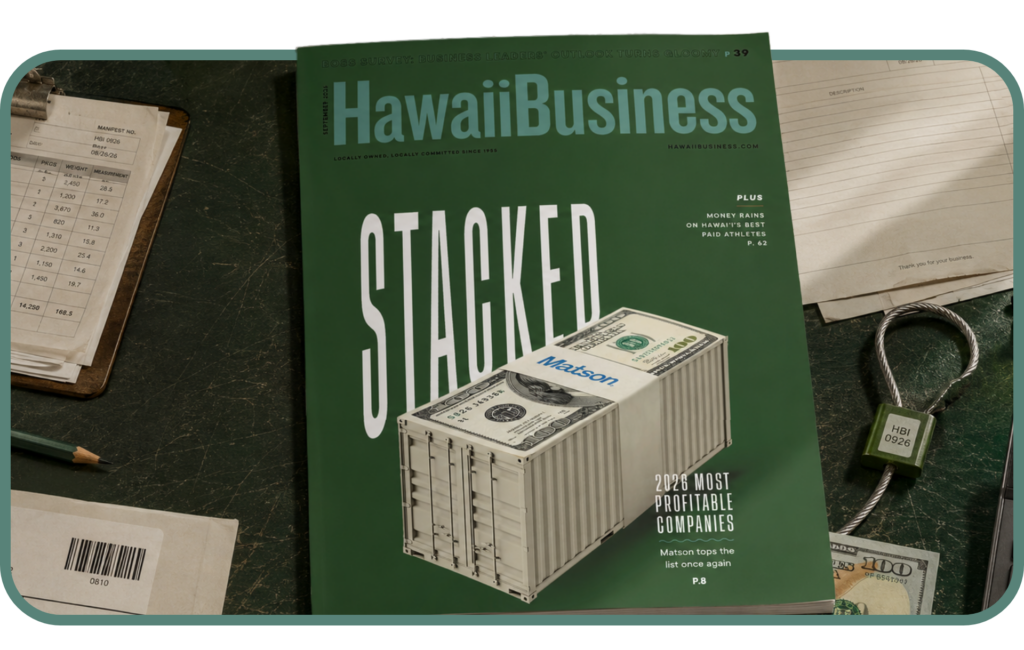
It’s a broad, shared loss of confidence and it isn’t confined to business leaders. In a parallel 808 Poll of 401 members of the general public, the outlook was even bleaker: just 10% of the public expects the local economy to improve in the coming year, versus 23% of business leaders, while 46% of the public and 45% of business leaders expect it to get worse. For more on BOSS, see page 39.
I’ve spent the past 12 months talking with small business owners, the lifeblood of our state’s economy, about exactly what the state could do, right now, to make Hawaiʻi a place where small businesses can hire and hold onto good employees instead of just surviving another quarter.
Bernice Parsons, President and Co-Founder of Vertaccount, put it plainly: “Don’t just subsidize businesses. Subsidize the cost of employing Hawaiʻi workers,” she says. If the state wanted to aggressively support small business hiring and retention, the most impactful tax breaks would probably be the following, she says: payroll tax credits tied to local hiring; relief from the General Excise Tax on labor-intensive services; subsidies for healthcare and training costs; incentives for profit-sharing and employee ownership; and credits for retaining long-term Hawaiʻi residents on staff.
None of these are radical ideas. They’re the kind of targeted, hiring-focused relief other states use every day to compete for jobs, and that Hawaiʻi, with its uniquely punishing General Excise Tax and high cost of living, needs more than most. Right now the tax code doesn’t care whether a company hires locally or keeps workers for the long haul; it taxes the transaction either way. Credits like these would change that math.
The overwhelming pessimism is already showing up in the numbers. Asked about their spending plans for the coming year, only one in five business owners and executives said they plan to substantially increase spending; nearly a third said they expect to cut costs instead.
And when we asked what’s actually driving the anxiety, the answer was consistent: cost of living, named by 54% of business leaders and 58% of the general public as the single biggest issue facing the state, with the cost of housing close behind.
That housing pressure falls hardest on Hawaiʻi’s future workforce. Renters, Millennials and Gen Zers were significantly more likely than anyone else to name housing costs among the state’s biggest problems, precisely the group Parsons’s retention credits are meant to keep from leaving. The “Paradise Tax” is scaring new businesses away and enraging small local business owners who would like to call Hawaiʻi home forever.
None of the concerns is a call for a bailout. It’s a call for the state to stop taxing employers for the simple act of hiring a neighbor, and to start treating that relief as the floor, not an afterthought, for a state that just finished dead last in the nation.
I welcome your thoughts, views, opinions and perspective on this topic. Please write me at jennifera@hawaiibusiness.com.
Pokémon Update
Rachel Wagenman’s June feature on the Pokémon craze just got a new chapter. Japan’s ruling Liberal Democratic Party has formed a group to study regulating the trading card market, which grew 90% over four years to roughly $2.3 billion in 2025. Lawmakers cite rising counterfeiting, tax evasion and money-laundering risks as cards fetch record sums, including a $16.4 million Pikachu card bought by YouTuber Logan Paul.