Should Hawaiʻi Have a Constitutional Convention in 2030?
People are divided: Some say the state’s political status quo needs an overhaul that only a Constitutional Convention can provide. Others fear a new ConCon could be hijacked by outside interests and valuable rights and institutions damaged.
Part I
The Constitutional Convention of 1978 was a major turning point for Hawaiʻi’s state and county governments. After three months of debate, that ConCon proposed 34 amendments to the state constitution, and voters later approved all of them.
Voters said yes to greater authority for county governments, the expansion of personal privacy rights, the establishment of the Office of Hawaiian Affairs, the creation of a state ethics code for public officials and much more. A generation of leaders from both parties got their political starts at the convention, including a future state governor and Honolulu mayor.
But that was 48 years ago, and in 2028 it will be time for voters to consider: Should we hold another ConCon in 2030? That is the subject of Part I of this special report. In Part II we look into the lessons we can learn from the 1978 session.
That ConCon was a chaotic, democratic and highly fractured process that mirrored a modern, contradictory and unreconciled society. Understanding what happened, why and what could have been done better is essential to making good decisions about a future ConCon.
A Vote at Least Every 10 Years
Hawaiʻi’s unique state constitution requires a general election vote at least every 10 years on this question: “Shall there be a convention to propose a revision of or amendments to the Constitution?”
Hawaiʻi’s voters responded yes by a nearly 3-to-1 margin in the November 1976 election, but that was the last time support was so high. Subsequent votes over the decades all fell short, and no ConCons have been convened since then. (The 1996 vote had far more yes than no votes, but the Hawaiʻi Supreme Court invalidated it, and set the standard for passage on this ballot declaration: Yes votes must outnumber no votes and blank votes combined.)
In 2018, when residents last voted on whether to hold a ConCon, they chose no by a 3-to-1 margin. Among those leading the charge against was Josh Wisch, then-executive director of the American Civil Liberties Union of Hawaiʻi.
“Around the country,” Wisch warned on the Honolulu Civil Beat news site on Oct. 30, 2018, “we see government and special interests participating in the dismantling of labor rights, invasions of privacy, rolling back hard-won protections for sexual minorities, and the advancement of private ownership of once-public spaces, just to name a few. Those same systems of power would like nothing more than a crack at our state constitution.”
Many environmental groups and unions voiced similar concerns, and those voices may have reversed public opinion. The actual vote belied a statewide poll published by Civil Beat 11 months earlier. In that poll, 54% of all residents supported another ConCon, while only 20% were opposed.
Young and Old Weigh In
PBS Hawaiʻi held a ConCon discussion in January 2026 as part of its public affairs series “Kākou: Hawaiʻi’s Town Hall.” The 10 panelists, which included myself, were people with widely diverse views and experiences concerning the legacy of the 1978 Constitutional Convention and whether Hawaiʻi should authorize another such convention. (View the discussion at tinyurl.com/ConConPBS.)
It was less a debate than a dialogue, moderated by Hawaiʻi journalist Yunji de Nies, about the need to be more aware of the risks and rewards of another ConCon.
Sandee Oshiro, a key chronicler of the 1978 ConCon while a reporter at The Honolulu Advertiser, functioned as a keeper of history. She also noted that the media landscape is much scarcer than it was in 1978. “Given the news desert we have right now [and] the lack of news resources in the community, it was so different back then. We had two robust newspapers. We had the (TV) stations covering ConCon. We had the wire services and a number of independent publications. That’s no longer the case today.”
The greatly diminished reporting resources of traditional media have been only partly offset by the existence of Civil Beat, a more robust Hawaiʻi Public Radio and other small media outlets. With the news media we have today, can the public gain a clear understanding of the political dynamics at a prospective convention?
Colin Moore, a professor of political science at UH Mānoa with a doctorate in government from Harvard University, lent an academic perspective to the conversation.
In 2018, Moore sponsored the Citizen’s Jury, along with such groups as the Hawaiʻi Community Foundation, the Collaborative Leaders Network, UH’s William S. Richardson School of Law, UH’s Public Policy Center, the Accord 3.0 Network and Common Cause.
A “jury” of 18 voters was selected to represent a range of “gender, age group, education level, ethnicity and political leanings.” Moore says he observed enthusiasm among jury members for another ConCon, though actual voters overwhelmingly rejected the idea in the 2018 general election.
“I was surprised at how depressed I felt by this result,” he recalled in 2020. “Unlike what I heard in our citizens’ jury, the arguments from professional lobbyists came from a place of fear – of what might be lost, rather than the possibilities to change our system of government for the better.”
Six years later, the risks attached to another convention haven’t changed, Moore said during the PBS discussion. “I think that special interests are more powerful. They’re more influential. After Citizens United, they probably have more opportunities to spend a lot of money affecting the delegate elections, which would be part of ConCon.”
Citizens United v. FEC was a 2010 U.S. Supreme Court ruling that determined that corporations, unions and other groups have a First Amendment right to spend unlimited money independently to influence elections, as long as they do not coordinate directly with candidates. The future influence of such spending in Hawaiʻi is complicated by Gov. Josh Green’s signing of Senate Bill 2471 into law in May. The measure, advocates contend, will limit how corporations, political action committees and other Hawaiʻi-based entities can spend money during political campaigns. If the law is not struck down as unconstitutional, it could limit in-state money’s influence on any future ConCon, too. Money from entities incorporated outside Hawaiʻi would not be covered and might complicate the process.
During the PBS discussion, Barbara Marumoto, a former state representative, provided a critical Republican Party counterbalance to former Gov. John D. Waiheʻe, a Democrat. While then-delegate Marumoto had often voted with the dissidents at the 1978 ConCon, Waiheʻe, also a delegate, had coalesced with the majority group.
Many Avenues Can Lead to Change
Two current legislators provide a younger counterbalance: Democratic state Rep. Tina Grandinetti and Republican state Rep. Diamond Garcia.
“It’s less of a question of whether to ConCon or not to ConCon,” Grandinetti noted on PBS, “and more about the community organizing that will come neighborhood by neighborhood as we ask ourselves that question. The ConCon is one vehicle for change, but there are many other avenues that communities can take to build that power to chart a new path that’s more independent of corporate control and special interests. I think the next year or so will be really exciting to see how the community leaders – the people on the ground – respond to this question.”
Garcia said a ConCon was overdue. “I believe that speaking from a Gen Z generation that it is time for our generation to stand up and really affect the constitution of our state,” Garcia argued. “We’re going to be in charge of government, of the private sector, of what happens here in Hawaiʻi for decades to come, and I believe it’s time for our generation to really have a voice in constructing and looking at our current constitution to make it work for us.”
Two groups that may see a risk in opening up Hawaiʻi’s Constitution are Native Hawaiians and public sector unions.
Kaialiʻi “Kai” Kahele, a former U.S. congressman and now chair of the Office of Hawaiian Affairs, expressed concerns that a new ConCon might seek to diminish the powers of OHA, an organization created by the 1978 ConCon.
“Do the conditions exist in Hawaiʻi today — and also at the national level — that would warrant reopening the state’s constitution and addressing what some would perceive [as] the shortfalls that the Legislature hasn’t been able to enact?”
The “shortfalls,” he says, are in the language of the constitution itself, which he says allows the state Legislature to meddle in the branch’s affairs.
“What we saw after the [1978] ConCon is when the Legislature put its finger on the scale and the watering down of what the true intent of the ConCon delegates was in the creation of OHA in 1979 in its enabling statute, and then the determination of how OHA would be funded through its pro rata share. [In] those two issues the Legislature has deviated from what the delegates wanted.”
Kahele says that he opposes another ConCon because he believes Hawaiʻi is not prepared for that conversation.
OHA, however, is still open to amending the constitution. During the 2026 legislative session, OHA sought a moratorium on live fire training by the military on public trust lands, which would require a constitutional amendment. Neither bill proposing this amendment received a hearing.
Concern Over Environmental Risks
Isaac Moriwake, managing attorney for Earthjustice’s Mid-Pacific Office, also expressed doubts about the utility of another convention, largely because the strong environmental language in the constitution has played a major role in important legal cases, including a recent one: Navahine v. Hawaiʻi Department of Transportation. The case, which resulted in a settlement on June 20, 2024, hinged on the rights of the plaintiffs to “a clean and healthful environment.”
“We’re doing a fine job with the laws that we have now, and there’s a definite risk that if you open it up, it’s all going to be huli. It’s all going to be overturned,” he said.
Former Rep. Marumoto was not convinced. “I don’t think another ConCon would take away these things that we fought so hard for and found so important,” she contended. “When people went into the ’78 ConCon, they were thinking in terms of initiative, referendum and recall and not much else. But what came out of it was a merit selection of judges, a reapportionment commission that did the reapportionment instead of the legislators themselves, a general fund spending ceiling, a balanced budget debt ceiling, which is very effective and has held pretty strong.”
Wisch, now president of the Holomua Collaborative, a nonprofit that works to make Hawaiʻi more affordable for families, wrote the 2018 Civil Beat article that opposed a new ConCon. But he said his views have changed, and so have the feelings of Hawaiʻi’s people.
“I am much more open to it than I was then,” Wisch said. “One of the main reasons that I am is that since that time I have gained a greater appreciation for all of the safeguards that are in place.”
Before any ConCon can happen, voters would have to decide whether they even want one. If they vote yes, voters would elect the delegates who align with their views. Moore agreed that this would be one of the “pretty strong guardrails” that would make it hard for outsider interests to hijack the election.
Next, Wisch said, the elected delegates would be charged with either amending the constitution or not amending it. Once they complete their work, voters would have the power to accept or reject every proposal.
“They’re also not going in with a completely blank piece of paper. They’re not erasing the constitution and starting over. It is making amendments.” A ConCon is a journey, not a singular moment. “This isn’t just necessarily a runaway train. It’s more like a hiking trail with a bunch of checkpoints that you’ve got to go through.”
Kahele Calls It “Heart Surgery”
OHA Chair Kahele responded that a ConCon is akin, in the democratic sense, to “heart surgery.” The 1978 Constitutional Convention ended up being monumental in scope, so Kahele’s metaphor may be apt.
There is an overriding question in Kahele’s eyes: Does today’s Hawaiʻi require the political equivalent of heart surgery?
To continue this metaphor, the annual work of the state Legislature, in comparison, is more like a yearly checkup with your doctor. New treatments and prescriptions may be begun, but no major surgery is performed.
“What is the problem we’re trying to solve?” Kahele asked. “And do the conditions exist that warrant us doing this today?” Right now, he said, there appears to be no clear agenda for a ConCon from the public.
Democratic Rep. Grandinetti offered one reason for a ConCon. “There are serious risks when we open up our constitution. But I think that many of us feel that we’re in a crisis of democracy right now,” she said.
“People have big feelings here at home about what’s happening at a state level and nationally, so the idea of inviting people in to redesign the system is exciting to me. I think it has to come with a commitment to ensuring that it is citizen-led again.”
Former Gov. Waiheʻe offered his guidance. “I think one of the mistakes would be to try and imagine that you’re going to have the same Constitutional Convention again. The decision about whether you have it or not, I believe, has to be made in the context of the time.”
When the people of Hawaiʻi vote on another ConCon in 2028, will they be comfortable enough with a status quo future or will they be willing to roll the dice on possible major constitutional changes aimed at fixing our imperfect society?
Those are the grand questions that make democracy both exciting and scary. Democracy is a risk, especially when it unleashes something powerful like a Constitutional Convention. What we choose will help determine our destiny.
Part II: The Lessons of the 1978 ConCon

Those important lessons included that delegates needed more time to discuss the issues and voters needed more time to ponder any proposed constitutional amendments that emerge from a new ConCon.
In November 1976, when Hawaiʻi decided to hold a Constitutional Convention, 168,445 citizens voted yes and 58,852 voted no, an overwhelming 3-to-1 margin. People wanted the kind of change that only constitutional amendments could bring.
Anne Harpham, then a reporter with The Honolulu Advertiser, suggested the big yes majority was a protest vote against status quo politics and recently enacted laws of the time, including those that increased legislators’ pay and pensions.
That anti-status quo sentiment was shared by The Advertiser’s editorial page, which suggested: “The need is not to have a convention that is run by a duplication of the legislative establishment. If it were, we could save money by holding a special session of the Legislature.”
In the media establishment’s eyes, a ConCon was a democratic opportunity to reform state government functions, without meddling from elected officials.
But many leaders saw the ConCon as an opportunity to make changes they’d long sought but had not been able to make.
County leaders like Honolulu Mayor Frank Fasi wanted greater home rule and full county control over property taxes, rather than the system then that included partial state control.
The chief justice of Hawaiʻi’s Supreme Court, William S. Richardson, saw the ConCon as an opportunity to overhaul the state’s entire court system and create the Judicial Selection Commission, a group of attorneys who would vet all candidates considered for nomination as state court judges. Both ideas were proposed by ConCon delegates and approved by voters, as was the establishment of the Intermediate Court of Appeals, a body of judges who today rule on most appeals, freeing the state Supreme Court to focus on the most important cases.
Several business leaders took leaves of absence to serve as delegates. William Paty, the eventual president of the convention, was a plantation manager, and Peter C. Lewis, chair of the ConCon’s Committee on Taxation and Finance, was an executive with Hawaiian Electric Co.
Another group that gained prominence at the 1978 ConCon was the first graduating class of UH’s new law school, which included future-Gov. Waiheʻe, Anthony “Tony” Chang, Franklin Hayashida and Carol Fukunaga. The second class included Craig Nakamura and Michael Liu.
Special Election to Choose ConCon Delegates
While there was a massive appetite for constitutional reform in the general election of 1976, the special election to select delegates was marked by low voter turnout, strong union influence and an aversion to establishment figures.
In 1975, the state attorney general’s office declared that a person could serve both as a representative or senator in the Legislature and as a ConCon delegate, but many people opposed that dual role.
In the end, 697 candidates for 102 seats were on the ballot for the special election to choose ConCon delegates. Morris Takushi, then-state elections administrator, called the May 1978 election the largest in state history.
Despite the excitement, an April poll published in The Advertiser showed that 45% of respondents statewide were “not very well informed” about issues that might be discussed at the ConCon. And 50% said they knew little about the ConCon candidates running in their districts.
Sadly, the election drew historically low turnout. UH political science professor Richard Kosaki said it was the lowest-recorded turnout of any election in the state’s history, less than half that to select delegates to Hawaiʻi’s first convention to debate a state constitution, in 1950.
Of the 102 elected delegates in 1978, only three were active elected officials. Kekoa Kaapu was a city councilmember on Oʻahu, and Donald Ching and Robert Taira were members of the state Senate.
Time was short for delegates to organize in coherent blocs on the issues: the election of candidates was in May, the ConCon convened in July, and all proposed constitutional amendments had to be completed by September.
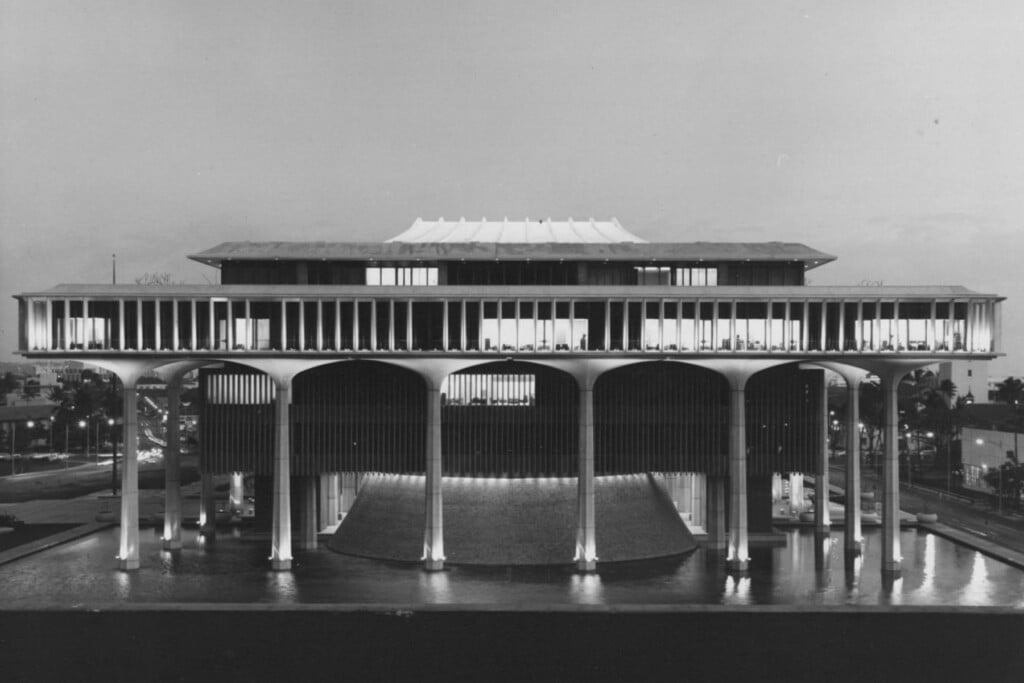
Ultimately, the ConCon would be held at the old post office building in Downtown Honolulu, a short walk from the state Capitol and other government offices.

The Chaos of the Convention
Delegate Floyd Pulham of East Hawaiʻi island, in his capacity as acting chair, convened the ConCon on July 5, 1978. “I am rather reminded at this moment of the mosquito who found himself in a nudist colony — he didn’t know where to begin either,” he said.
No one knew how the convention would go. It was full of novices pulled together to review an entire constitution in three months. Folks like Pulham, a Republican excluded from the emerging majority of delegates, felt it was not fair to be left out of political debate before the convention had even started.
“If we expect the general public to accept the results of our deliberations, some of you are going to have to clean up your act,” he said.
He was speaking about how the majority of delegates had consolidated power over the convention’s 16 committees before it even started.
Among those following this division was Sandee Oshiro, then a young reporter with the Star-Bulletin. “The divisiveness in the pre-convention organizing is almost a textbook example of the basic pattern of political power which scholars say was shaped in past constitutional conversations both here and on the mainland,” Oshiro observed.
“There emerged a group of ‘reformers’ and a group of ‘stand-patters’ — those interested in change and those opposed to it.”
The majority was seen as an alliance of three factions: those aligned with Sens. Donald Ching and Robert Taira; those with close ties to unions like the HGEA; and a group of young attorneys and aspiring politicians. Oshiro considered this last group, which included Waiheʻe, as the most independent members of the majority alliance.
“Some have ties with such unions as the Hawaii Government Employees Association,” Oshiro observed, while “most boast of some political experience and all are said to view themselves as the realists among the young idealists.”
Before the convention convened, William Paty, the ConCon’s eventual president, rewarded his allies and backers with committee chairmanships. Every delegate got a seat on their preferred committee, but no member of the minority, now called the “independents,” was granted control over any of the 16 committees. Less than a handful of independents were even granted a committee vice chairmanship.
The lineup of chairs was a telling mix of establishment figures and outsiders loosely affiliated with the majority faction.
Teruo “Terry” Ihara, a longtime organizer for the Democratic Party of Hawaiʻi and a traditional John Burns acolyte, controlled the Education Committee. Melvin Nishimoto, a deputy attorney general under Gov. George Ariyoshi, chaired the Committee on the Legislature. Akira Sakima, who represented Kalihi in the Legislature from 1959 to 1976, led the Committee on Local Government. Thomas Hamilton, the former UH president and the head of the Hawaiʻi Visitors and Convention Bureau under John A. Burns, got the Committee on Style. Anthony “Tony” Chang, a former classmate of Waiheʻe and Carol Fukunaga, was named chair of the committee on Environment, Agriculture, Conservation, and Land, a committee with an expansive reach. Adelaide “Frenchy” DeSoto got authority over the Committee on Hawaiian Affairs, a job that had garnered little attention in previous conventions. Fukunaga was granted control of the Committee on the Executive.
For some chairs, this was their first public leadership role.
For lobbyists, including those from influential union and business groups, lobbying at the convention was far more challenging than at the state Legislature. The ConCon had 102 delegates, most of whom carried little to no political experience.
Unions, in particular, had been reviled since negative press coverage in May over their perceived influence over the delegates. “Lobbying is made to look like it’s not the generally accepted American way of participating in politics,” union leader David Trask explained. “That’s because a lot of people there don’t understand the process because we have a lot of young delegates who haven’t been around [politics] long.”
Other lobbyists like Samuel Caldwell of the Hawaiian Sugar Planters Association found the delegates to be thoroughly undisciplined. Caldwell recognized that the overall majority alliance struggled to keep a rein on majority members in every committee. One difference between lobbying at the Legislature and the ConCon “is that the convention chairmen don’t have control of their committees the way legislators do, and that’s because there really isn’t a majority group.”
On the other side of these complaints, Carol Zachary of Common Cause Hawaiʻi, a government watchdog group, found a more receptive audience than at the state Legislature.
“The major differences between the Legislature and the ConCon is that the people who came into this [convention] were political novices, and they didn’t move into a well-established system like at the Capitol.”
In this temporary vacuum of traditional power, lobbyists often functioned as de facto experts on rapidly evolving efforts and proposals.
Some chairs faced key political tests as they pushed for incremental reform, among them Tom Okamura, just 29 and the chair of the Ethics Committee. He was a member of Waiheʻe’s faction fighting to strengthen ethics across state government.
Okamura believed the government could be more transparent and less quid pro quo. “I remember as a youngster in Hilo, the county workers would pave the driveways and repair the homes of people who were friends of the mayor,” Okamura told the convention. “Everybody knew it and, although most personally objected, it was nevertheless condoned. Things like that aren’t accepted so easily anymore.”
The Republican political machine of James Kealoha that once ran county government on Hawaiʻi island had long disappeared. Nonetheless, Okamura believed in further ethical reform.
Eleven years earlier, the state Legislature had established an Ethics Commission and different counties later established their own, each with their own standards and rules.
There were many investigations into Fasi. One notable one centered on the Kukui Plaza scandal of the 1970s; it involved allegations that politically connected buyers received preferential access to condos in the new Kukui Plaza development in downtown Honolulu.
Okamura believed that a baseline for ethical standards across state and county governments seemed reasonable. “In other words, we will make state and county ethics codes more consistent. At the same time, we will prevent either state or county government from repealing or diminishing an ethics code area such as financial disclosure.”
Delegates needed to submit proposals to the convention by July 31 and all votes on proposed constitutional amendments had to be completed by Sept. 20. That was so election officials could print ballots for the November election and voters had time to ponder the proposed amendments.
The delegates felt rushed. Delegate DeSoto expressed the widespread feeling of being burned out. “We have all experienced, at this point in time, the frustrations of the time constraints that we have to operate under. I think that this is the greatest injustice in this convention. The time constraints have caused us to make, many times, rash statements, rash judgments. Our fuses are short because we are meeting night and day and trying to absorb information as fast as we can. … I think that the constitution deserves more deliberation and time in order to make good decisions for the public.”
But the delegates soldiered on. DeSoto’s committee crafted language that doubled-down on the state’s commitment to supporting the Department of Hawaiian Home Lands while simultaneously establishing a new political body to organize Native Hawaiians across the Islands, now known as the Office of Hawaiian Affairs.

The People Adopt a Revised Constitution
The vote to approve or reject the 34 proposed amendments took place on Nov. 8. Unlike the special election to select the delegates in May, voter turnout was high at 74% of registered voters.
The convention ultimately spent about $140,000 on newspaper, radio and television ads on education efforts concerning their proposed amendments. When adjusted for inflation, that’s the equivalent of almost $700,000 in today’s dollars.
The ballot allowed voters to either adopt all of the amendments or reject all. They could also selectively approve or disapprove every individual proposal, which, as it turned out, most voters did. Out of a total of 292,692 ballots, 53,102 voters had supported all amendments, while 51,761 residents opposed all amendments. Here were key outcomes:
On granting greater authority to county governments, 130,960 voters supported more county home rule, while 121,263 voters wanted to leave such power to state government. On expanding an individual’s right to privacy, 131,241 voters approved the measure and 120,982 voters opposed it. The establishment of the Office of Hawaiian Affairs was even closer: 130,230 supported the idea, while 121,993 voters did not. The recognition of traditional and customary rights for Hawaiians earned a bit more support, about 10,000 more yes ballots than the OHA amendment. Support for strengthening the Department of Hawaiian Home Lands was narrow too: 129,087 voters in favor and 123,993 voters opposed. The most popular amendment to come out of the 1978 ConCon had been shepherded by Okamura’s Ethics Committee: the framing of a statewide ethics code. It gained 179,958 affirmative votes.
The success of every ballot measure also created controversy: Was it illegal for the ballot to allow voters to choose yes on all 34 amendments at once? More importantly, had the ballot been designed in favor of driving every amendment’s success? If voters wanted to selectively vote on amendments, they needed to check yes or no on each one. If they failed to indicate their vote on an amendment, it counted as an automatic ‘yes.’
Plaintiffs from Maui County represented by Miriam Kahalekai filed a lawsuit against this ballot, resulting in a case that reached the Hawaiʻi Supreme Court. Kahalekai v. Doi was an attempt to throw out the vote that approved the constitutional amendments.
The plaintiffs were inspired by Susan Halas, a reporter with Maui News who had covered the convention and grown disenchanted with the proceedings and the ballot’s design.
While he was officially charged with defending the validity of the 1978 election that approved the revised constitution, outgoing Lt. Gov. Nelson Doi personally agreed with Halas. He too wanted to scrap the proposed constitutional amendments.
ConCon President Paty hit back. “I think confusion resulted primarily from short lead time between the end of the convention and Nov. 7,” he told Jerry Burris of The Advertiser. “People just didn’t have the time to get the feel of it in many cases and reacted justifiably to the lack of time to fully understand the amendments.”
A month later, new Lt. Gov. Jean King, who had taken office on Dec. 4, 1978, supported conducting a new vote on the amendments. “Personally speaking,” King told Gregg Kakesako of the Star-Bulletin, “I would have preferred allowing the people to vote on each issue separately.”
Supreme Court Chief Justice Richardson and Justices Homer B. Kidwell, Thomas Ogata, Benjamin Menor and Bert T. Kobayashi presided over the case. At issue was the question of “whether the proposed amendments were submitted to the voters in the form and manner required by law.”
The case proved politically awkward for the Supreme Court, whose chief justice had successfully fought to overhaul the court system through the ConCon and create the Judicial Selection Commission and the Intermediate Court of Appeals.
“The burden upon the convention of informing the electorate was especially heavy, but required, by reason of the number and complexity of the amendments proposed by it,” the court found. “Correlatively, however, it was incumbent upon members of the public to educate and familiarize themselves with the contents and effect of the proposed amendments before expressing themselves at the polls.”

The people of Hawaiʻi had been educated. Their vote was valid. The court ruled that the process had been legal.
Other attempts were made to water down the full force of the 1978 ConCon’s amendments. One legal strategy came down to a term inserted into several amendments: “as provided by law.”
Fujio Matsuda, president of the UH System in 1978, had seen the ConCon as an opportunity to assert UH’s autonomy. However, such plans were challenged by the machinations, in Matsuda’s mind, of the chief attorney retained by ConCon: James Funaki. As the chief attorney of the Hawaiʻi House of Representatives, Funaki sought to protect the Legislature’s authority.
“He was an expert on legislative language,” Matsuda recalled in February 1997, “so he stuck in a phrase that says ‘in accordance with law.'”
“That created an ambiguity” that the ConCon delegates may not have intended but which the Legislature would use to reassert its control. As Matsuda said: “The Legislature decides what the degree of autonomy is for the university, instead of the constitution deciding that.”
Such language dots much of the work that came out of the 1978 convention. For instance, the amendment relating to the treatment of the state of Hawaiʻi’s obligation “to protect, control and regulate the use of Hawaiʻi’s water resources for the benefits of its people” was left to the state Legislature for full implementation. The constitution provided a mandate. The Legislature was saddled with the responsibility of implementing that mandate. The eventual body, the Commission on Water Resource Management and its attendant Water Code were not realized until 1987, soon after former delegate Waiheʻe was elected governor.
With agricultural lands, the reality was far murkier. Article 11, Section 3 of the 1978 Constitution declared that the state of Hawaiʻi “shall conserve and protect agricultural lands, promote diversified agriculture, increase agricultural self-sufficiency and assure the availability of agriculturally suitable lands.” Such language is incredibly powerful if left alone. However, there is a qualifier: “The legislature shall provide standards and criteria to accomplish the foregoing.”
The language, when scanned across the entire document, reserves the full force of many amendments to the Legislature’s prerogative.
The Legislature, in the case of agricultural lands and their stewardship, did not act to provide these standards until 2005, nearly 40 years after the 1978 Constitutional Convention.
Some people’s concerns about the new constitution were tied to fears of a mystical “Palaka Power,” a phrase used to describe the influence of local blue-collar, often union-connected Democrats. Some even described the new constitution as a “Palaka” constitution.
The origin of the term was a pamphlet titled “Palaka Power” written by a Democratic Party outsider David Hagino. Hagino was intent on reforming the party, making it more inclusive for younger Democrats. The pamphlet took its name from the rough checkered palaka shirts, traditionally worn by plantation laborers, paniolo and other workers. Hagino chose it as a symbol of working-class strength, “localism” and a revival of Democratic Party ideals that he felt had been coopted by big business, special interests and outsiders.
On Oct. 25, 1978, John Leopold, a state senator and Republican nominee for governor, said “the greatest degree of racial antagonism came not from the old, more traditional delegates but from the younger ones” enmeshed in the movement organized around Palaka Power. Leopold feared for “the growing ethnic and racial tensions in our state.”
In his memoir, “Ben,” former Gov. Ben Cayetano, who was running for the state Senate in 1978, contended that the Palaka Power doctrine had only widened the political gulf between insiders and outsiders. “Preserving local values was important, but ‘Palaka Power’ [pamphlet] seemed written to exclude political outsiders, haole and local. I felt excluded. And I think most independent Democrats I was allied with felt the same way.”
At the formal ratification of the constitution on Saturday, Dec. 2, 1978, delegates protested against the constitution and Palaka Power. Several delegates felt bitter about the ConCon’s outcome and either refused to sign the document or affixed their signatures alongside the phrase “with reservations.”

The Political Aftermath
With the convention over, several delegates immediately furthered their political careers. In the 1978 general election, Okamura was elected to the state Board of Education, while Donna Ikeda, Clarice Hashimoto, Fukunaga, Barbara Marumoto and Tony Takitani won House seats.
But they were only the start of an avalanche of former delegates to gain office at the state and county level.
To ensure that no sweeping convention with the same force as the 1978 Constitutional Convention ever took place again, the state Legislature set clear limits on where and how a constitutional amendment could be settled.
The 1979 legislative session proposed an amendment that would raise the approval threshold from 35% to 50% of the total vote cast, including ballots that left constitutional amendments blank. In the 1980 session, Senate Bill 1703 further provided that “each amendment shall be submitted in the form of a question embracing but one subject; and provided further, that each question shall have designated spaces to mark Yes or No on the amendment.”
In the 1980 general election, both amendments to the constitution were approved by voters. It was a deliberate action by the Legislature to prevent another ballot design similar to the one produced for voters in November 1978.
In 2011, Paty was interviewed by PBS’ Leslie Wilcox. He said his political acumen as a plantation manager gave him insight into both local culture and union dynamics, making him a unique force at the convention, and that the ConCon president’s role was to “develop the rules, develop committees, get the hearings going, and come up with recommendations all in terms of 60 actual workdays.”
Such a job was fitting for a luna, as “the social dynamics of that by itself were highly exceptional in terms of the job that we wanted to accomplish,” he said.
In his old age, Paty appeared to see that the constitution needed to evolve in the face of a changing Hawaiʻi. “I recognize that the ConCon was kind of special in terms of its influence on the long-term structure of our state, the management of our resources, [and] the fiscal responsibilities that we have today,” Paty said.
“But at the same time, you can’t ignore that the constitution is a living document. And in terms of the passage of time — in terms of where people are — it should be perhaps hauled out of the garage and washed up and [we] should take a look at this car to see how it’s running.”