Tanaka of Tokyo Restaurant Chain Founder Shares Tales of Survival as He Passes Baton
New leadership team includes founder's daughter, Bo Tanaka, who promises continuity as well as creativity in an evolving and volatile market.
Chronic hunger is a sharp-edged chisel that etched its name into a boy’s DNA and carved his personality—decades before he would create a Hawaiʻi restaurant chain that today feeds many thousands.
As a child from a broken home fending for himself on the streets in Tokyo, and later as a homeless, college-scholarship student living in Washington Square Park in New York City, Richard E. Tanaka recalls hunger’s motivating drive during those formative years.
“There were so many times in my early days when I was not sure where my next meal was coming from, but I always figured it out day-to-day,” says Tanaka, who became the founder, chairman and chief executive of the chain of Tanaka of Tokyo Restaurants.
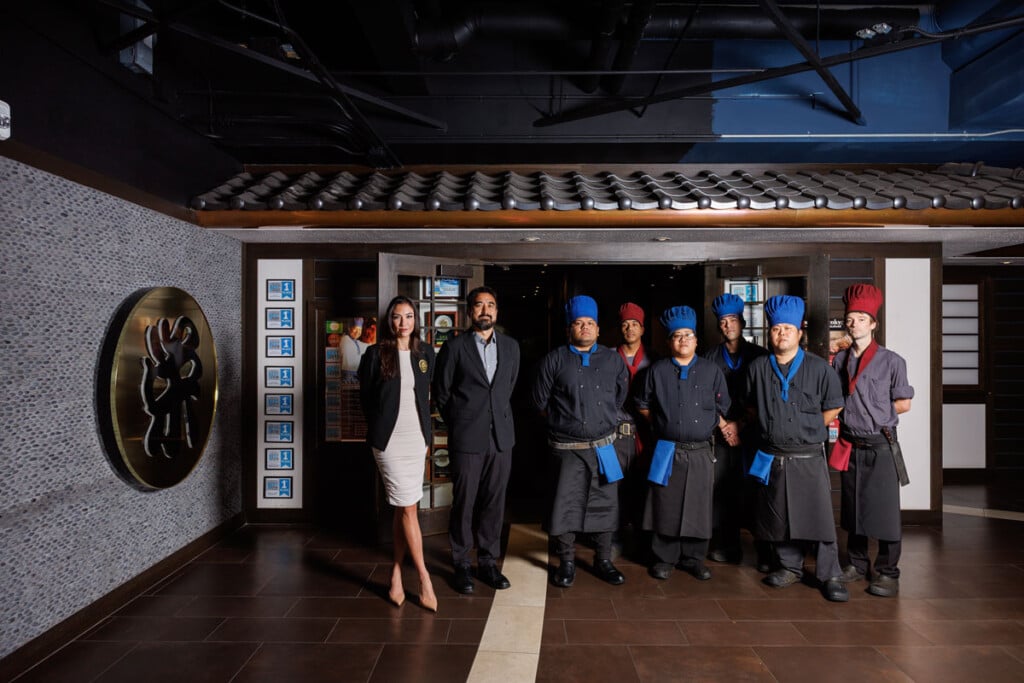
From his executive suite at the Waikiki Shopping Plaza next to the company’s flagship restaurant, Tanaka reminisced about his decades at the helm of the Honolulu chain that he is handing over to his daughter, Alison H. “Bo” Tanaka, who serves as Executive Vice President and Chief Financial Officer, and to President Hiroshi D. Lamansky.
Although the 76-year-old Tanaka says he has no timeline for full retirement, he has effectively given them managerial control.
My role has already diminished to the point of really being an adviser, coach and mentor,” he says.
Meanwhile, human resources functions, including recruitment, are being handled by his other daughter, Katherine M. “Katy” Tanaka, who joined the company during the Covid period.

PHOTO: Getty Images
What Tanaka is handing over is more than the keys to the popular chain of teppanyaki restaurants; it is also a culture, an ethos and a moral code that infuses everyone who works there, including some who have remained for decades.
In an era when second-generation leaders squander prior achievements, the Tanaka family stands out in contrast for its insistence on hard work, compassion and humility. The company’s managers get their hands dirty and rise to the top only after showing they have mastered the skills of the lowest jobs in the hierarchy of restaurant work.
Tanaka tells a story of taking his family to dinner at another restaurant in Honolulu, where the staff recognized him as the owner of Tanaka of Tokyo Restaurants.
“I said, ‘How did you know that?’ And the waiter replied: ‘You’re the guy who washes dishes at your own restaurant.’ So, word got around quickly,” he adds with a chuckle.
What follows is a portrait of the man and his business—one he will pass on—along with the goals of the new leaders of what has been a Hawaiʻi institution for decades. Tanaka, who admits to having superstitions, shuns the spotlight and has refused for decades to be photographed. He had to be coaxed even to reveal details about his background.
But as a well-read student of human nature who aspired to become a novelist, he also appreciates a good yarn—and his life story is just that.
A BLEND OF EAST AND WEST

Richard Tanaka in 1978 with his staff at the first Tanaka of Tokyo restaurant in Waikiki. | PHOTO: Tanaka of Tokyo
From his birthplace in Canada, to an early childhood in Japan, and later back to Canada and the New York region, Tanaka straddled Eastern and Western cultures, adding pieces of each to his personality. He developed a Samurai-like discipline, an intensely competitive spirit while also fostering compassion and a true ʻohana culture at the workplace.
The company handbook, which he proudly says was written 47 years ago on a manual typewriter, abounds with a moral code and ethical instruction that, as employees attest, is practiced on a daily basis and makes the company unique.
One section advises:
“Like the hungry Samurai, do not lose faith when you have minor or even major setbacks. Pick yourself up and try again, and again and again. Eventually, you will succeed. And always remember that the possibility of bitter defeat is the ingredient that makes eventual success so sweet.”
Indeed, unflinching perseverance through adversity could be the company’s defining mantra that has enabled it to survive while many competitors have fallen by the wayside.
“We want to stick to our traditions and values that have made us a part of so many local families’ traditions over the years and generations,” says Bo. “That said, sticking to values and traditions definitely does not mean operating exactly how we always have. I do see us continuing to find ways to adapt and be innovative. One of our corporate cultural values is ‘kaizen,’ or continuously working towards improvement. This applies in every area when it comes to efficiency, innovation, flexibility and business strategy.”
The company was forced into a sudden period of “kaizen” and nearly went under during the Covid pandemic, as Hawaiʻi imposed a virtual lockdown and tourism came to a standstill.
“By the time Covid hit, I thought I’d seen it all, done it all. Nothing’s going to catch me off guard,” recalls the elder Tanaka. “Then Covid hit. Driving down Kalakaua Avenue and not seeing one person. All the lights were off. And not knowing when it was going to end. The first month we lost a million dollars … . We kept thinking how long can we sustain this?”
It turned out to be the transformative moment that catapulted Lamansky and Bo Tanaka into the leadership roles they have today.

Bo Tanaka makes a last inspection of restaurant dining room before doors open for the evening rush. | PHOTO: Aaron K. Yoshino
“Covid gave these guys about 10 years of experience in 18 months and taught them to deal with stress and stay positive,” says the elder Tanaka.
“The first thing these two did was say we want to change this, we want to do that, we want to go to OpenTable, change this supplier—my head was spinning,” he recalls. “I said, ‘That’s kind of scary, but if you want to do it, then do it.’ By the time we came out of Covid, they were already in the midst of total change. It looks the same on the surface, but everything underneath is different.”
For Richard Tanaka—who is affectionately called “Kaicho,” or chairman in Japanese—respect, loyalty and civility cannot be compromised. And it doesn’t matter if the offending employee is at the lowest level or is a manager—either will be fired for showing disrespect to a colleague.
Indeed, his impromptu appearances at his restaurants are legendary, and a little mischievous, in an industry where gruff manners are endemic.
“I have a master key that opens every door in the restaurants,” the Kaicho says with a grin. “There was a report that there was no dishwasher one night. It was a busy night. I open up the back door, go in and start washing dishes … .
“Because of dish racks, you can’t see the person washing dishes. You get the bus people coming in, jamming things and saying, ‘we’re out of forks! What, are you stupid?! We’ve been out of forks for half an hour!’ He says to me, ‘Who is this idiot?’ He goes on and on and on. Eventually a manager comes back there and sees me, and then he does a big bow, and word gets around. All of a sudden, I’ve got all these people coming to the back, bowing and saying, thank you for helping us out tonight, boss.
“It’s really a lot of fun … .”
The company makes room for underperformers who display the right attitude to improve. For instance, Lamansky and Bo Tanaka have taught unit managers how to get the best out of an employee who might come in late or dress sloppily but otherwise displays a good attitude.
“Find everything good to say about him first,” the elder Tanaka says. “And then say, ‘here’s some stuff you can work on.'”
With no formal business training, Tanaka learned to live by his wits and applied his street-smart ability to read human nature, avoiding pitfalls and sniffing out opportunities. He also learned how to motivate employees with praise and attention.
That sort of concern for employees builds loyalty among staff, some of whom have stayed on for decades.
Lisa Skonecki, who started 30 years ago as a hostess, moved on to become a server and then turned down multiple opportunities to take on other roles because she liked the flexibility of the server’s schedule.
“During Covid, all of the restaurants closed, but Mr. Tanaka sent me an email to ask how I was doing and how my family was doing,” she recalls. “He told me if there was anything I needed, to just give him a call and he’ll do it. It made me cry. Over the years he’s been such a wonderful boss.”

President Hiroshi D. Lamansky knows that today’s diners want an experience that they can share with friends and family on social media, and he aims to deliver that each day. | PHOTO: Aaron K. Yoshino
Lamansky, too, first came to the restaurant because he felt at home among the tight-knit group of employees. He had lived in Tokyo for 10 years until he graduated from high school. So, when he landed in Honolulu to go to college at UH Mānoa, he looked at classified ads for a part-time job.
“I saw an ad for Tanaka of Tokyo,” Lamansky recalls. “I had lived in Tokyo so I thought maybe I should apply. I felt like I was a part of something even though I didn’t know anything. They just kind of took me in. After three months, I was trained as a front host, a couple of months later as a cashier, then barback and server all within about a 12-month period. I was 21 at the time, they called me and asked if I wanted to join the management.”
Lamansky decided to drop out of college to follow his heart, starting up the ladder to president—from learning the ropes to teaching the ropes at Tanaka of Tokyo. Now he is carrying on the gentle, but firm, instructional style learned from his mentor.
The influence of Lamansky’s leadership would eventually ripple well beyond the restaurant, imparting invaluable lessons that helped lay the foundation for a brand with a global digital reach.
During her four-year stint at Tanaka of Tokyo, one server said Lamansky and others taught her teamwork and civility that later guided the launch of her hugely successful social media brand, Cyber Bunny, that now has more than a million combined followers on YouTube, Instagram, Facebook, TikTok and Threads.
Today, as she takes tourists around Japan, she still employs those lessons. “I carefully curate an experience based on the customer’s needs and make them feel like they are VIP, which is something we were trained to do as a server and host at Tanaka of Tokyo. Even the small customer details are taken into account, and that’s the magic of Japanese hospitality,” she says.
“I never imagined how making a pot of tea in a busy kitchen could lead me to my purpose in life.”
A HUNGER FOR FOOD, A THIRST FOR EDUCATION

Richard Tanaka holds dog tags, inscribed with epigraphs to author W. Somerset Maugham’s novels, that he has worn for decades for inspiration. | PHOTO: Tanaka of Tokyo
As much as hunger shaped Richard Tanaka’s personality, a desire to learn may have motivated him even more. Despite keenly honed street-smarts acquired when he was homeless, and bouncing between four different high schools, his overarching goal became to obtain a college education.
The seeds were planted when he encountered a teacher who instilled in him a love of learning.
“The most important person in my life was a math teacher at the American School in Japan,” Tanaka says of John Ronca, the man who would become his tutor. “When he found out I was sleeping at Shinjuku Station, he said ‘I have a job for you, come stay at my place.’ He had a six-tatami mat room. He used to tutor kids at his house after school. I did the dishes, I scrubbed floors and the bathtub … . He got me reading. He changed my life.”
“His home was open to everybody,” Tanaka recalls. “So, when I was his house boy, there were kids at his table all the time. He would always have me go buy steak and cook up steak and potatoes, and he would help them with their homework. He would help them understand books that were in English.”
After the others went home, Tanaka would clean up the house and then Ronca would give him books to read before going to bed. “I read all of Maugham, all of Hemingway, all of Fitzgerald and then I started going into the classics,” Tanaka recalls.
To this day, Tanaka wears a chain around his neck with two metal tags inscribed with epigraphs to W. Somerset Maugham, including “The sharp edge of a razor is difficult to pass over; thus the wise say the path to Salvation is hard”; and “Short, therefore, is man’s life, and narrow is the corner of earth wherein he dwells.”
Tanaka says he identified with the character Larry in Maugham’s “The Razor’s Edge.”
“His journey to enlightenment was very hard, but his spirit and commitment stayed strong throughout,” Tanaka says. “This epigraph around my neck from an early age carried me through tough times when I was insecure and afraid. It still does.”
For many years, adversity followed Tanaka, even when good fortune seemed within reach. He was awarded a scholarship to attend New York University, but when he arrived at the registrar’s office, he learned it only covered tuition, books and supplies, but not housing.
And so he banded with a dozen other students in a similar situation and lived in Washington Square Park for weeks, making hand-made “flowers” out of coat hangers and hawking them to wealthier students who strolled through the park. One flower would sell for 25 cents, the same cost as a slice of pizza. In this way, he and the other students were able to survive.
“That was when I learned how to be a salesman,” Tanaka says.
He recalled another survival technique—capturing pigeons for food. They roasted pigeons over fires in garbage drums repurposed as grills. “All we used was salt and pepper—the best thing,” he says. “I’ve had squab in fancy restaurants, and they were nothing like that. I thought this was really bad at the time, but I look back on it now and think this was the happiest time of my life.”
TWO BIG BREAKS
Teppanyaki restaurants first became popular in the United States in the mid-1960s. Hiroaki “Rocky” Aoki, the founder of Benihana restaurants, took the formula from the first U.S. location in New York City to multiple cities across the country, including in Honolulu. The entertaining dining method made Benihana a household name across the continent.
At teppan restaurants, chefs command a metal grill at each table like a spectator sport, thrilling the diners with skilled swipes of spatulas and knives they use to cut and grill slices of steaks, seafood and vegetables just a few feet in front of the customers, all the while serving up a rapid banter along with the food.
In the 1970s, Tanaka opened his own restaurant in Toronto, which included a sushi bar, tatami rooms for sukiyaki and a small teppan dining room. He quickly learned that most of his customers were coming for the teppanyaki experience.
One day, Aoki visited his restaurant and advised Tanaka to come to Hawaiʻi to open a restaurant there. Serendipity struck again. After decades of no contact with his father, the two met by happenstance, and his father encouraged him to start a restaurant in Honolulu. Years later, out of the blue, his father called to say he had paid for a lease, the impetus he needed to make the move.
In 1978, the first Tanaka of Tokyo restaurant in Hawaiʻi opened in Waikiki.
“I THINK IT’S IN OUR BLOOD”
Restaurant work is hard, as anyone in the business will tell you. It’s not for the faint of heart. There’s a reason that most new restaurants don’t survive to see their second year. But for those restaurateurs who can ride the wave, it provides an adrenaline rush that keeps managers coming back for more.
Richard Tanaka explains it this way:
“It’s one of the most exciting things, if you’re a restaurant manager on a busy night, and you’re the key manager. It kind of brings tears to my eyes, because it’s so pleasurable for me. To feel like you’ve got all this stuff that’s going wrong, you’ve got people coming in, you’ve got staff running around and you’re orchestrating. You’re everywhere, you know what’s going on, you’re putting out one fire after another, you’re helping here, doing this, doing that, you keep making the rounds.
“You develop what’s called ‘the eye’. You can walk through the restaurant and tell every table that’s been waiting too long for their drinks. That table needs to be bussed. We should have had that table back 10 minutes ago. Where’s the server for that table? The kitchen’s running out of this or that. Okay, we can substitute this. The bartender’s saying, ‘I’m swamped back here. I’ve got all these dishes and glasses piling up,’ and you pull support off and send them back to help out for five minutes.
“And at the end of the night, it’s quiet. And you sit at the bar and have a pau drink. And you put on some of your own music, and you start to do your paperwork, and you’re thinking: I can’t wait to do this again.”
While listening to her father’s description, Bo Tanaka swells with pride but also exhibits a sympathetic recognition that she, too, has experienced this thrilling feeling. Defensively, she points out that her father did everything he could to dissuade his daughters from following in his footsteps as they were growing up.
“He definitely did not want me or my sister to end up in the restaurant industry,” Bo confides. “He said that many times. Lo and behold, both of us ended up working in restaurants and loved it. I think it’s in our blood.”
Bo studied art at college and later achieved success as Miss Hawaiʻi USA. While going to school, she began helping out at the restaurant, filling in as a dishwasher or at the front desk or bussing tables as needed. That’s when she caught the bug and decided to accept her father’s stipulation—in order to join the management team, she’d first have to get an MBA.
She and Lamansky discovered they shared many of the same ideas and ambitions—”my adopted brother” is how Bo Tanaka describes the close relationship. Asked what lessons she and Lamansky have learned from her father, Bo says: “My dad has instilled in the two of us so many important principles, like hard work, humility, resilience and ‘don’t take any crap from anyone!'”
THE NEXT GENERATION

President Hiroshi Lamansky and Executive Vice President and CFO Alison H. “Bo” Tanaka take over as the new leadership team at Tanaka of Tokyo Restaurants. | PHOTO: Aaron K. Yoshino
Lamansky and the younger Tanaka have a vision for the chain of restaurants that blends tradition and innovation. Two of the restaurants are in Waikiki and one is at the Ala Moana Shopping Center. They’ve even considered a Tanaka of Hawaiʻi to be based in Tokyo.
The pair knows they need to constantly look for opportunities while preserving the foundation the Kaicho created. Their challenges include rising prices for meat, seafood, vegetables and other ingredients caused by U.S.-imposed tariffs. They also face a downturn in Japanese tourists visiting the islands because of the unfavorable exchange rate, as well as fewer tourists from Canada.
“I believe staying true to our corporate culture and the fundamentals of what we have done for nearly five decades is extremely important,” says Lamansky, blending tradition and innovation to accommodate shifting tastes. “Tanaka of Tokyo earned a fine reputation and was built on consistency, quality ingredients, skilled chefs, warm and friendly staff, and providing a dining experience centered around hospitality. Preserving this tradition remains the foundation of our vision for the future.”
At the same time, he notes, tastes and preferences are evolving, especially in today’s social media-driven dining culture. And the managers have to stay attuned to the concerns about affordability.
“Dining out has become much more about the experience and the story-telling people can share with their family, friends and on social media platforms. People get excited to try something new, take photos/videos, talk about what they ate, check out places they saw on social media and introduce others to something they felt was special.”
As an adviser and mentor, the elder Tanaka says he has confidence in the ideas and energy exhibited by Lamansky and his daughters.
“This is the worst economic environment I have seen in the past 47 years,” he says. “I project that it will take two to four years before we see improvement. In the meantime, we need to be nimble, proactive and determined!”
Paradoxically, he notes, the company is in its best cash position.
“If I get hit by a bus tomorrow, I’ll be happy knowing they can take over.”
As he reminisces about a life well-lived, Tanaka reaches for the two metal tags that hang from a chain on his neck.
“I’ve been able to overcome adversity simply because I know that adversity is just part of life,” Tanaka says. “It can wear you down and destroy you, or it can invigorate and motivate you. The choice is really yours.”