You’re Fired! Trump-Style Termination of Exemplary Hawaiʻi Judge Leaves Questions
Immigration Judge Clarence M. Wagner Jr.’s long federal career cut short by a three-sentence email. “Disappointed” and “hurt,” the self-proclaimed “poster child for public service” still offers advice to improve the immigration court system.
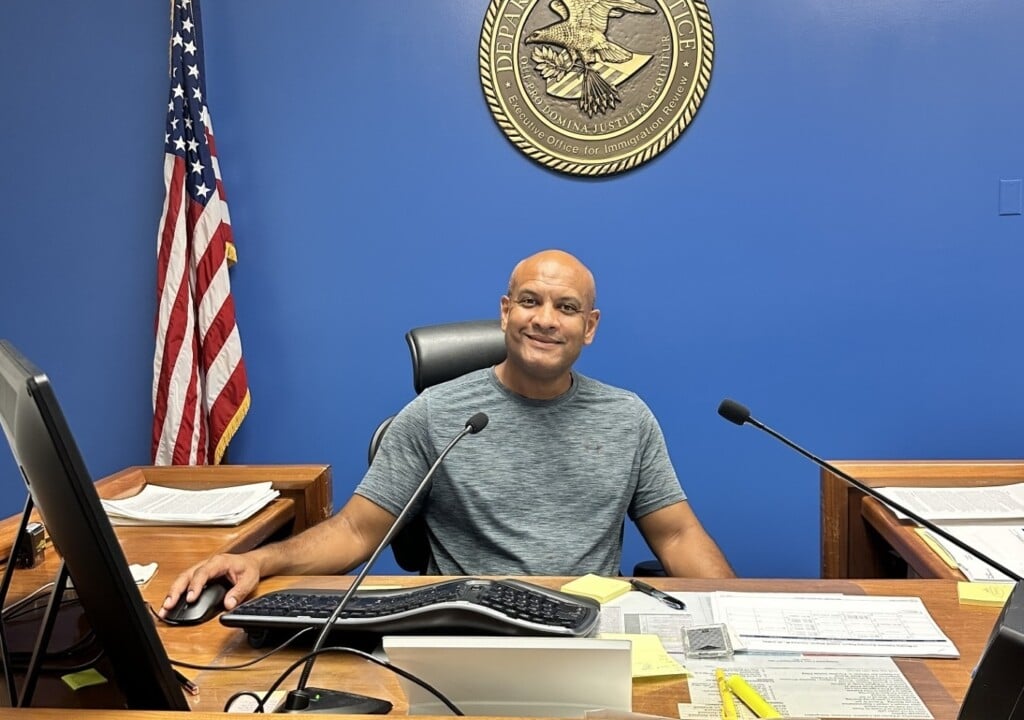
Honolulu Immigration Judge Clarence M. Wagner Jr. rarely checked emails before his morning court hearings, but on May 21 he was composing a judicial ruling and needed to consult material he had stored in a prior message.
What happened next is burned into his memory: About 8:15 a.m. he glanced through his inbox and saw an email with “Termination” in the header.
“I thought it was spam,” Wagner recalls in an interview with Hawaii Business Magazine. Instead, it was a three-sentence message informing him that his 27-year career with the federal government had abruptly come to an end.
“Dear Judge Wagner,” it read. “This notice serves to inform you that pursuant to Article 2 of the Constitution, the Acting Attorney General has decided to remove you from your position as an excepted service immigration judge with the United States Department of Justice, Executive Office for Immigration Review. Your removal is effective today. You are required to return all government property by the end of the day.”
No justification. No forewarning. No acknowledgement of his years of exemplary service.
Stunned, Wagner informed his staff and canceled the hearings scheduled to start less than 15 minutes later in his courtroom. “Clerks were crying and asking what just happened. Lawyers and their clients were still coming to court… They saw me walking out with a cart of my things.”
“I don’t exactly understand, even up until this point in time, how or why the firing took place.”
Since taking office in January 2025, President Donald Trump has removed 119 immigration judges across the country, according to the National Association of Immigration Judges, which says “all have been removed without due process, cause or explanation.”
What was particularly surprising about the timing, Wagner says, is that the notice came only weeks after he had completed his semi-annual performance review in which he received praise and achieved the required performance level in categories including “legal analysis” and “professionalism.”
What’s more, only a day before he was dismissed, Wagner had been talking with the personnel department about options for taking early retirement at the end of the year. He turns 55 on July 5.
Asked about his reaction to the dismissal, Wagner said: “Disappointed. Disturbed. To have a career that I have had where I’ve been a high performer throughout my career and having it come to an end in that manner. That was disappointing, very disappointing.”
“It hurt because there was not even a common sense of courtesy or professionalism in the way this was handled.” After 27 years of federal work, he adds wryly, “it basically means I got one sentence per decade of service.”
But in the same way he conducted court hearings without emotion – relying on the law and the facts in each case – he also refrained from lashing out.
“I cannot say, honestly, that I was angry,” Wagner recalls, “only because anger is an emotion that I try to avoid by all extremes. I’m trained in martial arts, and nothing good happens in the zone of anger. So, I try to avoid anger.”
The email from Daren Margolin, director of the Executive Office for Immigration Review and head of all U.S. immigration courts, was sent out on behalf of Acting U.S. Attorney General Todd Blanche.
Blanche did not have immigration at the top of his mind that day in May when the email was sent. As Wagner was clearing out his office at the courthouse in Honolulu, six time zones away to the east in Washington, Blanche was being grilled by lawmakers on Capitol Hill. He was embroiled in a heated closed-door meeting with Senate Republicans where he sought to defend Trump’s proposed $1.8 billion “Anti-Weaponization Fund” and the sweeping grant of immunity for Trump, his family and his companies from any past or future tax violations.
“So the nation’s top law enforcement official is asking for a slush fund to pay people who assault cops? Utterly stupid, morally wrong – Take your pick,” Republican Sen. Mitch McConnell said in a statement after the meeting, reflecting a rare split among the party’s leaders. Blanche later pulled back plans for the fund but has continued to promote Trump’s legal immunity plan, prosecutions of perceived political enemies and the administration’s anti-immigration agenda. Days later, Trump said he would nominate Blanche for Attorney General to succeed Pam Bondi.
Far from that background of political maneuverings in Washington, Wagner says he was only motivated in the courtroom by one mission: “My job is to hear evidence, and based upon the evidence that I hear, to balance it, apply the facts to the law and to issue a decision. And that’s what I’ve been doing my entire career.”
Wagner, who has been an immigration judge for 16 years, including 14 in Hawaiʻi, was previously with the Department of Homeland Security since its inception in 2003 and has held various roles as legal adviser and counsel for Immigration and Customs Enforcement under Republican as well as Democratic administrations.
From 1998 to 2001, he served as an officer in the U.S. Army, Office of the Staff Judge Advocate in Honolulu.
“There certainly were no objective facts or criteria that would lead me to believe that my job was at risk,” Wagner says. “I mean, I think I’m probably a poster child for public service. I started my career as an army Judge Advocate General in Hawaiʻi. I was at the 25th infantry. I worked my way up through the Department of Homeland Security as an assistant chief counsel, then a deputy chief counsel, and then I became chief counsel in Honolulu. So, I was the lead attorney for all of the immigration and customs enforcement actions in Honolulu from 2008 until I became an immigration judge in 2010.”
Weighing Laws and Facts
Because Wagnerʻs termination notice provided no justification for the move, as a judge who weighs the facts, he says he cannot speculate about what the real motive might be. But as a judge who weighs available evidence, he can also “read the room,” as he says.
“Right after President Trump was sworn into office, the very first day, the director, the assistant director, the chief immigration judge, the general counsel and one of the deputy chief immigration judges were terminated. And nothing like that had ever happened before.”
He likened the purge to the administration’s military strategy in Iran – decapitating the leadership of the enemy.
“You know, where the military went in and took out the leadership in hopes of decapitation. I think that you can draw a corollary with what happened with the leadership of immigration,” he says. “To lose the director, assistant director, the chief immigration judge, the senior level management of the Executive Office for Immigration Review. That certainly was a decapitation for them. … We’re in a new space where we’re operating under rules that just have simply not existed [previously]. Historically, immigration judges are not considered political positions.”
In the past, normal turnover through attrition and retirements involved a gradual replacement. The new system involved the dismissal of 119 judges so far in the second Trump term followed by the appointment of nearly 80 new immigration judges, aimed at narrowing a backlog of cases, which the Justice Department said in May was about 3.5 million cases.
“It’s a huge loss,” says Neribel Chardon, senior staff attorney at The Legal Clinic in Honolulu, who has presented cases before Judge Wagner for seven years. “Somebody of that level of professionalism, it is very sad. It is unfortunate. From a legal, professional standpoint, we lost a good person. … Being a good judge doesn’t mean that you need to rule in somebody’s favor all the time.”
Chardon says she was one of the attorneys who was to appear online for Wagner’s court hearing at 8:30 on the morning he was dismissed. “Judge Wagner was always on time for his hearings,” she says. So, when he didn’t appear, Chardon reached out to his clerk, who told him the hearing would have to be rescheduled.
Chardon later learned the reason. “I’m not going use the word shocked, because we know that this is what’s happening. … However, I never thought that this was going to hit home, you know, that this was going to hit Hawaiʻi, because we only have two [immigration] judges. And this one has been here for over 15 years.”
Kiley R. Hyatt, a U.S. Army colonel and attorney, was appointed Temporary Immigration Judge in Honolulu on May 21, one of 77 temporary judges appointed around the country that day. The other immigration judge based in Honolulu is Robin E. Feder, who has been in that position for nearly 20 years. Jason R. Waterloo, Assistant Chief Immigration Judge, based in California, has supervisory oversight of the Honolulu-based judges.
By the Numbers
Wagner says he only considered the law and the facts when adjudicating his cases. Lawyers who argued cases before him frequently told him he was fair, he says. “ʻWe didn’t always agree with what you said, but we thought you allowed us to present our case,’” he says they’d tell him. “And that, for me, is a source of pride, because that was what I had intended to do all along.”
Given that track record, he can only wonder what caused him to become a target of the administration. A spokesperson for the Justice Department’s Executive Office for Immigration Review in Washington said it “declines to comment on personnel matters.”
On a purely numerical basis, Wagner’s rate of asylum dismissals was lower than the national average, according to TRAC, a research center affiliated with Syracuse University. In the first 11 months of 2025, Wagnerʻs denial rate was 34.7% compared to a national average of 58.9%.
Wagner says each case should be decided based on the merits, and he puts little value in such comparisons. Even so, he also notes that because Hawaiʻi courts handle more cases involving asylum-seekers from China than from Latin American countries, different human rights records and political situations in those locations would naturally lead to different outcomes.
“I’ve been before his court for over 10 years,” says Frank Hwu, managing partner at CHH Law in Los Angeles, who represents many Chinese clients seeking asylum in Hawaiʻi. He says he had a client hearing the day after Wagner was fired and was shocked to learn the news. He calls Wagner a “kind gentleman.”
“I wouldn’t be surprised if his ethnicity or his race and his grant rate all played a part in it,” Hwu says, adding: “He’s very stern on the bench. He’s not one of those judges where he’s smiling and telling jokes or talking. He’s very stern. So, if you’re in his court, you would not think he’s a very liberal judge. But at the end of the day, if you prove your case, he will grant it.”
On a personal level, Wagner says he’s been influenced by his father and grandfather, who were ministers, and by his military and legal training to respect the law and chain of command. His grandfather, the Rev. T.J. Jemison, was a friend of the Rev. Dr. Martin Luther King Jr. and led the first successful civil rights bus boycott in Baton Rouge, Louisiana, in 1953. “Martin Luther King patterned his [Montgomery, Alabama] boycott after my grandfather’s, and that’s reflected in his book, where he acknowledged that my grandfather was a great help to him in constructing his boycott.”
Another important influence in Wagner’s life was his military service, which he says prevents him from speaking out in a partisan way as others have done.
“Throughout my career, I’ve served under every administration,” Wagner says. “So, you’re not going to hear me say anything derogatory [about the president], because my military service requires that I respect the position. But with great power comes great responsibility.”

Clarence M. Wagner Jr. hiking at Koko Head, one of his favorite activities to help relieve the stresses of his job.
Still Seeking to Serve
Looking toward the future, Wagner says he has already received offers for new opportunities, which he’ll keep on reserve while he visits relatives on the continent. He considers Hawaiʻi home and expects to be back hiking the Koko Head trail, his favorite pastime.
Immediate questions remain. More than two weeks after his dismissal, he has not received a termination package or information about whether he’s eligible for Cobra insurance coverage or whether he’ll get his pension, basic post-termination obligations of employers.
He won’t miss the stress of the job, he admits. Some people go to spas to release tensions, but Wagner says he needs to run and has made it a habit after heavy caseloads. He twice finished the Honolulu marathon. “I need adrenaline,” he says. “I need to run.”
After being fired, he says, he didn’t sleep at all the first night. The next day, a weekday, he went for a hike.
“I normally hike Koko Head on the weekend,” Wagner says. “And I remember thinking that I don’t have to just wait for the weekend anymore. I can do it any day.”
Even so, he still feels invested in the system of adjudicating immigration cases and wants to see improvements, an issue he says he can talk about for hours.
“The court needs to be able to operate with efficiency, while at the same time maintaining integrity, due process and justice,” Wagner says. “To achieve that, you have to have judges that you can trust. And you need to allow them to act freely and utilize their best judgment and evaluate the facts, applying facts to law, and make decisions.
“That needs to be done with as much independence and autonomy as possible,” he adds while noting that judges must also be subject to oversight, whether remaining under the Department of Justice or as part of the independent branch of the Judiciary.
While acknowledging a political divide in the country that swings both directions over time, with self-correcting mechanisms built into the political system, Wagner also sees worrisome signs.
“There are some principles that I think we have moved away from, and it is my hope that that’s not a permanent departure from the principles that have made this country the country it is, because I do believe in the rule of law. I do believe that ultimately, the rule of law does prevail. If the rule of law does not prevail, then we’re going to be in a world of hurt.”
Immigration judges are not just impartial evaluators of asylum-seekers’ aspirations to improve their lives, Wagner says. They are also guardians of the interests of those already in the U.S.
“So, I can honestly say that I’m proud of the body of work that I have produced, because at the end of the day, every time an immigration judge renders a decision, they are participating in some way, shape or form in the fabric of the country’s makeup. We allow people to stay or require people to depart. One way or the other, if you allow them to stay, you have started a new generation of people that will live in the United States, and probably have family in the United States, and so forth.”
On the other hand, “if you cannot allow them to stay, you have forever pushed those individuals out. So, I’m very careful in protecting the people of the United States.
“But I would tell you,” he adds, “with my experience, the number of ‘bad hombres’ is vastly less than the number of people that just want to better their station in life.”