Beyond the Cards: Pokémon’s Growing Fan Base in Hawaiʻi
On Pokémon's 30th anniversary, what was once a childhood pastime has become a global phenomenon and big business. In Hawaiʻi, collectors, players and small business owners are building something more lasting than a card collection.
For those who grew up collecting Pokémon cards in the ’90s, high-profile sales like influencer Logan Paul’s $16.4-million PSA 10 Pikachu Illustrator have helped bring dollar signs to what was once merely a childhood hobby. In recent years, the beloved trading cards have once again found their way into the spotlight, with Pokémon’s 30th anniversary adding another wave of attention.
When Honolulu hosted the 2024 Pokémon World Championships, more than 14,000 people attended, including roughly 3,000 competitors, with lines stretching hundreds deep just to enter the Pokémon Center pop-up shop. Annual events like Hawaiʻi Pop Con, the state’s largest pop culture celebration, draw thousands to the exhibition hall at Neal S. Blaisdell Center, where collectors gather to trade Pokémon, sports cards and other collectibles. Smaller card events and meetups take place across Oʻahu nearly every weekend, reflecting a community that has surged in recent years, as part of a global phenomenon.
In Hawaiʻi, the focus in the local trading card scene is less about chasing big profits and more on sustaining a passion for Pokémon — its cards, its characters — and the community built around them.
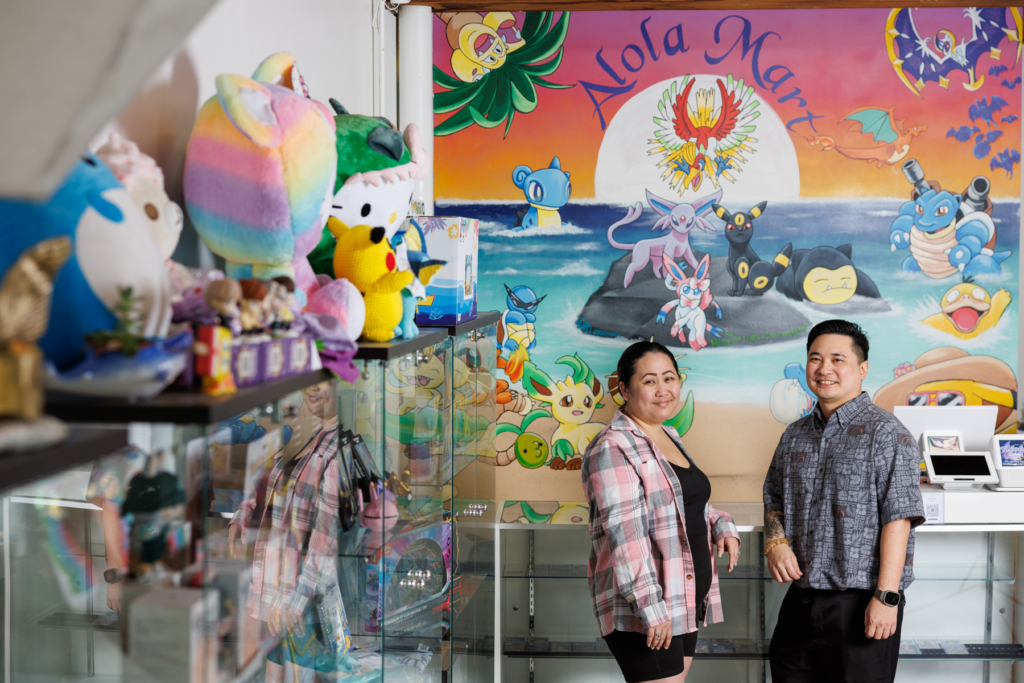
In Mānoa, husband-and-wife team Andy and Mari Oshiro turned their love of Pokémon into a business, Alola Mart. Founded in 2023, the small venture grew into a brick-and-mortar shop by August 2025, fueled in part by a pandemic-era boom in the trading card market. The name is a nod to the Alola region from the Pokémon Sun and Pokémon Moon games, which was inspired by the Hawaiian Islands.
Opening Alola Mart was a full-circle moment for Andy, who first discovered Pokémon cards at a neighborhood store in Mānoa where he grew up.
“I wanted to give back to my neighborhood because that’s where I got started collecting — and look at where it’s taken me,” he says. “We now have a shop in the valley, and I can do the same for new collectors.”
Andy has seen the market’s upside firsthand, selling a PSA 10 Shiny Rayquaza Poncho-Wearing Pikachu card for $6,500 during a recent upswing. Today, he says the same card could likely fetch five figures. Pikachu, a longtime fan favorite, fits into a broader trend he sees in the shop: it’s often the cute Pokémon that sell best.

Photo Courtesy: Alola Mart
For the Oshiros, Pokémon isn’t just something they sell — it’s something they share at home. Their young daughter already has a few rare Sylveon cards in her collection, and her growing interest in Pokémon is what brought the family back into collecting. She also shares her parents’ love of Eeveelutions — Andy and Mari’s favorite Pokémon, Umbreon and Espeon respectively, make up their shop logo. Inside Alola Mart, that personal connection is even more evident through a vibrant mural that spans an entire wall of the shop — featuring Pokémon like Psyduck, Blastoise, Snorlax and Ho-Oh, each representing a loved one in the family’s life.
While demand for cards has made inventory a challenge, the Oshiros say the bigger reward has been watching a community form around the shop — one that spans longtime collectors and a new generation of fans.
“We’re in it for the community,” Andy says. “Pokémon is for every age. We have some senior citizens that come in, young kids — I even have some of my classmates from high school bring their kids in.”
It’s this sense of community that keeps the shop’s “Open” sign glowing long after posted hours.
“The door’s pretty much always open,” Andy says. Mari runs the shop seven days a week while Andy works a day job. He says it can be tiring juggling both, but it’s worth the grind. “We leave the sign on if we’re still here, so if people see it flashing, they’ll come in.”
Beyond Alola Mart, Hawaiʻi’s Pokémon card scene stretches across weekly meetups, conventions and informal marketplaces, all built on the same sense of nostalgia and passion.

Photo Courtesy: Jomari Garcia
Jomari Garcia says he’s been collecting Pokémon cards on and off since around 2016 or 2017. As his collection grew, he began selling at events like Pearlridge’s 808 Showcase Trade Night to help sustain the hobby. Similar gatherings have also popped up at venues like The Republik and the Blaisdell Center.
“Pokémon cards are really expensive now — just getting product is so hard,” Garcia says. “Technically I don’t really make money. I’m just funding my collection and breaking even.”
While his favorite Pokémon include Psyduck, Shroomish and Corphish, one of his most prized cards is a PSA 8 Mewtwo GX signed by Mitsuhiro Arita, one of the original illustrators for the Pokémon Trading Card Game — a piece he values far beyond its resale value.
“He did an illustration on the card for me and signed it, so it’s hard to put a dollar value on it. I see similar cards go for $5,000 to $10,000,” Garcia says. “I waited an hour or two just to get it signed, and it cost $200.”
Pokémon fans aren’t just waiting in line for signatures. Garcia says they’re also regularly camping out for new pack releases.
“People are waiting overnight at Target just to get some product,” he shares. “Today I was going to go, but I heard there were already 50 people in line at 3 a.m. The craziest thing is there wasn’t even a Pokémon drop — they were just waiting in line for the chance at one.”

Photo Courtesy: Jomari Garcia
With sealed pack inventory so scarce, Garcia deals primarily in individual cards. “The good thing about Pokémon is there’s money to be made, so people are selling off their collections at a percentage,” he says. “I price it out, give them around 70 percent of the value, and hopefully on the back end I make my 30 percent.”
An official report from The Pokémon Company International states that 10.2 billion Pokémon Trading Card Game (TCG) cards were printed worldwide over the 2024-2025 fiscal year, bringing the total to more than 75 billion cards as of March 2025. Even with that level of production, the company has acknowledged that some fans are experiencing difficulties purchasing certain Pokémon TCG products. The company says it is working to print affected products “as quickly as possible and at maximum capacity,” while maximizing production for future releases.
Garcia acknowledges the current surge in demand has made trading more competitive, but he views it as part of a larger cycle. Long term, he says he’s less interested in quick profits and more focused on the community that keeps him coming back — connecting with fellow collectors, flipping through Pokémon binders, and making a young fan’s day.
“I have cards for the kids — like a dollar and under. And if they’re really stoked about it, I’ll just give it to them for free,” Garcia says. “That’s what I like about Pokémon — you kind of foster your own community. We try our best to spread the love around.”
That same sense of community is also taking shape in more organized spaces.

Photo Courtesy: Box Jellyz in ʻAiea
Kohl Kitagawa, owner of Box Jellyz in ʻAiea, has created a hub for players focused on the competitive side of the Pokémon Trading Card Game. The shop hosts tournaments Thursday through Sunday, with Pokémon events taking place on Sunday afternoons.
“We mostly care about players,” he says. “We do a little bit on the collectible side, but the main crowd we cater to are the people who actually sit down and play. We wanted to give them a safe place where they can feel comfortable.”
Kitagawa says the recent surge in interest has been fueled in part by new audiences discovering the game through the Pokémon TCG Pocket mobile app, which launched in late 2024, before transitioning to physical cards.
“The free app lets you open packs, then you get cards and play a simpler version of the card game,” he explains. “People got a little taste of opening a pack and getting something good, so then they were like, ‘I want to do that for real!'”
With Pokémon’s popularity driving demand, Kitagawa says the collectibles side of his business still faces inconsistent inventory, but the shop has remained steady thanks to its community.
“My business is still able to thrive, and we’re able to figure out solutions for the lack of inventory,” he says. “We always keep some stuff on the side for the kids. We had one come in who worked really hard for his allowance money and just wanted some Pokémon cards, so we gave him a little to make him feel like he at least got something.”
Outside of running Box Jellyz, Kitagawa also works a full-time job. As a kid who grew up in the ’90s, his love of Pokémon started when he got his hands on Pokémon Blue Version for the Game Boy. Today, he’s built a tight-knit community of players and customers he knows by name, all sharing the same passion.
“It initially started as somewhere I wanted all my friends to come — a place to hang out and play games,” Kitagawa says. “It turned into something a little bit bigger. It’s a place where people come on their lunch break, or they’re stopping in on the way home from running errands.”

Photo Courtesy: Alola Mart
While the community has grown, Kitagawa says there’s still a focus on helping younger players get started — after all, Pokémon began as a game for kids. His advice for young trading card collectors? Collect what you love, and don’t pay attention to the market. He especially enjoys seeing customers come into the shop looking for Pokémon cards outside the usual favorites. Some collectors even focus entirely on the artwork, drawn to cards with unique illustrations or unusual designs, including Pokémon paired with everyday objects like apples.
“I had this boy come in the other day — his favorite is Zygarde. They just did the [Pokémon TCG: Mega Evolution — Perfect Order] set with him, but generally speaking, nobody was excited that he was in that set,” Kitagawa laughs. “But this kid was stoked! So I’m like, ‘Right on, bro. Just keep collecting Zygarde.'”
Pokémon may have started as a childhood hobby, but here in Hawaiʻi, it has become something more — a community shaped by collectors, players and the small businesses behind it.
“I would like to keep doing this for a long, long time, and to do that, I want the kids to be inspired to keep collecting,” Kitagawa says. “We’re all still super in love with the game, and we enjoy what we’re doing.”