Big Island Artist Gary Ackerman Inspired by Creative Muses Over 5 Decades
Still going strong at 85, Ackerman has built a global following but remains anchored in his North Kohala community. He continues to see the world with fresh eyes and paints every single day.
Communities are complex tapestries of multicolored threads woven into a textured whole, sometimes vibrant, sometimes worn or threadbare. Hawaiʻi island’s North Kohala region, which juts out like a chin pointing toward Maui, has a rich history whose fabric reveals rips as well as bright patches from economic swings it has weathered.
The last half-century has brought recovery in the wake of sugar’s collapse, despite the pandemic’s devastating interruption. Along the way, one family has both helped drive the area’s transformation and benefited from it.
Gary Ackerman, at 85 an elder statesman of the Hawaiʻi art community, recalls his love affair with the two towns of Hawi and Kapaʻau that make up North Kohala. He first arrived in 1976, a year after the last sugar mill shut down, marking the end of a 112-year run that had shaped the land, the population and the economy.
At the time, its depressed towns were hardly places that screamed opportunity. But in the same way an artist sees beauty where others do not, Ackerman envisioned a future for himself, his art and his family. Along with many others, he helped revive the towns.
“Opportunity was probably the last thing I thought about,” recalls Ackerman during an interview at his gallery in Kapaʻau that displays his paintings of impressionism and abstract styles as well as new sculptures. “I think opportunity, if I may be bold enough to say, usually just arrives because you’re ready for it.
“When I first arrived on the Big Island, I saw an area that was just starting again, certainly not thriving, but it had its natural course to begin again. And that’s where I was. I was just beginning to get revitalized.”
Plagued by a genetic heart condition that killed his father at the age of 40, Ackerman was recuperating from his own heart surgery that he underwent in California when he was only 34. A friend told him to check out Kalalau Valley on Kauaʻi, and he spent more than a year there living off the land, painting and regaining his health. He later visited Hawaiʻi island and was mesmerized by the vast undeveloped spaces, the lava zones alternating with grasslands, long stretches of pristine, empty beaches and lush tropical valleys.
“It felt comfortable, and I thought the people that I ended up being surrounded with had good vibes and good feelings, good understandings. And so I stayed on, and as I stayed on, I managed to be in the right place at the right time.”

Gary Ackerman’s first art gallery, called Gallery One, located in a converted gas station in Kapa‘au. Photo Courtesy of Gary Ackerman
A Gallery of His Own
Birthplace of King Kamehameha and once home to some 28,000 Native Hawaiians, the North Kohala district’s population was decimated by foreign diseases brought by early missionaries, explorers and traders. Over decades starting in the 1800s, the area contributed forests of sandalwood exports to China, and it enjoyed prosperity during a century-long stretch when immigrants from Japan, the Philippines, China, Portugal and elsewhere arrived to do the backbreaking work of growing, harvesting and transporting sugar cane. By 1975, with the demise of the region’s sugar industry, the population of North Kohala’s two towns dwindled to barely more than 3,000 people, half its current population.
“When I first came here, I saw a variety of landscapes, and it intrigued me to see layers and miles of lava and ash that hardened, and the newborn life that came from it,” Ackerman says. “It became the groundwork for the trees that started to grow throughout the years. I’m fascinated with that aspect.”
He started his first gallery in Kapaʻau “just to house my own things,” he recalls, noting that the district had only recently been connected by a new road to the developing resort zones along the coast and to Kailua-Kona. Previously, all traffic had to traverse a twisty mountain road to the one-time cattle town of Waimea, also known as Kamuela, and as a result, tourists were scarce at this northern tip of the island.
Divorced and single in his 30s, Ackerman met the woman who would become his wife at a Kohala party. Yesan Ko, a resident of Hong Kong, had a career as a flight attendant with Pan American World Airlines before it folded in 1991. She enjoyed her stopovers on Hawaiʻi island that became more frequent after meeting Ackerman. They share a love of travel, and her airline employee status allowed the couple to cheaply visit destinations all over the world, a passion that’s continued for nearly 45 years.
That became the start of their business in Kohala. “During our travels, if we were in New Zealand, I bought a few blocks of butter and brought them home, and of course the few local people that I knew said, ‘Oh! Is that for sale?’ I said ‘why sure!'”
“I’m not quite the businessman, but I take advantage of needs and wants and desires.”
Having discovered a local demand for goods, they increasingly stocked up on items from their far-flung trips. Meanwhile, their shop moved to a location directly across the street from the statue honoring King Kamehameha.
One day in the late ’70s, before tourism picked up, Ackerman discovered there was a potential market for his art. While painting on the roadside out by the lush Pololu Valley, a man in what Ackerman remembers as a “fancy” car stopped to watch him.
“He says, ‘Nice painting. Is it for sale?’ Well, of course, my eyes popped out because I didn’t know how many meals I had going forward. He gave me quite a bit of money for it, and it somehow made a difference in my life. I said, ‘look at what I can do. I can paint a picture, and somebody can come and buy it from me.’ That was a new story in my life.”
In the 1980s, Ackerman heard that a Kapaʻau gas station was for sale, and he could buy it at an attractive price. The catch was that the new owner would have to dig out and remove the underground gasoline storage tanks while meeting federal environmental standards for the soil surrounding it. It was a gamble, but it paid off, and today it’s the location of Ackerman Galleries, Fine Art by Gary Ackerman, which displays his paintings and sculptures. That’s just a block away from the Ackerman Galleries gift shop run by his daughter.
His path might have gone a different way entirely. At one point, he’d had a chance to buy oceanfront property in Puako for about $800. Then it was just a beautiful stretch of shoreline with few homes; today that purchase alone would have netted him many millions of dollars. But he shrugs it off, saying money was never a motivating factor, because he’s happy where he is, and has achieved his own financial success.

Left: Upright sculpture with various artworks behind in Ackerman’s studio viewing room. Right: Experimental use of Coke bottles fused together while being melted in a kiln. Photo: Ken Wills
A Building With a Colorful Past
His new gallery building had a storied history if little commercial value. While digging up the 5,000-gallon gasoline tanks, the crew discovered hundreds of bottles of all shapes and sizes that had been discarded and buried there. Ackerman kept dozens, including some with Chinese characters, a whiskey bottle from Scotland and others from distant lands that had been carried here over the years. Cleaned and preserved, many now are neatly lined on shelves in his art studio. Others would be incorporated into his sculptures.
Ackerman says that besides being a gas station and an auto repair shop (the car lift is still under the floor boards in the back of the rebuilt structure), the building also had a stint as a showroom for Model-A Fords and was even a dentist’s office at one point. Among the items left behind, which Ackerman saved, are gold teeth and empty opium bottles, the medicine apparently used as an anesthetic before Novocain became widely available.
During the plantation years, the building held another attraction: immigrant women would offer dances out front for 10 cents to attract sugar plantation workers passing by on the street. For some particularly attentive men, the dancers might lead them to upstairs rooms for more private encounters.
For sure, it was a polyglot community that mingled and mixed despite ethnically segregated plantation camps, and the region today reflects that blend.
Tom Morse, who wrote a historical tome, The Rise and Fall of Sugar in Kohala, describes the remnants of that period: “While the buildings are gone, and only traces of history can be found beneath the now wild cane grass fields, the cultural melting pot has remained long after.”
Beginning of the Handover
Now, 50 years later, Ackerman’s fine arts gallery benefits from a steady stream of tourists who drive through town to see the statue and to hike scenic Pololu Valley at the end of the road. This gallery is operated by one of his three daughters, Maylan. It is filled with his paintings that are purchased by clients from all over the world and includes a busy workshop and art studio next to a peaceful garden.
Ackerman transferred ownership of a second building strategically located directly across the street from the King Kamehameha statue in Kapaʻau to another daughter, Camille Dugan. A third daughter, Alyssa Slaven, owns the business that runs a gift shop gallery and the bustling King’s View Cafe inside that building, and she recently started operating a gift shop in neighboring Hawi as well.
All three daughters have their own artistic interests and pursuits, ranging from paintings to epoxy and resin woodwork, music, jewelry and crafts.
Ackerman relies heavily on his wife, Yesan, who he says is the disciplined bookkeeper of the family who keeps him in line and also tells him when to stop making endless final touches on his paintings.
What was once a single colorful thread in the community tapestry has multiplied into many. It’s a point of pride for Ackerman, as he reflects on his life, but he also knows the challenges of juggling family dynamics.
“Time will tell what’s next,” Ackerman says hopefully and with obvious affection, but in a nod to the struggles many family businesses face, he adds wryly: “Having a business that’s in the family is not always charming.”

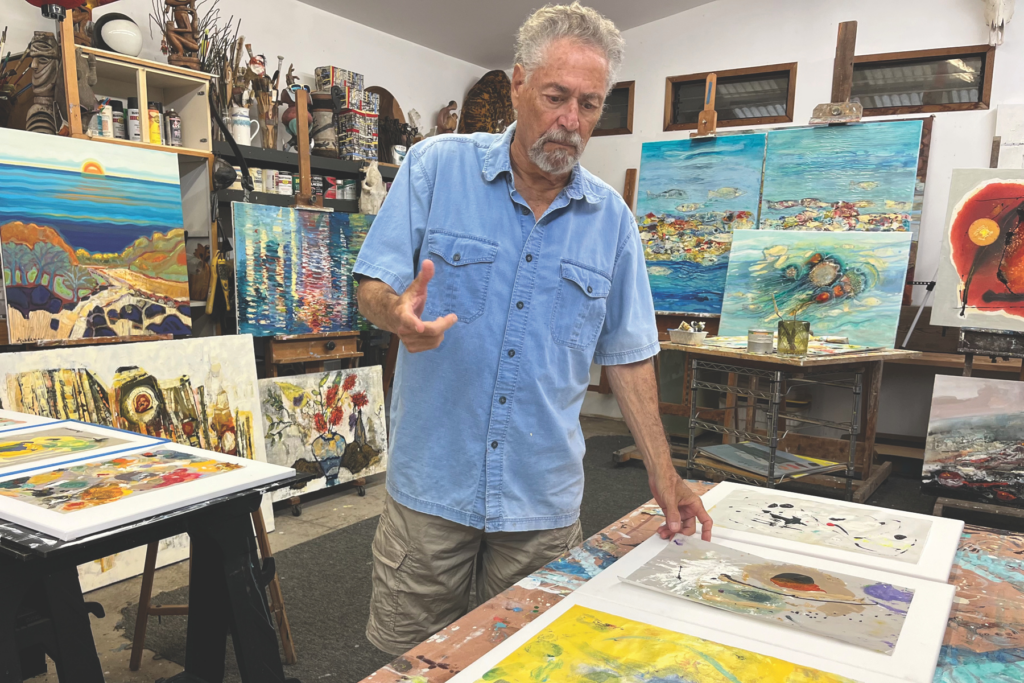
Ackerman explain his vision and use of colors and materials for an abstract painting. Photo: Ken Wills
Drawing Visitors to Kohala
Mary Spears, a prominent artist based in Waimea since 1989, recalls Ackerman’s impact on the community.
“Gary and Yesan appeared to have a vision of turning Kapaʻau into an art destination when they purchased a building and set up his studio and gallery there,” Spears says. “The area was in that post-sugar-cane sag. Not much was happening. Buildings looked derelict and unkempt. Once they purchased Gary’s studio and gallery, they started turning it into a beautiful place to not only create art but showcase his work.
“I always appreciated that they encouraged their daughters to pursue their own art and gave them an amazing platform to do so,” Spears adds. “Gary and Yesan focused on North Kohala and have been a major part of keeping the town vibrant and interesting and drawing visitors to the area for the other businesses there.”
As tourists discovered the community and started spending money there, storefronts that once provided basic necessities like appliances and housewares gave way to cafes, galleries, ice cream stands, gift shops and even a zipline operator. A new vitality, and tax base, took hold.
Don’t get the wrong impression. As Ackerman edges closer to his ninth decade, he has no interest in slowing down. For a man who was inspired to paint nearly every single day of his life, each day brings discovery and excitement about seeing the world with fresh eyes. Remarkably, he still has 20-20 vision, but his real talent is preserving a childlike appreciation for everything that comes into view.
He has always looked at the world in a unique way. Even as a schoolboy in Los Angeles, teachers would reprimand him for gazing out the windows at trees and clouds.
“My job is to see things,” Ackerman explains. “I used to just sit there and look at stuff, and teachers used to tell me I’m dreaming, I’m not paying attention. I was paying more attention than they knew.
“One thing that is happening for me all the time, I can’t help this. It’s a learning process. I’m always learning something new, and I want to use it.”
For instance, he becomes animated when discussing his craft and what excites him even after so many years.
“There are ways to take paint and not just apply it with a brush,” Ackerman says, using his hands to illustrate. “You can apply it by squeezing it out of bottles, you can do it through spray cans or you can dab it with other chemicals, from waters to alcohols. And you can make things look different than with a brush. A brush will only do certain things. I don’t know all the things that it can do.”
Tourists and local residents alike often stop at the gallery out of curiosity and find museum-level artwork displayed on the walls. He previously used the space just as a studio, but when passers-by saw him at work and asked whether they could buy paintings, he realized he could turn it into a gallery. Some visitors inevitably asked him about his craft, and he’s willing to expound at length.
When the subject of oil paint comes up, even non-artists would struggle not to feel his enthusiasm.
“Oils have the viscosity that has the right temperature control. It even has the odor of being fabulous. I’m married to it,” Ackerman declares with intensity. “And I can do things with it. You can control it because you can dry it slowly, you can speed it up, you can make it thin, you can make it thick. You can make an atmosphere the way you want it.”
Whatever he does, he finds a ready customer base. Today, his paintings generally sell for $5,000 to $20,000 and above. His paintings are part of the decorations at the Mauna Lani, Auberge Resorts Collection, in Waikoloa; several are owned by Warren Buffett’s sister, Bertie; more hang in homes of the Martinellis, owners of the cider and beverage business; and one was part of Whitney Houston’s estate.
“I don’t try to paint for sale, I try to paint for me,” Ackerman states emphatically, a visceral backlash to an earlier point in his career when he was working for an art distributor who required constant reproductions of a small number of images. He quit that job and ever since has jealously guarded his freedom to create what he wanted, when he wanted.

Front and side of Ackerman Galleries, Fine Art by Gary Ackerman, as it appears today in Kapa‘au. Photo: Ken Wills
Endless Experimentation
What he has wanted to create has spanned an ever-widening expanse of art. He generally eschews realism (“I can’t improve upon nature”) but ventures into abstract paintings in addition to his mainstay impressionism. Once he noticed that a house painter left paint out too long, and it started to curdle. Inspired by the design that formed, Ackerman sought to recreate the technique on his canvases. They show up as textured bodies of jellyfish and other images that raise up off the level surface.
He has recently begun experimenting with glass and bottles melted in a kiln, combining the flattened glass, epoxy, wood, metal and other materials in sculptures of all sorts. Fish started to become a focus of his recent creations, a natural reflection of his environment.
Hawaiʻi, and North Kohala in particular, he says, have special characteristics that make open air landscape painting in Hawaiʻi the rival of anyplace in the world. Partly that’s a factor of the long days of sunlight, “the only real light there is,” he notes.
“There’s no better lighting than in the middle of the Pacific here at times when the volcano is settled in and the light trade winds are coming through. The light is fabulous,” Ackerman says. “It does change all the time. And that’s what I like about it, and the passing clouds that hide the sun, which diffuses and gives a different kind of light and is wonderful. But the intense light here is like I’ve never known in any other place.”
Asked where he might live if not in Hawaiʻi, top of the list is the south of France, where he has traveled many times. But still he’s partial to the visual smorgasbord available to an artist in the middle of the Pacific ocean, with shifting clouds and rainbows.
A special challenge of painting outdoors in North Kohala is the sudden change of weather.
“You can’t take a very big canvas because all of a sudden the wind will pick up and turn it into a sail. It’ll end up in Maui,” Ackerman says, laughing while recalling prior attempts.
A constant theme is reinvention. While passing the collection of glass bottles retrieved decades earlier from under his gallery, he suddenly saw them as art and wondered what would happen if he put them in a kiln, melting them just enough. In one experiment, the labels burned off, but the Coca-Cola imprint was still visible on the glass surface.
Similarly, he noticed a few years ago that the paper pallets he used while making paintings on the easel became a kind of unintentional byproduct creation, so he started framing some of those.
And while he prefers oils to watercolors, Ackerman also tried his hand at an abstract watercolor painting. “Look, you see how the watercolor just spreads and creates a diffuse mix?” You can’t do that with oils, he says with a mischievous smile, and then holds up a painting in which he successfully recreated the same technique using oil.
“I’m keeping this one,” he says, possessively. “I won’t sell it.”
Ackerman remains humble. After decades of using every technique he can imagine, every edge of his brushes and other materials, he still says he’s only mastered 5% of what’s possible.
How might his life have been different if he’d moved to global artistic centers in New York, Paris, Venice and elsewhere like many other accomplished artists?
“Sure, there were a few times that I was wondering why I’m here and not there,” Ackerman muses. “Fundamentally it was because I felt that it was important to keep my health. It’s one thing to have recognition and a bit of fame and be dead. I’d rather be alive and healthy.”
“I chose a simpler life,” he says. “I’m just out in the wilderness somewhere in the middle of the Pacific, and it’s okay. Out in the wilderness, I love that.”
As a result of that choice, he’s become a radiant thread running through the community fabric of North Kohala and Hawaiʻi, a tapestry that’s more colorful because a region captured his imagination.