Hilo Theater Founder Shares His Broadway and Hollywood Experiences With Aspiring Hawai‘i Actors
Overcoming initial pushback as an outsider, HEART theater founder finds warm welcome in Hilo, a town bursting with local talent
Larry Reitzer admits he bungled his stage entrance when he moved from Los Angeles to Hilo, delivering a misguided message to community members about how the transformative power of theater could springboard local youth toward opportunities far from Hawaiʻi island.
A production veteran of Broadway blockbusters including La Cage aux Folles, Phantom of the Opera and Les Misérables in New York and on national tours, and later a writer for TV series and films in Los Angeles, Reitzer arrived in Hawaiʻi with a passion and excitement for his craft that he wanted to share with residents of his adopted home.
“I want to help these kids get off this island,” he remembers saying while he was introducing himself around town. “I want these kids to feel comfortable going to LA, going to New York. I want to empower them because these kids are really talented. I want these kids to know how talented they are, and they would have a shot” at the big-time stages.
His good intentions turned into its own drama.
One parent, he recalls, was particularly unwelcoming and unimpressed with his background. “‘We were okay before you got here,’” Reitzer recalls her saying. “And I said, I’m not saying you weren’t… I’m not trying to take anything. I’m just trying to bring something,’ and she said, ‘but what you’re trying to bring might be different than what we want.’”
With credentials that sparkled, Reitzer was proud of what he had accomplished in his more than 30-year career. But like a standup comic who misreads his audience, his message fell flat in a community that, to a large extent, is content with what it has and seeks to build opportunity closer to home. The transformative experience, it turned out, reshaped Reitzer and his outlook as much as it changed his adopted home.
On the beaches near Hilo, far from the busy streets of New York and Los Angeles, Reitzer felt a spark of inspiration that urged him to engage with the community around him.

Reitzer at rehearsal of Chicago: The Musical at Hilo Palace Theater. Photo: Nicholas Souza
“I thought, well, what could I do for the community? What can I give back?” In a twist to John F. Kennedy’s famous credo, he told himself: “Don’t ask what you can take from Hawaiʻi, ask what you can give Hawaiʻi. And for me, that was beautiful. That was my whole life. That was the best part of my life.” After more than a decade writing, including for TV hits Spin City, Just Shoot Me! and Ugly Betty, “I thought, well, maybe I could start anew.”
He was slapped down again when he was nominated to be on the board of the oldest community theater in town, the Hilo Community Players, which dates back to 1938. The board rejected him, he says. When he asked why, despite all the experience he could share, a board member told him: “‘They just felt like you would, they didn’t know you, you’d come, you’d want to change everything. And they’re just being protective.’”
For Reitzer, it was a painful moment that spurred him toward a new approach.
Hilo Community Players Executive Director Rachel Klein recalls that vote differently.
“I’m not sure if it was a miscommunication or a misinterpretation or what, but he feels that we turned him down when what we were attempting to do was just, you know, essentially not put someone we didn’t know on our board,” Klein says. “It’s just the way that it unfolded, it was just that he was nominated to the board before anyone even had met him, so we didn’t really know him, so we couldn’t put him on our board at that time.”
Since then, she adds, she and others on the board have had opportunities to work with Reitzer.
“We’ve all seen his work. I think everyone thinks that he’s doing great work, and he’s very talented,” Klein says.
Humbled by the perspective gained from living in the community for years, Reitzer’s outlook is more refined and targeted: “A lot of things that I have said were wrong, and I’m happy to own that.”
Now, with a better understanding of the community’s desires, he says, “My hope is to empower kids not to want to leave. My hope is to create a really professional environment and a professional theater where kids who want to experience that can [do so] without leaving this island. And kids who want to train and learn acting and learn from a director and not leave can do that and get professional training.”
Rejected by Hilo Community Players, Reitzer decided to create Hilo Education Arts Repertory Theatre (H.E.A.R.T.) and started with Avenue Q, a Sesame Street-inspired look at challenges of modern life, and then Biloxi Blues, a drama that explores wartime camaraderie but also prejudice and antisemitism among soldiers training during World War II.
“It kind of went crazy, in a good way,” Reitzer recalls of the initial reception. “It took on a life of its own and became this thing, you know, [bringing together] community people, politicians, council members and our mayor, Mayor Mitch Roth at the time.”
Many productions followed, some with roles for hundreds of students and community members, from five years old to more than 50, in performances including Aladdin Jr.; Grease; Cabaret; Chicago, the Musical; One Flew Over the Cuckoo’s Nest; The Lion King Jr.; A View From the Bridge and most recently, Frozen. In March, on the 40th anniversary of the Broadway opening of Les Misérables, H.E.A.R.T. will perform the ambitious production that has special meaning for Reitzer, who worked on the original shows.
Although it wasn’t his first Broadway production, he says, “I guess that was more of the start of my moving up in the business with a real career as opposed to me getting coffee.” He started as assistant general manager, then assistant company manager and finally company manager.

Reitzer at auditions for Chicago: The Musical at Hilo Palace Theater. Photo: Nicholas Souza
THERE’S SOMETHING ABOUT HILO
With a population slightly under 50,000, Hilo has a disproportionate abundance of theater activity for its size. Besides HCP and H.E.A.R.T., Mālama Arts and also University of Hawaiʻi-Hilo stage performances. Local troupes as well as touring companies perform at the East Hawaiʻi Cultural Center and at the Palace Theater, a Beaux-Arts-style structure originally built in 1925 as a movie theater. After an extended closure and renovations, it reopened in 1998 as an arthouse venue and now has nearly 500 seats. HCP stages productions at the historic Keawe Theater and also holds annual outdoor Shakespeare in the Park productions at the UH Hilo Performing Arts Center Lawn. (It marks its 70th anniversary of these productions with a series of performances next spring.)
When productions are in full swing, downtown restaurants and bars get an injection of pre- or post-show business. H.E.A.R.T., for its part, puts on four productions a year with runs lasting three weeks. Performances have attracted attendees from as far away as Waimea and Kailua-Kona, a nearly two-hour drive.
“Hilo Community Players has been around for about 100 years,” notes Carla Kuo, executive officer of the Hawaiʻi Island Chamber of Commerce. “More recently, H.E.A.R.T. has sprung up, and Mālama Arts has sprung up, and I know that folks travel even from the continent to come here to see some of the productions.”
Performances by those theater groups, as well as at the University of Hawaiʻi-Hilo campus, have helped inject an economic vitality into city restaurants, bars and other businesses, she adds.
“Just recently, I was in downtown Hilo, and it was really cool, because we were there on a Sunday, early evening, and it’s busy [because of a nearby performance]. It never used to be like that before.”
That, combined with singing, dancing and acting classes for aspiring performers, creates jobs and adds to the economic base of the community.
“I work in a restaurant downtown, so I have seen how there will be a flurry of people coming in at a certain hour, usually before the shows,” says Zac Toomay, who works part-time as a waiter at the popular Pineapple’s restaurant to supplement his other jobs as a flight attendant and an online personal trainer.
In late 2024, Toomay was lured into a theater role as a dancer in H.E.A.R.T.’s production of Cabaret after meeting Reitzer at a party.
“I told him I’m rusty and I’ve never acted and I’ve never sung,” Toomay recalls from his first conversation with Reitzer. “Despite me saying all that, he was like, ‘It’s all good. We’ve got you covered, and you can learn to act. We’ve got local coaches who are going to help you with the singing and, you know, you’re safe with us.’”
Toomay has since performed in a second production with H.E.A.R.T., is currently preparing for a role with another company through the Palace Theater and also has his eyes on a part with Hilo Community Players, which biennially performs The Rocky Horror Picture Show. He credits Reitzer with reigniting a creative spark in him that lay dormant.
“I was very impressed with where he comes from professionally and artistically,” Toomay adds. “It felt like I was going to get an opportunity to learn from somebody who knows a lot about the art form and the industry.”
A transplant from San Francisco, Toomay says he plans to stay in Hilo for the foreseeable future, though he’s also tempted to send out audition tapes for productions on the continent.
When Reitzer first came to Hilo, he says, “I saw an incredible amount of untapped talent, but I don’t think anyone would have described it as a major theater hub. I started to meet great vocalists and great dancers. What struck me was how many people wanted to create, perform and be a part of something like theater if they were given an opportunity and challenged to do work and train in a professional setting.”
Over the years, he says, he realized Hilo has something very special. “There is an extraordinary sense of community here. People support one another, families become invested, and audiences are willing to embrace ambitious productions.”
Klein, too, gushes about the community’s interest in theater. “I’m blown away by the talent here,” she says. “We have talented people who have come from somewhere else, we have talented people who are from here…. We’re constantly meeting new people and discovering new people in the community.”
While individual actors compete for roles, she says, the various companies create plenty of opportunities.
“So there is inherently some competition in theater [for individuals], but as the production companies, we try to foster the feeling of community and the sense that we’re all kind of in this together. … The process of theater is what we’re doing it for.”
Despite Reitzer’s primary focus on building opportunities locally, he has helped a number of talented actors and singers reach their Broadway dreams, while others have used their theater experience to gain acceptance to premier universities, national touring companies or have landed jobs performing on cruise ships. Taking a personal interest in many of his actors, Reitzer has written letters of recommendation, lobbied industry insiders and even put actors up in his New York apartment so they could defray costs while trying out for auditions while he was back in Hawaiʻi.
He says his motivation to give young people in Hawaiʻi a break stems from the one he had when he was young.
Two of his proteges are now performing on a Disney Cruise Line sailing all over the Caribbean on a tour that will extend to December.
Hilo native Jason Makoa Aiwohi-Tomlin got his start with H.E.A.R.T. after graduating from high school and is now performing aboard the Disney Treasure along with another Hilo resident, Kyra Gomes.
Aiwohi-Tomlin, 22, feels indebted to Reitzer for instilling an appreciation for the arts but also for lessons in life.
“There were many times when I simply sat and picked his brain, asking why he made certain creative choices or why he directed an actor to approach a role differently than what might be considered the traditional interpretation,” Aiwohi-Tomlin says. The tutelage paid off, and Reitzer gave him a shot at directing The Little Mermaid while he was still 20. “I had never done anything like that before,” Aiwohi-Tomlin adds, “and I never would have had the confidence to do it without Larry’s love, trust and support.”
Now he says he’s committed to a career in the arts, “wherever life takes me, whether that’s in the middle of the ocean or on land.”
For her part, Gomes, 24, who knew she wanted to be an actor after performance roles at Kamehameha Schools Hawaiʻi Campus, started working with Reitzer during her final year in high school.
“Larry has always believed in giving people opportunities to succeed, even before they fully believe in themselves,” she says. “He encouraged me to take on roles that stretched my abilities and helped me discover a love for teaching and music directing alongside performing. The confidence, discipline and sense of community I developed through H.E.A.R.T. continue to influence the way I approach my work professionally every day.”
Now Gomes is the Disney ship cast’s vocal captain and performs as a soloist in The Disney Victrophonics, as Sina in The Tale of Moana, and as Garderobe in Beauty and the Beast.
Yet another actor has moved to the continent as an ensemble performer and understudy for the roles of Pepper and Eddie in the North American tour of MAMMA MIA! Makoa, who only uses one name, left Hawaiʻi in 2023 for the tour, which included a limited engagement on Broadway at the Winter Garden Theatre.
After his travels, Makoa gained a new perspective about Reitzer’s impact: “He introduced a level of artistry and theatrical perspective that connected Hilo to the broader theater world while still honoring the heart of our local community. For young performers like me, that exposure was invaluable.”
While the performers have ventured beyond Hawaiʻi’s borders, they all say Hilo will always be home, and they plan to return someday.
“I’d love to find ways to bring what I’ve learned back to Hawaiʻi and help create opportunities for young artists growing up there, just as others did for me,” says Makoa.

Reitzer blocking actors on stage at the East Hawaiʻi Cultural Center. Photo: Nicholas Souza
EARLY ALIENATION, EARLY START AS AN ACTOR
Growing up in Brooklyn, Reitzer recalls, “I was incredibly effeminate. My parents didn’t think I’d last in high school in Brooklyn.” He would have attended Erasmus Hall High School, which counts among its alumni Barbra Streisand, the director Authur Laurents, and much earlier Mae West. By the time Reitzer would have attended, he says, the school in Flatbush was “very gangy.” His parents moved the family to Staten Island where they thought Larry and his siblings would be safer.
“I’ll be honest, I was bullied in high school,” Reitzer says. “I was bullied in junior high school. I was proud of my feminineness. I didn’t hide it. I don’t know if I would have gone a trans route at that age if it was an option. I’m guessing I might have.”
Despite the prevailing views of the era, his parents and grandparents were very supportive and loving.
“Where I started to fit in, where I felt I belonged was in community theater. I got my Equity card. … I started in community theater, and I started working in lights, I started doing sound. I started learning community theater. I told everybody I wanted to direct. I started stage managing. I started doing a lot of acting. I thought I was really, really talented because I would always get cast and I would always get lead roles.”
By the time he arrived at New York University for college, Reitzer dreamed of a career in the arts. Suddenly he found himself among other very talented students from around the country. “My dancing was as competitive, you know, but their singing was really good. Their acting was really good,” Reitzer says. “I was in the acting program. And so I immediately kind of took a backseat. … I mean, Adam Sandler was in my class. Molly Shannon was in my class, Jessica Hecht, she’s got 3 Tony Award nominations.”
“It was a pretty talented group, and I made the transition to start thinking maybe playwriting was more of what I wanted to do.”
“I never went back to acting.”

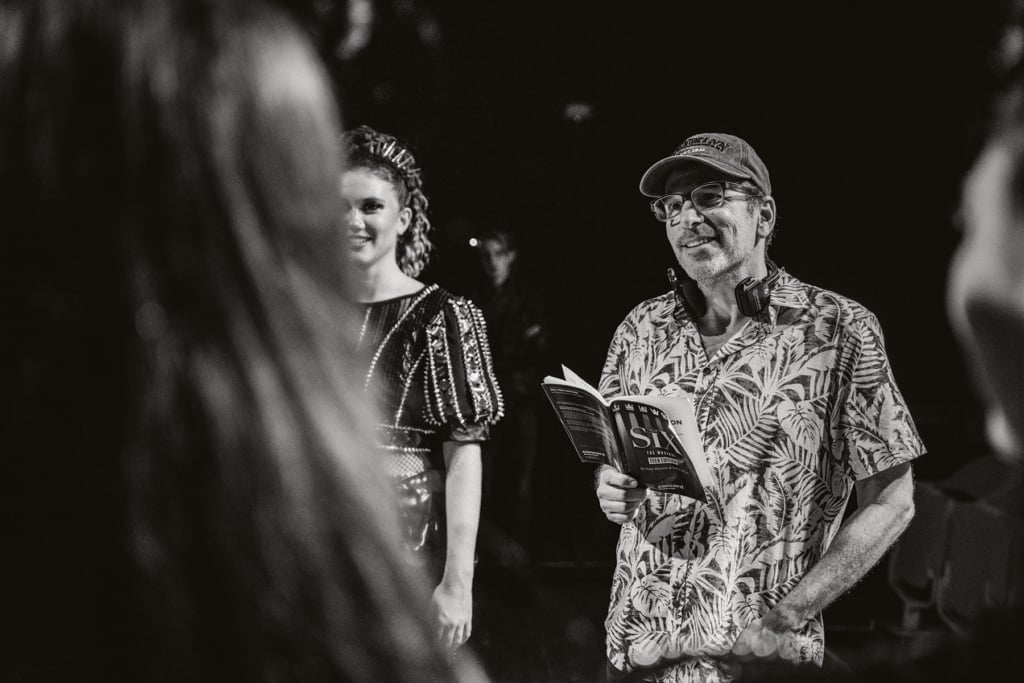
Reitzer talking with cast of SIX The Musical, a show he produced but did not direct. Photo: Nicholas Souza
HIS BIG BREAK: LA CAGE AUX FOLLES
In 1983, as a 17-year-old student at NYU, Reitzer interviewed with Harvey Fierstein, the actor, playwright and screenwriter who wrote La Cage aux Folles and Torch Song Trilogy.
“I had auditioned three times … and I got to know Harvey, and we were talking, and I told him my dream was to be a writer and a director, and he said, ‘Why don’t you be a production assistant?’ I said, ‘I don’t know what a production assistant is.’ And he said, ‘Well, a production assistant is someone who gets coffee.’
“He said, ‘you know, it’s not a glamorous job, and it’s free. You don’t get paid. … but you’re in the room, you sit near the director, you take notes. You don’t take the stage manager notes, but you are an assistant to the director. They have a personal assistant. You’re not their personal assistant, but you’re the production assistant.’ And I said, ‘I want to do that. How do I do that?’ And he said, ‘you have to find a show that is going into production, and you have to get in there.’ And I said, okay, how do I do that?’ And he said, ‘well, I actually am going to start rehearsals for La Cage aux Folles in a couple of weeks.’”
After interviewing with Arthur Laurents, who directed the Broadway production, Reitzer was initially turned down but was called back and given a job that launched his career.
“I really started to love management, company management, learning about that,” he says. “I kind of switched gears and said, ‘I think I want to be a producer and a company manager.’”
He ended up working on Broadway productions of Les Misérables and Phantom of the Opera, including a touring production in Los Angeles. When the traveling company was about to end its tour, the local producers asked if he would want to move over to the Los Angeles group. In 1991, he made the move official and also got sober.
“In my sobriety, I kind of realized what I really wanted to do was go back to what I went to NYU for and started writing, started doing specs, tried to get an agent. … I became a writer and then I stayed in LA and I was there for a lot of years.”
One more transition was yet to come. After visiting Oʻahu and Maui many times with his husband, Reitzer said he had no strong attraction to the resorts where many of the guests seemed to be fellow Californians on holiday.
But after visiting the east side of Hawaiʻi island near Hilo, he found a new connection that caused him to consider retiring.
“I fell in love with that area. I fell in love with the Big Island, the energy, I fell in love with the people, the community. So I said, let’s buy a house. And we bought a house in Puna on that trip.” Since then, they’ve moved to a home overlooking Onomea Bay on the coast north of Hilo, making for an easier commute when rehearsal nights stretch into late hours.

Reitzer as executive producer on the set of Hyperlinked, a show produced for YouTube. Photo: Nicholas Souza
THEATER SAVED HIS LIFE
Reitzer regularly reminds his cast members of his own story, his insecurities and how theater saved his life. Judging by some who have been in H.E.A.R.T. performances, the experience is similarly transformational.
Toomay reflects on his own path: “Theater or acting is an exercise in vulnerability in that when you try on these new hats you’re forced to abandon your own self for a little bit and see how it feels to occupy a different mindset.
“There is a great job helping you get there, right, when it’s difficult for you to try something new, reveal something different. In the long term, when you’ve practiced doing that so much, you become a lot more aware of who you are. That’s what I feel acting is doing for me, helping me get closer to my own self versus the hats that I put on in order to be in public. I’m figuring I’m getting closer to my own self, and I think that’s a fair thing to say for most people who get into acting: they get closer to their own selves. And Larry harbors a safe space to explore that.”
While helping performers work through their vulnerabilities, Reitzer can also be demanding and tough on his cast members.
“Look, I do have a reputation of being hard,” he admits. “One kid, after the show, said: ‘Just so you know, the amount of rehearsals and this and that, this isn’t Broadway.’ And I said, ‘Just so you know, I’m aware, but we can go for it.’ There is so much talent here,” he adds.
His tough standards pay off. The website BroadwayWorld.com awarded H.E.A.R.T. five of its 20 awards in the 2025 BroadwayWorld Hawaii Awards, including Best Direction for a Play awarded to Reitzer for A View From a Bridge. The others went to theater groups on Oʻahu.
Toomay, for one, says the extra effort makes Hilo a special place for theater. “I’m going to go out on a limb here and say that anyone in the theater world on Oʻahu, which by virtue of the population, is much bigger and has more funding, if people know of any other place in the Islands where theater is worth watching, they know it’s here.”
H.E.A.R.T.’s website says “we strive to create inspiring, thrilling, courageous and provocative performance, education and audience-building opportunities for arts-lovers of all ages on the Big Island of Hawaiʻi.”
Reitzer refines that a bit more, saying Hilo “needed a place for young people to explore who they were artistically, to come together and learn lights, learn sound, and be at a theater among each other.” He says he wanted to bring new energy to theater in a city where more opportunities would enable people to stay in the community.
By that measure, he is succeeding. The number of people involved in theater has increased and as more productions are staged, the residents of Hilo and surrounding areas have embraced that energy.
“Hilo has become a real theater town,” Reitzer says. “What makes Hilo unique is that once the community believes in a project, it embraces it wholeheartedly. That spirit is what has allowed H.E.A.R.T. to grow, and it’s why I continue to believe that some of the most exciting theater in Hawaiʻi is happening right here on the east side of the Big Island.”
Kuo of the Hawaiʻi Island Chamber of Commerce concurs. “I think that it’s something that’s just in our community culture,” she says. “I’m surprised, because you’d think that you’d see the same actors every single time, and you don’t.”
The performances leave a lasting imprint on the people in the community, whether those on stage or in the audience. Some performances are filled with song and joy, others raise disturbing questions about our personal struggles and society’s shifting roles.
Reitzer’s ambitions keep evolving, too. “It went from, now my dream is to create this world where kids can see professional theater, say to their parents, ‘I want to do that. How do I do that?’ And it becomes, I’m creating more kids who love theater, either want to see more shows, and building a theater audience, or creating these kids who want to take classes.”
“He hasn’t just built a theater company, he has built a home for countless artists, including me,” says Aiwohi-Tomlin.
Along the way, Reitzer challenges his audience as much as his performers. “I love the idea of pushing a community a little bit,” Reitzer says, fully aware that he lives and works in a community that can also push back in equal measure.